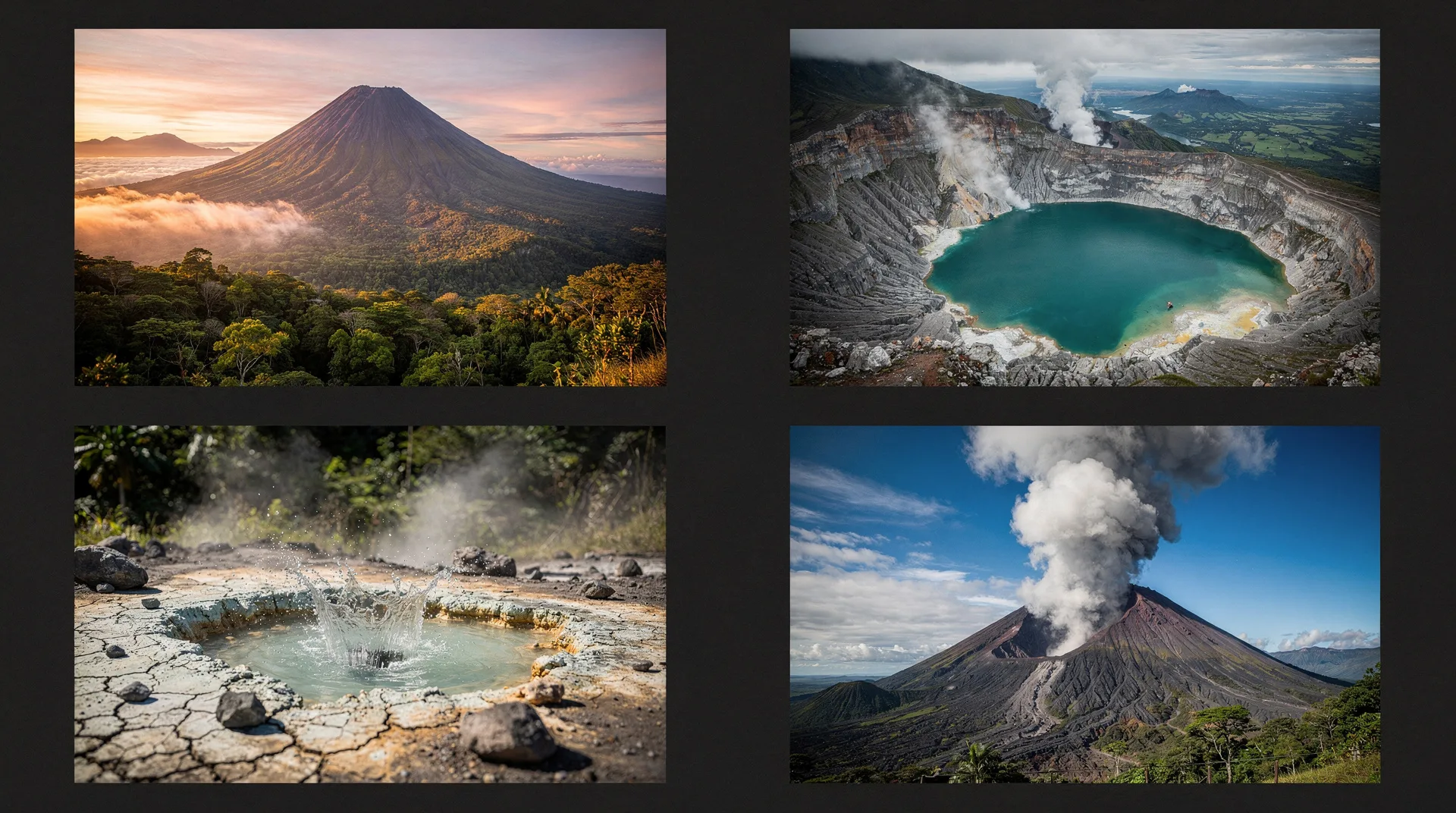
Best volcanoes in Costa Rica to visit
Which volcanoes can tourists visit?
Arenal, Poás, Irazú, Tenorio, Rincón de la Vieja, Turrialba (limited).
Six volcanoes, one trip: how to choose
| Easiest from San José | Poás or Irazú (~1.5 hrs, half-day trips) |
| Best for hot springs | Arenal, La Fortuna |
| Best for a unique landscape | Tenorio (Río Celeste’s blue river) |
| Most active right now | Turrialba (access varies with activity) |
| Typical park entry | $18–20 per volcano |
| Best light | Arrive before 9am, before afternoon cloud builds |
Costa Rica sits squarely on the Pacific Ring of Fire. The country has more than 60 volcanic features, of which six are classified as active by OVSICORI (the national vulcanological and seismological observatory). Of those, five are reliably accessible for tourists; a sixth — Turrialba — allows limited access depending on current activity levels. This guide compares all six so you can decide which to prioritize for your itinerary.
Each volcano offers something completely different. Arenal is about rainforest hiking and hot springs rather than crater drama. Poás delivers one of the most accessible active craters in the world. Irazú rewards hikers with dual-coast panoramas on clear mornings. Tenorio hides the surreal blue river of Río Celeste inside its national park. Rincón de la Vieja packs a bubbling mud pool, sulfur vents, and a canopy adventure park into one destination. Turrialba remains a raw, unpredictable experience for those willing to accept restrictions.
Budget 2-3 volcano days if you base yourself in the Central Valley or La Fortuna. You can realistically combine Arenal with Tenorio (one day each) or Poás with Irazú (back-to-back day trips from San José).
Arenal Volcano (1,670 m) — the icon
Arenal is Costa Rica’s most famous volcano and still its most visited. At 1,670 metres, the near-perfect cone dominates the sky above La Fortuna and Lake Arenal. Its last major eruptive phase ran from 1968 to 2010, when activity quieted significantly. Today the volcano is in a resting phase rather than dormant — small gas releases and seismic activity continue, and OVSICORI monitors it daily.
Visitors access Arenal through Arenal Volcano National Park, which protects the cone and surrounding lava fields. Hiking is permitted on the established Los Tucanes and Coladas trails — you’ll walk across 1968 lava flows, spot toucans and howler monkeys, and get superb views of the cone on clear mornings. Climbing the summit is prohibited and has been since 2012.
The main draw outside the park is the hot springs scene. La Fortuna has more than a dozen thermal resort options, from the luxury pools of Tabacón Grand Spa Resort and Nayara Springs to budget-friendly operations near town. The hot springs are heated by Arenal’s residual geothermal activity regardless of surface eruptions.
La Fortuna: waterfall, Arenal Volcano and hot springs tour — from $95Practical details: Arenal Volcano National Park entry costs approximately $20. Park hours run 8am-4pm. La Fortuna is 3 hours from San José. A 4WD is not strictly required for La Fortuna itself, but is useful for surrounding areas.
Poás Volcano (2,708 m) — crater drama up close
Poás offers one of the most spectacular accessible craters on earth. At 2,708 metres, the summit is cool and frequently mist-shrouded. The main Botos crater contains a hyperacidic lake roughly 300 metres wide that periodically erupts phreatomagmatic jets — the most recent significant eruption was in April 2017, when ash forced a prolonged closure.
Since reopening, Poás Volcano National Park operates on a strict reservation system managed by SINAC. Tickets must be booked online (sinac.go.cr) at least four weeks in advance for busy weekends and holiday periods. Visitor numbers per 30-minute time slot are capped to protect air quality near the active crater. Entry fee is approximately $20. The park is open 8am-2pm, and mornings (arriving before 9am) give the best chance of clear views before cloud builds.
The crater viewpoint is a short, paved walk from the parking area. A secondary trail leads to the beautiful, extinct Botos Lagoon, surrounded by stunted cloud forest. The entire visit takes 2-3 hours.
Poás Volcano active crater, La Paz Waterfall & birdwatching — from $140Tourist trap alert: Various tour operators in San José advertise “Poás day trips” at inflated prices. Compare with the GYG-listed tours, which bundle transport and park entry at transparent rates. The combination with La Paz Waterfall Gardens and a coffee plantation makes for a good full day from San José.
Poás Volcano, coffee plantation & La Paz Waterfall Gardens — from $130Irazú Volcano (3,432 m) — Costa Rica’s highest accessible peak
Irazú is the tallest accessible volcano in Costa Rica at 3,432 metres above sea level. On exceptionally clear mornings, you can see both the Pacific and the Caribbean from the crater rim — a rare dual-ocean view that is the main reason visitors make the drive.
Irazú last erupted significantly in 1994; before that, its 1963 eruption famously deposited ash on San José the morning US President John F. Kennedy arrived in the country. The main Diego de la Haya crater now holds a green sulphuric lake. A secondary crater, Playa Hermosa, is another 10-minute walk along the rim.
The volcano is 55 km east of San José in Cartago province. Most visitors combine it with the colonial Basílica de Nuestra Señora de los Ángeles in Cartago and the scenic Orosi Valley loop — making for a full cultural and volcanic day. Park entry is approximately $18; the recommended visiting window is 7-9am before afternoon cloud rolls in from both coasts.
San José: Irazú Volcano, Cartago city & Orosi Valley tour — from $110Tenorio Volcano (1,916 m) — home of Río Celeste
Tenorio is less about the volcano itself and more about what lives within its national park. Río Celeste — a river that glows a vivid turquoise blue where two streams combine, producing a volcanic mineral reaction — is one of Costa Rica’s most photographed natural wonders.
The Tenorio Volcano National Park trail (about 8 km round trip) leads through primary rainforest to the confluence point (Los Teñideros), then upstream to a turquoise waterfall, a blue lagoon, and a set of hot springs. Plan for 4-5 hours on the trail. Park entry is approximately $18 and online booking via SINAC is recommended for weekends.
Tenorio is best accessed from La Fortuna (about 1 hour) or from Liberia (about 2 hours). You cannot reach the park without a vehicle or tour. See our Tenorio Volcano National Park guide for trail maps and logistics.
Rincón de la Vieja (1,916 m) — the Guanacaste adventure hub
Rincón de la Vieja is the dominant feature of northern Guanacaste and one of the most active volcanoes in the country. OVSICORI regularly records phreatic eruptions and gas events. Despite this, the Las Pailas sector — which contains the main tourist trails, bubbling mud pools, fumaroles, and a small cool lagoon — is reliably open most of the year. The park closes on Mondays and after significant rain events.
Beyond the national park, the surrounding area has become Costa Rica’s adventure activity hub for Guanacaste. Hacienda Guachipelín (a working ranch on the park boundary) offers ziplining, canyoning, hot springs, river tubing, and horseback riding as a combined day pass. Several other operators run similar adventures from Liberia, 25 km away.
Rincón de la Vieja: one-day nature pass — from $110Rincón is an excellent complement to a beach week in Guanacaste — it adds genuine volcanic drama and nature without requiring a cross-country drive to Arenal. See our Rincón de la Vieja National Park guide for full trail details.
Turrialba Volcano (3,328 m) — restricted access, raw experience
Turrialba is the most active volcano in Costa Rica at present. Located 60 km east of San José in Cartago province, it has been erupting intermittently since 2010, with significant ash-fall events affecting the Irazú corridor and occasionally dusting San José. Access to the summit is restricted based on current activity and determined by OVSICORI and the Costa Rican Tourism Board (ICT).
When open, the approach road via Finca La Silvia (contact the local ranger station in advance) leads to a parking area near the crater rim. The views into an actively steaming crater are extraordinary. However, the access situation changes frequently — confirm conditions at least 48 hours before your visit. There are no guaranteed tour packages to Turrialba because operators cannot promise access.
If you’re staying in Turrialba town (the main adventure base for Pacuare rafting), a morning attempt at the volcano followed by an afternoon on the Pacuare River makes for an exceptional active day.
Volcano comparison table
| Volcano | Elevation | Crater access | Park entry | From San José | Best for |
|---|---|---|---|---|---|
| Arenal | 1,670 m | Trails only (not summit) | ~$20 | 3 hours | Hot springs + rainforest |
| Poás | 2,708 m | Crater viewpoint (reserved) | ~$20 | 1.5 hours | Crater drama |
| Irazú | 3,432 m | Crater rim walk | ~$18 | 1.5 hours | Dual-ocean views |
| Tenorio | 1,916 m | Park trails + Río Celeste | ~$18 | 3 h via La Fortuna | Blue river |
| Rincón de la Vieja | 1,916 m | Las Pailas sector | ~$18 | 4.5 hours | Adventure sports |
| Turrialba | 3,328 m | Variable (activity-dependent) | Free | 1.5 hours | Raw eruption views |
Hot springs: where volcanic heat becomes a tourist experience
Almost every tourist visit to the Arenal and Rincón de la Vieja volcanoes includes a hot springs component — and this is no marketing accident. Both volcanoes have active geothermal systems that heat underground aquifers, which emerge at surface temperatures between 38°C and 65°C.
At Arenal, the hot springs scene around La Fortuna is the most developed in the country. Tabacón Grand Spa Resort — a 4-hectare complex of thermal pools set on a geothermally heated river — is the benchmark. The pools are set in tropical gardens with waterfalls, and the thermal river itself flows through the property at 57°C, cooled at the pools to comfortable soaking temperatures. Day passes run $80-100. Eco Termales (capacity-limited, quieter) and Baldí (larger, more affordable, with waterslides) provide alternatives at different price points.
At Rincón de la Vieja, Hacienda Guachipelín and the national park zone have volcanic mud pools and sulfur hot spring options, though less developed than Arenal’s resort scene. The experience is rawer and more geological — sulfur smell, greyish mineral-rich water, and volcanic mud applied directly from thermal pools.
For visitors who want free access, Río Chollín near Tabacón at Arenal is a natural thermal river under a bridge with no fee or infrastructure. At Rincón, the volcanic mud pools at Las Pailas inside the national park are a different form of geothermal encounter — bubbling, sulfuric, and not for soaking.
Safety considerations at each volcano
The national park system manages volcanic hazards at each site. Key safety information:
Arenal: Trail boundaries are enforced by park rangers. Do not attempt to approach the cone outside designated trails. The 1968 eruption’s lateral blast direction is well-documented — avoid the northwest flank outside park boundaries.
Poás: Sulfuric gas monitoring is real-time. The viewpoint will be closed by rangers if SO2 levels spike. Visitors with respiratory conditions should check with their doctor before visiting. Children under 6 may be more vulnerable to gas effects.
Irazú: The crater rim walk is along a path prone to erosion. Stay on the marked path. Wind can be strong and cold — hypothermia in wet conditions is a greater risk than volcanic hazard for most visitors.
Tenorio: The trail to Río Celeste requires basic fitness (8 km round trip). Trail conditions deteriorate significantly in heavy rain — the clay-based paths become extremely slippery. Rubber boots are strongly recommended in green season.
Rincón de la Vieja: The park closes the Las Pailas sector after eruptions or heavy rain that makes the trail unsafe. Check closure status the day before your visit via SINAC’s social media channels.
Turrialba: Do not approach during active eruption phases. Summit access requires confirmation with local authorities within 48 hours of your visit. This is the only volcano in the country where independent day-of access decisions are inappropriate.
How to combine multiple volcanoes
From San José (Central Valley base):
- Day 1: Poás + La Paz Waterfall Gardens + coffee tour
- Day 2: Irazú + Cartago Basílica + Orosi Valley
From La Fortuna:
- Day 1: Arenal Volcano NP hike + hot springs
- Day 2: Tenorio / Río Celeste full-day tour
From Liberia (Guanacaste):
- Day 1: Rincón de la Vieja adventure day pass
- Optional: 2-hour drive to Tenorio for Río Celeste
See our 7-day Arenal and Manuel Antonio itinerary and 10-day Arenal, Monteverde and Manuel Antonio itinerary for full planning.
Frequently asked questions about volcanoes in Costa Rica
Do I need a guide to visit the volcanoes?
For Arenal, Poás, and Irazú national parks, guided tours are optional — you can enter independently. However, a guide adds significant value at Arenal (wildlife spotting on the lava field trails) and at Rincón de la Vieja (navigating the Las Pailas loop safely). For Turrialba, a local guide who knows the current access situation is strongly recommended.
Which volcano is easiest to visit from San José?
Poás and Irazú are both about 1.5 hours from San José and are routinely done as half-day or full-day trips from the capital. Poás requires advance SINAC reservations; Irazú does not. Both can be combined in a single long day if you start before 7am.
Can you see lava in Costa Rica?
Not at present. Arenal’s last lava flows were in 2010. Turrialba has produced small lava emissions during active phases but these are not tourist-accessible. The main volcanic spectacles in Costa Rica are craters, mud pools, fumaroles, sulfuric lakes, and the unique geochemical reaction at Río Celeste inside Tenorio park.
Is it dangerous to visit Costa Rican volcanoes?
The national parks are managed with safety in mind. Poás monitors air quality (sulfuric gas) at the crater viewpoint and evacuates visitors when levels spike. Rincón de la Vieja closes trails after eruptions. Turrialba remains restricted when active. Follow all park signage, never cross barriers, and keep children with you at all times.
What should I wear to visit a volcano?
Layers are essential. Poás and Irazú summit temperatures are typically 8-15°C cooler than San José — bring a fleece or light jacket even in dry season. Waterproof shoes are strongly recommended for muddy trails at Rincón de la Vieja and Tenorio. Sunscreen is vital at elevation where UV is stronger.
When is the best time of year to visit?
Dry season (December to April) gives the clearest summit views at Poás and Irazú. Arenal, Rincón de la Vieja, and Tenorio can be visited year-round — their trail conditions are similar across seasons, though green season (May-November) brings more lush vegetation and fewer crowds. Dawn visits across all volcanoes consistently produce the clearest conditions before afternoon cloud develops.
Related guides
For deeper dives into each volcano, read our dedicated Arenal Volcano National Park guide, Poás Volcano National Park guide, and Irazú Volcano National Park guide. If you’re planning to photograph these landscapes, our volcano photography tips guide covers timing, gear, and positioning. Wondering how geologically active the country really is? Read our guide to understanding Costa Rica’s volcanic activity.
How to choose if you can only pick one
Most first-time visitors do not have time for all six volcanoes, so it helps to think in terms of what you actually want from the visit rather than which peak is “best.” If your priority is a relaxing, low-effort experience with a guaranteed payoff, Arenal wins — the hot springs deliver regardless of cloud cover or eruption status, and the surrounding La Fortuna area has enough restaurants, waterfalls and canopy tours to fill several days without repeating yourself.
If your priority is the visual drama of an active crater up close, Poás is unmatched for accessibility, though the reservation system means you must commit to a date weeks ahead. If you’re based in San José for only a day or two and want maximum scenery for minimum driving, Irazú’s dual-ocean view and easy loop with Cartago and Orosi Valley makes it the efficient choice. And if you’re chasing something genuinely unlike anywhere else in the country, Tenorio’s Río Celeste is worth the longer drive.
Combining volcanoes with other regions works well because none of the main five requires an overnight stay to appreciate — Poás and Irazú are comfortably done from San José, and Arenal and Tenorio pair naturally with a stay in La Fortuna before continuing toward Monteverde or the Pacific coast.
Families traveling with young children generally have the easiest time at Arenal, where the appeal (hot springs, gentle rainforest trails) doesn’t depend on a clear crater view or a long hike. Poás and Irazú involve short, paved walks that are manageable for most ages but reward patience with weather. Tenorio’s Río Celeste hike is the most physically demanding of the accessible options — 8km round trip over sometimes-slippery terrain — and better suited to families with older kids or confident hikers. Rincón de la Vieja splits the difference: the Las Pailas loop is moderate, but the surrounding adventure park activities (ziplines, horseback riding) give non-hikers in the group something to do while others explore the trail.
Weather and crater visibility
Volcano visibility is the single biggest variable tourists underestimate. Even in dry season, tropical cloud cover builds through the morning and most craters — Poás and Irazú especially — are frequently obscured by early afternoon. The practical rule across all six volcanoes: the earlier you arrive, the better your odds.
Tour operators building 7-8am departures from San José are not being arbitrary; they are working around a genuine, predictable weather pattern. Green season adds afternoon rain on top of the cloud-cover issue, which is another reason most crater-focused visits (Poás, Irazú) are better attempted in dry season, while trail-based experiences (Arenal, Tenorio, Rincón de la Vieja) hold up fine year-round since the payoff isn’t a clear-sky summit view.
Arenal Volcano night tour with hot springs — from $60