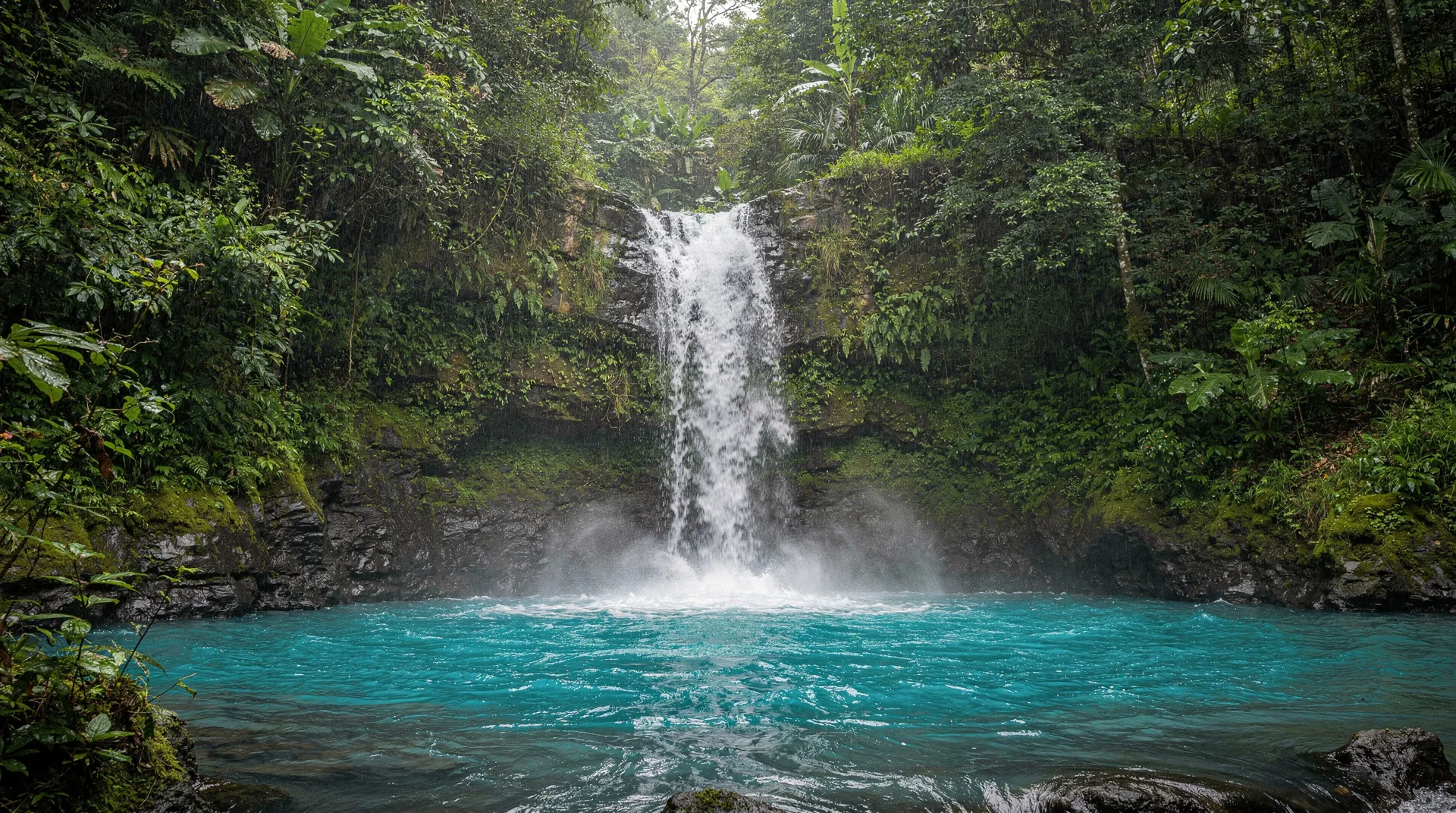
Tenorio Volcano National Park and Río Celeste: the blue river explained
Why is Río Celeste blue?
The striking sky-blue colour is caused by a phenomenon called Mie scattering. Two rivers — the Río Buena Vista and the Quebrada Agria — meet at a point called Los Teñideros. Their respective volcanic mineral loads combine and react, producing nanoparticles of aluminosilicate that scatter short-wavelength light, making the water appear intensely turquoise-blue. The colour is most vivid in morning light.
| Entry fee | $12 per person (foreign nationals) |
| Hike distance | 9km round trip, 3-4 hours |
| From La Fortuna | 1.5-2 hours by car |
| From Guanacaste | 2.5-3.5 hours by car |
| Best time | Dry season (Jan-Apr), morning light |
The turquoise river that defies explanation
Few natural phenomena in Costa Rica generate as much disbelief as the first sight of Río Celeste. The name means “sky river” — and the name is accurate. The water runs a vivid, unearthly turquoise that reads more like food colouring than anything produced by geology. First-time visitors invariably stop and look twice.
Tenorio Volcano National Park, which encompasses the river and its watershed, covers 18,400 hectares of lowland and premontane rainforest in the northern lowlands of Costa Rica, spanning the provinces of Guanacaste and Alajuela. The park borders the Miravalles Volcano Conservation Area to the north and the Arenal Tilaran Conservation Area to the east.
The park sees far fewer visitors than Arenal, Poás, or Manuel Antonio — in part because it takes some effort to reach. The nearest base towns are La Fortuna (1.5 to 2 hours east) and Bijagua (30 minutes south), a small village that has built a legitimate ecotourism economy around the park. From Guanacaste’s beach resorts, a day trip runs 3 to 4 hours each way.
Despite the distance, Río Celeste draws hundreds of thousands of visitors annually. The hike to the waterfall and Los Teñideros is one of the most photographed walks in Costa Rica, and the wildlife along the trail is genuinely outstanding.
The science of the blue colour
The turquoise colour of Río Celeste has been the subject of genuine scientific research. A 2013 study published in the journal Optics Express by Universidad de Costa Rica researchers established the current accepted explanation.
The Río Buena Vista carries dissolved volcanic minerals from the flanks of Tenorio Volcano. The Quebrada Agria is more acidic. Where these two streams converge at Los Teñideros, the combined chemistry precipitates nanoparticles of aluminosilicate calcium. These particles are the right size to scatter sunlight preferentially at shorter wavelengths — the blue and turquoise portion of the spectrum. The effect is Mie scattering, the same optical physics that makes the sky blue.
The intensity of the colour varies with the time of day (morning light produces the most vivid effect), rainfall (heavy rains dilute and stir the particles, reducing colour intensity), and season (the colour is most consistent in dry season). Upstream of Los Teñideros, the river is colourless. Downstream, it glows.
Because rainfall shapes the colour so much, it helps to understand the local climate before you pick a date. The microclimates explained guide shows why the northern lowlands behave differently from the Pacific coast, and the best time to visit Costa Rica guide helps you fit the river into the wider season. If you are packing for muddy trails, start with the packing list.
The main hike: waterfall, Los Teñideros, and back
The standard hike in Tenorio National Park follows a single main trail from the Bijagua entrance, descending to the river and following it upstream through primary rainforest.
Total distance: 9km round trip
Estimated time: 3 to 4 hours
Difficulty: Moderate — the path is well-maintained but involves significant root terrain, some steep sections, and gets very muddy in rainy season
Key waypoints on the trail:
Río Celeste waterfall: Located about 2km from the entrance, the main waterfall drops approximately 30m into a pool of brilliant blue water. The viewing platform gives a clear elevated perspective. Swimming at the waterfall is prohibited to protect the water quality and chemistry of the colour-producing particles.
Laguna Azul: A smaller but equally blue pool just before Los Teñideros. Often less crowded than the waterfall viewpoint.
Los Teñideros: The meeting point of the two rivers. This is where the colour begins and where the visual impact is most dramatic — you can literally watch clear water become turquoise. Boardwalks provide viewing access.
The thermal pool (Termales): A natural geothermal pool fed by the volcanic system. Swimming is permitted here — the water temperature is warm but not scalding (around 38–42°C). This section tends to have a sulfurous smell.
Tobogán: A natural rock slide formed by water erosion into a volcanic rock surface. Slippery and fun, though not for everyone.
Río Celeste National Park hike — from $95Entry fees and park rules
Entrance fee: $12 per person (foreign nationals). Paid at the Bijagua ranger station.
Opening hours: 8am to 4pm daily. Last entry at 2pm to allow time to complete the trail.
Important rules:
- No swimming at the waterfall or Los Teñideros (only at the thermal pool section)
- No drones (the park is bat habitat and drone noise disrupts roosting)
- Stick to marked trails — the volcanic terrain adjacent to the river can be unstable
Wildlife along the trail
Despite the crowds at the waterfall, the forest on either side of the trail holds excellent wildlife that patient and quiet visitors can observe.
Tapirs: Baird’s tapirs regularly use the riverbank areas. Their tracks are visible in the wet soil near the river crossings. Dawn and late afternoon improve chances of a sighting.
Sloths: Both species inhabit the park. Three-toed sloths particularly favour the Cecropia trees visible from the trail.
Great green macaws: Tenorio is within the range of Costa Rica’s most endangered macaw species. Smaller groups than at Corcovado but occasionally visible flying over the canopy.
Poison-dart frogs: Dendrobates pumilio (vivid red with blue-black legs) is common on the moist forest floor sections of the trail. Easy to spot once you know what you are looking for — they are surprisingly bold.
Monkeys: White-faced capuchins and howlers are present throughout. Spider monkeys are less common but possible in the deeper forest sections.
Birds: Mottled owls, great curassows, black-crowned antpittas, and various tanager species. Dawn hikers are rewarded with the most activity.
Walking quietly makes the difference here. Our wildlife watching ethics guide explains how to keep your distance and avoid stressing animals, and the where to see sloths and monkey species guides help you identify what you find. For a broader look at the region’s birdlife, see the bird watching by region guide.
From La Fortuna: Rio Celeste full-day tour — from $105Getting to Tenorio National Park
The park has one main entrance near the village of Bijagua, on the road that runs between Cañas (Pacific slope) and Upala.
From La Fortuna: 1.5 to 2 hours by car via the Bijagua road. Several tour operators in La Fortuna offer full-day Río Celeste excursions that include return transport, guide, and entrance fee.
From Guanacaste resorts (Tamarindo, Playa Hermosa, Liberia): 2.5 to 3.5 hours depending on starting point. A long but manageable day trip with an early departure.
From San José: 3.5 hours via Cañas and Upala.
By public bus: Upala-bound buses from San José stop in Bijagua. From there, taxis or tour operators can take you to the park entrance. Not a practical option for a day trip but works if you plan to stay overnight in Bijagua.
4WD requirement: The park entrance road deteriorates significantly in rainy season. A 4WD vehicle is recommended from May through November.
If you are weighing a rental against transfers, our driving in Costa Rica guide and road conditions by region cover what to expect on rural roads, and rent a car or not helps you decide. Your base town matters too: see the La Fortuna destination page or the Liberia destination page for where to stay before or after the hike.
Small-group blue river & Tenorio Volcano National Park hike — from $120Day trips vs staying in Bijagua
Day trips from La Fortuna are the most common format. The trade-off is 3 to 4 hours of driving for a 3 to 4 hour hike — a long day. Operators who run these tours are experienced and efficient, and the guided experience adds significant wildlife-spotting value.
Staying in Bijagua (one or two nights) transforms the experience. Bijagua is a small town with excellent community-based lodges, and being there at dawn means you enter the park at opening time (8am) with the lowest light and the most active wildlife. The Río Celeste Lodge and Celeste Mountain Lodge are the best-known options, both with birdwatching trails on their private grounds.
Horseback approach to the river
For travellers who want a different angle on the Tenorio landscape, several local outfitters in Bijagua run horseback rides through the dry forest and pasture surrounding the park boundary, ending at a swimming hole on a tributary of the Río Celeste. The ride works well as an afternoon complement to a morning hike, when your legs are done with trail walking but you still want time outdoors. Suitable for beginner riders.
a horseback riding tour around the Río Celeste area — from $67 — $65 for 2.5 hours including local guide and a farm-style lunch. A practical option for travellers basing in Bijagua who want a second activity day.
Ticket to Rio Celeste waterfall & Tenorio National Park — from $15Guanacaste day trips: what to consider
Multiple operators offer Río Celeste day trips from the Guanacaste beach resorts. These are popular but the logistics are demanding. The 6 to 7 hour round trip includes roughly 2.5 hours of driving each way plus the 3 to 4 hour hike — it is a full-day commitment with significant time in a vehicle.
If you are based in Tamarindo or the Papagayo area, consider whether a closer nature destination (Rincón de la Vieja National Park is 45 minutes from Liberia) might deliver a similar experience with less travel time. Río Celeste is worth the effort for the waterfall specifically — but if wildlife and volcanic features alone are your goal, Rincón de la Vieja covers similar ground more efficiently from Guanacaste. Our Arenal vs Rincón de la Vieja guide compares the two volcanic areas directly if you’re deciding between a La Fortuna base and a Guanacaste base for your trip.
Rio Celeste waterfall in Tenorio Volcano National Park — from $95Pairing Río Celeste with other La Fortuna activities
Most visitors base themselves in La Fortuna and treat Río Celeste as one day within a broader Arenal-area itinerary. The Arenal Volcano National Park guide covers the hikes and viewpoints on the volcano itself, and after a demanding Río Celeste hike, the region’s hot springs are the natural way to recover — the volcanic water at Tabacón, Baldí, or Eco Termales soothes the leg muscles from the 9km round trip better than anything else on offer locally.
Arenal Volcano tour with hot springs and lunch — a good recovery-day pairing — from $120Frequently asked questions about Río Celeste and Tenorio NP
Can I swim in Río Celeste?
Only at the designated thermal pool section (Los Termales). Swimming at the waterfall, Los Teñideros, or Laguna Azul is prohibited to protect the mineral chemistry that produces the blue colour and prevent erosion.
Is the colour visible year-round?
Yes, but with variation. The most consistent and vivid colour appears in dry season (January to April). Heavy rains dilute and stir the particles, making the river less intensely blue. September and October can be disappointing for colour if there has been recent heavy rainfall. The morning hours always produce richer colour than afternoon.
Do I need a guide?
A guide is not mandatory at Tenorio (unlike Corcovado), but is recommended for wildlife spotting. Self-guided visitors with good wildlife awareness will have a perfectly valid experience. Guides book through operators in Bijagua or La Fortuna.
How crowded is the park?
Weekends and the December–April peak season can see 300 to 500 visitors per day — the waterfall viewpoint gets congested. Weekday visits, particularly Tuesday and Wednesday, are noticeably quieter. Arriving at 8am opening significantly reduces congestion.
What should I wear?
Waterproof footwear is strongly recommended — river crossings and muddy sections will wet your feet. Quick-dry clothing, insect repellent, and water (no vendor inside the park) are essential. The trail offers very little shade in the open sections near the river.
Where to fit Tenorio in your itinerary
Tenorio works best as a day trip within a La Fortuna base — paired with Arenal Volcano, the hanging bridges, and hot springs in a 3- to 4-day circuit. The 10-day Arenal, Monteverde, Manuel Antonio itinerary includes a Río Celeste day as part of the northern circuit. For those in Guanacaste, see the 5-day Guanacaste resort itinerary which can incorporate a Río Celeste day trip. Compare the volcanic park options with our best volcanoes in Costa Rica guide.