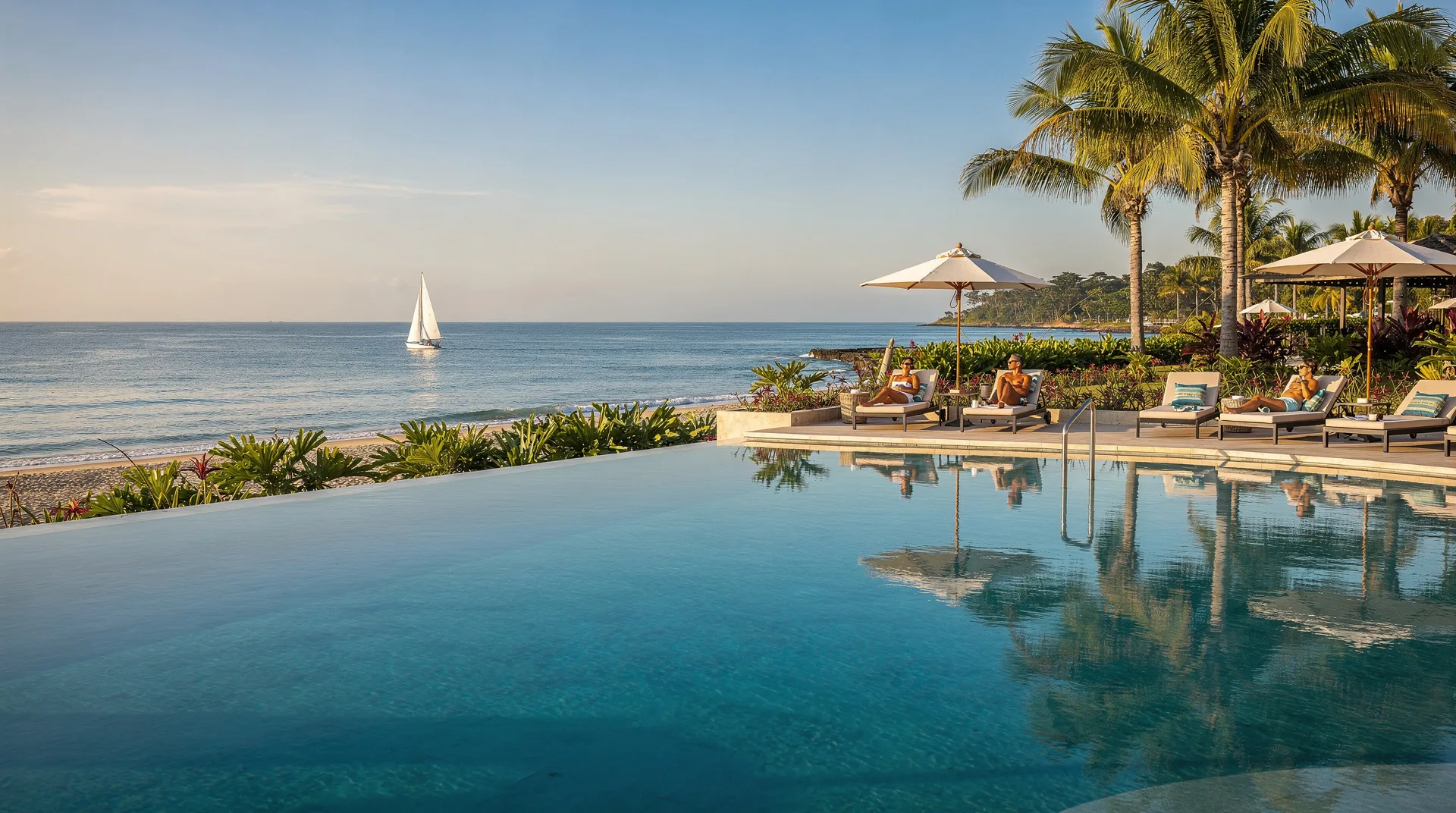
5-day Guanacaste resort escape: Playa Hermosa or Papagayo Peninsula
Five days in Guanacaste: the resort formula done right
Guanacaste is where the Costa Rica that appears in resort brochures actually lives. The north Pacific coast — particularly the Papagayo Peninsula and the Playa Hermosa bay — receives 300 days of sunshine per year in the dry season, has calm, swimmable water in most months, and hosts some of the most impressive resort hotels in Central America. The Four Seasons on Papagayo and the Andaz resort in the same area are genuinely world-class properties.
This 5-day itinerary works for couples who want a beach-forward escape with one or two adventure excursions, and for families with young children who need resort amenities (kids’ clubs, multiple pools, calm beaches) alongside authentic Costa Rica experiences. The format: base yourself at one resort, take day trips to Rincon de la Vieja National Park, Tamarindo, and the Papagayo Peninsula’s marine zone.
Two resort zones to choose from:
- Papagayo Peninsula (Andaz, Four Seasons): the most prestigious zone, 25 km south of Liberia airport. Protected bay, calm water, outstanding dining.
- Playa Hermosa Guanacaste: 45 km south of Liberia, calmer and less exclusive but still excellent, with the Diamante Eco Adventure Park nearby and Playa del Coco diving access.
Total estimated budget: USD 2,500–6,000 per couple for 5 days, excluding international flights.
At a glance
| Stat | Value |
|---|---|
| Total days | 5 |
| Best for | Couples, families, luxury resort travelers |
| With/without car | Optional — resort transfers and booked day trips cover all logistics |
| Budget range | USD 300–700 per person per day |
| Best season | December–April (dry season ideal); July–August veranillo also works |
| Nearest airport | Liberia (LIR) — 25 minutes to Papagayo, 45 minutes to Playa Hermosa |
Day-by-day breakdown
Day 1: Arrive at Liberia and resort check-in
Liberia (LIR) is the correct airport for Guanacaste — the terminal is modern, customs is fast, and the drive to either resort zone is under an hour. Prebook an airport transfer through your resort ($50–90 per vehicle, significantly more reliable than the taxi queue) or through your hotel concierge.
The Papagayo Peninsula feels like a different country from the rest of Costa Rica — the resort access road passes security, the vegetation is manicured, and the bay is the clear blue that appears in airline advertisements. The water in Bahía Culebra is remarkably calm — protected on three sides and shallow enough that children can stand 50 meters from shore.
Afternoon at the resort: pool, beach, a cold Imperial beer, and a slow readjustment to the pace of a beach vacation. The resorts on Papagayo have structured water sports available from the beach: kayaks, paddleboards, snorkeling equipment, and hobie cats.
Stay (Papagayo): Andaz Costa Rica Resort at Peninsula Papagayo (from $450/night, jungle-and-beach setting, excellent pool and spa) or Four Seasons Resort Costa Rica (from $900/night, two beaches, golf course, outstanding service).
Stay (Playa Hermosa): El Velero Hotel (mid-range, from $160/night, beachfront, excellent restaurant) or Hotel Bosque del Mar (mid-range, from $190/night, boutique, good gardens and pool).
Day 2: Papagayo marine day — sailing, snorkeling, and dolphins
Guanacaste’s waters are most productively explored on a sailing or catamaran excursion. The Gulf of Papagayo has rocky islets (Las Catalinas, Isla Playa, Playa Zapotillal) with excellent snorkeling and frequently visited by manta rays from December through May.
Guanacaste: discover scuba dive day in Papagayo Gulf — from $155Half-day catamaran tour from the marina: depart 8 AM, snorkel at two sites (the rocky islets around the peninsula), dolphin watch on the transit between sites, and return for lunch at the resort. Full-day versions add a beach barbecue and open bar.
Papagayo Gulf: 2 dives half-day scuba dive tour — from $135Afternoon: if marine interests extend to scuba, the Papagayo and Playa del Coco area offers excellent diving at Las Catalinas — devil rays, eagle rays, and manta rays December–May. A discover scuba experience for non-certified divers is available from the resort marina.
For families: the resort’s kids’ program typically includes kayak lessons, beach sand art, and a coral reef presentation — structured enough to engage children for a half-day without adult supervision.
Evening: resort dinner. The Andaz’s Nemu restaurant does an excellent Japanese-Costa Rican fusion; the Four Seasons Vista restaurant is the best view-dining in the region.
Day 3: Rincon de la Vieja National Park day trip
Drive 45 minutes northeast from the resort zone to Rincón de la Vieja National Park — an active volcanic park with boiling mud pools, fumaroles, and one of Costa Rica’s most dramatic dry forest landscapes. The Las Pailas trail (5 km loop, 2–3 hours, flat and accessible) circles the volcanic features: you can stand within 3 meters of a boiling mud cauldron, peer into sulfur vents, and walk through the steam field of active fumaroles.
Rincón de la Vieja NP: Las Pailas trail — from $90 Rincón de la Vieja: one-day nature pass — from $110The park also has excellent wildlife on the forest trails: howler monkeys, white-faced capuchins, kinkajous, and a remarkable density of birds including the turquoise-browed motmot (the national bird of both Costa Rica and Nicaragua). The park is open Wednesday–Sunday; closed Monday and Tuesday.
For more adventure: Hacienda Guachipelín, adjacent to the park, offers a full-day activity combination — zipline + horseback + hot springs + canyoning — in one package.
Guanacaste: 5-in-1 Rincón de la Vieja adventure day pass — from $120Return to the resort by 4 PM for the late afternoon swim.
Day 4: Tamarindo or Playa Conchal beach day
Drive 1–1.5 hours south to Tamarindo for a beach day with more energy than the resort zone. Tamarindo’s main beach has surf schools, board rentals, beach bars, and a lively morning scene. Rent a board, take a lesson, or simply walk the beach south to Playa Langosta for a quieter swim.
Alternatively, drive 45 minutes south to Playa Conchal — arguably the most beautiful beach in Guanacaste, composed of billions of crushed white and pink shells rather than sand. The water is exceptionally clear and the beach is protected from development. Bring snorkel equipment — the offshore reef is accessible from shore and the visibility is excellent.
Tamarindo surf: learn and practice surfing — from $50If you’re based at Playa Hermosa: Diamante Eco Adventure Park is 10 minutes away — the full-day pass includes ziplines, wildlife sanctuary, cultural village, and beach club. An excellent option for families who want structured activities without driving far.
Guanacaste: Diamante Eco Adventure Park day pass with lunch — from $135 Diamante Eco Adventure Park: wildlife sanctuary pass — from $50Evening: dinner in Tamarindo if you’re there for the day trip — Seasons by Shlomy does French-Mediterranean cuisine that consistently appears on Costa Rica’s best restaurant lists. Return to the resort by 8 PM.
Day 5: Resort morning and departure
Final morning: sunrise yoga on the beach (most resorts offer this), a last swim, and a long breakfast. Resort check-out is typically 11 AM or noon — negotiate a late check-out if your flight is afternoon.
The drive back to LIR is 25–45 minutes depending on your resort. Allow 2.5 hours before international departure for security and check-in — LIR has expanded but still fills up during peak season morning departures (8–11 AM).
If you have a late afternoon or evening flight: ask the resort about their “day use” rate — many allow pool and beach access until 3 PM for a half-day fee ($30–50 per person), letting you maximize your last Guanacaste hours.
Day trips from the Guanacaste resort zone
| Destination | Drive time | Best for | Cost/person |
|---|---|---|---|
| Rincón de la Vieja NP | 45 min | Volcanic landscape, wildlife | $15–80 |
| Tamarindo | 60–90 min | Surf, beach bars, restaurants | Free–$80 |
| Playa Conchal | 45 min | Shell beach, snorkeling | $0 |
| Las Catalinas diving | 30 min by boat | Scuba, manta rays | $120–160 |
| Palo Verde NP boat | 90 min | Birding, crocodiles | $70–90 |
| Diamante Park | 15–30 min | Families, ziplines, wildlife | $75–120 |
Cost breakdown
| Category | Per couple (mid-range) | Per couple (luxury) |
|---|---|---|
| Accommodation (5 nights) | $1,200–1,800 | $3,000–6,000 |
| Food ($80–200/day) | $400–1,000 | $800–1,500 |
| Day trips and activities (3 days) | $400–700 | $600–1,000 |
| Airport transfers | $100–160 | $100–200 |
| Total per couple | $2,100–3,660 | $4,500–8,700 |
When to go
December through April is the definition of Guanacaste perfection: zero rain, no humidity, 32°C days, and the calm bay conditions that make resort beach vacations work. The high season runs mid-December through April and room rates reflect this — expect premium pricing but also the best possible conditions.
July and August offer the veranillo (mini dry season) — a 2–3 week window within the green season when Guanacaste dries out and temperatures moderate. This is the best value window: 20–30% lower resort rates, manageable humidity, and conditions that rival the dry season’s best days.
Avoid October: the wettest month in Guanacaste. Some smaller resorts reduce or close services. The Four Seasons and Andaz remain fully operational, but the weather is genuinely challenging.
Marine activity note: Las Catalinas diving for manta rays peaks December–May. Humpback whale offshore sightings (from catamaran tours) are best August–October and December–March.
Frequently asked questions about this resort itinerary
Do I need a rental car for this itinerary?
No. With a small adjustment to the day trip structure, you can do everything via resort transfers and pre-booked day tours. Most resorts operate their own shuttle services to Rincón de la Vieja and Tamarindo. Book activities through the resort concierge and transportation is included. A rental car adds flexibility for spontaneous stops but is genuinely not necessary for 5 days.
Is the Four Seasons really worth twice the Andaz price?
Both are exceptional properties. The Four Seasons offers a level of personalized service that is difficult to quantify — staff will know your names by Day 2, arrangements happen before you voice them, and the food and beverage quality is marginally better. The Andaz is genuinely excellent and costs half as much; for most guests the difference in experience is not proportional to the price difference. Choose based on your overall budget.
Is Playa Hermosa safer for children’s swimming than Papagayo?
Both are good. Bahía Culebra at Papagayo is protected and calm — excellent for young children. Playa Hermosa (Guanacaste) is a sheltered bay with gentle surf, also safe for families. Neither should be confused with Playa Hermosa near Jacó on the central Pacific, which has powerful surf not suitable for recreational swimming.
What is the water visibility like for snorkeling?
In the dry season (December–April), visibility in the Papagayo waters reaches 15–20 meters on good days. The rocky islets around the peninsula have the best coral coverage. Playa Conchal’s nearshore snorkeling is good for reef fish in 3–6 meters of water. The Las Catalinas dive sites have the best visibility and marine diversity in the region.
Can I combine this with a Monteverde or Arenal extension?
Yes, though it adds a long driving day. Liberia to La Fortuna is 3 hours; Liberia to Monteverde is 3.5 hours via Cañas. A 5-day Guanacaste resort base + 3 days in Arenal makes a natural 8-day extension of this itinerary. See the 10-day Arenal and Monteverde route for ideas on how to structure the additional days.
Are there any tourist traps in the Guanacaste resort zone to avoid?
The main one: booking activities directly on the beach from vendors who approach you. Tours offered beach-side are typically overpriced and operated by unlicensed guides. Book all excursions through your resort concierge, through GYG in advance, or through established operators in Tamarindo and Liberia. The resort concierge adds a 15–20% commission but the operators are vetted.
Marine life in the Gulf of Papagayo
The Gulf of Papagayo’s marine ecosystem is more productive than its calm surface suggests. The gulf benefits from seasonal upwelling of cold, nutrient-rich water from the Pacific depths — a phenomenon called the “Papagayo winds effect” that brings cold water to the surface during December–March and produces exceptional visibility (15–25 meters) and high concentrations of pelagic fish.
December–May (peak marine season): This is the period of highest marine biodiversity in the gulf. Manta rays — both reef mantas and the rarer oceanic manta — arrive to feed on the plankton blooms. Encounters with mantas at the Las Catalinas dive sites during December–April are among the most remarkable diving experiences in Central America. Whale sharks have been reported at Bat Islands (north of Papagayo) during this window, though encounters are never guaranteed.
Snorkeling within swimming distance: The rocky outcrop at the north end of Playa Hermosa bay has a coral garden in 2–5 meters of water — accessible from shore with mask and fins. Parrotfish, surgeonfish, and the occasional hawksbill turtle are common. The Andaz and Four Seasons resorts supply snorkeling equipment to guests; at Playa Hermosa, the small dive shop near El Velero Hotel rents gear by the hour.
Catamaran snorkel tours from Papagayo: The half-day catamaran tours departing from the Papagayo marina stop at two snorkel sites — typically a rocky islet in the inner gulf (good for coral fish and the occasional ray) and a more exposed site outside the peninsula for pelagic encounters. Spinner dolphins are present in the gulf year-round and frequently bow-ride alongside the catamaran in the transit between sites.
Sport fishing from Guanacaste: The waters 20–40 miles offshore from Papagayo are among the most productive for sport fishing in Costa Rica. Sailfish are the primary target December–May; yellowfin tuna and dorado (mahi-mahi) are year-round. A half-day charter from Tamarindo or Flamingo marina runs $600–1,000 for the boat (2–4 anglers). Most reputable operators practice catch-and-release for billfish.
Half-day sport fishing charter from Guanacaste — from $850If a full day at sea is more your pace than a resort pool, a fishing charter also doubles as one of the better whale-watching platforms in the region during the August–October humpback window, since captains routinely divert to a breach if one’s spotted nearby.
Choosing between Papagayo and Playa Hermosa resort zones
Papagayo Peninsula (Andaz, Four Seasons): This zone is the most prestigious. The peninsula itself is a private concession — access roads have security gates and the guest experience is deliberately exclusive. The bay of Bahía Culebra is protected on three sides, resulting in the calmest swimming water in Guanacaste. The downside is relative isolation — leaving the resort zone for meals or activities requires a 25-minute drive to the nearest town (Comunidad or Liberia).
Many guests find the peninsula entirely self-contained: the resorts’ internal offerings (restaurants, water sports, guided tours) are sufficient for 5 days without leaving. The environmental management of the Papagayo concession is more rigorous than most Costa Rican beach developments — SINAC’s oversight requires impact assessments and green certifications for all operators.
Playa Hermosa Guanacaste: This bay (not to be confused with Playa Hermosa near Jacó on the central Pacific) is 45 km south of Liberia on the Gulf of Papagayo’s inner coast. The water is calm and excellent for swimming. The hotels are smaller and more intimate than Papagayo’s mega-resorts — El Velero Hotel’s 22 rooms, the Bosque del Mar Hotel’s 35 — and the local village character is more present. You can walk to the beach without crossing a resort lobby. Playa del Coco is 5 km south and adds the diving infrastructure of Las Catalinas without requiring a boat from the Papagayo marina. This zone is appropriate for travelers who want genuine resort quality without the complete enclosure of the peninsula concession.
The “resort enclave vs. authentic town” question: Both Papagayo and Playa Hermosa are fundamentally resort destinations — the local fishing villages that preceded them are largely subsumed. For travelers who want to experience Guanacaste’s authentic culture alongside the resort comfort, neither is the right choice in isolation — but day trips to Liberia, Guanacaste’s provincial capital, and to the towns along the Pan-American Highway corridor, provide that contrast.
Understanding Guanacaste’s dry season ecosystem
Guanacaste is a tropical dry forest — a biome type that confuses visitors who expect the jungles of Manuel Antonio or the cloud forest of Monteverde. From December through April, the trees shed their leaves and the landscape turns brown and rust-colored, with the bright flowers of the corteza amarilla (yellow poui) and the roble de sabana (meadow oak) punctuating the otherwise dry hills. It looks, to European or North American eyes, like a savanna — a genuine surprise in a country often marketed as perpetually green.
The dry forest ecosystem is ecologically distinct from the rainforest and hosts species adapted to six months without significant rain. White-tailed deer are common. Howler monkeys are loud and visible from the roads. Coatis forage openly. The heat is dry rather than humid, which means 35°C days in Guanacaste feel more bearable than 28°C days in Puerto Viejo.
The rainy season transformation (May–November) is dramatic: within days of the first significant rain, the dry forest leafs out from brown to green, the rivers fill, the waterfalls run, and the landscape is genuinely transformed. Travelers who visit in September or October see a completely different Guanacaste from the dry-season resort zone — lusher, greener, less crowded, and significantly cheaper.
Guanacaste wildlife calendar
December–April: coatis, white-tailed deer, howler monkeys, and dry forest birds are the primary land encounters. The Gulf of Papagayo’s calm waters bring manta rays December–May, and leatherback sea turtles nest at Playa Grande (Las Baulas National Park) October–February. Sport fishing for sailfish peaks January–May offshore from Tamarindo and Flamingo.
July–October: the return of Guanacaste’s rainy season brings migrant birds and humpback whale activity offshore (August–October, south hemisphere population). Olive ridley sea turtles perform their mass “arribada” nesting at Playa Ostional (35 km south of Nosara) during the waning moon of August through December — one of the world’s most extraordinary wildlife events, with up to 500,000 turtles nesting simultaneously.
Playa Grande and Las Baulas: this beach 15 minutes north of Tamarindo is one of the world’s most important leatherback nesting sites. Night tours (October–February) to observe the world’s largest sea turtle are among the most profound wildlife experiences in Guanacaste. Book through established MINAE-certified operators only; the beach is strictly regulated.
Dining in the Guanacaste resort zone
The Papagayo Peninsula and Playa Hermosa resort zones have dining options across a wide price range — from excellent in-resort restaurants to local sodas 10–15 minutes from the gates.
In-resort dining: The Andaz’s Nemu restaurant for Japanese-Costa Rican fusion ($25–45 per main course). The Four Seasons’ Vista restaurant for the best panoramic dining in Guanacaste ($40–80 per main). Both are exceptional but clearly resort-priced.
Local sodas in Guanacaste: Drive 15 minutes inland to the town of Liberia or the village of Sardinal for authentic local food at half the resort price. A casado at Soda La Barca in Sardinal runs $7–9 and is excellent. Soda Pura Vida on the road to Playa Hermosa is a reliable pit stop with fresh fruit drinks and generous portions.
Tamarindo dining: Seasons by Shlomy (French-influenced, excellent tasting menu), Nogui’s (casual, breakfast favorite, best granola and French toast in town), El Chiringuito (beachside, Spanish tapas, good sangria). Tamarindo has Costa Rica’s best restaurant density outside San José.
Traveling with young children on this itinerary
Guanacaste’s resort zone is one of the easier parts of Costa Rica for families with young kids, mainly because the infrastructure absorbs a lot of the friction that trips up first-time visitors elsewhere in the country. Bahía Culebra’s calm, shallow water at Papagayo means toddlers can wade safely under supervision, and both the Andaz and Four Seasons run structured kids’ clubs that free up a parent afternoon without a nanny booking.
The one day on this itinerary that needs adjusting for very young children is Day 3, the Rincón de la Vieja trip: the Las Pailas loop is flat and manageable, but boiling mud pools and sulfur vents close to the trail mean children need to stay close and follow instructions. Families with children under 4 sometimes skip this day in favor of an extra resort morning, substituting a shorter walk at Diamante Eco Adventure Park instead, which has a more contained, child-proofed layout.
For the broader question of what ages suit which Costa Rica activities, the activities for young children guide and family travel tips cover packing, pacing, and realistic expectations for traveling with kids under 10 anywhere in the country, not just Guanacaste.
Money, driving, and other practical logistics
Even a fully-inclusive resort trip has a handful of practical questions worth settling before you land. Costa Rica’s currency is the colón, but US dollars are accepted everywhere in the Guanacaste resort corridor — hotels, tour desks, and most restaurants quote in dollars. See the ATM and cash tips guide for the practical detail on withdrawal fees and where colones are actually useful (small sodas, local buses, market stalls).
Tipping in the resort zone follows the same conventions as elsewhere in the country: a 10% service charge is often already built into restaurant bills, and an additional small tip for exceptional service is appreciated but not obligatory. Housekeeping and drivers appreciate a few dollars per day or per trip. The tipping culture guide covers the specifics by service type.
Whether to rent a car is the one real decision this itinerary asks of you. As laid out above, resort transfers and pre-booked day tours cover every stop in this 5-day plan, and Liberia’s roads into town can be congested at peak arrival times. The rent a car or not guide walks through the trade-offs in more depth if you’re weighing a self-drive extension afterward — useful if the Arenal or Monteverde add-on above appeals to you.
Basic safety in the resort zone is straightforward: standard beach-bag precautions (don’t leave valuables visible on the sand), swim only where lifeguards or resort flags indicate it’s safe (rip currents exist even on calm-looking Guanacaste beaches), and use hotel safes for passports and cash. The Costa Rica beach safety guide has the fuller picture, including how to spot and escape a rip current if you’re ever caught in one.
A half-day in Liberia, Guanacaste’s provincial capital
Most Guanacaste resort guests see Liberia only as an airport code, but the town itself — Costa Rica’s fourth-largest city and the historic capital of the old Guanacaste province — rewards a half-day detour if you want a break from the resort bubble. The compact colonial center, sometimes called the “White City” for its once-whitewashed adobe buildings, includes the Iglesia La Agonía church and a handful of restored 19th-century houses along Calle Real.
Liberia also functions as the practical service town for the whole Guanacaste coast — pharmacies, a proper supermarket (Auto Mercado or Walmart, both well-stocked for anything a resort gift shop doesn’t carry), and a genuine local lunch scene at a fraction of resort prices. If you’re curious how the rest of Guanacaste’s beach towns compare to the Papagayo resort corridor, the Guanacaste beach guide profiles the full coastline from Playas del Coco down to Nosara, and best luxury beach resorts puts the Four Seasons and Andaz in context against the country’s other top properties.
Related itineraries
For families who want to add more wildlife and less beach time, the 10-day family sloths and beaches itinerary extends from Guanacaste through Arenal and Manuel Antonio. For couples who want a more adventure-forward Guanacaste experience, the 10-day surf trip begins in Tamarindo and pushes south through the full Nicoya coast. For a wellness-focused Nicoya experience beyond the resort, the 7-day yoga and wellness retreat in Nosara or Santa Teresa offers the alternative to the Papagayo resort zone.