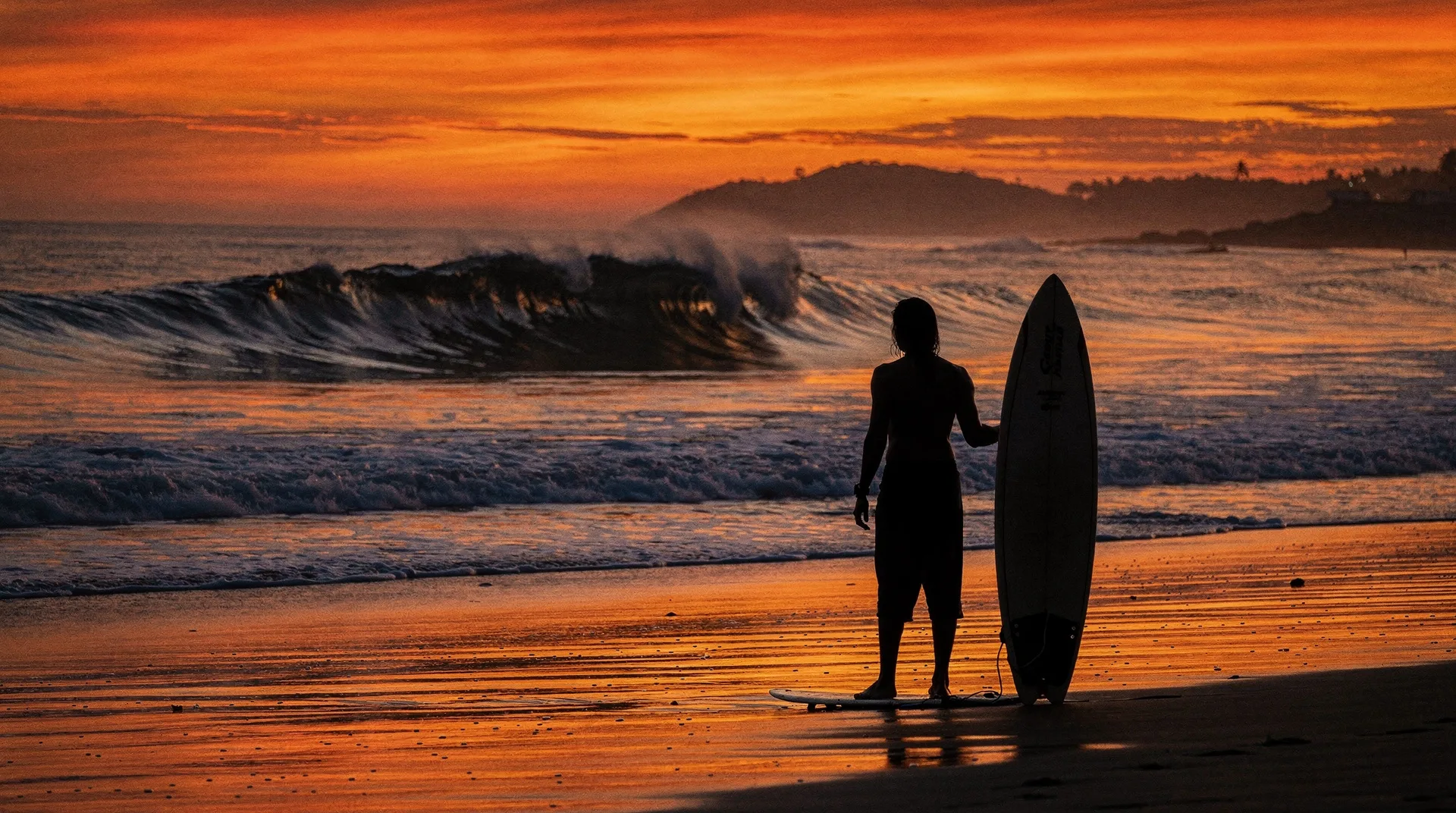
10-day Costa Rica surf trip: Tamarindo, Nosara, and Santa Teresa
The Pacific surf corridor
Costa Rica’s Pacific coast is one of the world’s great surfing destinations — not because it has the biggest waves, but because it has the most consistent variety across a single coastline. In 10 days you can surf three very different breaks at three very different towns, each with its own culture and vibe, connected by a drive through Guanacaste’s dry forest and Nicoya’s rugged hills.
Tamarindo is the starting point: a busy beach town with multiple breaks and dozens of surf schools — ideal for beginners working on their popup or intermediates looking to log high-volume sessions. Nosara is the next step: a quieter, more focused surf destination where Playa Guiones breaks perfectly year-round and the community leans wellness. Santa Teresa is the finish: more powerful, less forgiving, more international, and arguably the most charged surf atmosphere in the country.
A 4WD rental is essential — the roads between Nosara and Santa Teresa traverse unpaved Nicoya Peninsula routes that require ground clearance, particularly in the May–November green season.
Total estimated budget: USD 2,500–4,500 per person for 10 days, excluding international flights.
At a glance
| Stat | Value |
|---|---|
| Total days | 10 |
| Best for | Surfers (beginner to advanced), surf couples, solo surfers |
| With/without car | Yes — 4WD required for Nicoya roads |
| Budget range | USD 150–350 per person per day |
| Best surf season | April–October (south swell season, most consistent) |
| Total drive time | ~8 hours across the trip |
Day-by-day breakdown
Days 1–2: Arrive Liberia and drive to Tamarindo
Fly into Liberia (LIR) — the logical gateway for any northern Pacific surf trip. Collect your 4WD rental and drive 1 hour south to Tamarindo. The road from LIR to Tamarindo is completely paved and straightforward; you’ll arrive well in time for the afternoon session.
Tamarindo is the most developed surf town in Costa Rica — which is a double-edged descriptor. It means you’ll find multiple good surf schools, a strong board-rental market, and breaks suited to every level. It also means crowds, especially during December–April high season. Morning sessions (6–9 AM) beat the crowds and get the best light.
The town’s main break, Playa Tamarindo, is a long beach break with multiple sections. For beginners, the reform waves on the inside work well for learning. For intermediates, the outside peak near the estuary mouth offers consistent hollow sections. Playa Langosta, a 20-minute walk south, is quieter and more shapely.
Tamarindo surf: learn and practice surfing — from $50Day 2: surf the morning session on Tamarindo, then drive north to explore Playa Flamingo and Playa Grande — Playa Grande is one of Costa Rica’s best beach breaks and a leatherback sea turtle nesting site (protected). The Las Baulas National Park prohibits surfing in designated sections during October–February nesting season; respect this boundary.
Stay: Tamarindo Diria Beach Resort (mid-range, from $130/night, right on the beach, consistent swell view from rooms) or La Casita del Pescador (budget-friendly, from $60/night, small and local, walking distance to breaks).
Days 3–4: Tamarindo — afternoon boat and estuary sessions
Day 3: morning surf session on the main break, then take a boat tour through the Tamarindo Estuary — a 2-hour mangrove exploration with American crocodiles and bird life. The afternoon surfbreak from the estuary mouth is excellent when the swell is 2–4 feet.
Tamarindo estuary boat tour with naturalist guide — from $45Day 4: consider a surf charter to Witch’s Rock (Santa Rosa National Park, 35 minutes north by boat) — one of the most famous right-hand breaks in Central America. Access is by boat only, and you need a park guide. This is not a beginner wave, but for intermediate-to-advanced surfers it’s a bucket-list session.
Alternatively, drive 15 minutes north to Playa Avellanas — a consistently good beach break with four distinct peaks and a fraction of Tamarindo’s crowd. Lola’s restaurant on the beach is a legendary surf hangout: fresh ceviche, cold beer, pigs wandering the sand.
Days 5–6: Tamarindo to Nosara
Drive south from Tamarindo to Nosara — approximately 1.5–2 hours via Nicoya town, with the last section of road being unpaved. Leave by 8 AM to arrive in Nosara in time for the late morning session.
Nosara is built around Playa Guiones, a 7 km beach with a consistent year-round beach break. The waves here are a step up from Tamarindo — cleaner, slightly faster, with more powerful rips. The Nosara surf community is international and year-round, which means the lineup is never truly empty, but the beach is long enough to spread out.
Day 5: arrive, rent boards (if you haven’t brought your own — most surfers on a road trip rent locally), surf the afternoon session when the winds typically go offshore. La Luna restaurant at Playa Pelada is worth the 2 km drive south for sunset dinner.
Day 6: full day in Nosara. Dawn session at Guiones before the crowd arrives (6 AM, low tide), then a stand-up paddleboard tour in the Nosara estuary. The estuary offers mangrove channels and crocodile sightings with none of the surf pressure. Afternoon: yoga class at the Nosara Yoga Institute — even if you’re not a regular practitioner, a single session with a world-class teacher in an open-air pavilion above the Pacific is worth the $25.
Nosara catamaran sunset charter — from $135Stay: Café de Paris Hotel (mid-range, from $85/night, pool, central location, surf-culture vibe) or Harmony Hotel (mid-range, from $380/night, beach access, two pools, excellent breakfast).
Days 7–8: Nosara to Santa Teresa
The road from Nosara to Santa Teresa is the most demanding section of this trip. The most direct route goes south via Sámara, Carrillo, and then cuts inland to Cóbano before descending to Santa Teresa — roughly 3–4 hours depending on conditions. In the dry season, the roads are washboard but manageable. In the wet season (May–November), creek crossings can be an issue.
Santa Teresa is different in character from both Tamarindo and Nosara. The waves are more powerful, the beach is more exposed, and the crowd in the lineup is more experienced. The main break in front of the town delivers A-frame beach break with hollow sections when the swell is working. Playa Hermosa (the Nicoya one, north of Santa Teresa) is longer and less crowded.
Day 7: arrive and settle in. Afternoon session to read the break before paddling out — Santa Teresa’s waves can look manageable and be significantly more demanding than Nosara. The beach drops off sharply and rips are stronger. Intermediate surfers who felt confident at Nosara should surf with a local or take a lesson to understand this specific break.
Day 8: dawn session, then rent an ATV or mountain bike to explore the coastline south toward Mal País. Playa Hermosa (south end, near Mal País) is a reef break that works best at mid tide and rewards tube-hunters at a good swell. Budget surf: boards rent for $15–20 per day at multiple shops on the main road.
Santa Teresa: Tortuga Island full-day boat tour with snorkel — from $155Evening: Koji’s sushi restaurant — booked in advance — for the best dinner in Santa Teresa. Otherwise, Burger Rancho on the main drag for an honest cheap eat.
Stay: Drift Bay Lodge (mid-range, from $95/night, small boutique, excellent surf culture, walking distance to break) or Florblanca Resort (luxury, from $500/night, the benchmark of Santa Teresa accommodation).
Days 9–10: Final Santa Teresa sessions and return
Day 9: book a surfing lesson with a local coach to work on specific weaknesses — the coaches in Santa Teresa tend to be more technically focused than the school instructors in Tamarindo. A private 2-hour session runs $60–90 and is worth it if you’re serious about improving.
Afternoon: visit Cabo Blanco Nature Reserve, 20 km south near Mal País — Costa Rica’s oldest nature reserve, established in 1963. The trail to Playa Balsita inside the reserve passes through primary dry forest and ends at a gorgeous empty beach. Entry $12; closed Mondays and Tuesdays.
Day 10: return drive to Liberia (LIR) for the international flight. Route: Santa Teresa → Cóbano → Paquera ferry (1h20 crossing to Puntarenas) → north on the Interamerican Highway to Liberia. Allow 4–5 hours total. Alternatively, arrange a private transfer with your rental car returned to the Liberia airport.
Costa Rica: private transportation service — from $220If your flight departs from San José (SJO), add 1–2 hours to the journey — the ferry + drive to SJO runs about 5–6 hours from Santa Teresa.
Costa Rica: sport fishing private boat charter (Guanacaste) — from $850Best surf breaks on this route
| Beach | Break type | Best for | Best swell |
|---|---|---|---|
| Playa Tamarindo | Beach break | Beginners–intermediate | NW swell, 2–5 ft |
| Playa Langosta | Beach break | Intermediate | NW–W, 3–6 ft |
| Playa Avellanas | Beach break | Intermediate | W–SW swell |
| Playa Guiones, Nosara | Beach break | Intermediate | SW swell, consistent |
| Santa Teresa | Beach break | Intermediate–advanced | SW swell, 4–8 ft |
| Mal País | Reef break | Advanced | SW swell, 6+ ft |
Cost breakdown
| Category | Per person (mid-range) |
|---|---|
| Accommodation (10 nights) | $900–1,400 |
| Food ($35–70/day) | $350–700 |
| Surf lessons / coaching | $180–350 |
| Board rental (if needed, 6–8 days) | $120–200 |
| 4WD rental + fuel | $380–520 |
| Activities (estuary, boat, snorkel) | $200–350 |
| Total per person | $2,130–3,520 |
When to go
April through October is the prime surf window on Costa Rica’s Pacific coast. The south swells generated in the South Pacific deliver consistent, powerful waves across all three destinations. The peak of this window — June through August — combines good surf with the veranillo mini dry season in July and lower prices than December–April.
December through March (dry season) is the high tourist season with better weather but smaller, less consistent surf. The north/northwest swells that arrive December–February work particularly well at Playa Grande north of Tamarindo, but the southern breaks at Nosara and Santa Teresa are less reliably powered.
September and October can deliver excellent, uncrowded surf but require flexibility — the rainy season is at its heaviest and Nicoya Peninsula roads can be challenging. Experienced surfers who don’t mind logistics are rewarded with empty lineups and large, powerful swell.
Frequently asked questions about this surf itinerary
What surf level is required for this route?
Tamarindo works for complete beginners — you’ll learn the basics in 1–2 days with a school. Nosara requires at least basic popup competence and comfort in shoulder-high waves. Santa Teresa demands intermediate skills at minimum: confident paddling, reasonable popup, and comfort reading a more powerful break. Do not paddle out at Mal País unless you are an experienced surfer.
Can I travel with a surfboard on this route?
Yes, and many surfers do. Airlines charge $35–75 per board bag as checked luggage. A 6’0”–7’0” shortboard in a padded travel bag handles the full route. Alternatively, rent boards at each destination — quality varies but average rents run $15–25 per day, which means for 8 surf days you’d spend $120–200 vs. the airline baggage fee plus wear on your board.
Is the road from Nosara to Santa Teresa really that bad?
In the dry season (December–April), it’s a washboard dirt road but manageable in a 4WD with good ground clearance. In the wet season (May–November), creek crossings can rise to knee-depth or higher after heavy rain. If you’re driving this route in September–October, check local Facebook groups (Costa Rica 4WD, Nicoya roads) for current conditions before departure.
Which is better for beginners — Tamarindo or Nosara?
Tamarindo. It has more surf schools, more instructors, more beginner-friendly inner breaks, and better infrastructure for people learning. Nosara’s Guiones is excellent for learning but the waves are slightly more powerful and the community expectation in the lineup is higher. Start in Tamarindo; progress to Nosara.
Are there surf camps on this route?
Yes — Tamarindo has multiple full-service surf camps with accommodation and instruction (7-day packages from $800–1,500 per person all-inclusive). Nosara has Corky Carroll’s and Del Mar surf schools with accommodation partners. Santa Teresa has Drift Bay Surf Camp and several boutique operations. If you prefer a camp structure over the freelance approach, these are solid options.
What should I do on flat days?
This route has enough alternatives to fill any flat day: Tamarindo estuary by boat, Nosara yoga and cooking classes, Santa Teresa ATV rentals and Cabo Blanco hiking. The Guanacaste dry forest interior around Nicoya has several good hiking trails and waterfall swimming holes accessible by 4WD. Rincon de la Vieja National Park from Liberia is also within range for a day trip.
How do I get from Santa Teresa back to the airport?
Liberia (LIR): Paquera ferry + Interamerican Highway north, approximately 4–5 hours. San José (SJO): Paquera ferry + Costanera Sur south, approximately 5–6 hours. Private shuttles can be arranged from most hotels in Santa Teresa to either airport for $100–150 per vehicle.
Reading Costa Rica surf conditions
Understanding swell forecasts is important for getting the most out of this circuit. Several tools and sources are worth bookmarking before departure:
Swell and forecast sources: Magic Seaweed (MSW) covers Tamarindo, Nosara, and Santa Teresa with reasonable accuracy for Central American breaks. Surfline provides more detailed local forecasts for major spots including Playa Grande and Guiones. The Windguru app is widely used by Costa Rica surf schools for wind and swell combined forecasting — particularly useful for timing Nosara’s offshore window (typically 5–9 AM before the onshore thermal kicks in around midday).
Tide tables: The IMN (Instituto Meteorológico Nacional) publishes Costa Rican tide tables; most surf schools post tide times in their shop windows. Low tide at Tamarindo’s river mouth creates a strong current and rip — high tide or mid-tide is preferred for beginners. Santa Teresa’s main break is best surfed at mid-tide (2–3 hours either side of high) when the wave has more shape.
Hazards to know:
- Rip currents: all three beaches have rip currents at certain tide and swell combinations. Nosara’s Guiones has a central channel rip visible from the beach at low tide. If caught in a rip, paddle parallel to shore rather than fighting it directly.
- Sea urchins: the rocky sections at Tamarindo’s estuary point and at Mal País reef have sea urchins in water 0.5–1.5 meters deep. Bootie surf shoes eliminate the risk on entry/exit.
- Jellyfish: occasional jellyfish (aguaviva) blooms occur March–May in Guanacaste waters. Transparent and nearly invisible — if you feel a sting, exit the water and apply white vinegar (most surf shops carry it).
Local surf community knowledge: Both Nosara Surf Club and Santa Teresa’s informal local surf networks post daily conditions via Instagram stories. Following local surf schools on Instagram before your trip gives you real-time condition reports that no forecast app can match. The community knowledge about specific breaks — which peak is working, where the rip is running, whether the offshore window held — is invaluable.
Surf culture and community on this route
Tamarindo: The most commercially developed surf scene in Costa Rica. Dozens of surf schools compete on the beach, board rentals are plentiful, and the town’s nightlife centers around surf culture. The downside is that Tamarindo’s popularity has made the lineup crowded during December–April high season — locals and experienced surfers head early morning or midweek to avoid the worst of it. The town’s Witch’s Rock Surf Camp is a well-regarded school with a reputation for quality instruction that extends beyond beginner level.
Nosara: Nosara’s surf community is self-selecting — it attracts people who are serious about surfing and serious about wellness, and the town is designed around both. There are no clubs, minimal nightlife, and the restaurants close early. The Guiones break tends to be the domain of intermediate-to-advanced surfers, with a respectful but competitive lineup etiquette. The Nosara Surf Club does weekly movie nights and has a good noticeboard for local surf conditions and events.
Santa Teresa: The most internationally charged of the three surf towns. The wave attracts experienced surfers from Brazil, Argentina, Australia, and Europe, which means the lineup has a confident, sometimes intense energy. The town’s social scene is more active than Nosara — open-air bars, good restaurant scene, and enough nightlife to fill an evening without effort. The surf community here is genuinely global and connections made in the water tend to carry over to recommendations for breaks further afield in the Nicoya Peninsula.
Surf equipment on the road
Board transport: bringing your own board on this route requires careful packing (padded travel bag minimum, hard case recommended for boards you care about), and airline board bag fees of $35–75 each way. A 6’0”–6’6” all-around thruster handles Tamarindo and Nosara; for Santa Teresa you may want something with a bit more foam underfoot for the power. Rentals at all three destinations average $15–25/day for quality boards — 10 days of rental runs $150–250, comparable to checked bag fees.
Wax: Bring your own base coat and warm-water topcoat — Costa Rica’s Pacific water averages 27–30°C and tropical wax is essential. Local surf shops sell FCS plugs, leashes, and wax but specific fin sizes or replacement hardware are harder to source quickly.
Rash guards and sun protection: The equatorial sun at 10° north latitude is intense. A long-sleeve rash guard is standard in the lineup and reduces sun exposure without limiting movement. Reef-safe sunscreen is required inside national park marine zones (Manuel Antonio, Marino Ballena); standard SPF 50+ is fine elsewhere.
Related itineraries
For surfers who want to add the Caribbean coast’s different wave style, the 21-day backpacker route includes Puerto Viejo’s Caribbean surf along with the full Pacific circuit. For a focused 7-day surf and wellness retreat in a single location, see the 7-day yoga and wellness route.
For couples who want to combine the surf and romance angle in Nosara and Santa Teresa with a volcano finale, see the 10-day honeymoon itinerary. For a deeper breakdown of each stop’s individual break and season, see the Tamarindo surf guide, Nosara surf guide, and Santa Teresa surf guide.