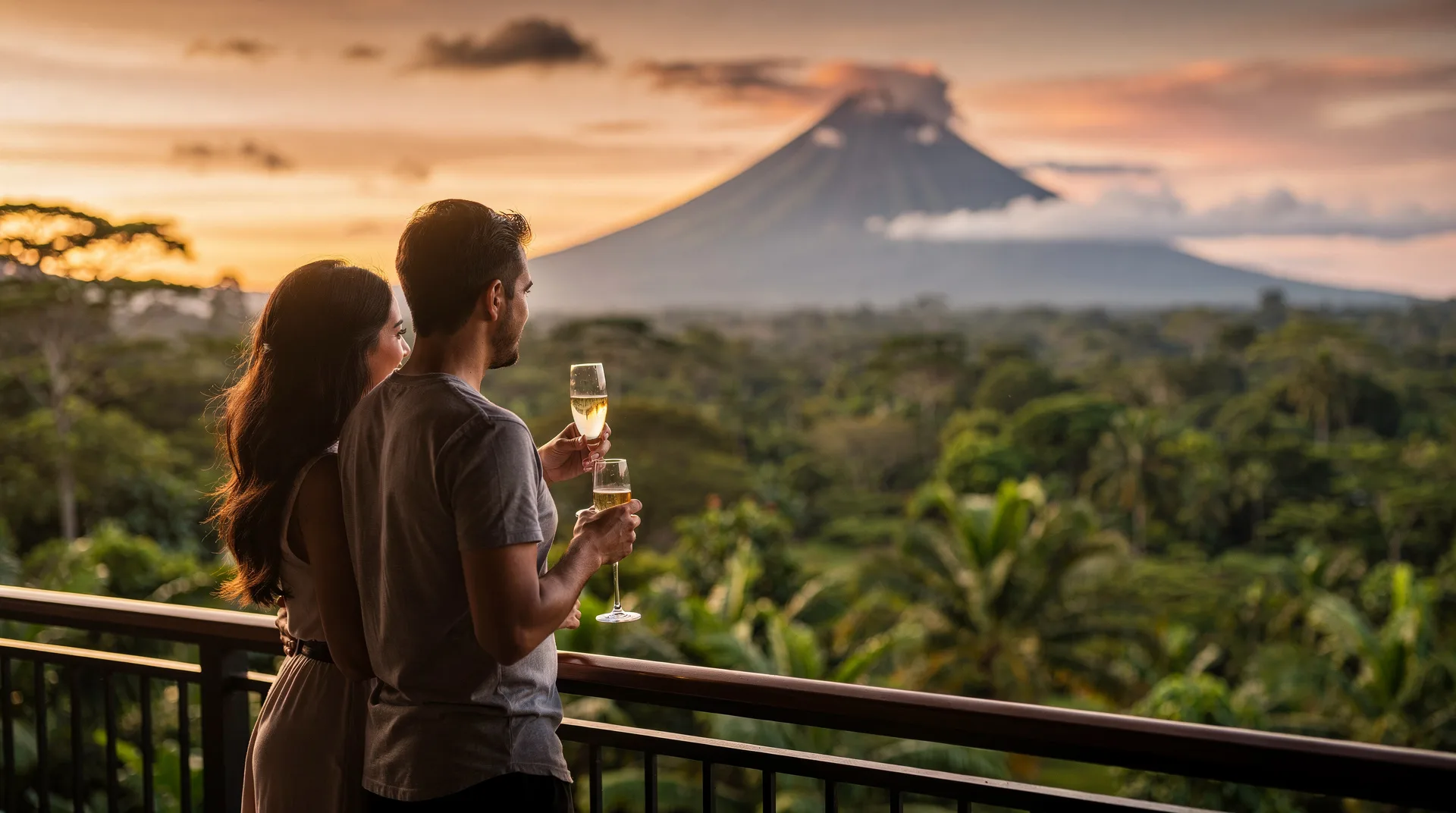
10-day Costa Rica honeymoon: Nicoya Peninsula to Arenal
Why Nicoya to Arenal makes a perfect honeymoon
Few honeymoon routes in Latin America match this one for sheer variety: you begin in Nosara, a quiet Guanacaste enclave famous for yoga retreats and consistent surf waves, cross the Nicoya Peninsula to Santa Teresa for its bohemian beach scene and world-class wellness resorts, and finish at La Fortuna soaking in volcanic hot springs with Arenal’s perfect cone reflected in thermal pools at dusk. Each destination has its own identity. The transition between them feels like moving through three different moods — meditative, free-spirited, and indulgent — which is exactly what a honeymoon should feel like.
This is not a budget route. Nosara’s Bodhi Tree and Florblanca in Santa Teresa cater to couples willing to invest in exceptional experiences. But nothing is gratuitous — every recommendation here earns its price.
Total estimated budget: USD 5,000–9,000 per couple for 10 days, excluding international flights.
At a glance
| Stat | Value |
|---|---|
| Total days | 10 |
| Best for | Honeymooners, couples, wellness travelers |
| With/without car | Yes — 4WD essential for Nicoya roads |
| Budget range | USD 400–700 per person per day |
| Best season | December–April (dry, Nosara and Santa Teresa ideal); July–August also excellent |
| Total drive time | ~9 hours spread across the trip |
Day-by-day breakdown
Day 1: Arrival and first evening in Nosara
Fly into Liberia (LIR) — the closest gateway to the Nicoya Peninsula. Collect your 4WD rental car and drive south on the Interamerican Highway toward Nicoya, then cut west toward Nosara. The road from Nicoya to Nosara is partially unpaved but manageable; allow 2.5–3 hours from the airport. If you prefer to skip the driving entirely on arrival day, Sansa operates a 35-minute domestic flight from San José to Nosara’s small airstrip.
Nosara is split between the surf village of Playa Guiones and the quieter Pelada and Garza coves further south. Your honeymoon base is likely near Guiones — the yoga and wellness infrastructure is concentrated here. Check in, open the balcony, and do absolutely nothing useful for the rest of the day. You’ve just crossed however many time zones — rest matters.
Dinner: La Luna in Playa Pelada is the most romantic option for a first night — open-air tables above the estuary, fresh ceviche, good caipirinhas, and a sunset that arrives at the exact right angle.
Stay: Bodhi Tree Yoga Resort (from $280/night, ocean-view bungalows, daily yoga, spa services) or Harmony Hotel (from $380/night, Surf Club vibe, two pools, direct beach access).
Day 2: Surf lesson and yoga immersion
Nosara’s Playa Guiones is one of the most consistent beach breaks in Central America — perfectly suited for learning. The wave breaks cleanly and the beach is wide enough that even a crowded morning session gives you space. Take a private lesson in the early morning when the offshore winds are at their best.
Nosara catamaran sunset charter — from $135Afternoon: yoga class at the Nosara Yoga Institute or Bodhi Tree’s open practice. Both welcome drop-in students. The Nosara Yoga Institute is arguably the most well-regarded yoga school in the country — it trained many of the instructors you’ll find at resorts throughout Costa Rica.
Evening: walk the estuary trail at Playa Pelada at dusk for a near-guaranteed sighting of howler monkeys and proboscis bats emerging from the mangroves.
Day 3: Nosara’s quieter side — Garza and cooking class
Rent kayaks at Playa Garza, the fishing village 3 km north of Guiones. The bay is calm and the snorkeling around the rocky headland is decent. Paddle south along the coast until the waves get too large, then turn back and dry off on the black-sand beach.
Nosara: traditional Costa Rican cooking class and meal — from $95Afternoon: massage at Bodhi Tree’s spa or an Ayurvedic treatment at Aqua Wellness Resort. Many of Nosara’s spa menus are exceptional by any international standard — partly because the town attracts serious wellness practitioners.
Day 4: Nosara to Santa Teresa via Nicoya ferry or inland road
The route from Nosara to Santa Teresa requires either backtracking north to take the Nicoya–Paquera route (with the Puntarenas ferry, if coming from the Central Valley) or driving south via the coast through Cóbano. The most direct route for a 4WD: Nosara → Nicoya → Cóbano → Santa Teresa, roughly 3–3.5 hours on mixed paved and gravel road. Alternatively, hire a driver for the day — the roads south of Cóbano can be rough in the rainy season.
Arrive in Santa Teresa for a late lunch. The main road (which most locals call “the strip”) runs parallel to the beach and has a dense concentration of cafes, health food spots, and smoothie bars. Habaneros is a reliable lunch stop — solid tacos and refreshing cocktails in a breezy open-air setting.
Stay: Florblanca Resort (from $500/night, oceanfront villas with private plunge pools, exceptional spa) or Pranamar Oceanfront Villas (from $280/night, beachfront yoga deck, romantic garden villas).
Day 5: Santa Teresa — sunset surf and private beach
Santa Teresa’s wave is more powerful than Nosara’s — this is intermediate to advanced surf territory. If one of you surfs at that level, rent a board at Sunset Surf shop and head to the southern end of the beach where the break is most consistent. For the non-surfer, walk 20 minutes north along the shoreline to Playa Hermosa (the Nicoya one, not to be confused with Playa Hermosa in Guanacaste) — it’s less crowded and lined with tide pools perfect for an hour of exploration.
Santa Teresa: Tortuga Island full-day boat tour with snorkel — from $155Afternoon: visit Cabo Blanco Nature Reserve, Costa Rica’s oldest protected area, 20 km south of Santa Teresa near Mal País. The trail through the reserve ends at a secluded beach that almost no one has all to themselves — arrive by 2 PM to beat the gate closing at 4 PM. Entry is $12.
Evening: dinner at Koji’s — the sushi restaurant in Santa Teresa that consistently appears on “best of” lists for the region. Reserve in advance; it fills up by 7 PM.
Day 6: Wellness day in Santa Teresa
Give yourselves a full day with no agenda. Both Florblanca and Pranamar offer couples’ spa packages — typically a 90-minute massage, body wrap, and access to their pools for a half-day. Budget $200–300 per couple for a package.
If inaction isn’t in the cards, rent mountain bikes and explore the hills behind Santa Teresa — the views of the Pacific from the ridge trails are exceptional and the red dirt roads wind past small farms and casitas. A guide from the town’s rental shops can point you toward the best ridge route (2 hours, easy gradient).
Nosara catamaran sunset charter — from $135Day 7: Santa Teresa to La Fortuna — the long crossing
This is the logistically demanding day of the trip, and it’s worth planning carefully. The most comfortable option: take the Puntarenas–Paquera ferry across the Gulf of Nicoya (1 hour 20 minutes), then drive north to San José and east to La Fortuna — total road time of about 6–7 hours with the ferry. An alternative for couples with a bigger budget: book a private driver for the full crossing, or take the Santa Teresa–San José shuttle ($65 per person) and then a separate La Fortuna transfer.
The fastest option by far: fly from the Tambor airstrip (40 minutes south of Santa Teresa) to San José with Sansa, then connect to La Fortuna by road or take the second Sansa flight. Total time: about 3 hours.
Arrive in La Fortuna by late afternoon. The volcano is most clearly visible at dusk and at dawn — check your hotel’s orientation. Check in and walk into town for dinner at Soda La Hormiga near the central park — unpretentious, honest gallo pinto, and a good place to decompress from the travel day.
Stay: Nayara Springs (from $450/night, the most romantically conceived hotel in Costa Rica — adult-only suites with private plunge pools and Arenal framed through the trees) or Tabacón Thermal Resort (from $290/night, direct access to the hot springs thermal garden).
Day 8: Hanging bridges and hot springs
Day 8 belongs to Arenal. Start at the Místico hanging bridges park at 6 AM — 16 suspension bridges crossing the primary rainforest at canopy level, with Arenal’s cone visible on clear mornings. A naturalist guide will find sloths, toucans, and Jesus Christ lizards you would otherwise walk past.
Costa Rica: Mistico hanging bridges guided tour — from $70Afternoon: La Fortuna Waterfall. A 70-meter cascade at the end of a 480-step descent — the swimming pool at its base is cold, turquoise, and very worth it. Entry is $18.
Evening: Tabacón Grand Spa hot springs. For a honeymoon, consider the spa’s couples’ treatment package — a private thermal massage suite followed by unrestricted access to the thermal river gardens. The pools range from 27°C to 40°C; the hottest ones glow under solar lighting after dark.
La Fortuna: Arenal Volcano, lunch & hot springs morning tour — from $120Day 9: Río Celeste and final evening
Drive 2 hours northwest from La Fortuna to Tenorio Volcano National Park for Río Celeste — an electric-blue river and waterfall produced by the meeting of two volcanic mineral streams. The trail is 9 km return, requiring about 3–4 hours at a comfortable pace. Go early: the parking lot fills quickly and the trail crowds by 10 AM.
Río Celeste National Park hike — from $95Return to La Fortuna by early afternoon. If Nayara Springs is your base, the resort’s Amor restaurant is one of the best dining experiences in the region — an open-air tasting menu with local sourcing and exceptional cocktails. Book a table for your final dinner in Costa Rica.
Day 10: Return to San José
Drive from La Fortuna to San José — 3 hours on the highway via Naranjo. Return your rental car at SJO. If your flight is later in the day, Escalante neighborhood in San José offers the city’s best restaurants and a final espresso at Cafeoteca, arguably Costa Rica’s finest specialty coffee shop.
Where to stay
| Destination | Mid-range option | Luxury option |
|---|---|---|
| Nosara | Harmony Hotel (~$380/night) | Bodhi Tree Yoga Resort (~$280/night) |
| Santa Teresa | Pranamar Villas (~$280/night) | Florblanca Resort (~$500/night) |
| La Fortuna | Tabacón Thermal Resort (~$290/night) | Nayara Springs (~$450/night) |
Cost breakdown
| Category | Per couple (luxury) | Per couple (mid-range) |
|---|---|---|
| Accommodation (10 nights) | $3,500–5,000 | $1,800–2,800 |
| Food ($80–180/day per couple) | $800–1,800 | $500–800 |
| Activities and spa | $800–1,500 | $400–600 |
| 4WD rental + fuel (10 days) | $500–700 | $350–500 |
| Domestic flights (optional) | $200–400 | — |
| Park fees and transfers | $150–200 | $100–150 |
| Total per couple | $5,950–9,600 | $3,150–4,850 |
When to go
December through April is the sweet spot for a Nicoya honeymoon. Nosara and Santa Teresa receive almost no rain, evenings are cool, and the surf is consistent but not as heavy as during the swell season. The Pacific coast has 8–10 hours of sunshine per day.
July and August are excellent as well — the brief “veranillo” (mini dry season) interrupts the green season, and prices are 20–30% lower than peak season. La Fortuna is lush and deeply green in this period, which makes the hot springs experience feel even more surrounded by jungle.
Avoid May and October: May is the opening of the rainy season and roads on the Nicoya Peninsula can become impassable. October is the wettest month on the Pacific and some Santa Teresa accommodations reduce services.
La Fortuna is a year-round destination — rainfall doesn’t significantly disrupt the main activities, and the hot springs are arguably better appreciated during the cooler evenings of the rainy season.
Frequently asked questions about this honeymoon route
Is this route manageable without a car?
With some effort, yes. Nosara and Santa Teresa are both served by shuttle companies (Interbus, GrayLine). The Nosara–Santa Teresa leg requires a shuttle to Nicoya, a connection to Paquera, and another to Cóbano — typically 5–6 hours total vs. 3–3.5 hours by 4WD. For La Fortuna, shared shuttle service from San José is reliable and comfortable. If you’d rather not drive, it’s entirely doable — just pre-book all segments.
Do I need to speak Spanish?
No. Both Nosara and Santa Teresa have high concentrations of international residents and tourism professionals who speak fluent English. La Fortuna is similarly well-equipped. That said, a few phrases — “pura vida,” “gracias,” “qué rico” — go a long way in any Tico establishment.
Which resort is better for a honeymoon — Florblanca or Nayara Springs?
They serve different moods. Florblanca is beach-front in Santa Teresa — you walk off your private terrace onto the sand. It’s bohemian-luxe: beautiful, slightly imperfect, and surrounded by surf culture. Nayara Springs is adult-only in La Fortuna — architecturally perfect, with private plunge pools and Arenal visible from your bath. If the honeymoon vibe is “barefoot on the beach at sunset,” Florblanca. If it’s “steaming in a private pool with volcano views,” Nayara Springs.
Are there any safety concerns for couples driving on Nicoya?
The Nicoya roads require attention but are not dangerous if you drive cautiously. The main risk is the unpaved sections between Nosara and Cóbano — creek crossings after rain can surprise drivers in low-clearance vehicles. A 4WD with good ground clearance handles everything on this route. Drive in daylight only; night driving on Nicoya roads is not recommended.
Can we combine this route with a Tortuguero extension?
Yes, but it adds significant complexity. Tortuguero is on the Caribbean coast and requires either a flight from San José or a boat transfer from the Caribbean port — both require returning to San José, which is a half-day detour. For a 10-day honeymoon, the Nicoya–Arenal combination is complete enough. If you have 14 days, add 3 nights in Tortuguero at the start, before heading west.
What’s the best waterfall near Santa Teresa for couples?
Montezuma Waterfalls, about 20 km south of Santa Teresa near Montezuma village, are the area’s most impressive cascades — three tiers dropping into swimming holes, with a rope swing at the lower level. The hike from Montezuma town takes 20–30 minutes. Go early morning (before 9 AM) for the light and the solitude.
Is Nosara suitable for non-surfers?
Absolutely. The surf culture is visible but not exclusive. Non-surfers spend their time in yoga classes, spa treatments, kayaking, estuary walks, and beach dining. Many wellness-focused visitors to Nosara never touch a surfboard and leave completely satisfied. The town’s pace suits couples who want to decompress more than adrenaline-seekers.
Romantic dining: the best restaurants on this route
In Nosara: La Luna (the reference evening restaurant, above the Pelada estuary, ceviche and candlelit tables), El Café de Paris (French-influenced breakfast and lunch, best espresso in Nosara), La Lora (beachfront cocktail bar at Guiones, good for watching the surf at sunset). For a special dinner, the Nosara Beach Hotel’s La Dolce Vita restaurant does Italian-Costa Rican fusion with pasta made fresh daily — book 24 hours ahead.
In Santa Teresa: Koji’s (sushi and Japanese-inspired plates, requires reservation, the best food in Santa Teresa), Burger Rancho (unpretentious, excellent fresh beef, a good contrast to resort dining), The Place (cocktail bar with a firepit, good for evening drinks, relaxed crowd). For beach dining, the small restaurant attached to Florblanca Resort has a table-in-the-sand option for sunset — the most romantic setting on the Nicoya Peninsula.
In La Fortuna: Restaurante Vagabondo (pizza and pasta, the best mid-range dinner in town, popular with locals and tourists alike), Soda La Hormiga (authentic casado breakfast, $7–9, no frills, excellent value), Nayara Resort’s Amor restaurant (the region’s finest tasting menu, open-air, local sourcing — if you’re staying at Nayara, do not miss this dinner, and if you’re not staying there, it may still be worth the taxi and reservation).
Logistics for the Nicoya roads
The Nicoya Peninsula’s road network is the most commonly misunderstood aspect of this itinerary. The key facts:
Liberia to Nosara: mostly paved (Highway 21 to Nicoya, then a short unpaved section to Nosara). In dry season, a standard SUV handles it comfortably. In wet season (May–November), the unpaved section can be muddy after rain — 4WD is strongly recommended.
Nosara to Santa Teresa: the most demanding road section. No route is fully paved. The most common option is Nosara → Nicoya → Cóbano → Santa Teresa (3–3.5 hours, mix of paved and gravel). Creek crossings on this route can rise significantly during heavy rain in the wet season. Always drive this section in daylight. Check current road conditions via local WhatsApp groups or the tourist-oriented Facebook group “Costa Rica 4WD Road Conditions.”
Santa Teresa to La Fortuna: the longest transit day of the trip. Options: drive north to Paquera, take the ferry to Puntarenas, then drive north to La Fortuna (total 6–7 hours); or take the ferry and then a shuttle for the remaining legs. The Sansa domestic flight from Tambor (40 minutes from Santa Teresa) to San José, then road to La Fortuna, compresses the journey to under 4 hours for couples who value their vacation days.
4WD vs regular SUV: On dry season roads, a regular SUV (Honda CR-V, Toyota RAV4) handles everything on this route. In wet season, a proper 4WD with ground clearance (Toyota 4Runner, Mitsubishi Montero) is significantly safer. Creek crossings are the primary concern — a 4WD’s higher ground clearance keeps the engine above water that a regular SUV would stall in.
Related itineraries
For couples who want more adventure in their romantic escape, the 12-day south Pacific deep dive adds Drake Bay and the Osa Peninsula — wild, boat-access jungle lodges with extraordinary biodiversity. For a shorter first look at this region, the 7-day yoga and wellness route focuses exclusively on Nosara or Santa Teresa and allows deeper engagement with one destination.
For the Arenal hot springs experience extended to a full 10-day circuit, the classic 10-day Arenal, Monteverde and Manuel Antonio route is the most popular couples’ itinerary in the country. Wellness-focused couples deciding between Nosara and Santa Teresa specifically should also read Santa Teresa wellness and Nosara yoga retreats side by side before booking, since the two towns’ retreat cultures differ more than their shared “Nicoya” label suggests.