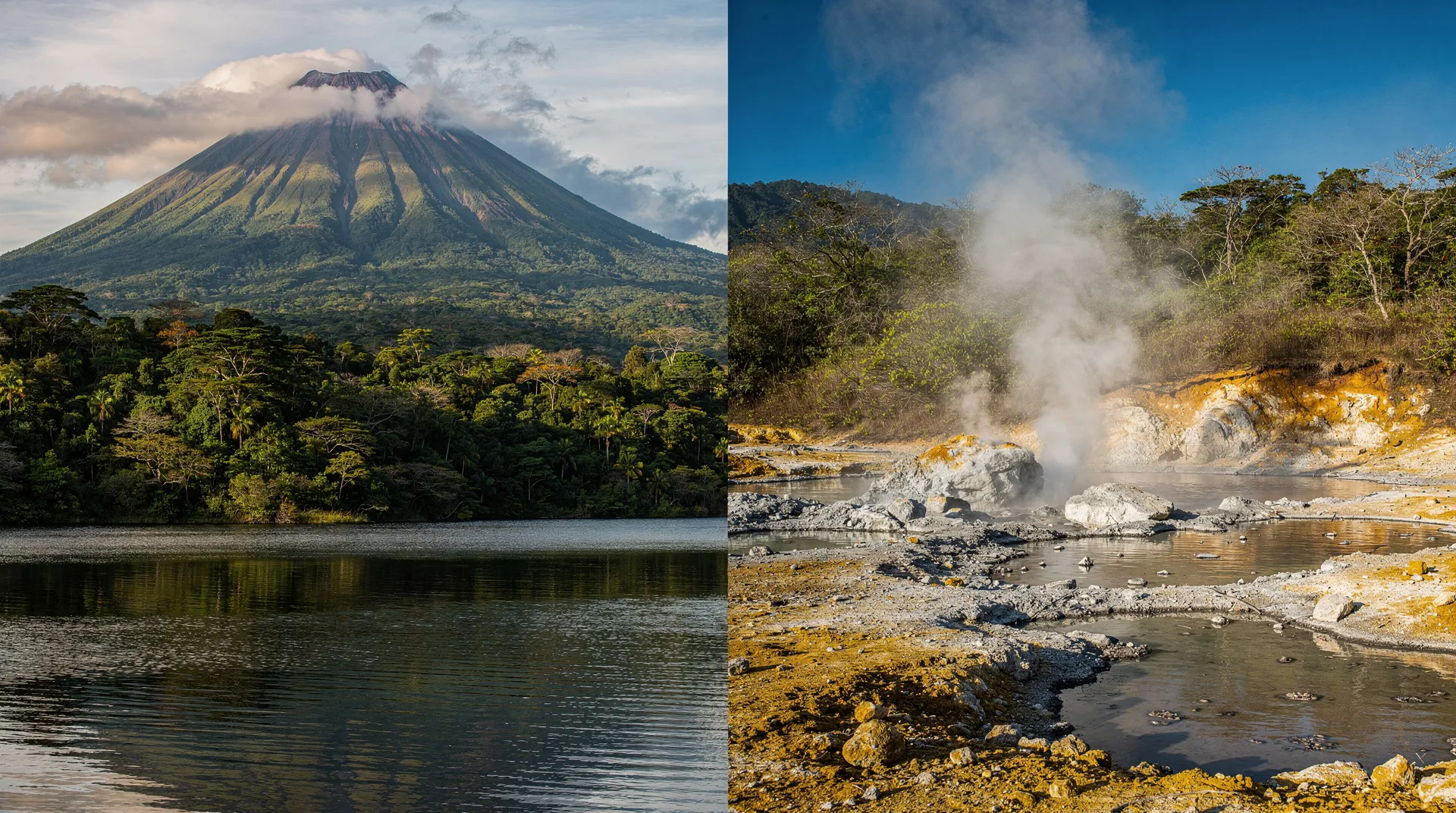
Arenal vs Rincón de la Vieja: which volcano destination should you visit?
Arenal or Rincón de la Vieja?
Arenal offers the most developed volcano destination in Costa Rica — hot springs, waterfalls, ziplines, and family infrastructure. Rincón de la Vieja is rawer and quieter, with active volcanic features, dry forest, and adventure tourism that feels less commercial.
Two volcanoes, two completely different experiences
Arenal and Rincón de la Vieja are Costa Rica’s two most visited volcanic destinations after Poás and Irazú, but they operate in entirely different registers. Arenal, near La Fortuna in the northern Caribbean lowlands, is the most comprehensively developed nature destination in the country — a polished, well-resourced circuit of hot springs, hanging bridges, waterfalls, ziplines, and wildlife. Rincón de la Vieja, in Guanacaste’s dry forest northwest of Liberia, is rougher, wilder, and genuinely active in ways that Arenal — in a resting phase since 2010 — is not.
This guide compares them directly: what each volcano delivers, who each suits, and how to fit either or both into a Costa Rica itinerary.
| Arenal base | La Fortuna, 3 hrs from San José |
| Rincón base | Liberia, 45 min from LIR airport |
| Arenal highlight | World-class hot springs (Tabacón, Eco Termales) |
| Rincón highlight | Active mud pools and fumaroles (Las Pailas) |
| Combine both? | Yes — logical on a 10–14 day circuit |
Arenal: Costa Rica’s iconic volcano destination
The destination, not just the park
Arenal Volcano National Park protects the iconic 1,670-metre cone, but the destination that surrounds it is much larger. La Fortuna de San Carlos — the town at the base of the volcano — has become one of the most developed tourist hubs in Costa Rica, with a wide range of accommodation, dozens of tour operators, and a concentration of activities that makes it possible to fill 3-4 days without repetition.
The volcano itself has been in a resting phase since its last significant eruptive cycle ended in 2010. No lava flows, no eruptions, no significant ashfall. What remains is a dramatically shaped cone frequently wreathed in cloud, a national park with excellent forest trails, and the geothermal hot springs that the 1968 eruption made possible.
Activities
Hot springs: The definitive Arenal experience. Tabacón Grand Spa Resort — directly on a geothermally heated river — offers the most atmospheric hot springs in the country, with multiple natural-feel pools, a full spa, and restaurant access included in day passes ($80-100). Eco Termales is smaller, reservation-only, and capped at a low visitor number that keeps it quiet ($60-70 day pass). Baldí is larger and more resort-style with slides and pools at a lower price ($45). The free Río Chollín hot river under the bridge near Tabacón is a genuine option but has no infrastructure.
National park trails: The Coladas trail crosses the 1968 lava field — otherworldly terrain where pioneer vegetation grows through black solidified lava. Los Tucanes trail passes through forest with good bird and mammal sightings. Park entry is approximately $20; no reservation required.
La Fortuna Waterfall: One of Costa Rica’s most dramatic waterfalls at 70 metres, accessed via a 500-step descent (steep return). Entry approximately $20. A significant physical effort for the view and the swimming pool at the base — genuinely worthwhile.
Hanging bridges at Mistico Park: The most celebrated hanging bridge experience in Costa Rica, combining forest trails with suspension bridges across river canyons and canopy level. A 3-4 hour self-guided or guided experience. Entry approximately $26; guided tours available.
La Fortuna: Místico Arenal hanging bridges admission ticket — from $26Ziplines, canyoning, ATV, kayaking: La Fortuna has a complete adventure menu. Sky Adventures Arenal has a zipline circuit with volcano backdrop. Pure Trek and Lost Canyon operate canyoning programs with waterfall rappelling. Multiple operators run ATV circuits through the surrounding forest and farmland.
La Fortuna: canyoning and waterfall rappelling experience — from $110 La Fortuna: waterfall rappelling and river fun with lunch — from $110Wildlife: Howler and white-faced capuchin monkeys are common around the lake and forest edges. Toucans, trogons, and hummingbirds are seen daily. The Mistico park hanging bridges are particularly productive for wildlife sightings.
Logistics
- Base town: La Fortuna
- Distance from San José: 3 hours by car or shuttle
- Distance from Monteverde: 3 hours via lake crossing (jeep-boat-jeep)
- Distance from Liberia: 3 hours
- Accommodation range: Full — from $25/night hostels to Nayara Springs at $600+/night
Rincón de la Vieja: active, raw, and genuinely Guanacaste
What makes it different
Rincón de la Vieja is an active stratovolcano (1,916 metres, Guanacaste’s highest peak) with a summit crater that erupts phreatomagmatically on a regular schedule — there were recorded eruptions in 2019, 2020, 2021, and 2022. You cannot summit the volcano (restricted access), but the Las Pailas sector at the base of the park is an extraordinary volcanic landscape: boiling mud pools (pailas), sulfurous fumaroles, hot gas vents, and a small cold waterfall within a short easy circuit. This active geothermal activity is real and visible in a way that Arenal’s resting cone is not.
The park sits in a dry tropical forest environment — very different from the humid cloud and rainforest around Arenal. In the dry season, the Guanacaste dry forest takes on golden tones as deciduous trees lose their leaves. Wildlife is excellent: howler monkeys, white-faced capuchins, white-tailed deer, great curassows, and three-wattled bellbirds in season. The Catarata La Cangreja, a spectacular waterfall accessed via a 3.5 km trail through the forest, is one of the most beautiful waterfall hikes in Guanacaste.
The Las Pailas circuit
The Las Pailas trail is the core Rincón de la Vieja park experience: a 3.5 km circuit (approximately 2 hours at a comfortable pace) through the volcanic zone. You pass mud pools bubbling with geothermal gas, vents releasing steam, hot and cold springs within metres of each other, and a small lagoon. The trail is flat and accessible for most fitness levels. Park entry costs approximately $20; the park is closed on Mondays and sometimes after heavy rain (volcanic gas monitoring drives closures).
Beyond Las Pailas, the Catarata Oropéndola trail (1.8 km each way) leads to a beautiful waterfall with a swimming pool at the base — a good half-day addition.
Rincón de la Vieja NP: Las Pailas trail — from $90Adventure activities
Rincón de la Vieja is the adventure tourism hub of northern Guanacaste. Hacienda Guachipelín — the main multi-activity ranch near the park — offers one of the most comprehensive single-day adventure packages in Costa Rica: ziplines, hanging bridges, river tubing, horseback riding, ATV, volcanic mud bath, and hot springs. The volcanic mud pools at Hacienda Guachipelín are a legitimate experience — sulfurous mineral-rich mud applied to the skin and dried in the sun before rinsing off. Unusual and worth doing.
Guanacaste: 5-in-1 Rincón de la Vieja adventure day pass — from $120Horseback riding into Rincón de la Vieja through the dry forest is one of the best ways to experience the landscape — several operators near the park entrance offer half-day and full-day rides.
Thermal spas
The geothermal activity at Rincón de la Vieja produces hot springs, though these are different in character from the Arenal hot springs. Hacienda Guachipelín has a thermal spa complex using geothermal water. The experience is more rustic than Tabacón but more authentically volcanic — you are in a working ranch environment rather than a designed resort landscape. Entry to the spa as a standalone is approximately $40-60.
See the Rincón de la Vieja thermal spas guide for the full comparison of hot spring options near the park.
Logistics
- Base town: Liberia (30-45 minutes from park entrance) or on-site at Hacienda Guachipelín / Borinquen Mountain Resort
- Distance from Liberia Airport (LIR): 45 minutes to 1 hour
- Distance from Tamarindo: 2 hours
- Accommodation range: Limited near park (hacienda-style lodges and Borinquen resort); full range in Liberia
Head-to-head comparison
| Criterion | Arenal (La Fortuna) | Rincón de la Vieja |
|---|---|---|
| Elevation | 1,670 m | 1,916 m |
| Volcanic activity | Resting since 2010 | Actively erupting (summit restricted) |
| Active geothermal visible? | No (at park level) | Yes — mud pools, fumaroles, steam |
| Hot springs quality | World-class (Tabacón, Eco Termales) | Good (Guachipelín thermal spa) |
| National park trails | Excellent, varied | Good (Las Pailas circuit excellent) |
| Waterfall access | La Fortuna waterfall ($20) | Catarata La Cangreja (in park) |
| Ziplines/adventure | Excellent (Sky, EcoGlide, canyoning) | Excellent (Guachipelín multi-activity) |
| Hanging bridges | Mistico Park (world-class) | Guachipelín (good, more basic) |
| Wildlife | Good to excellent | Good |
| Distance from San José | 3 hours | 4 hours (via Liberia) |
| Nearest airport | SJO (3h) | LIR (45 min) |
| Accommodation range | Extensive (full range) | Limited near park; Liberia for range |
| Crowds | High (most visited Costa Rica destination) | Moderate |
| Cost | Moderate to high | Moderate |
| Best for families | Excellent | Good |
| Dry season feel | Humid green forest | Dry golden forest (dramatic) |
| Multi-day justification | 3-5 days easily | 2-3 days |
Who should choose Arenal?
- Visitors with 3-4 nights who want the most varied activity menu possible.
- Families with children of all ages — the hot springs, wildlife, and accessible trails are well-suited.
- First-time visitors to Costa Rica who want the iconic experience.
- Travelers coming from San José who do not want to fly to Liberia.
- Anyone who wants world-class hot springs with real geothermal character (Tabacón is genuinely exceptional).
- Visitors combining Arenal with Monteverde on a standard circuit.
Who should choose Rincón de la Vieja?
- Visitors flying into Liberia (LIR) who want a Guanacaste-based itinerary.
- Travelers who want to see actively visible volcanic geothermal activity (mud pools, fumaroles) rather than just a volcanic cone.
- Those who prefer quieter parks with fewer visitors — Rincón sees a fraction of Arenal’s traffic.
- Adventure seekers who want a multi-activity ranch experience at Hacienda Guachipelín.
- Dry forest enthusiasts — the Guanacaste dry forest ecosystem is ecologically distinct from anything at Arenal.
Can you do both?
Yes — and the combination is logical on a 10-14 day itinerary.
The most efficient route: fly into Liberia (LIR) → spend 2 nights near Rincón de la Vieja → drive 3 hours to La Fortuna for 3 nights at Arenal → continue to Monteverde (3 hours via lake crossing) for 2 nights → return to San José.
This gives you both volcanic landscapes, both hot spring experiences, and the most celebrated circuit in Costa Rica. It works well within 10-12 days and does not require backtracking.
Alternatively, if your base is San José and time is limited, Arenal is the clear priority — it offers more per day and is more directly accessible. Rincón de la Vieja rewards visitors who are already in Guanacaste or flying into Liberia.
Arenal’s strongest argument: the hot springs ecosystem
Nothing in Costa Rica matches the Arenal hot springs ecosystem for its combination of quality, variety, and setting. Tabacón is the benchmark — a geothermally heated river channelled into a series of pools surrounded by dense tropical vegetation, with a full-service restaurant and spa. The water temperature varies by pool from 37°C to 42°C. Evening visits, when the pool lighting creates a magical atmosphere against the dark volcano silhouette, are a memory that stays with visitors for years.
Eco Termales, though smaller, is the choice for visitors who find Tabacón’s scale and price point excessive. Its reservation cap (maximum ~80 visitors at any time) makes it one of the most quietly luxurious hot spring experiences in the country at $60-70, compared to Tabacón’s $80-100. Book ahead as the limited slots fill weeks in advance in high season.
The existence of a free natural hot river option (Río Chollín) also makes Arenal’s hot springs accessible at every budget level.
Rincón de la Vieja’s thermal spas are good but are not in the same league as Tabacón. If hot springs are a primary motivation for your trip, Arenal wins by a significant margin.
Rincón de la Vieja’s strongest argument: volcanic authenticity
If you want to see what a volcano actually does — not a resting cone but a living, bubbling, steaming volcanic system — Rincón de la Vieja is the honest answer. The Las Pailas circuit is unlike any other national park trail in Costa Rica: you walk next to pools of grey mud bubbling at the temperature of a kettle, between vents releasing streams of sulfurous gas, through a landscape that is visibly, actively formed by the geology beneath it.
Arenal’s park is beautiful — the lava field trail is genuinely impressive — but it is a historical experience (the 1968 eruption, the 2010 resting phase) rather than an ongoing one. Rincón’s Las Pailas is an ongoing geological event that happens every day regardless of tourist interest. That authenticity is hard to replicate.
Frequently asked questions about Arenal vs Rincón de la Vieja
Is the road to Rincón de la Vieja difficult?
The road from Liberia to the Las Pailas sector is paved for most of the way and accessible in a regular car in dry season. The last section to the park entrance is rougher and a 4WD or high-clearance vehicle is more comfortable, particularly in the wet season. The road to Hacienda Guachipelín is well-maintained as part of the resort operation.
Which volcano is better for photography?
Both offer excellent photography opportunities, but for different subjects. Arenal’s perfect cone — especially reflected in Lake Arenal or framed by hanging bridges — is the postcard image of Costa Rica. Rincón’s mud pools and steam vents are more unusual and harder to photograph than expected (steam makes exposure challenging), but more dramatic in geological character. Dawn light at Arenal, or steam at Las Pailas in the morning before the sun burns off the mist, are the peak photography windows.
How active is Rincón de la Vieja — should I be concerned?
Rincón is actively monitored by OVSICORI (the Costa Rican volcanological institute). Phreatomagmatic eruptions (steam-driven, without lava flows) are regular but confined to the summit crater. The Las Pailas visitor zone at the base is well below the summit and is not affected by eruptive activity. The park sometimes closes temporarily after significant activity — check OVSICORI or the park website before visiting.
Do I need a guide for either park?
Neither Arenal nor Rincón de la Vieja requires a mandatory certified guide (unlike Corcovado). However, guides are strongly recommended for both parks — wildlife sightings are dramatically better with a trained naturalist. For Arenal’s hanging bridges, guides with spotting scopes transform the experience. For Rincón’s Las Pailas, a guide explains the geology and finds wildlife in the dry forest.
Can I visit Rincón de la Vieja and Guanacaste beaches on the same trip?
Yes, easily. Liberia is the hub for both Rincón de la Vieja and the northern Guanacaste beaches. Tamarindo is 1 hour from Liberia; Playa Conchal and Flamingo are 1.5 hours; Nosara is 2 hours. A Guanacaste itinerary of Liberia/Rincón (2 nights) followed by Tamarindo or Nosara (3-4 nights) is one of the most logical compact itineraries for visitors flying into LIR.
Building the trip around your base
Whichever volcano wins, the choice of base shapes the rest of the trip. La Fortuna rewards travellers who like to wake up, pick an activity, and have an evening soak waiting. Liberia suits those who prefer an easy arrival and a slower, more rural pace, with the park a short drive away.
If you are still weighing how much adventure you want, the zip-lining vs canyoning vs hanging bridges comparison helps you pick one or two headline activities rather than trying everything. For the Arenal side in more detail, see the canyoning in Arenal guide, and use the hot springs day pass guide to decide how to fit a soak into a busy day.
Understanding the volcanoes before you go
A little context makes both visits richer. Our explainer on volcanic activity in Costa Rica covers what resting, active, and dormant actually mean, and why a closed trail is a sign of good monitoring rather than a reason to cancel. If the Arenal cone is the postcard you came for, read how to see Arenal eruptions to set realistic expectations about what the volcano shows today.
Where to go next
- Pairing Arenal with the Pacific coast: the 7 days Arenal and Manuel Antonio itinerary keeps transfers manageable.
- Adding cloud forest: Monteverde is the natural next stop after La Fortuna, and the 10 days Arenal, Monteverde and Manuel Antonio route shows how the pieces connect.
- Finishing on the beach after Rincón: the Guanacaste beach guide and Tamarindo are the easiest follow-ons from Liberia.
Planning resources
For detailed information on each volcano, see our Arenal Volcano National Park guide and Rincón de la Vieja National Park guide. For the full comparison of all Costa Rica volcanoes, read best volcanoes in Costa Rica. For hot spring options at each destination, see Tabacón vs Baldí vs Eco Termales (Arenal) and Rincón de la Vieja thermal spas (Guanacaste).