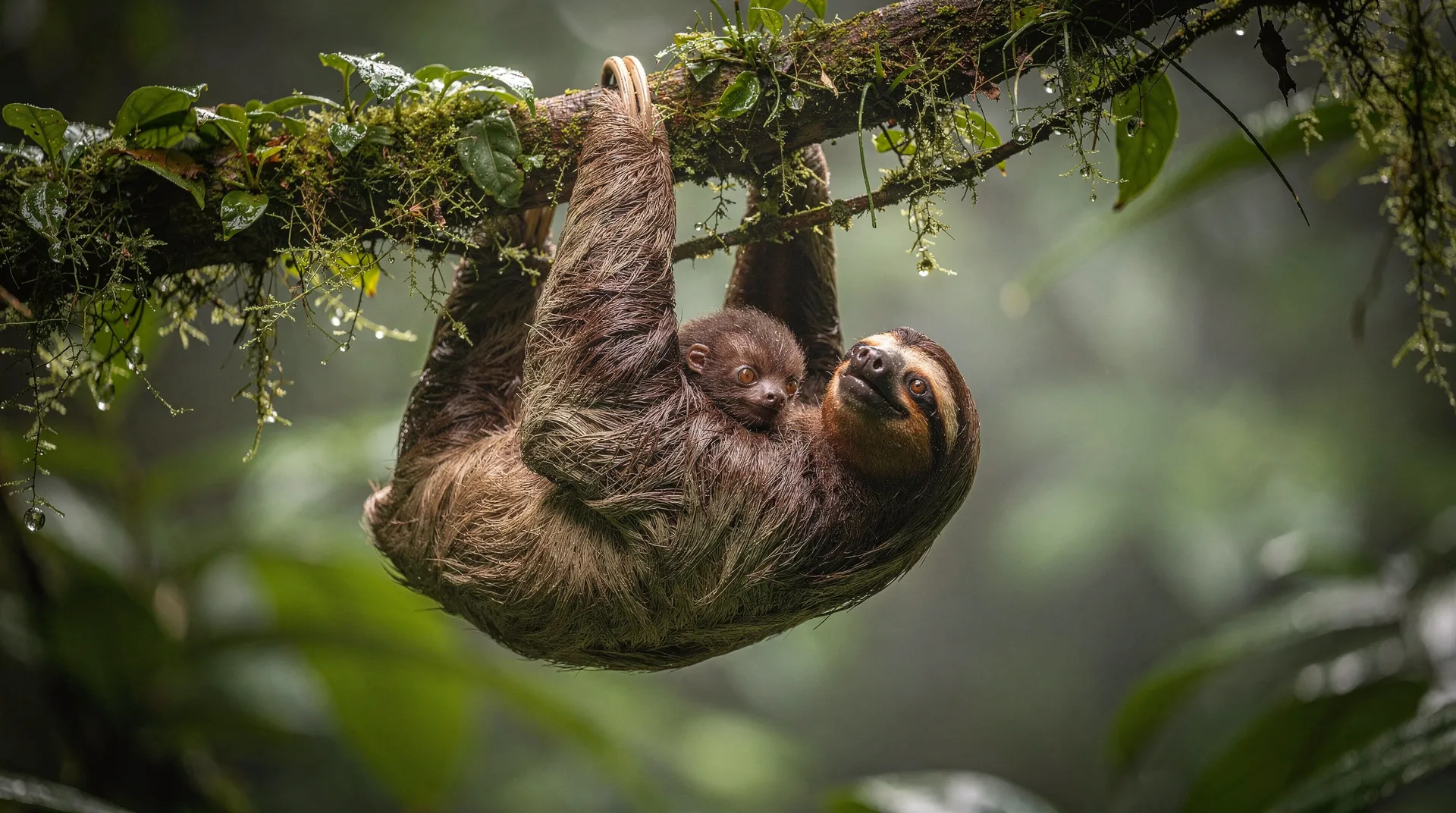
Where to see sloths in Costa Rica
Where can I reliably see sloths in Costa Rica?
Manuel Antonio National Park and Cahuita National Park offer consistent wild sightings year-round. For guaranteed close encounters, the Sloth Sanctuary near Limón and the Toucan Rescue Ranch near San José are two reputable rescue centres that welcome visitors.
| Best wild sightings | Manuel Antonio National Park, Cahuita National Park |
| Guaranteed close encounters | Sloth Sanctuary (Limón), Toucan Rescue Ranch (San José) |
| Best time of day | 6–9am for three-toed; night tours for two-toed |
| Cost | Sanctuary visits ~$30–75; guided park walks vary by tour |
| Rule #1 | Never touch or approach a wild sloth |
Costa Rica’s most beloved residents
Few encounters stop travellers dead on a trail quite like a sloth draped three metres above the path, its long claws curved around a cecropia branch, blinking slowly at the commotion below. Costa Rica has two sloth species — the three-toed sloth (Bradypus variegatus) and the two-toed sloth (Choloepus hoffmanni) — and both are surprisingly widespread once you know where and how to look.
The key word is “how.” Sloths spend up to twenty hours a day motionless in the canopy, often tucking themselves into the fork of a tree or draping a mossy arm over a branch. Their fur harbours green algae that camouflages them effectively against the dappled light of the forest. Most independent travellers walk past three or four animals without seeing a single one.
That is where a certified naturalist guide changes the equation entirely. Experienced guides spot sloths from thirty metres away because they know which trees attract them and what a motionless animal looks like against foliage. Whether you choose a wild encounter in a national park or a visit to a rescue centre, this guide covers every reliable option across the country.
The best national parks for wild sloth sightings
Manuel Antonio National Park
Manuel Antonio is the single most reliable location in the country for seeing sloths in the wild, and the main reason is the guides. The park entrance near Quepos is served by dozens of licensed naturalists who position themselves along the main trail each morning, telescopes aimed at known sloth spots. A good guide might show you four or five animals in a three-hour walk — sometimes as low as head height on a coastal almond tree.
Manuel Antonio is closed on Tuesdays. Tickets sell out, especially December through March, so book in advance through the SINAC reservation system or through a guided tour that includes the entrance. The park sits roughly three hours from San José by road along the central Pacific coast.
a guided sloth-spotting tour inside Manuel Antonio with park entrance included — from $60The park protects 683 hectares of secondary tropical forest and beaches. Three-toed sloths are particularly abundant along the main Punta Catedral trail, which loops through coastal forest to the isthmus connecting the former island to the mainland. Two-toed sloths are nocturnal and harder to spot here — most daytime encounters are with three-toed animals. Read more in the Manuel Antonio National Park guide.
A walk with a naturalist guide combines sloth-spotting with broader wildlife tracking. Capuchin monkeys, squirrel monkeys, iguanas, and dozens of bird species share the same corridor. See monkey species of Costa Rica for more on the four monkey species present.
a naturalist-guided walking tour of Manuel Antonio National Park — from $65KSTR — Kids Saving the Rainforest sanctuary
Just outside Manuel Antonio National Park, the Kids Saving the Rainforest (KSTR) wildlife rescue sanctuary rehabilitates injured and orphaned animals — including sloths, monkeys, and macaws — recovered from the central Pacific corridor. Founded in 1999 by two children who later turned the project into a fully accredited rescue, KSTR holds MINAE certification and runs visitor tours that explain rehabilitation cases and Costa Rican wildlife law. It is the most accessible sanctuary visit for travellers based on the park-road strip, and a useful pairing with a morning walk in the national park itself.
a guided visit to the KSTR wildlife sanctuary near Manuel Antonio — from $70Cahuita National Park
The Caribbean coast delivers a completely different atmosphere — reggae rhythms, coconut palm beaches, and a laid-back pace that matches sloth life perfectly. Cahuita National Park, about 45 kilometres south of Puerto Limón, has a free entry system at the Kelly Creek entrance (donations appreciated) and a nominal fee at the Puerto Vargas entrance.
Sloths are extremely common here because the park is surrounded by cacao farms and food gardens that sloths raid at dawn. The coastal trail hugging the reef is one of the most scenic sloth-watching routes in the country. Three-toed sloths often descend to ground level to cross open areas — a rare chance to observe them without craning your neck.
Read the full Cahuita National Park guide for trail maps, reef snorkelling options, and how to combine the park with the rest of the Caribbean coast.
Sloth sanctuaries and rescue centres
Sloth Sanctuary of Costa Rica — Limón province
Located in Cahuita, about 12 kilometres north of the town, the Sloth Sanctuary of Costa Rica (also known as Aviarios del Caribe) is the world’s original sloth rehabilitation centre. Founded in 1992 by Judy and Luis Arroyo, it has cared for over 1,000 sloths and currently houses hundreds of animals in various stages of rehabilitation.
Visit options include the Buttercup Tour (45 minutes, approximately $30, focuses on non-releasable ambassador sloths and the education centre) and the Canoe Adventure (2 hours, approximately $75, adds a guided river paddle through the surrounding mangroves with iguana and bird sightings). The sanctuary is clear that ambassador animals cannot be held by visitors — an ethical policy that reflects genuine rescue priorities rather than tourism pressure.
a half-day visit to the sloth and wildlife sanctuary near Cahuita — from $65Toucan Rescue Ranch — near San José
If you are arriving or departing through Juan Santamaría Airport in Alajuela, the Toucan Rescue Ranch is worth building into your schedule. It is located in the Central Valley about 40 minutes from the airport, making it a sensible first or last stop without eating into your main itinerary.
The Ranch rehabilitates over 200 species of animal including toucans, owls, coatis, porcupines, and yes — sloths. The guided tour (around $45–65 depending on the tour type) runs visitors through the facility and explains Costa Rica’s wildlife rehabilitation laws, which prohibit the keeping of wild animals as pets but make exceptions for MINAE-licensed rescue centres.
a sloth and wildlife rescue centre tour near San José — from $80Guanacaste sloth encounters
The dry north-west coast of Guanacaste is not natural sloth habitat — the dry forest and hot climate favour different species. That said, tour operators in the Liberia area have built sloth sanctuary day trips that combine a visit to a coastal rescue centre with a waterfall stop, making it possible to tick both wildlife and adventure boxes in a single excursion.
a sloth sanctuary and waterfall adventure from the Guanacaste coast — from $120Where to go: wild parks vs rescue sanctuaries
| Option | Sighting odds | Distance from close-up | Best for |
|---|---|---|---|
| Manuel Antonio NP (guided) | Very high with a guide | Often high in canopy, scope-assisted | Combining sloths with monkeys, birds |
| Cahuita NP | High | Sometimes ground-level crossings | Laid-back Caribbean pace |
| Sloth Sanctuary (Limón) | Guaranteed | Close, ambassador animals | Guaranteed encounter + rehab education |
| Toucan Rescue Ranch (San José) | Guaranteed | Close, ambassador animals | Airport-day stopover |
Wild sloth spotting tips
When to look
Three-toed sloths are active during daylight but move so slowly that most activity happens at dusk and dawn, when they shift position or descend to defecate (which they do only once a week at the base of their preferred tree). Early morning, 6–9am, is the best window — animals are transitioning positions, the light is manageable for photography, and the forest is alive with accompanying bird activity.
Two-toed sloths are almost exclusively nocturnal. Spotting them during the day means finding them sleeping — they hang upside-down from a branch, often deep in shade. Night tours in Monteverde and Arenal consistently produce two-toed sightings.
What to look for
Train your eyes to find the irregular lump rather than the animal shape. A sloth resting in a tree looks less like a mammal and more like a curved piece of bark or a bundle of hanging moss. Look for the same shape at the junction of large branches, in the shaded underside of palm crowns, and in cecropia trees — a sloth favourite.
Ethical behaviour
Never approach, touch, or attempt to move a sloth. Three-toed sloths have very slow metabolisms, and human interaction causes measurable stress. A sloth photographed by tourists who take turns holding it on a roadside is not having a good day. Book your experience through accredited operators and walk away if a guide or facility offers physical contact with wild-caught animals.
See wildlife watching ethics for a broader guide on photographing and observing Costa Rican fauna responsibly.
Where sloths are NOT worth looking for
Sloths are forest animals. You will not see them on beaches, in cities, or in scrub pasture. Some roadside operations near tourist towns keep semi-tame animals for photo opportunities — these are almost always illegally held pets, and paying to interact with them sustains the illegal wildlife trade.
Avoid any operator who cannot show a MINAE (Costa Rica’s Ministry of Environment and Energy) rescue certificate. A legitimate rescue centre will explain their rehabilitation protocols and be clear that most animals are being prepared for release.
Planning a sloth-focused itinerary
A sloth itinerary across Costa Rica’s most reliable zones follows a natural circuit: start at the Toucan Rescue Ranch near San José (day 1), spend two nights in Manuel Antonio for guided park walks (days 2–3), then travel to the Caribbean coast for Cahuita National Park and the Sloth Sanctuary (days 4–5). The drive from Manuel Antonio to Cahuita takes roughly five to six hours through San José.
If you only have one day and are based in Quepos, prioritise the morning tour at Manuel Antonio. If you are based on the Caribbean coast, combine Cahuita NP with the sanctuary in a single day — they are 12 kilometres apart.
For context on the rest of Costa Rica’s extraordinary fauna, see the Costa Rica wildlife overview and bird watching by region guides.
Frequently asked questions about sloths in Costa Rica
Is Manuel Antonio the best place to see sloths?
It is the most reliable single location for wild sightings, yes. The combination of concentrated wildlife, experienced guides at the gate, and a high density of cecropia and coastal almond trees makes it the top choice. Cahuita is a close second, with a less crowded atmosphere.
Can I see sloths without a guide?
Technically yes — they are wild animals in a national park. But practically, your chances of spotting more than one animal without a trained naturalist are slim. Guides with telescopes turn a potential thirty-second sighting into a fifteen-minute close-up observation. The guided tour cost is worth it.
What is the difference between two-toed and three-toed sloths?
Three-toed sloths (Bradypus variegatus) are active during the day, have a distinctive round face with a dark eye mask, and are more commonly seen in coastal lowland forest. Two-toed sloths (Choloepus hoffmanni) are nocturnal, slightly larger, and have a more dog-like face. Both species occur in Costa Rica, but three-toed sloths are more frequently encountered on day tours.
Are the sloths at sanctuaries wild or captive?
At legitimate rescue centres like the Sloth Sanctuary of Costa Rica and Toucan Rescue Ranch, animals are wild-born rescues — orphans, traffic victims, electrocution cases. Animals that can be released are rehabilitated and returned to the wild. Those that cannot survive independently (due to missing limbs or imprinting) become ambassadors for conservation education. They are not captive-bred for tourism.
How long do sloths live?
In the wild, three-toed sloths live approximately 20–30 years. In rescue facilities with consistent food and veterinary care, they can live longer. Buttercup, the famous sloth at the Sloth Sanctuary, has been there since 1992 and is one of the oldest known individuals.
Is it safe to drive a rental car to Manuel Antonio?
The road from San José to Quepos and Manuel Antonio is fully paved and manageable with a regular car — no 4WD needed. The drive takes about three hours. Parking inside the national park is very limited; most visitors park in Quepos and take a taxi or the local bus the final seven kilometres to the park entrance. See transport in Costa Rica for more driving context.
What else can I see on a sloth tour in Manuel Antonio?
Capuchin monkeys, squirrel monkeys (rare further north), howler monkeys, Jesus Christ lizards (basilisks), iguanas, scarlet macaws at certain times of year, dozens of bird species, and occasionally raccoons and coatis along the beach trail. The biodiversity density in Manuel Antonio is exceptional for a small park. See monkey species of Costa Rica for the full rundown.
Is it better to visit a wild park or a sanctuary if I only have time for one?
If you want the thrill of a genuinely wild encounter and don’t mind the animal being higher up or partly obscured, choose Manuel Antonio or Cahuita with a naturalist guide. If a close, guaranteed, up-close view matters more — especially with kids — a reputable rescue sanctuary like the Sloth Sanctuary or Toucan Rescue Ranch delivers that reliably, with the added value of conservation education.
Do sloths bite or pose any danger to visitors?
Sloths are not aggressive, but they do have sharp claws designed for gripping branches, and their bite (rare, defensive only) can be surprisingly strong for their size. This is part of why legitimate sanctuaries prohibit visitors from holding ambassador animals — it protects both the animal’s wellbeing and the visitor.
Related guides
Sloth sightings are just the beginning of what Costa Rica’s wildlife has to offer. The Costa Rica wildlife overview explains why the country holds six percent of the world’s biodiversity in such a small area. For the ultimate wildlife immersion, Corcovado National Park on the Osa Peninsula is the most species-rich spot in the country — see the Corcovado guide for what it takes to visit.
If photography is your priority, wildlife photography tips covers the gear and ethics for capturing Costa Rican animals without harming them. And for a full wildlife-focused route, the 14-day wildlife photography itinerary visits Tortuguero, Sarapiquí, Monteverde, San Gerardo de Dota, and Drake Bay.