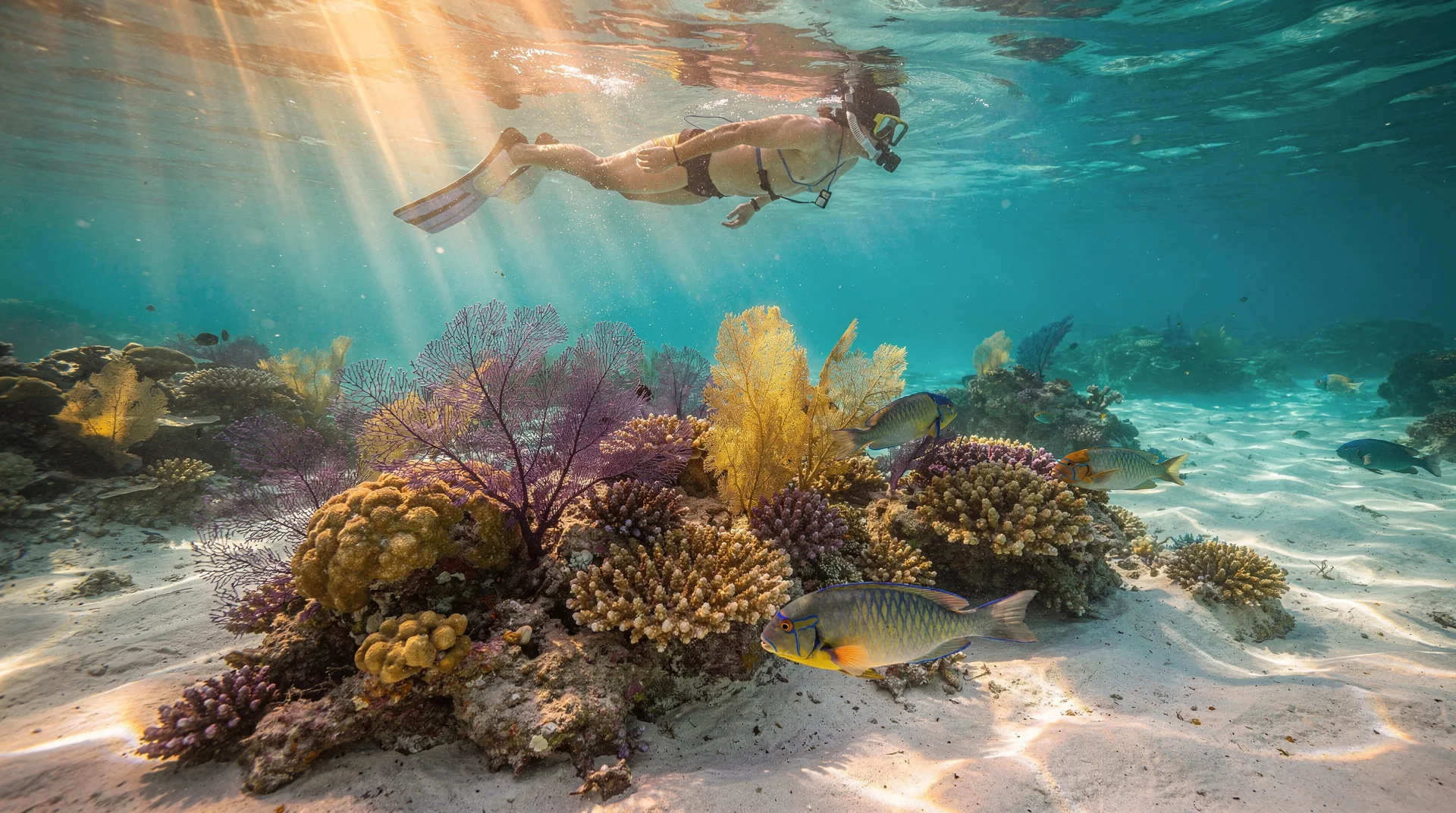
Cahuita National Park: reef snorkelling, sloths, and Caribbean shoreline
Is there an entrance fee for Cahuita National Park?
It depends on which entrance you use. The Kelly Creek entrance in Cahuita village operates on a voluntary donation basis (suggested $5–10). The Puerto Vargas entrance, 5km south, charges a fixed $5 per person entry fee. Both entrances access the same coastal trail and beach.
| Where | Cahuita village, Limón Province, Caribbean coast |
| Cost | Donation $5–10 (Kelly Creek) or $5 fixed (Puerto Vargas) |
| Time needed | 2–4 hours for the coastal trail; add 1.5–2 hrs for a boat snorkel |
| Getting there | ~4–4.5 hrs from San José by car or Mepe bus |
| Best time | September–October or January–April for reef visibility |
Caribbean reef and rainforest on one coastal trail
Cahuita National Park is the most accessible introduction to Costa Rica’s Caribbean coast. The park protects 1,067 hectares of rainforest and 600 hectares of coral reef — the largest coral reef system in Costa Rica — along a stretch of coastline that curves between the town of Cahuita and the Puerto Vargas ranger station. The main coastal trail runs 8km through the park, passing through secondary and primary forest before emerging repeatedly onto Playa Vargas, one of the most beautiful stretches of brown-sand Caribbean beach in the country.
Unlike the more remote national parks of the Osa Peninsula, Cahuita is directly accessible on foot from the town centre. You can walk from your hotel into the park within minutes, stroll the trail at your own pace with no guide required, and emerge at Puerto Vargas to catch a taxi or bus back. This accessibility makes it a favourite for travellers who want a genuine nature experience without the planning overhead of places like Corcovado.
The park sits in Limón Province, about 45km south of Puerto Limón and just 25km north of Puerto Viejo. The coastal road connecting these towns makes Cahuita an easy stop on a Caribbean itinerary, and the town itself is one of the most characterful in Costa Rica — a small Caribbean community with wooden painted houses, soda restaurants serving rice and beans cooked in coconut milk, and an Afro-Caribbean cultural heritage distinct from anywhere else in the country.
Two entrances, two fee systems
Kelly Creek entrance (town-side): Located right in the centre of Cahuita village, this entrance has a simple donation box and a ranger station staffed during daylight hours. The suggested donation is $5 to $10 — the honour system is genuine, and visitors who skip the donation are noticed by local rangers who depend on that income. The vast majority of day visitors use this entrance.
Puerto Vargas entrance (south side): Located 5km south of Cahuita village on the road to Puerto Viejo, this entrance has a fixed entry fee of $5 per person collected by a ranger. There is a campsite here (booking required through SINAC) and direct access to Playa Vargas from the parking area. Many visitors who have a car use Puerto Vargas for the snorkelling sections of the reef.
The park is open daily 6am to 5pm. Unlike Manuel Antonio, there are no advance reservations required and no daily quotas — you can simply show up.
The coral reef: snorkelling conditions and expectations
Cahuita reef was severely damaged by the 1991 earthquake that shifted the Caribbean floor and killed large sections of coral. Climate change bleaching events in 1997, 2010, and 2016 caused additional mortality. The reef is not what it was thirty years ago — be honest with yourself about expectations.
That said, the reef is recovering. Brain corals are visibly growing back. The fish diversity is excellent: you will reliably see parrotfish, sergeant majors, snapper, bar jacks, moray eels, and sea urchins. During dry season visibility (January to April), underwater conditions can be genuinely impressive. Nurse sharks rest in sandy pockets. Octopuses hide under plate coral ledges.
When to snorkel: January to April is peak visibility season when rivers run lower and marine sediment is minimal. May onwards, river runoff increases and visibility can drop significantly. September and October — Caribbean’s relative dry season — often offer a second good window.
Where to snorkel: The reef begins just offshore from Playa Cahuita (accessible from Kelly Creek) and extends along the park’s marine zone. Snorkelling from shore is possible but the best sections require a short boat ride with a licensed snorkel operator — the boat positions you over the coral heads rather than the sandy edges where visibility is lowest.
Snorkel in Cahuita National Park: explore the reef — from $60Wildlife on the coastal trail
The 8km coastal trail between Kelly Creek and Puerto Vargas is one of the most productive and enjoyable wildlife walks in Costa Rica that requires no advance booking.
Three-toed sloths are common in the Cecropia and guarumo trees along the first 2km of trail. Local guides and rangers can point them out, and after a few encounters you will develop an eye for the characteristic rounded shape in the fork of a branch.
Howler monkeys are very loud and very present. Morning visits in particular are accompanied by the territorial calls that carry through the forest canopy.
White-faced capuchin monkeys move in family groups along the trail edge and have learned that tourists carry food. Keep snacks in sealed bags and resist the temptation to feed them — they can bite when frustrated.
Two-toed and three-toed sloths both inhabit the park. The three-toed variant is diurnal and much easier to spot.
Crab-eating raccoons, white-nosed coatis, and agoutis forage along the forest floor, particularly in the early morning. The Caribbean slope also hosts species you will not find on the Pacific coast: the collared peccary and the great curassow move through the secondary forest sections.
Reptiles: Green iguanas sunbathe on branches overhanging the trail. Yellow-bellied sea snakes occasionally wash up on the beach. The highly venomous bushmaster (Lachesis muta) exists in the park but encounters are rare.
Cahuita NP: snorkeling & wildlife hike (certified guide) — from $75Guided snorkel and hike combinations
The Kelly Creek entrance rangers can recommend licensed local guides who offer combination snorkel-and-hike tours departing directly from Cahuita village. These typically include a 2 to 3 hour hike through the forest portion, then a boat ride to the reef for snorkelling, followed by beach time. Prices run $60 to $85 per person.
Hiring a local certified guide supports the community economy directly — Cahuita was one of the communities most affected by the 1991 earthquake and subsequent years of economic disruption. The local guide association (ATEC — Asociación Talamanqueña de Ecoturismo y Conservación) connects visitors with vetted community guides for hiking, snorkelling, and cultural tours.
Cahuita National Park: snorkel — from $55Best time to visit Cahuita
Cahuita’s Caribbean climate is the inverse of the Pacific coast.
September to October: The relative Caribbean dry season — often sunny while the Pacific gets drenched. Reef visibility is good, crowds minimal, and lodging in Cahuita town at low prices. Easily the best-value window.
January to April: Pacific dry season, but also good on the Caribbean — less rain than May–August, best reef visibility of the year. More tourists than September but fewer than July–August.
July to August: High season for Caribbean tourism from within Costa Rica — Ticos flock to Cahuita and Puerto Viejo during school holidays. Accommodation books out. Book ahead.
May to June and November: The wettest periods on the Caribbean side. Hiking trails can be muddy and reef visibility is at its lowest. Still workable but not optimal.
Cahuita NP guided hike with snorkel and lunch — from $85Getting to Cahuita
Cahuita is located on the Caribbean coastal road (Route 36), making it straightforward to reach.
- From San José: 4 to 4.5 hours by car or bus via the Braulio Carrillo highway. Public Mepe buses run from San José’s Gran Terminal del Caribe several times daily (~$12). Shared shuttles from San José hotels cost ~$55–65 per person.
- From Puerto Limón: 45 minutes by car or bus south along Route 36.
- From Puerto Viejo: 25km north — about 30 minutes by car or bus.
There is no domestic airport in Cahuita. The nearest airstrip is in Puerto Limón.
Where to stay in Cahuita
The town of Cahuita is small and the lodging scene is correspondingly compact but warm.
In town: El Encanto B&B (one of the best breakfasts on the Caribbean coast), Magellan Inn, Kelly Creek Hotel (right at the park entrance), and several family guesthouses at $40–80/night.
Playa Negra area (2km north of town): A series of small eco-lodges and bungalows along Playa Negra, a dramatic black-sand beach backed by coconut palms. La Piscina Suites, Playa Negra Guesthouse, and Chalet Hibiscus are reliable options at $70–130/night.
Most visitors use Cahuita as a 2-night stop on a broader Caribbean itinerary rather than a destination in itself — though the village’s pace and character often convince people to stay an extra day.
Manzanillo and Cahuita snorkeling duo tour — from $95Frequently asked questions about Cahuita National Park
Is snorkelling from the shore enough, or do I need a boat?
Shore snorkelling from Playa Cahuita gives you a taste of the reef but puts you over the sandy edges where visibility is lower and coral coverage is sparser. A short boat ride to the coral heads significantly improves the experience. A 1.5 to 2 hour guided snorkel tour is worth the additional cost if you care about the reef.
Are there sharks at Cahuita?
Nurse sharks are the most common species in the reef zone — docile bottom-dwellers that are harmless unless provoked. Bull shark encounters have been reported offshore but are not typical in the shallow reef snorkel zone.
Is the trail passable in the rainy season?
Yes, with appropriate footwear (waterproof sandals or light hiking shoes). The trail is generally flat but can be muddy. Fallen trees are cleared periodically by rangers. Even in the wettest months the trail stays open.
Can I camp in the park?
Camping is available at Puerto Vargas campsite, which has basic facilities (cold showers, toilets). Must be booked through SINAC in advance. This is a budget option that gives you sunset and sunrise on the beach — worthwhile if you enjoy camping.
Where to fit Cahuita in your itinerary
Cahuita sits naturally between Tortuguero (to the north, accessible by boat and bus) and Puerto Viejo (25km south). The 7-day Caribbean itinerary connects these three destinations in a logical sequence. For the 14-day wildlife photography trip, Cahuita’s coastal wildlife trail is a reliable daytime photography location that complements the nocturnal turtle experience at Tortuguero. See our Caribbean vs Pacific coast comparison if you are deciding between the two coasts for your visit.
Combining Cahuita with other parks and coasts
Cahuita works well as a gentler counterpart to the bigger wildlife parks. If the coastal trail whets your appetite for sloths, the guide to where to see sloths in Costa Rica compares the best places to look, and the broader wildlife overview helps you decide which other reserves deserve a place on your route. Travellers who like the idea of a quiet, no-reservation park can pair it with Tortuguero National Park for a canal-based rainforest experience, or with Manuel Antonio National Park on the Pacific side for a very different take on coast and jungle.
Reef-focused visitors should read the dedicated Cahuita reef snorkel guide and the roundup of the best snorkel beaches in Costa Rica to compare conditions. If you are still choosing your coast, the Caribbean vs Pacific beaches comparison and the list of the best Caribbean beaches put Playa Vargas and Playa Negra in context. For the town itself, the Cahuita destination page covers the village beyond the park gates, and Limón Province gives the wider regional picture.
Planning the practical side is easier with the best time to visit Costa Rica overview and the notes on wildlife watching ethics, which are worth a read before you walk a trail where monkeys and sloths share the path with visitors.
Cahuita vs Puerto Viejo: which Caribbean base to choose
Travelers deciding between Cahuita and nearby Puerto Viejo as their Caribbean base are really choosing between two different paces. Cahuita is smaller, quieter, and more centred on its national park — the town essentially exists around the Kelly Creek entrance, and evenings are subdued, with a handful of soda restaurants and an early-to-bed rhythm.
Puerto Viejo, 25km south, has more nightlife, a wider range of restaurants, surf culture around Salsa Brava, and day-trip access to the Jaguar Rescue Center and Manzanillo. Many visitors solve the dilemma by basing in Cahuita for one or two nights specifically for the national park and reef, then moving to Puerto Viejo for a livelier final stretch of the Caribbean leg — the 30-minute drive between them makes this easy to combine rather than forcing a single choice.
Practical trail tips beyond the basics
A few details make the difference between a good and a frustrating visit to the coastal trail. Go early — arriving at Kelly Creek by 7-8am not only beats the heat but coincides with peak wildlife activity, particularly for sloths and howler monkeys, which quiet down considerably by mid-morning. Bring more water than feels necessary; there are no facilities or vendors along the 8km trail between entrances, and Caribbean humidity makes dehydration sneak up faster than the flat, easy terrain suggests.
If you plan to exit at Puerto Vargas rather than doubling back, arrange transport in advance — taxis do not wait at that end of the park, and the walk back to town along the road adds an unplanned hour in full sun. Finally, insect repellent matters here even in daylight; the trail’s proximity to both forest and beach creates ideal conditions for sandflies in the late afternoon.
a sloth sanctuary tour near Cahuita — from $65