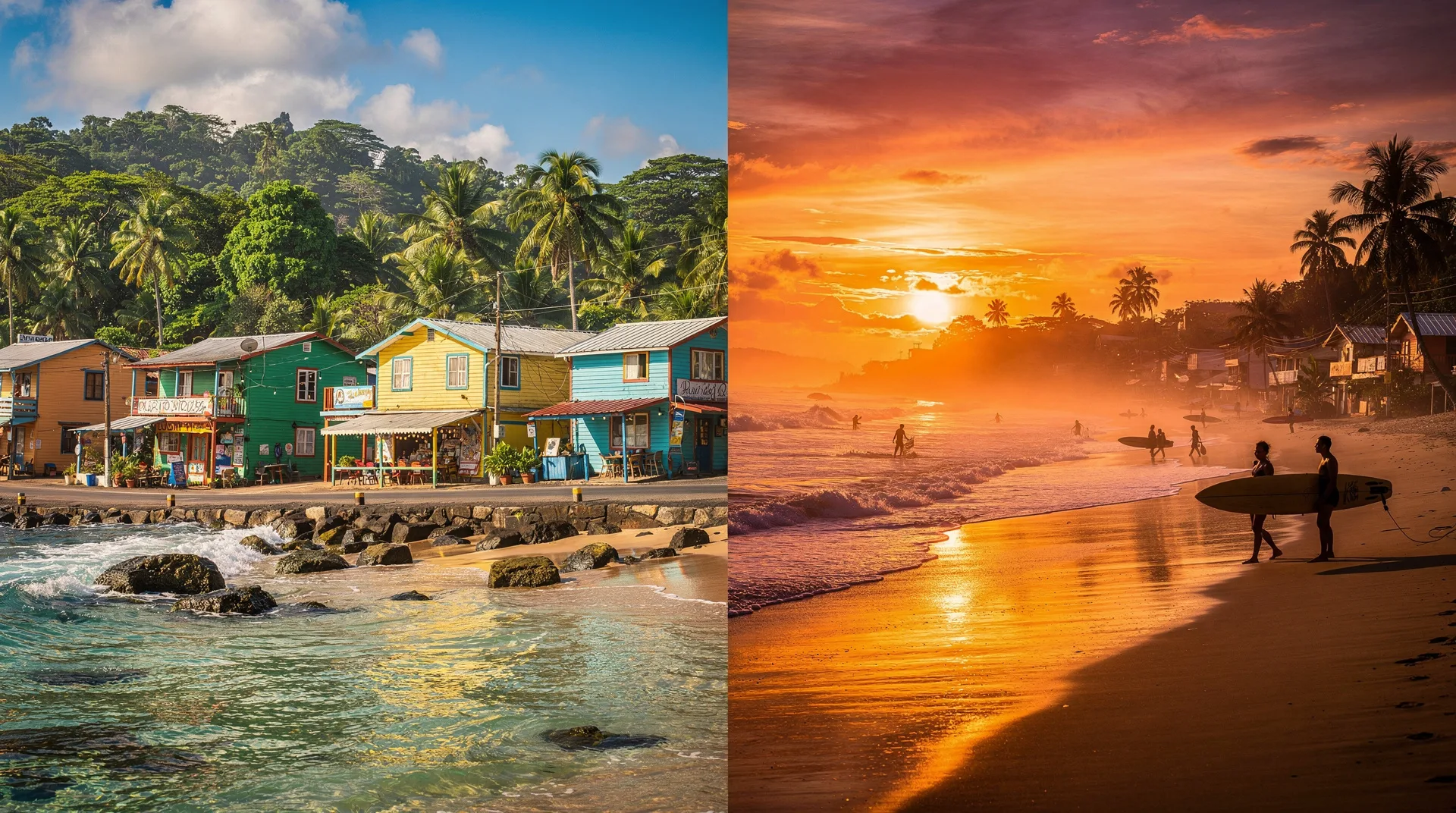
Caribbean vs Pacific coast Costa Rica: a first-timer's planning guide
First time in Costa Rica — Caribbean or Pacific?
The Pacific coast is the default for first-timers: easier logistics, reliable dry-season weather, and the most developed tourism infrastructure. The Caribbean coast rewards visitors willing to step further off the beaten path — it offers reef snorkelling, Afro-Caribbean culture, and a completely different vibe that surprises most people.
The most common planning question Costa Rica gets
“Should I go to the Pacific or the Caribbean?” This is the question asked most often by people planning their first trip to Costa Rica. It is also the question most often answered with an unhelpful “both coasts have something to offer.” This guide is not that.
The Pacific coast and Caribbean coast of Costa Rica share a country, a currency, and a president. In terms of landscape, culture, logistics, weather patterns, marine life, and the character of the places you will visit, they are as different as two coasts of the same small country can be. Getting this choice wrong does not ruin a trip, but it can produce a genuine sense of disappointment when you arrive expecting one thing and find another.
This guide gives you the practical framework to make an informed decision — not based on which coast is “better” (there is no answer to that question), but based on what your trip actually needs.
What the Pacific coast gives you
Weather you can predict
The Pacific coast operates on Costa Rica’s standard season:
- Dry season (December–April): Near-zero rainfall on the northern Pacific (Guanacaste). Clear skies, hot temperatures (30-35°C), ideal beach conditions. This is when the country fills with visitors and prices peak.
- Green season (May–November): Afternoon rain showers, lower prices, lush green landscape. The rain pattern is generally predictable — sunshine in the morning, rain in the afternoon or evening — which allows morning beach and tour activities.
If you are visiting in January, February, March, or April and want guaranteed beach weather, the Pacific coast — specifically Guanacaste or Manuel Antonio — delivers it reliably.
Logistics that work
The Pacific coast is built for tourism. Liberia International Airport (LIR) serves most major US cities, Toronto, and some European connections directly. From the airport to Tamarindo is 1 hour by transfer; to Nosara or Sámara is 2 hours; to Playa Flamingo or Conchal is 1.5 hours. Most major beaches have paved roads.
San José International Airport (SJO) serves the central and southern Pacific. From SJO to Manuel Antonio (Quepos) is 3 hours by shuttle; to Jacó is 1.5 hours.
What’s on offer
- Surf (Tamarindo, Nosara, Santa Teresa, Pavones): the most developed surf infrastructure in Central America.
- Resort beaches with calm swimming: Conchal, Hermosa Guanacaste, Sámara, Manuel Antonio.
- Whale watching: Marino Ballena National Park (Uvita) hosts humpback whale populations August–October and December–April.
- National parks: Manuel Antonio, Corcovado, Carara, Marino Ballena, Palo Verde, Santa Rosa, Rincón de la Vieja.
- Yoga and wellness: Nosara and Santa Teresa are internationally recognized wellness destinations.
- Luxury resorts: Four Seasons Papagayo, Andaz, Nantipa, Lapa Rios.
What the Caribbean coast gives you
A genuinely different culture
The Caribbean coast of Costa Rica — specifically the Talamanca region from Limón south to the Panamanian border — is culturally distinct from the rest of the country. The communities here are Afro-Caribbean in origin, descendants of Jamaican workers who built the Atlantic railroad and worked the banana plantations in the late 19th century. English and Creole coexist with Spanish. The food is coconut-based: Caribbean rice and beans (not gallo pinto), jerk chicken, rondon fish stew, breadfruit. Reggae and dancehall play from the bars. Bob Marley murals outnumber tico football ones.
This is not a subtle difference. Puerto Viejo de Talamanca, the main tourist hub on the Caribbean coast, feels more like Jamaica than it does like Tamarindo. Cahuita feels like a Caribbean village. Manzanillo at the end of the road feels like the edge of the world.
For visitors who find the internationalised Pacific coast tourist infrastructure generic, the Caribbean coast is an antidote. It has not been sanitised in the same way.
Reef snorkelling from the beach
This is the Caribbean coast’s decisive practical advantage for a specific type of traveler.
Cahuita National Park contains the most accessible coral reef in Costa Rica — snorkellers can enter the water directly from the park beach (Playa Blanca) and be over living reef within minutes. The reef has suffered coral bleaching events but is reviving and supports a vivid community of reef fish, hawksbill turtles, and occasional rays. Further south, Punta Uva and the Gandoca-Manzanillo National Wildlife Refuge have equally accessible and healthier reef sections.
Snorkel in Cahuita National Park: explore the reef — from $60This does not exist on the Pacific coast. Pacific shore snorkelling is poor — the water is more turbid and there are no fringing reefs. To snorkel on the Pacific you need a boat trip to Caño Island (from Uvita or Drake Bay, approximately $100-140) or the Catalinas Islands (from Tamarindo or Coco, approximately $80-120). Both are excellent, but they require tour bookings and significantly more cost.
If independent reef snorkelling from a beach matters to you — especially with children, or on a budget — go to the Caribbean.
A reversed season
The Caribbean coast’s weather does not follow the Pacific pattern. Understanding this is critical for planning.
- December–March: Often the Caribbean’s wettest period.
- February–April: A partial dry window — the best general Caribbean beach weather.
- June–August: Mixed — showers but also sunny periods.
- September–October: The Caribbean’s best-kept secret. This is the relative dry season on the Caribbean coast, coinciding with the wettest period on the Pacific. If you are visiting in October, the Caribbean is dramatically better than anywhere on the Pacific.
This reversed season makes the Caribbean coast the logical choice for visitors traveling in October, the most affordable month in Costa Rica.
Direct comparison by factor
| Factor | Pacific Coast | Caribbean Coast |
|---|---|---|
| Weather predictability | High (dry season Dec–Apr) | Lower (reversed season) |
| Best dry season | Dec–Apr | Feb–Apr, Sep–Oct |
| International airport | LIR (Guanacaste), SJO | SJO only — then 4-5h drive |
| Road access | Good to excellent | Good to reasonable (coastal road slower) |
| Accommodation range | Full (budget to ultra-luxury) | Budget to mid-range; limited luxury |
| Average meal cost | $15-30 (restaurants) | $8-18 (Caribbean sodas cheaper) |
| Reef snorkelling from shore | No | Yes (Cahuita, Punta Uva) |
| Surf | Excellent (Pacific dominant) | Limited (Playa Negra, Nov–Mar only) |
| Whale watching | Yes (Uvita — outstanding) | No established season |
| Cultural distinctiveness | International / Tico | Afro-Caribbean (unique) |
| Crowds | Higher | Lower |
| Safety | Good | Requires more attention (petty theft Puerto Viejo) |
| Best for families | Pacific (calm resort beaches) | Caribbean (if snorkelling prioritized) |
| Budget travelers | Both good | Caribbean slightly cheaper |
The wildlife difference
Both coasts offer excellent wildlife, but different species in different contexts.
Pacific coast wildlife strengths:
- Humpback whales at Marino Ballena (Uvita) — two seasonal populations.
- Scarlet macaws at Carara National Park and Manuel Antonio.
- Sea turtles nesting at Playa Grande (Las Baulas leatherbacks, October–February) and Ostional (olive ridley arribadas, August–December).
- Comprehensive national park network with easy guided access.
Caribbean coast wildlife strengths:
- Sloths — three-toed sloths are abundant at Cahuita, Puerto Viejo, and in the forest-edge habitat of the coast.
- Howler monkeys — audible and visible throughout the coast.
- Hawksbill turtles — seen while snorkelling on the reef or during nesting (September–October).
- Green sea turtles nesting at Tortuguero (July–October) — the most important green turtle nesting site in the Western Hemisphere. Tortuguero National Park is accessible from the Caribbean coast via boat and canal, though it requires a dedicated 2-night trip.
For the complete sea turtle nesting experience, Tortuguero National Park on the Caribbean north coast is unmatched in Costa Rica. See the Tortuguero turtle nesting guide and the 7-day quick Caribbean itinerary for how to structure a dedicated Caribbean wildlife trip.
Getting to the Caribbean coast: realistic logistics
The Caribbean coast requires a realistic assessment of logistics from most international gateways.
From San José (SJO), the drive to Puerto Viejo de Talamanca is 4-5 hours by car or shuttle. The road to Limón is now highway quality; the coastal road from Limón south to Cahuita and Puerto Viejo is well-maintained but slower, with speed bumps through every village. Bus service from San José to Puerto Viejo operates multiple times daily (approximately $8-12, 5-6 hours). Interbus and Caribe Shuttle offer private shuttle services ($55-70, 4 hours).
There is no international airport on the Caribbean coast. All travelers arrive via SJO. This means that Caribbean coast trips effectively require flying into San José and spending either the first or last night there — or doing an airport-hotel-shuttle sequence.
From Guanacaste (LIR), reaching the Caribbean coast requires driving across the entire country — 5-6 hours via San José. This is not practical as a same-trip addition unless you are driving the full country circuit.
First-timer scenarios: which coast to choose
You are visiting in January for 7 days, flying into Liberia
Pacific coast. Specifically, northern Guanacaste. The combination of LIR direct access and January dry-season perfection means the Pacific coast is the obvious choice. Spend 4-5 nights on the Nicoya Peninsula or northern Guanacaste and add Rincón de la Vieja for 2 nights.
You are visiting in October for 10 days
Caribbean coast, definitely. October is the wettest month on the Pacific; the Caribbean coast’s September-October dry window makes it dramatically more appealing. A 10-day trip combining Tortuguero (sea turtle nesting) with Cahuita and Puerto Viejo, with Arenal at the start or end, is the optimal October structure.
You are visiting in March for 14 days with your family
Both coasts, starting Pacific. A 14-day trip has room for both. Classic approach: La Fortuna (Arenal, 3 nights) → Manuel Antonio (3 nights) → Uvita (2 nights) → back to SJO → Puerto Viejo (3 nights) → Cahuita (1 night) → SJO. This requires either a rented car or a combination of shuttles. The 14-day Caribbean and Pacific combined circuit covers this structure in detail.
You want to snorkel from a beach
Caribbean coast. No qualification needed. Cahuita’s National Park reef is within walking distance of the park entrance. Punta Uva is quieter and equally accessible. The quality of shore snorkelling on the Pacific coast cannot match it.
You want surf lessons
Pacific coast. Tamarindo is the best place in Costa Rica to learn to surf — gentle reform waves, dozens of certified schools, and consistent year-round conditions. The Caribbean has limited surf (Playa Negra near Puerto Viejo, November–March in northern swells) but nothing comparable to Tamarindo or Nosara for learning.
The honest trade-off
The Pacific coast gives you predictability, ease, and a mature tourism infrastructure that removes friction from a first trip. The Caribbean coast gives you authenticity, better snorkelling access, cheaper prices, and the surprise of a culturally distinct experience that most visitors describe as the most memorable part of their trip.
The Pacific is the better choice for families with young children who need reliable logistics and calm swimming. The Caribbean is the better choice for independent travelers who find conventional beach resorts unremarkable and want something genuinely different.
Most people visiting Costa Rica for the first time go to the Pacific. Most people visiting for the second time include the Caribbean. This says something about how the Caribbean coast works on visitors — it typically exceeds expectations in a way the Pacific, excellent as it is, has been thoroughly documented.
Frequently asked questions about Caribbean vs Pacific coast Costa Rica
How long do I need on the Caribbean coast?
A minimum of 4-5 nights to actually experience the Caribbean coast rather than just transit through it. Puerto Viejo and Cahuita each merit 2-3 nights. Tortuguero as an add-on requires 2 dedicated nights (boat access, no road access). If you want to combine Tortuguero with Puerto Viejo and Cahuita, budget at least 7 nights on the Caribbean.
Is the Caribbean coast safe for solo travelers?
Puerto Viejo has a higher petty crime rate than most Costa Rica tourist areas. The main risks are bag snatching on bikes or scooters and theft from unlocked accommodation. Solo travelers should: not walk the road between Puerto Viejo and Cahuita at night (take a taxi for the 13 km), use hotel safes consistently, and maintain higher general awareness than in, say, Manuel Antonio or Nosara. It is not dangerous in a serious sense but requires more attention.
Can I visit both coasts without a car?
Yes, with planning. Shuttle services (Interbus, Caribe Shuttle, GrayLine) cover the main Pacific coast destinations. Caribe Shuttle specifically specializes in Caribbean coast connections. Bus service from San José to Puerto Viejo is reliable and cheap. The main challenge is transferring between coasts — it always goes through San José.
Which coast has better food?
Different types of food. The Caribbean has more distinctive culinary identity — coconut-based rice and beans, jerk chicken, breadfruit, fresh fish with Caribbean herbs — that is genuinely unlike anything on the Pacific. The Pacific has more high-end restaurant options (Nosara, Santa Teresa, Quepos). Budget eating is cheaper on the Caribbean. Overall culinary culture is more interesting on the Caribbean for food-focused travelers.
What should I prioritize if I only have 5 days?
Choose one coast and focus on it. Five days split between Pacific and Caribbean means spending two of your five days in transit. Better to do 5 days of Pacific (Arenal + Manuel Antonio is the classic circuit, 3h between them) or 5 days of Caribbean (Tortuguero 2 nights + Puerto Viejo/Cahuita 3 nights). See our 7-day Arenal-Manuel Antonio itinerary or 7-day Caribbean itinerary.
Practical costs on each coast
Understanding the real cost difference helps with planning the overall trip budget.
Pacific coast costs (mid-range daily estimate per person):
- Accommodation: $60-100 (shared double room, mid-range hotel)
- Meals: $25-45 (mix of restaurants and local sodas)
- Activities: $60-120 (guided tour or park entry + activity)
- Transport: $20-40 (shuttle or rental car share)
- Total: $165-305/person/day
Caribbean coast costs (mid-range daily estimate per person):
- Accommodation: $45-80 (shared double room, mid-range guesthouse)
- Meals: $18-30 (Caribbean sodas, local restaurants notably cheaper)
- Activities: $40-80 (snorkel tours, park entry, night walks)
- Transport: $15-25 (taxi, bus, or shuttle share)
- Total: $118-215/person/day
The Caribbean coast is meaningfully cheaper — roughly 25-35% less per day at mid-range. This makes a significant difference on a 14-day trip: a couple could save $700-1,400 total by choosing Caribbean over Pacific at similar quality levels.
Budget travelers find the Caribbean even more favourable: hostel dormitories in Puerto Viejo run $15-22/night, and a full Caribbean meal at a local soda costs $7-12.
What returning visitors do differently
A useful signal for first-timers: repeat visitors to Costa Rica overwhelmingly gravitate toward the Caribbean coast on their second or third trip, even when their first trip was Pacific-only and they loved it. This isn’t because the Pacific disappoints — it’s because the Caribbean’s cultural distinctiveness and lower cost reward a bit more travel experience and a slightly higher tolerance for imperfect logistics. If you’re a first-timer reading this and torn, that pattern is a reasonable tiebreaker: default to the Pacific for an easier first trip, and treat the Caribbean as the upgrade you save for next time rather than something to rush through on day one.
Start your planning
For detailed destination guides, begin with Puerto Viejo and Cahuita for the Caribbean, or Tamarindo and Manuel Antonio for the Pacific. For the beach comparison specifically, our Caribbean vs Pacific beaches guide goes deeper on the beach-by-beach specifics. For the complete wildlife picture, the best snorkel beaches guide covers Cahuita reef in full detail. For a combined route covering both coasts, see the 14-day Caribbean and Pacific circuit.