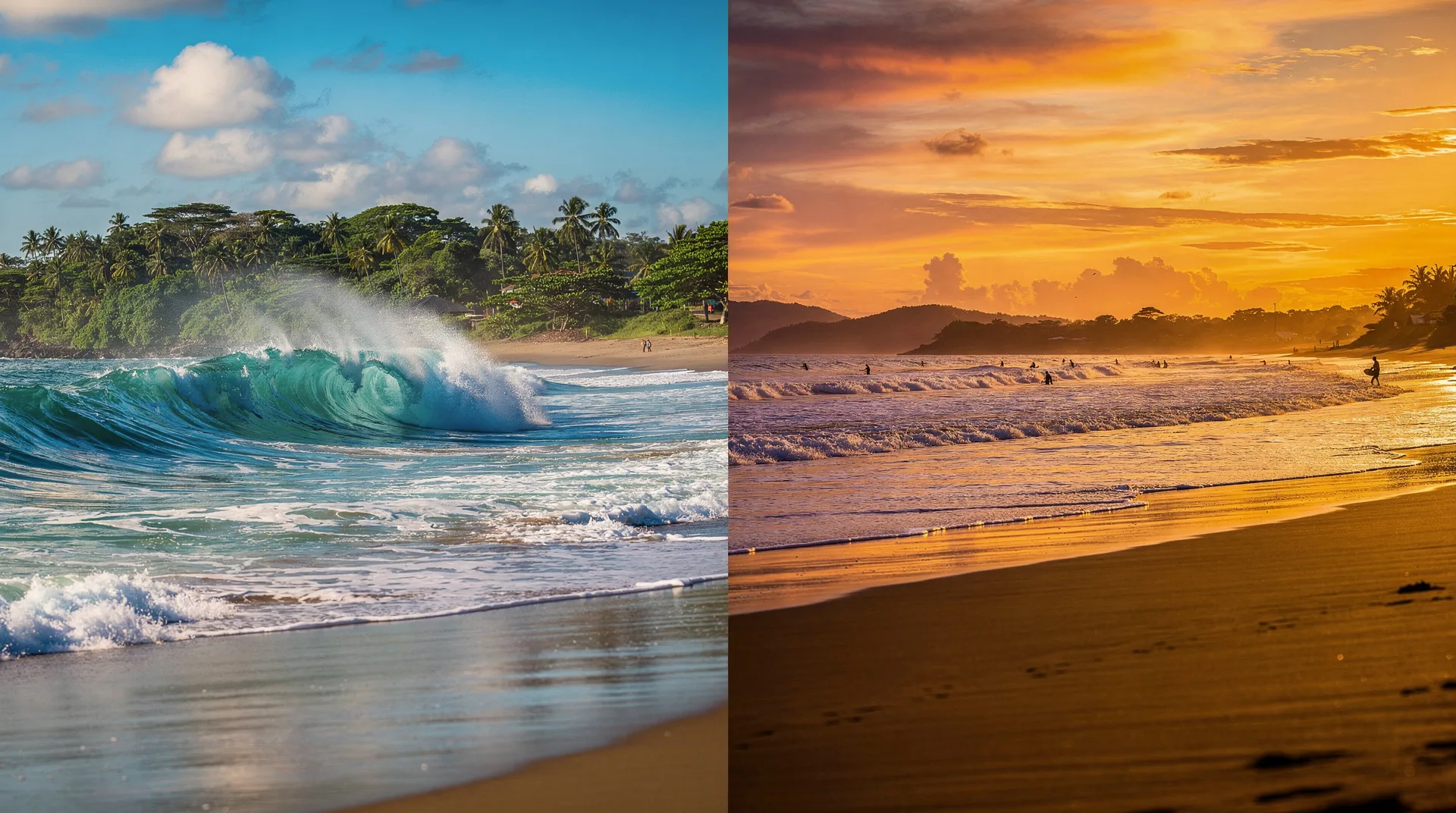
Caribbean vs Pacific beaches Costa Rica: which coast for your trip?
Which coast for which trip?
Pacific = sunsets + variety; Caribbean = reggae + reefs.
The fundamental difference between the two coasts
Most visitors to Costa Rica go to the Pacific coast. This is rational: the Pacific has more beaches, more resorts, better surf infrastructure, more direct flight access, and the famous sunsets. But the Caribbean coast offers something the Pacific cannot: a completely different cultural and ecological experience that shares almost nothing with the resort Guanacaste that most people associate with Costa Rica beach travel.
Understanding the difference saves you from making a choice you will regret. Some travellers arrive on the Caribbean coast expecting the calm, clear resort beaches of Tamarindo and are surprised by rougher water, reggae rather than vallenato, and fish and chips with Caribbean seasoning rather than ceviche. Others arrive on the Pacific coast hoping for authentic local culture and intact reef, and find instead a thoroughly internationalised tourist infrastructure.
This guide is a direct comparison across the factors that actually determine whether you will love your beach trip: weather, water, culture, cost, wildlife, and logistics.
At a glance
| Pacific coast | Caribbean coast | |
|---|---|---|
| Best season | Dec-Apr (dry season) | Sep-Oct + Feb-Apr |
| Worst season | Sep-Nov (heavy rains) | Dec-Mar (wettest period) |
| Sunsets over water | Yes — iconic | No (faces east) |
| Shore snorkelling | Poor (low visibility) | Excellent (Cahuita, Punta Uva) |
| Surf quality | Excellent (Tamarindo, Nosara, Santa Teresa) | Limited (Playa Negra area) |
| Cultural character | Latino Tico + international resort | Afro-Caribbean, Creole, reggae |
| Budget (mid-range hotel) | $90-160/night | $70-100/night |
| Airport access | LIR (Guanacaste) or SJO | SJO only (4-5 h to Puerto Viejo) |
| Best for | Resorts, surf, whale watching, sunsets | Reef, culture, budget travel, Oct visits |
Weather: the seasons run opposite on each coast
This is the single most important practical consideration for planning.
Pacific coast operates on the standard Costa Rica season:
- Dry season (December through April): sunny, little rain, best beach conditions, highest prices.
- Green season (May through November): afternoon rains, surf swells, lower prices, lush scenery.
Caribbean coast operates on an almost reversed pattern:
- December through March: this is when the Caribbean is often wettest.
- February through April: a partial dry window, the best Caribbean beach weather.
- September through October: a distinct dry window on the Caribbean coast that coincides with the wettest period on the Pacific. This is the Caribbean’s best-kept secret.
- June through August: relatively mixed, with showers but also sunny periods.
Practical implication: If you are visiting Costa Rica in October — generally considered “off-season” on the Pacific — the Caribbean coast is often at its best. The reverse is true: if you visit in February during the Pacific dry season, the Caribbean may be having its wettest period.
This is why serious Costa Rica planners check regional weather forecasts by coast, not just country-wide.
Beach character
Pacific:
- Wider range of beach types: from the grey volcanic sand of Jacó to the crushed-shell white of Conchal to the expansive open beaches of Dominical.
- Pacific sunsets are one of Costa Rica’s signature experiences — the sun drops into the ocean and the sky goes orange, pink, and red. This does not happen on the Caribbean coast, which faces east.
- Waves are generally higher energy, creating better surf but more riptide risk.
- The most developed resort infrastructure in the country is on the Pacific.
Caribbean:
- Warmer, more tropical feel — coconut palms, jungle to the water’s edge, Afro-Caribbean architecture.
- The beaches tend toward pale gold and dark gold sand, backed by vegetation that is denser and greener than on the dry Pacific coast.
- Water is calmer and often clearer for snorkelling (particularly in sheltered bays like Punta Uva and Cahuita).
- No resort infrastructure comparable to Papagayo or Playa Conchal — the Caribbean remains predominantly small-scale and locally owned.
Culture
The Caribbean coast of Costa Rica (specifically the Talamanca region from Cahuita to the Panamanian border) is Afro-Caribbean in culture. The communities here are descendants of Jamaican workers who came to build the railroad and work the banana plantations in the 19th century. English, Creole, and Spanish coexist. The food is coconut-based rice and beans (not gallo pinto), Caribbean jerk chicken, breadfruit, and ackee. Reggae and dancehall play from the bars. The culture feels more Caribbean island than Latin America.
The Pacific coast is primarily Latino Tico culture, increasingly mixed with North American and European expat influence. Spanish is universal. The food leans toward gallo pinto, casados, and ceviche. The cultural texture varies: Guanacaste has Sabanero (cowboy) heritage; Quepos has Tico fishing culture; Tamarindo has become a fairly generic international beach town.
Snorkel in Cahuita National Park: explore the reef — from $60If cultural immersion in a genuinely distinct community matters to you, the Caribbean coast offers something more unexpected and more textured than the Pacific.
Snorkelling and marine life
This is where the Caribbean coast wins decisively for shore access.
Caribbean: Fringing reefs at Cahuita, Punta Uva, and Manzanillo are accessible directly from the beach. The reef at Cahuita National Park is the most accessible coral reef in Costa Rica. Water clarity is higher in the calm season. Hawksbill turtles are regularly sighted from shore. See the best snorkel beaches guide for full detail.
Pacific: Shore snorkelling is poor — lower visibility, absence of accessible fringing reefs. The best Pacific snorkelling requires a boat to Caño Island (from Uvita or Drake Bay) or the Catalinas Islands (from Tamarindo). These are excellent experiences but they require a day tour commitment and $100-150 per person.
Tamarindo: horseback to Conchal Beach — from $70If you want to snorkel from a beach independently, go to the Caribbean. If you want the highest-quality snorkel experience money can buy (clear water, diverse pelagic life), book a Caño Island or Catalinas boat tour from the Pacific.
Whale watching and large marine life
Pacific wins clearly. Humpback whale watching at Marino Ballena National Park (Uvita) is one of the premier wildlife experiences in Central America — two distinct populations visit, one from August through October, one from December through April. See the Uvita whale watching guide for full detail.
The Caribbean coast does not have established whale watching. The Gulf of Mexico humpback populations are too far north, and Caribbean whale activity near the Talamanca coast is sporadic.
Surf
Pacific wins. The Pacific coast has the most consistent, varied, and internationally recognised surf in Costa Rica — Tamarindo, Nosara, Santa Teresa, Pavones, Witch’s Rock. The Caribbean coast has surf (Playa Negra near Puerto Viejo, and sections of the coast near Limón work in northern swells from November to March) but the infrastructure, surf camp scene, and overall consistency are vastly inferior.
Getting there: logistics
Pacific coast is easier to access. Liberia airport (LIR) serves northern Guanacaste directly from multiple US and Canadian gateways. San José airport (SJO) is 3 hours from Manuel Antonio and 1 hour from San José. Most Pacific beaches have good paved road access.
Caribbean coast is accessed via San José (4-5 hours by car or bus to Puerto Viejo). There is no international airport. The highway to Limón has improved significantly since 2022 but the final 50 km of coastal road to Cahuita and Puerto Viejo requires attention (speed bumps, sections of narrow road). Buses from San José operate multiple times daily and are reliable.
Puerto Viejo Limón: best canopy tour / ziplines — from $70Cost comparison
Pacific coast ranges from budget (Jacó hostels at $20-30/night) to ultra-luxury (Four Seasons Papagayo at $800+/night). The mid-range at $90-160/night is well-served by quality hotels at Nosara, Santa Teresa, and Manuel Antonio.
Caribbean coast is generally cheaper. Puerto Viejo and Cahuita have budget accommodation ($30-60/night guesthouses), mid-range options ($70-100), and a few eco-luxe properties (Almonds and Corals, Playa Cativo Lodge) at the high end. Restaurants are cheaper than on the Pacific — a full meal at a Caribbean soda runs $6-10.
Summary: which coast to choose
Choose the Pacific if:
- You want resort infrastructure and a wide beach facility choice.
- Surfing is a priority.
- You want whale watching.
- You prefer reliable dry-season weather (December-April) and are visiting in that window.
- Sunsets matter to you.
- You are flying into Liberia (LIR).
Choose the Caribbean if:
- You want shore snorkelling from a beach.
- Cultural authenticity and Afro-Caribbean character appeal to you.
- You are visiting in September-October (the Caribbean’s best window).
- Budget is a constraint — the Caribbean is meaningfully cheaper.
- You want a less touristy experience.
Choose both (on a 10-14 day trip): The most rewarding Costa Rica trips combine both coasts. The classic route from San José takes visitors to La Fortuna and Monteverde first, then a choice of coast — Pacific (Manuel Antonio or Guanacaste) or Caribbean (Tortuguero and Puerto Viejo) — before returning. See the 14-day combined circuit for a route that covers both.
Frequently asked questions about coast comparison
Can I do both coasts in one week?
Technically yes, practically poorly. San José to Manuel Antonio (Pacific) and back to San José to Puerto Viejo (Caribbean) in seven days is possible by car, but you spend a significant portion of the week driving rather than relaxing. A week is better spent on one coast. See the 7-day Caribbean itinerary or 7-day Arenal-Manuel Antonio itinerary for focused one-week options.
Which coast has better food?
Subjective, but the Caribbean coast has a more distinctive culinary identity — the coconut-based rice and beans, jerk seasoning, and freshly caught fish prepared with Caribbean herbs are genuinely different from anything on the Pacific. The Pacific has better high-end restaurant options (particularly at Nosara, Santa Teresa, and Quepos) but less unique character.
Is the Caribbean coast safe for solo travellers?
Puerto Viejo has a higher petty crime rate than most Costa Rica destinations. Solo travellers should take standard precautions: do not walk the road between Puerto Viejo and Cahuita at night (use a taxi for the 13 km stretch), secure valuables in a hotel safe, and keep awareness levels higher than in more settled tourist areas. It is not dangerous in a serious sense, but it requires more attention than, say, Nosara.
Which coast is better for wildlife?
Different wildlife, not a quality ranking. The Caribbean coast is unbeatable for sloths (Cahuita, Playa Manzanillo), howler monkeys (everywhere), and reef life (hawksbill turtles, reef fish). The Pacific coast is better for humpback whales (Uvita), sea turtles nesting (Tortuguero, Playa Grande), quetzals (San Gerardo de Dota), and scarlet macaws (Carara, Manuel Antonio). A combined trip covers more of the full spectrum.
Road-trip logistics if you want a taste of both
Some travellers don’t want to choose — they want a sample of both coasts inside one trip without the full 10-14 day commitment. The realistic version of this is a short Pacific stint (Manuel Antonio or Jacó, 2-3 nights) bookended by a Caribbean stint (Puerto Viejo or Cahuita, 2-3 nights), connected via San José with a night there to break up the drive. Doing this in under 8 days means one coast will feel rushed; budget at least 9-10 days if a genuine two-coast sampler matters to you, and check the 7-day Caribbean itinerary or 7-day Arenal-Manuel Antonio itinerary if a full week is all you have and you’d rather commit to one coast properly.
Where to start planning
For full detail on Pacific beaches, see best Pacific beaches and the Guanacaste beach guide. For Caribbean beaches, see best Caribbean beaches and best snorkel beaches. For the trip planning comparison guide, see Caribbean vs Pacific coast trip.