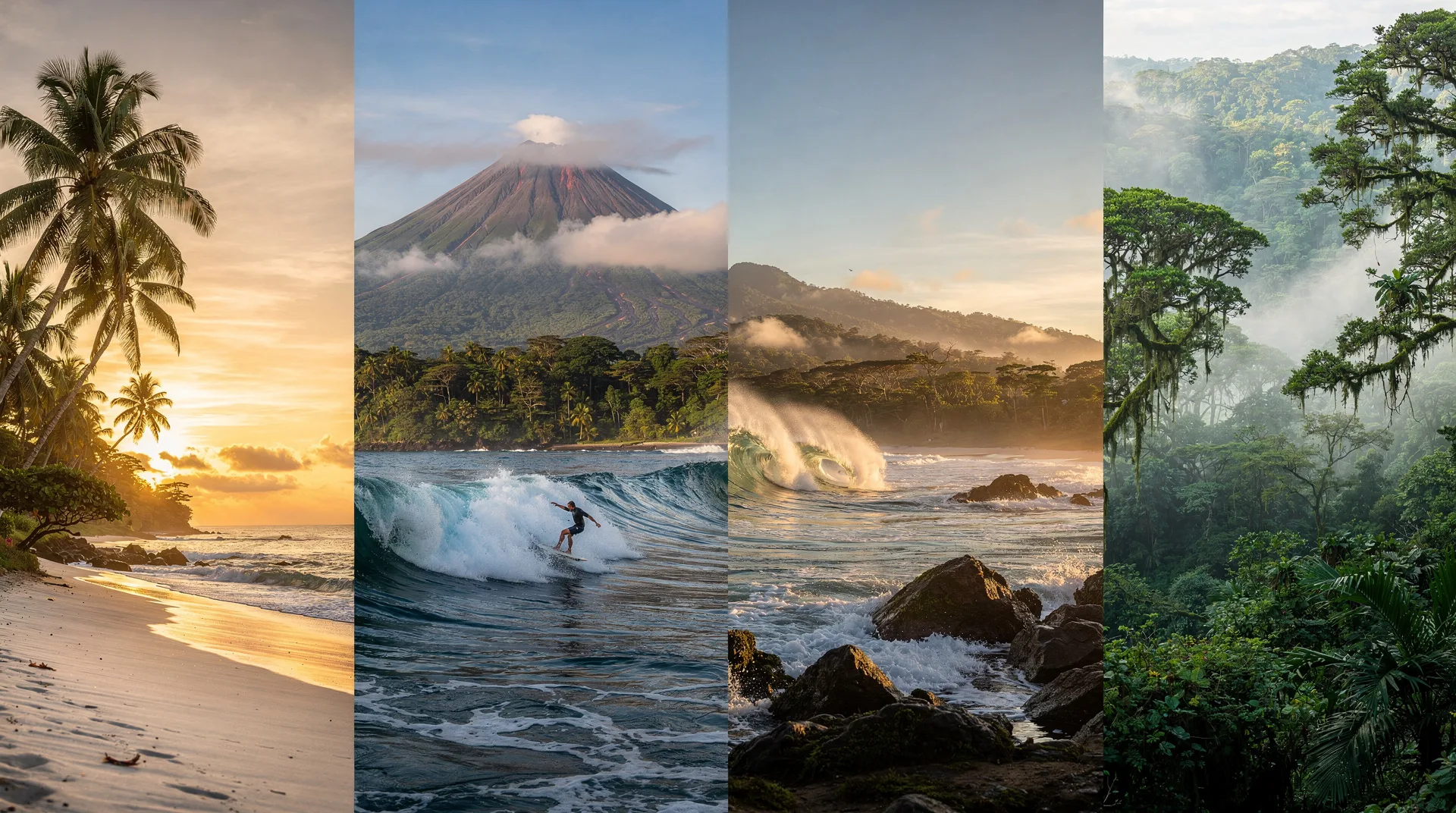
2 weeks in Costa Rica: Caribbean, Pacific, and volcanoes complete loop
Why two weeks unlocks a different Costa Rica
Seven or ten days in Costa Rica is enough to see one coast and one ecosystem. Two weeks lets you see both coasts and several ecosystems — and the contrast is what makes this country remarkable. The Pacific and the Caribbean are not just different in appearance; they have different cultures, different food, different rhythms, and completely different microclimates.
This 14-day loop starts and ends in San José, covering Arenal’s volcanoes and hot springs, Monteverde’s cloud forest, Uvita’s whale sanctuary on the southern Pacific, and finally Puerto Viejo and Cahuita on the Caribbean — where the reggae plays, the coral reef survives, and the food has coconut in everything.
No other two-week route gives you this breadth. It suits first-time visitors wanting a comprehensive introduction, and it also works for travelers returning to Costa Rica who want to finally see the Caribbean coast.
At a glance
| Stat | Value |
|---|---|
| Total days | 14 |
| Best for | All profiles — adaptable for families, couples, solo travelers |
| With/without car | Yes — 4WD strongly recommended (Caribbean road conditions) |
| Budget range | USD 160–320 per person per day, excluding flights |
| Best season | January–March (Pacific dry + Caribbean manageable); September–October (Caribbean dry window) |
| Total drive time | ~22 hours spread across 14 days |
Day-by-day breakdown
Day 1: San José arrival
Land at SJO and take the first day at a relaxed pace. San José is a transit hub rather than a major draw, but the Escalante neighborhood has excellent restaurants, and the National Museum and Pre-Columbian Gold Museum are both worthwhile half-day stops.
Stay in Escalante or Barrio Amón (both safe, walkable, well-reviewed hotel zones). Hotel Presidente is central and reliable at $90–120/night. Kap’s Place hostel is a well-run budget option at $25–45/night.
Days 2–4: La Fortuna and Arenal
Drive north to La Fortuna — 3 hours from San José via Naranjo. Pick up your 4WD rental car at the airport before departing.
Three days in the Arenal area allows a proper pace: one day for the Místico hanging bridges and hot springs, one day for a day trip to Río Celeste (Tenorio National Park, 2 hours away — the electric-blue waterfall is one of Costa Rica’s most surreal landscapes), and one day for a canyoning adventure or kayaking on Lake Arenal.
La Fortuna: Místico Arenal hanging bridges admission ticket — from $26 gives self-guided access to 16 bridges through primary rainforest. Arrive at 6 AM for best wildlife activity.
La Fortuna: waterfall, Arenal Volcano and hot springs tour — from $95 bundles the La Fortuna Waterfall, volcano views, and hot springs into a full guided day — efficient and well-reviewed.
For hot springs, Tabacón Grand Spa (from $75/day pass) is the gold standard. Eco Termales ($45) is quieter and more atmospheric. Budget option: the natural thermal river near the Río Chollín bridge — free, informal, good if the current is calm.
Stay: Arenal Manoa Hotel (mid-range, $95–130/night) or Nayara Springs (luxury, from $450/night).
Days 5–6: Monteverde cloud forest
Transfer from La Fortuna to Monteverde via the famous lake crossing — a van-boat-van combination across Lake Arenal that takes about 3 hours and costs $32 per person.
La Fortuna de Arenal: lake crossing to Monteverde — from $32 is the shuttle service for this transfer. Book in advance during peak season.
Monteverde rewards two full days: one morning for the cloud forest biological reserve with a guide, one afternoon for ziplines, and a night walk on the second evening.
Immerse yourself in the Monteverde Cloud Forest — from $55 is a guided cloud forest walk highly rated for wildlife encounters — quetzals, hummingbirds, tapirs sometimes.
Monteverde: thrilling zip line canopy tour — from $60 is the Sky Adventures canopy tour — cables running through the cloud forest canopy with volcano views on clear days.
Monteverde is also excellent for independent exploration: the cheese factory tour (Monteverde Cheese Factory, founded by Quaker settlers in the 1950s), the butterfly garden at Selvatura Park, and the Children’s Eternal Rainforest trail system.
Stay: Monteverde Lodge and Gardens ($120–150/night) or Camino Verde Hostel ($20–45/night for budget travelers).
Days 7–9: Uvita and the southern Pacific
From Monteverde, drive south. The route via Puntarenas and then down the Costanera Sur (Coastal Highway) to Uvita takes about 5 hours. This Pacific coastal highway is one of the great road trips in Costa Rica — good asphalt, ocean views, roadside fruit stands, and the occasional troop of howler monkeys crossing the road.
Uvita is the gateway to Marino Ballena National Park, named for the whale-tail formation visible from above at low tide. The park protects the primary humpback whale breeding grounds on the southern Pacific coast.
Marino Ballena: whale watching in Uvita — from $80 is a whale and dolphin watching tour from Uvita — humpbacks are present August–October (southern hemisphere migration) and December–April (northern hemisphere migration). Spinner and bottlenose dolphins are seen year-round.
Spend two days in Uvita: one for the whale watching tour, one for the Costanera beaches and a visit to the whale tail formation (walk out at low tide) or a snorkeling trip to Caño Island.
The Uvita area also has excellent restaurants: La Parcela for grilled fish, Cantina Titi for tacos and local beer. Accommodation is excellent value — Oxygen Jungle Villas offers jungle-view villas at $140–200/night, significantly cheaper than equivalent lodges in Arenal or Manuel Antonio.
Stay: Oxygen Jungle Villas (~$150/night) or Canto del Mar (budget, $50–75/night).
Days 10–12: Puerto Viejo and the Caribbean
From Uvita, drive north to San José (about 3 hours via the Costanera), then east toward Puerto Viejo de Talamanca on the Caribbean coast. Total: approximately 6–7 hours. Alternatively, break the journey with a night in San José.
The Caribbean coast is a genuinely different country. The culture here is Afro-Caribbean — descendants of Jamaican and Trinidadian workers brought to build the railroad in the 19th century. The food changes: rice and beans cooked in coconut milk, jerk chicken, “bread” that’s actually Johnny cakes, fresh passion fruit juice. The music is reggae and dancehall. The pace is slower.
Puerto Viejo is the hub — a small, funky town with an excellent beach boardwalk, good restaurants, and several kilometers of Caribbean reef accessible by bicycle.
Day 11: snorkeling and reef in Cahuita. Cahuita National Park (20 minutes from Puerto Viejo) has Costa Rica’s most accessible coral reef — 600 hectares of protected reef with 35 species of coral and over 120 fish species. Entry is donation-based at Kelly Creek.
Snorkel in Cahuita National Park: explore the reef — from $60 is a guided snorkeling tour in Cahuita NP that handles the logistics and provides equipment.
Day 12: wildlife. The Sloth Sanctuary near Cahuita rescues and rehabilitates sloths — it’s controversial among conservationists (they allow photos with animals, which some regard as stressful), but the rescue work is genuine. An honest alternative for wildlife: the Jaguar Rescue Center in Puerto Viejo rehabilitates over 100 species and does tours that prioritize animal welfare.
Cahuita sloth and wildlife sanctuary half-day tour — from $65 is the half-day sloth and wildlife sanctuary tour in Cahuita.
Stay: Agapi Hotel ($90–130/night, well-maintained bungalows near the beach) or Cariblue Beach and Jungle Resort ($120–160/night, excellent garden and pool).
Days 13–14: Return loop
Drive back to San José from Puerto Viejo — 4–5 hours via the Caribbean lowland highway through Limón. If time allows, a stop at the botanical garden Centro Agronómico CATIE in Turrialba (on the return route if you loop via Cartago) adds a pleasant 2-hour break. Return your rental car and position for departure.
Where to stay
| Destination | Mid-range option | Luxury option |
|---|---|---|
| San José | Hotel Presidente (~$100/night) | Kempinski San José (~$280/night) |
| La Fortuna | Arenal Manoa Hotel (~$110/night) | Nayara Springs (~$450/night) |
| Monteverde | Monteverde Lodge (~$120/night) | El Silencio del Campo (~$220/night) |
| Uvita | Canto del Mar (~$65/night) | Oxygen Jungle Villas (~$170/night) |
| Puerto Viejo | Agapi Hotel (~$110/night) | Cariblue Resort (~$155/night) |
Total estimated budget
| Category | Per person (mid-range) |
|---|---|
| Accommodation (14 nights) | $1,200–1,700 |
| Food ($25–55/day) | $350–770 |
| Activities (6–8 tours) | $400–650 |
| Car rental 4WD + fuel (14 days) | $550–750 |
| Park entrance fees | $80–100 |
| Total | $2,580–3,970 |
What to add or skip
Add if possible: A night in Tortuguero National Park between the Arenal section and Monteverde (possible via a canal water taxi from Caño Blanco or a short flight). Tortuguero’s canal system — the Amazon of Costa Rica — is extraordinary for wildlife density and works as an add-on that most 14-day travelers skip.
Consider skipping: The San José city sights. Unless you’re genuinely interested in pre-Columbian history, San José rewards one meal and a morning more than a full day. Don’t let the capital eat into your nature time.
The Caribbean road reality: The road between San José and Puerto Viejo is paved but winding through mountains. In heavy rain, the Braulio Carrillo Highway can have landslides. Check road conditions before departure and leave early.
Pacific vs. Caribbean: what actually changes
Because this is the one itinerary in the collection that visits both coasts, it’s worth being explicit about what changes and what doesn’t. Weather patterns run roughly opposite: the Pacific’s dry season (December–April) is the Caribbean’s wetter stretch, while the Caribbean’s driest windows (September–October, and a shorter one around February–March) often coincide with the Pacific’s rainy season. Food, music, and pace shift noticeably too, as described above.
What doesn’t change as much as visitors expect: road quality on the main routes is comparable, and safety norms are similar — sensible precautions rather than dramatically different risk levels. For a fuller comparison before you commit to this route, see Caribbean vs. Pacific beaches and best time to visit Costa Rica.
Frequently asked questions about this itinerary
Is the Caribbean side of Costa Rica safe?
Puerto Viejo and Cahuita are generally safe for tourists, but exercise more caution than on the Pacific side. Don’t leave valuables in your car — vehicle break-ins at parking areas are the main issue. The town center of Puerto Viejo is well-lit and active until midnight; use common sense at night. Don’t walk on the beach between Playa Negra and Cahuita after dark.
What is the best month for whale watching in Uvita?
Peak season is August–October, when southern hemisphere humpbacks arrive from Antarctica. A second peak runs December–April with northern hemisphere humpbacks. Outside these windows, dolphin watching is reliable year-round. The park is open year-round, and sightings are common (though not guaranteed) even outside peak whale season.
Can I do this loop without a rental car?
It’s harder but possible. Shuttle services connect San José to La Fortuna, La Fortuna to Monteverde (lake crossing), Monteverde to Uvita (typically via San José), and San José to Puerto Viejo. The main gap is Uvita to Puerto Viejo — there’s no direct shuttle, requiring a transfer through San José. Budget an extra day and $200–300 in shuttle costs compared to renting a car.
How is the Caribbean food different from the Pacific side?
Dramatically. The Afro-Caribbean tradition means rice and beans cooked in coconut milk (not the same as gallo pinto), spiced chicken and fish with Caribbean peppers, pan bon (Caribbean bread), and patí (spiced beef in pastry). Bread and Chocolate café in Puerto Viejo and Café Rico are the best starting points. Budget $12–20 per meal at good Caribbean restaurants.
Do I need to speak Spanish for the Caribbean section?
English is widely spoken in Puerto Viejo and Cahuita — the Afro-Caribbean community historically spoke English (Creole English), and the tourist industry is well-developed. Spanish is helpful but not required.
Is Tortuguero worth adding?
If turtles are a priority (July–October for green turtle nesting), absolutely. Tortuguero has no roads — you arrive by water taxi or small plane — and staying one or two nights in the village feels genuinely isolated. Adding it requires 2 extra days and some logistical flexibility. See the 7-day Caribbean itinerary for a Tortuguero-focused alternative.
Related itineraries
For a shorter version focused on the Pacific loop only, see the 10-day Arenal, Monteverde, and Manuel Antonio route. Travelers who want to focus exclusively on the Caribbean with more time should look at the 7-day quick Caribbean itinerary, which goes deeper into Tortuguero, Puerto Viejo, and Cahuita.