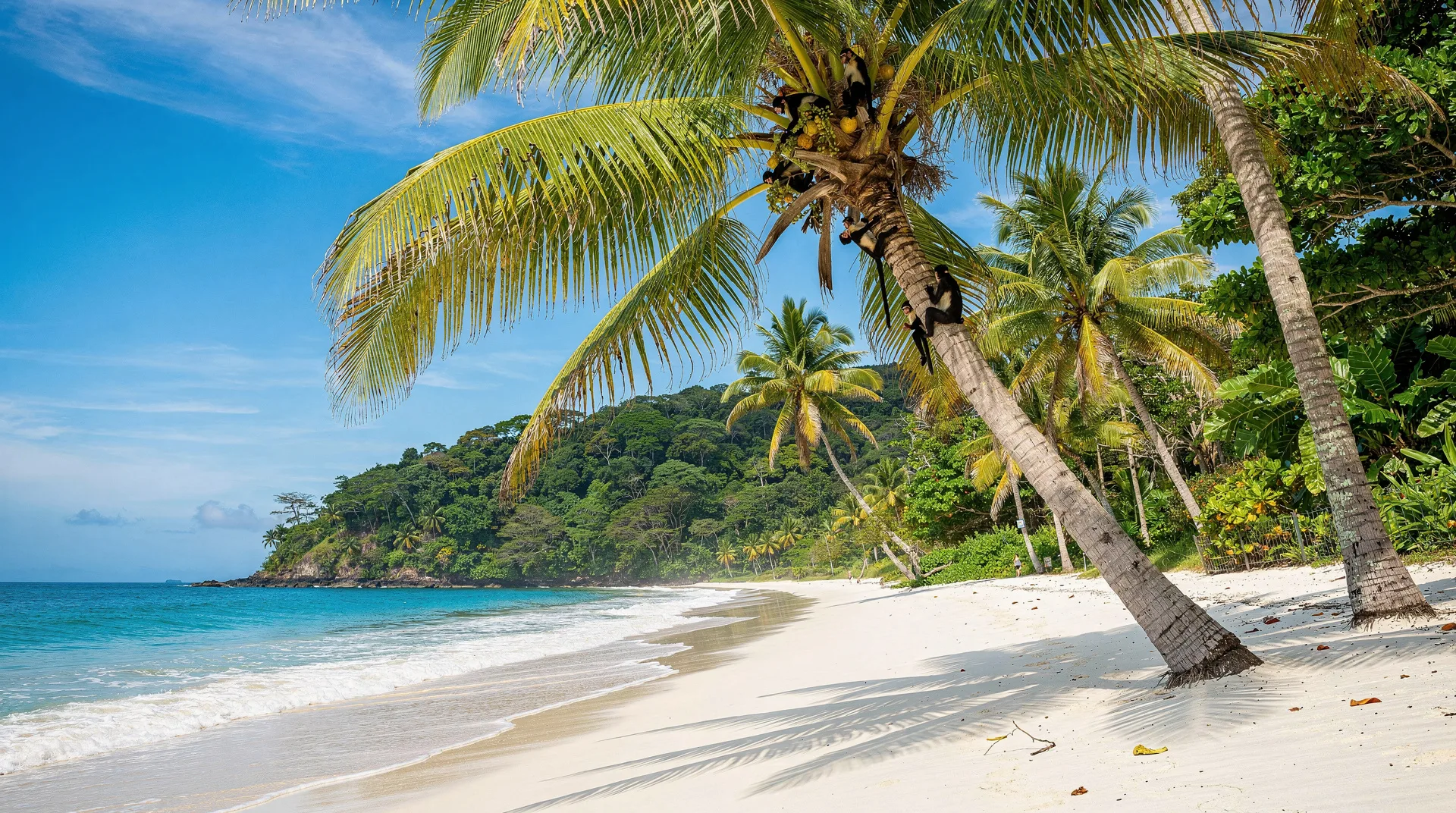
Manuel Antonio National Park: the complete visitor guide
Do I need a guide for Manuel Antonio NP?
A guide is strongly recommended. Entry quotas mean slots sell out days in advance, and certified naturalist guides find sloths, crab-eating raccoons, and poison-dart frogs in minutes that self-guided visitors walk straight past. Book a guide and your ticket together online.
Inside one of the world’s most biodiverse small parks
Manuel Antonio National Park covers just 683 hectares — making it one of the smallest national parks in Costa Rica — yet it ranks among the most biologically dense protected areas on the planet. The park packs four beaches, two well-marked trail systems, primary and secondary rainforest, coral reef, and a captive population of white-faced capuchin monkeys habituated enough to appear within arm’s reach of the main path.
Located on the central Pacific coast of Costa Rica, the park sits a short drive south of Quepos, a town that serves as the practical base for most visitors. The drive from San José takes about three hours on the Costanera Sur highway — a straightforward route by Costa Rican standards. From the park entrance, Quepos is roughly 7 km away, and the road connecting them passes through a strip of hotels, restaurants, and tour operators of varying quality.
The park’s appeal is simple: you can walk from primary jungle to a white-sand beach in under twenty minutes, all while three-toed sloths hang overhead and scarlet macaws cross the canopy in pairs. For travellers who want accessible wildlife in a compact, well-maintained setting, Manuel Antonio reliably delivers.
| Where | central Pacific coast, 7km south of Quepos |
| Cost | $18 adult / $5 child (2-12), booked online |
| Time needed | 3-4 hours guided, 5-6 hours self-paced |
| Getting there | around 3 hours from San José via Costanera Sur |
| Booking | online 24hrs+ ahead, mandatory — no walk-up tickets |
Entry, tickets, and the quota system
Manuel Antonio operates a strict daily quota of 1,500 visitors. That figure sounds generous until you realise the park is closed every Tuesday and operates limited hours Wednesday through Friday. On peak-season weekends and US holiday periods, tickets sell out days in advance.
Ticket prices (2026):
- Adults (non-resident): $18 per person
- Children (2–12 years): $5
- Resident rates differ — always carry your cedula
Tickets must be purchased online through the SINAC reservation portal at least 24 hours before your visit. Walk-up ticket purchases are not available. The park is open Wednesday through Monday, 7am to 4pm. Last entry is at 3pm to allow visitors time to exit before closing.
Critical warning about fake guides at the entrance: The access road to the park is lined with men and women offering “guide services” and selling what they claim are park entrance tickets. These are not licensed guides and what they sell are not tickets — the park has no walk-up ticket counter. Do not pay anyone on the street. Legitimate ICT-certified guides book through established operators, pick you up at your hotel, and present their guide license on request.
Manuel Antonio NP: guided tour with entrance fee included — from $60Wildlife you can realistically expect to see
Manuel Antonio is one of the most reliable places in Costa Rica to observe the following species. A good naturalist guide dramatically increases your encounter rate. If you want to know how the park compares with other sites, the monkey species of Costa Rica guide explains what separates the four monkeys you may meet here, and the wildlife watching ethics guide covers how to behave around animals that have grown used to people.
Three-toed sloths are the star attraction. They are present year-round and a skilled guide will locate them in the Cecropia trees along the main Cathedral Point trail within the first thirty minutes. Two-toed sloths also live in the park but are harder to spot due to their nocturnal habits and higher canopy preference.
White-faced capuchin monkeys are everywhere. They are highly intelligent, completely habituated to humans, and have been known to steal food, sunscreen, and anything shiny left unattended on the beach. Keep all bags closed and never feed them — it is illegal and harmful to their health.
Crab-eating raccoons are commonly seen on Playa Manuel Antonio at low tide, foraging along the shoreline. They look similar to their North American cousins but have adapted to a coastal diet including fiddler crabs and ghost crabs.
Mantled howler monkeys are heard long before they are seen. Their calls carry up to 3 km and tend to peak at dawn and late afternoon. They favour the canopy and spend most of the day resting in fig trees.
Squirrel monkeys (mono tití) are the park’s signature conservation story. Manuel Antonio is one of only two places on Costa Rica’s Pacific coast where the endangered Central American squirrel monkey still survives. Sightings are common near Playa Espadilla Sur.
You may also encounter white-nosed coatis, agoutis, green iguanas, and the startlingly bright poison-dart frogs (Oophaga granulifera) along the wetter sections of trail.
Manuel Antonio Park: guided walking tour with a naturalist — from $65Trails and beaches inside the park
The park has two primary trail loops, plus the beach corridors.
Cathedral Point trail (Sendero Punta Catedral): This is the signature loop — a 45-minute circuit around a headland that was once an island but became connected to the mainland by a tombolo (sandbar). The trail passes through primary forest with excellent wildlife viewing, climbs to a rocky viewpoint looking out over the Damas Estuary and open Pacific, then descends to Playa Manuel Antonio. The path is well-maintained but has some uneven roots; comfortable walking shoes are adequate.
El Perezoso trail: A flatter, shadier secondary forest trail that connects the park entrance area to the southern beaches. Good for slower wildlife observation.
Playa Manuel Antonio: The most protected beach inside the park, with calm waters suitable for swimming year-round. The tombolo at the eastern end is a good low-tide exploration area.
Playa Espadilla Sur: The first beach inside the park entrance. Waves are somewhat stronger here, and swimming conditions vary with season and swell. This is where you are most likely to encounter squirrel monkeys at the forest edge.
Playa Biesanz: Not technically inside the national park, but a short walk south of the entrance area. Calmer than Espadilla Norte, excellent snorkelling during dry season.
Best time to visit Manuel Antonio
The park operates year-round, but conditions differ significantly by season.
December to April (dry season): Best wildlife viewing conditions, easiest trails, clearest ocean. The park is at maximum tourist capacity — book tickets and guides weeks ahead. Peak prices.
May to November (green season): Afternoon rains are common, but mornings are typically clear and the forest is lush and photogenic. Wildlife is equally present, crowds are thinner, and prices at nearby hotels drop by 30–40%. September and October are the wettest months and see the fewest visitors. The sloths do not take days off.
For a wider view of the seasons, the best time to visit Costa Rica and green season pros and cons guides explain what to expect in each period, and the packing list for Costa Rica covers what to carry on a rainy afternoon.
What to bring: Water (fountains are available near the entrance), reef-safe sunscreen, insect repellent, and a dry bag if you plan to swim. There are lockers near the main beach for a small fee.
Getting to the park
Most visitors base themselves in Manuel Antonio itself or in Quepos. If you are weighing a rental car against shuttles, the rent a car or not and shuttle services overview guides lay out the trade-offs, and driving in Costa Rica helps you prepare for the road.
From Quepos, the park is 7 km south via the main coastal road. Options:
- Shared taxi or bus: Collectivos (shared taxis) run from Quepos market roughly every thirty minutes and cost around $2. Local buses also cover the route.
- Private taxi: ~$12–15 from central Quepos to the park entrance.
- Rental car: Parking near the park entrance costs around $10–15/day. Arrive before 8am on weekends to get a space.
- From San José: A direct shuttle from San José (3 hours) is the easiest option without a car. Several operators run hotel-to-hotel service.
Where to stay near Manuel Antonio
The coastal road between Quepos and the park entrance is densely lined with accommodation options at every price point. A few worth knowing:
Budget to mid-range: Several boutique hotels and guesthouses along the hill road — look for places with pool and jungle views rather than beachfront (which commands a significant premium).
Mid to luxury: Hotel Makanda by the Sea, Villa Punto de Vista, Arenas del Mar (beach-level rooms), and Kura Design Villas are consistently praised for service and location. Most have pool access and some form of breakfast included.
Quepos town: Quieter, cheaper, more local. Fifteen minutes from the park and close to the marina and excellent seafood restaurants.
Manuel Antonio vs Corcovado: which park fits your trip
Manuel Antonio is often compared to Corcovado National Park on the Osa Peninsula, and the two suit different travellers.
| Priority | Best pick | Why |
|---|---|---|
| Easiest access, tight schedule | Manuel Antonio | 3hrs from San José, no flight needed |
| Highest wildlife density and remoteness | Corcovado | Larger, wilder, fewer visitors per hectare |
| Beach + jungle combined in one short visit | Manuel Antonio | Beach cove inside the park itself |
| Best squirrel monkey sightings | Manuel Antonio | One of only two Pacific coast strongholds |
| Multi-day wilderness trek | Corcovado | Sirena station, overnight options |
Our full Manuel Antonio vs Corcovado comparison goes deeper on logistics, cost, and which matches your travel style. For a broader view of the country’s wildlife hotspots, see the Costa Rica wildlife overview and the where to see sloths guide.
Manuel Antonio: catamaran cruise with a meal — from $110 Manuel Antonio National guided park tour — from $60What to skip
The souvenir stalls at the entrance: Some are fine for t-shirts, but the “authentic indigenous craft” market is almost entirely mass-produced merchandise. For genuine Boruca or Bribrí crafts, seek out cooperatives in Limón province or reputable shops in San José.
Any operator who cannot show you a SINAC-certified guide license on request. Genuine naturalist guides take a multi-year course and must renew ICT certification regularly.
Swimming at Playa Espadilla Norte (outside the park, north of the entrance) without checking local conditions. Rip currents are strong and drownings occur every year. Swim only at Playa Manuel Antonio inside the park, where conditions are calmer. Our Costa Rica beach safety guide explains how to read the water, and the honest look at tourist traps post covers other scams worth avoiding around the park.
Guided tour of Manuel Antonio National Park — from $58Frequently asked questions about Manuel Antonio National Park
Can I enter the park without a ticket booked in advance?
No. The park switched to a mandatory online reservation system and does not sell walk-up tickets. Visit the SINAC website (sinacweb.sinac.go.cr) to book your slot. During peak season, book at least one week ahead — during Christmas and Easter week, two to three weeks minimum.
Is the park open every day?
No. Manuel Antonio is closed every Tuesday. It operates Wednesday through Monday, 7am to 4pm, with last entry at 3pm.
Are there food and drink options inside the park?
There is a small refreshment stand near the main beach, but options are limited and expensive. Most visitors bring their own water and snacks. Quepos and the road strip have dozens of restaurant options for before or after your visit.
How long should I spend in the park?
Most guided tours last 3 to 4 hours and cover the Cathedral Point loop plus time at the beach. If you plan to hike all trails and spend time swimming, allow 5 to 6 hours.
Is it safe to swim at the park beaches?
Playa Manuel Antonio (inside the park) is generally safe for swimming with calm, protected waters. Playa Espadilla Sur has stronger surf and should be assessed on the day. Always check with park staff if you are unsure.
Can I bring pets into the park?
No. Pets are prohibited in all Costa Rican national parks.
What currency is accepted at the park?
The SINAC online system accepts major credit cards. Inside the park, cash (USD or colones) is typically required for the locker fee and refreshment stand.
Are there accessible trails for wheelchairs or mobility limitations?
Parts of the main path near the entrance are paved, but the Cathedral Point loop is a natural forest trail with roots and uneven terrain. The park can provide a wheelchair-assisted route — contact SINAC in advance to arrange this.
Is Manuel Antonio worth it if I’ve already seen sloths elsewhere in Costa Rica?
Yes — the density and reliability of sightings here are hard to match elsewhere on a short visit. Even travellers who’ve spotted sloths at other lodges or reserves consistently find Manuel Antonio’s combination of squirrel monkeys, capuchins, and coatis all in one compact walk worth the entry fee and quota hassle.
Where to fit Manuel Antonio in your itinerary
Manuel Antonio works best as a 2- to 3-night stay within a longer coastal Pacific circuit. It pairs naturally with Jacó to the north (1.5 hours) and Uvita and Marino Ballena to the south (1 hour). From San José, it is the most accessible major wildlife park — just 3 hours by car or shuttle — making it the ideal first taste of Costa Rica’s biodiversity for visitors on a tight schedule.
For families, the 7-day Arenal and Manuel Antonio itinerary combines the park with Arenal’s waterfalls and hot springs in a circuit that works well without a car. For those wanting something wilder and more remote, see our Manuel Antonio vs Corcovado comparison to decide which park suits your travel style.
Planning a full day at Manuel Antonio, hour by hour
A well-paced Manuel Antonio day looks different from a rushed one, and the difference is almost entirely about timing your entry.
7:00-7:30am — Arrive at the entrance. The gates open early and the first hour delivers the coolest temperatures, the most active wildlife, and the thinnest crowds on the trails. Howler monkeys are typically most vocal at dawn, and a guide will find sloths more easily before the midday heat sends them higher into the canopy for shade.
7:30-10:30am — Cathedral Point trail. The signature 45-minute loop, taken slowly with a naturalist guide, easily fills two to three hours once you factor in wildlife stops. This window covers the trail’s best light for photography and the highest likelihood of squirrel monkey sightings near the coastal edge.
10:30am-1:00pm — Beach time at Playa Manuel Antonio. The calmest swimming inside the park, with capuchins and coatis regularly visible along the sand. By late morning the beach is busier but rarely uncomfortable given the park’s daily quota.
1:00pm — Exit before the afternoon heat peaks. Most visitors are ready to leave by early afternoon; lingering into the hottest hours (1-3pm) adds little beyond discomfort, since wildlife activity drops noticeably once the sun is directly overhead.
This structure consistently outperforms an afternoon arrival, which trades cooler mornings and quieter trails for a compressed, hotter visit with less time to find wildlife.