Monkey species of Costa Rica: the complete guide
How many monkey species live in Costa Rica?
Four species: the mantled howler, Geoffroy's spider monkey, white-faced capuchin, and Central American squirrel monkey. Corcovado National Park is the only place you can reliably see all four in a single visit.
Four species in one country
Costa Rica is home to four of the roughly 100 primate species found in the Americas. That might not sound remarkable until you consider that the country is smaller than the state of West Virginia. The survival of all four species here is the direct result of a conservation model built on national parks and biological corridors that now protect over 28 percent of the national territory.
Each of the four species has a distinct personality, social structure, and preferred habitat. Getting to know them as individuals — rather than just “monkeys” — transforms every encounter from background noise into something genuinely absorbing.
| Species | Weight | Group size | Best place to see |
|---|---|---|---|
| Mantled howler | 7-10 kg | 6-15 | Almost anywhere forested |
| White-faced capuchin | 2-4 kg | 6-30 | Manuel Antonio, Cahuita |
| Geoffroy’s spider monkey | 6-9 kg | 15-25 | Corcovado, Tortuguero |
| Central American squirrel monkey | 700-900 g | 20-50 | Manuel Antonio |
The four species in detail
Mantled howler monkey (Alouatta palliata)
The howler is the species most likely to wake you up in the night. Their call — a deep, resonating roar produced by a specialised hyoid bone in the throat — carries up to three kilometres through dense forest and has been described as the loudest land-animal sound relative to body size. Groups typically call at dawn to declare their territory, which means that staying anywhere near forested land, including Manuel Antonio or Monteverde, often involves a 5am wake-up call that no alarm clock can compete with.
Howlers are the largest Costa Rican monkey (adults weigh 7–10 kg) and the most phlegmatic. They spend up to 70 percent of their time resting — a metabolism-conservation strategy for a diet of leaves that deliver minimal caloric return. Their black or dark brown coats, prehensile tail, and thick build make them unmistakeable when spotted.
Where to find them: Howlers are the most widespread monkey in Costa Rica, found in virtually every forested area from Guanacaste’s dry forests to the Caribbean lowlands. Reliable spots include La Fortuna, Cahuita, Manuel Antonio, the Osa Peninsula, and along the Tárcoles River estuary near Carara. They are the species most often seen from roads and viewpoints even without a guide.
White-faced capuchin (Cebus capucinus)
The capuchin is the primate that visitors most commonly interact with — and not always positively. These are highly intelligent, curious, and mischievous animals that have learned to associate tourists with food. In Manuel Antonio National Park, capuchins raid unattended bags, steal food from hands, and occasionally become aggressive when boundaries are not respected.
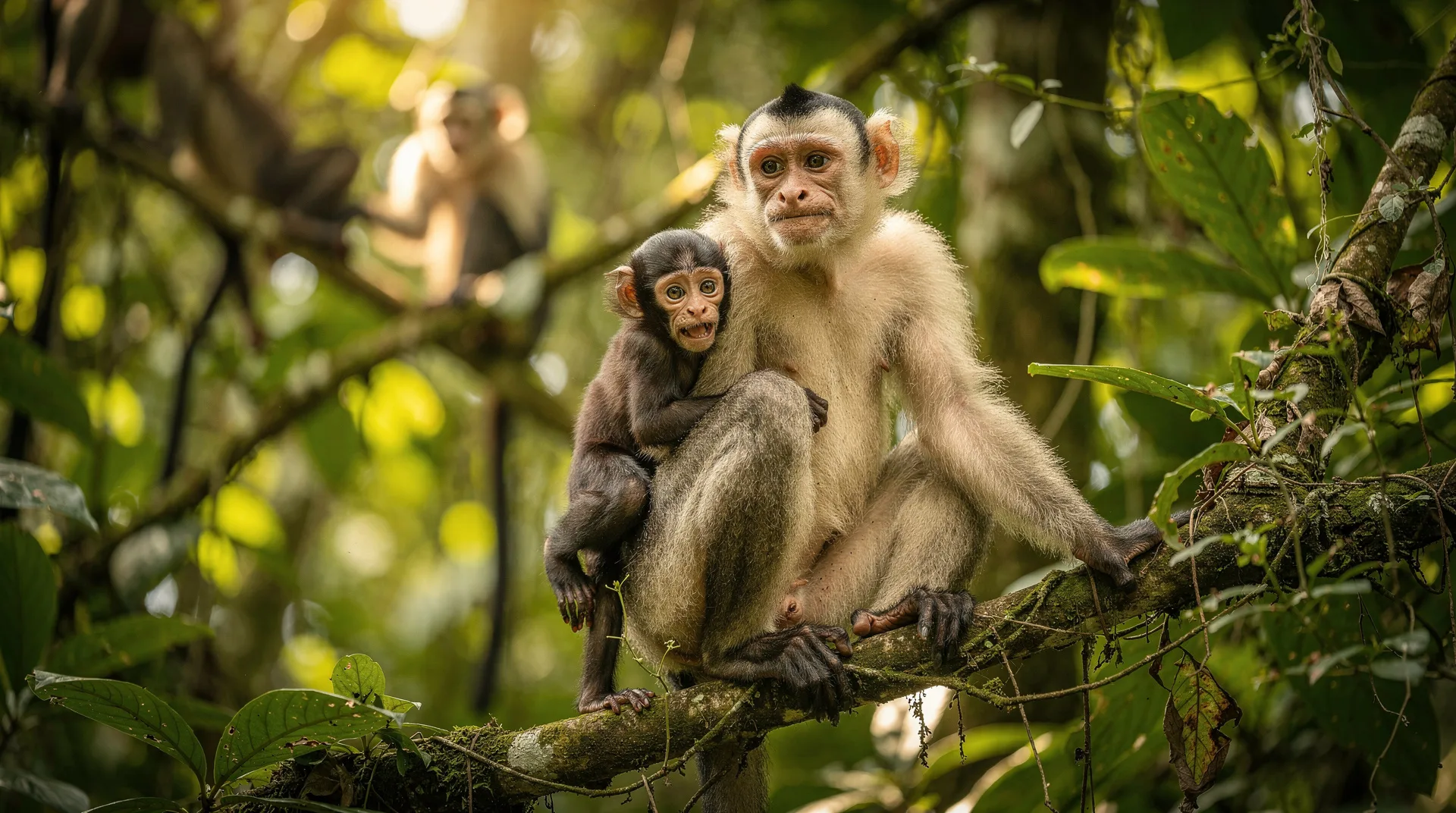
They are also fascinating to watch when not being problematic. Capuchins use tools — stones to crack palm nuts, sticks to extract insects from bark — and their social behaviour is complex, involving grooming coalitions, dominance hierarchies, and sophisticated communication. Groups of 6–30 individuals range through large home territories, and their path through a tree canopy is noticeably faster and more energetic than a howler’s deliberate plod.
Capuchins weigh 2–4 kg and have distinctively black-and-white colouration: black cap, white face and chest, dark body and limbs.
Where to find them: Capuchins are very common at Manuel Antonio and Cahuita. They also occur widely through the Pacific and Caribbean lowland forests, along rivers with gallery forest (Tárcoles, Tempisque, Sarapiquí), and in any secondary forest adjacent to human settlements. They are rarely seen above 1,000 metres.
a naturalist-guided walk in Manuel Antonio where capuchin and squirrel monkeys share the same trails — from $65Geoffroy’s spider monkey (Ateles geoffroyi)
Spider monkeys are the athletes of the primate world. Long-limbed, with a prehensile tail that acts as a fifth hand, they swing through the forest canopy in a style called brachiation — arm over arm, like a hairy acrobat. Watching a spider monkey cross a 20-metre gap between trees by swinging on successive branches is one of the highlights of any rainforest visit.
They are also among the most ecologically sensitive primates in the Americas. Spider monkeys require large tracts of mature forest and cannot persist in fragmented habitat. Their presence is therefore a reliable indicator of forest quality. They were once widespread across Costa Rica but have been eliminated from most of the Pacific lowlands by deforestation; today, viable populations exist primarily in Corcovado, Tortuguero, and some Caribbean lowland reserves.
Adults weigh 6–9 kg and are variable in colour — from golden-buff to dark brown depending on the subspecies. Their faces are distinctive: a small, flattened visage with a sometimes pink or mottled bare skin around the eyes.
Where to find them: Corcovado National Park on the Osa Peninsula is the best place to see spider monkeys. The Sirena ranger station trail corridor is excellent. Tortuguero is the main Caribbean population centre. Spider monkeys are essentially absent from Manuel Antonio and Monteverde.
Central American squirrel monkey (Saimiri oerstedii)
The squirrel monkey is the rarest, smallest, and arguably most charming of the four. Weighing only 700–900 grams, these orange-and-grey primates move through the lower and mid canopy in large groups — typically 20–50 individuals — that travel quickly and noisily through fruiting trees. The social structure is unusual: females are dominant, and male coalitions are only present during the breeding season.
The Central American squirrel monkey is listed as Vulnerable by the IUCN. Costa Rica and a small strip of western Panama constitute its entire world range. Loss of coastal forest — particularly the secondary growth that squirrel monkeys favour — continues to squeeze their population.
Where to find them: Manuel Antonio National Park and the surrounding Quepos corridor is the primary mainland stronghold for this species. The coastal almond trees along the beach trail at Manuel Antonio are a reliable squirrel monkey spot from December through April. They also occur through the Golfo Dulce area — around Golfito and the Osa lowlands — which forms a secondary range.
a guided day tour of Corcovado NP from Drake Bay, where spider and squirrel monkeys share the same forest — from $135Where to see all four species
Corcovado National Park — the only place for the full set
Corcovado is the only place in Costa Rica where all four monkey species coexist in a single protected area. The Sirena ranger station in the park’s interior sits at the junction of several ecosystems — lowland rainforest, river gallery forest, beach, and transitional zones — which creates habitat diversity that supports all primate species simultaneously.
A full day at Sirena with a certified guide will almost certainly produce sightings of howlers, capuchins, and spider monkeys. Squirrel monkey sightings at Corcovado are less consistent than at Manuel Antonio but do occur, particularly along the Río Claro trail.
Access to Corcovado’s Sirena station requires a licensed guide — this rule is strictly enforced and exists to protect the wildlife from disturbance. Day trips from Drake Bay and Puerto Jiménez are the two main access routes. The boat journey from Drake Bay includes excellent offshore wildlife watching.
a 2-day 1-night expedition to Corcovado’s Sirena station from Drake Bay — from $425Manuel Antonio — three species reliably, one frequently
Manuel Antonio is the most accessible option for most visitors and delivers reliable sightings of howlers, capuchins, and squirrel monkeys. Spider monkeys have been absent from this park for decades due to the area’s forest fragmentation, which is the one gap in the Manuel Antonio experience for serious primate watchers.
The small park size and managed visitor numbers (limited daily entries) mean that wildlife sightings per hour of trail time are among the highest in the country. See the Manuel Antonio National Park guide for park entry details, trail maps, and the Tuesday closure.
Watching behaviour: what to look for
Foraging patterns
Each species forages differently. Howlers move slowly and rarely — a group might spend four hours in a single fig tree. Capuchins are constantly moving, probing, and manipulating objects. Spider monkeys follow fruit availability through the canopy at high speed. Squirrel monkeys move in chaotic, fast-moving groups that pass through a zone in minutes.
Understanding these patterns helps set expectations. If you see a howler group, you can afford to observe at length because they will stay put. If you see a spider monkey group, you have perhaps five minutes before they have moved 200 metres through the canopy.
Social interactions
Watch for grooming in howlers and capuchins — this is the primary social bonding activity and occupies large portions of their day. Capuchin infants are particularly engaging to watch as they explore the world with a combination of reckless curiosity and immediate retreat to the mother when alarmed. Spider monkey males are often seen hanging by their tails while feeding, using their prehensile tail as a literal fifth limb.
Ethical guidelines for monkey encounters
Never feed monkeys. This is the single most important rule. Provisioned monkeys become aggressive, lose fear of humans, and eventually need to be destroyed. In Manuel Antonio, capuchins that have been fed by tourists have become dangerous enough to injure children.
Keep your distance. Five metres is a minimum safe distance for all species. Approach closer and you risk stress responses, especially in mothers with young infants.
Do not approach if infants are present. Mothers will defend their young aggressively, and the stress of a perceived threat can cause a mother to drop or abandon an infant.
No flash photography. This applies equally to all Costa Rican wildlife. See wildlife photography tips for ethical photography guidance in detail.
Conservation status
| Species | IUCN Status | Costa Rica trend |
|---|---|---|
| Mantled howler | Least concern | Stable |
| White-faced capuchin | Least concern | Declining in fragmented zones |
| Geoffroy’s spider monkey | Endangered | Declining; viable only in large reserves |
| Central American squirrel monkey | Vulnerable | Slowly recovering in protected areas |
Electrocution on poorly insulated power lines is the leading cause of injury and death for urban-edge populations of all four species. Several organisations in Costa Rica install wildlife bridges and insulated power lines in key corridors — if you see a monkey on a telephone wire, it is navigating human infrastructure the best it can.
Frequently asked questions about monkeys in Costa Rica
Is it safe to be near wild monkeys in Costa Rica?
Generally yes, provided you follow the ethical guidelines above. The main risk is capuchins in Manuel Antonio, which have been conditioned by feeding and may grab at food or bags. Do not carry loose food visibly, and if a capuchin approaches aggressively, stand still, make yourself large, and back away calmly.
Can I see monkeys year-round in Costa Rica?
Yes. All four species are resident and present every month of the year. Activity and visibility vary with fruit production cycles, temperature, and visitor numbers, but there is no bad month for monkey watching in Costa Rica.
Do squirrel monkeys only live in Manuel Antonio?
No, but Manuel Antonio is the most accessible location. The broader Quepos–Manuel Antonio coastal corridor, the Golfo Dulce region around Golfito, and parts of the Osa Peninsula lowlands also support squirrel monkey populations. Sightings from Drake Bay are possible.
How long does a monkey-watching tour take?
Most guided wildlife walks that focus on primates run 3–4 hours, ideally starting at sunrise. A half-day is usually sufficient to see the main species in Manuel Antonio; Corcovado warrants a full day (8+ hours) to cover enough habitat. See the Corcovado guide for expedition logistics.
Are spider monkeys aggressive?
No. Spider monkeys are shy and generally flee from human presence. Their acrobatic movement through the canopy can be startling — a large group moving fast overhead sounds like the forest is breaking — but they pose no threat to humans.
What is the best time of day to see monkeys?
Early morning (6–9am) and late afternoon (4–6pm) are the peak activity windows. During midday heat, howlers in particular are almost entirely motionless. Capuchins are active throughout the day. Night walks occasionally produce sleeping monkey groups.
How can I tell which species I’m hearing before I see it?
The howler’s roar is unmistakable — a deep, resonating call audible up to 3 km away, most common at dawn. Capuchins make sharp, chattering alarm calls when disturbed. Spider monkeys give a distinctive whinnying bark when a group is agitated or spread out. Squirrel monkeys travel in loud, high-pitched chattering troops that sound almost like a flock of birds moving through the canopy — often heard before the group itself comes into view.
Related guides
Primates are one highlight of a broader Costa Rican wildlife tapestry. The Costa Rica wildlife overview explains the ecological systems that support this biodiversity. For the full Corcovado experience — where all four monkey species share the forest with tapirs, peccaries, and over 500 bird species — see the Corcovado National Park guide. If sloths are equally on your radar, where to see sloths in Costa Rica covers both wild encounters and rescue centre visits.
Bird watching by region maps the same forest zones where monkeys and birds share the canopy. For night encounters with sleeping monkeys and the nocturnal two-toed sloth, read the nocturnal wildlife guide. And the 14-day wildlife photography itinerary plots a route specifically designed to maximise primate and bird sightings across multiple ecosystems.