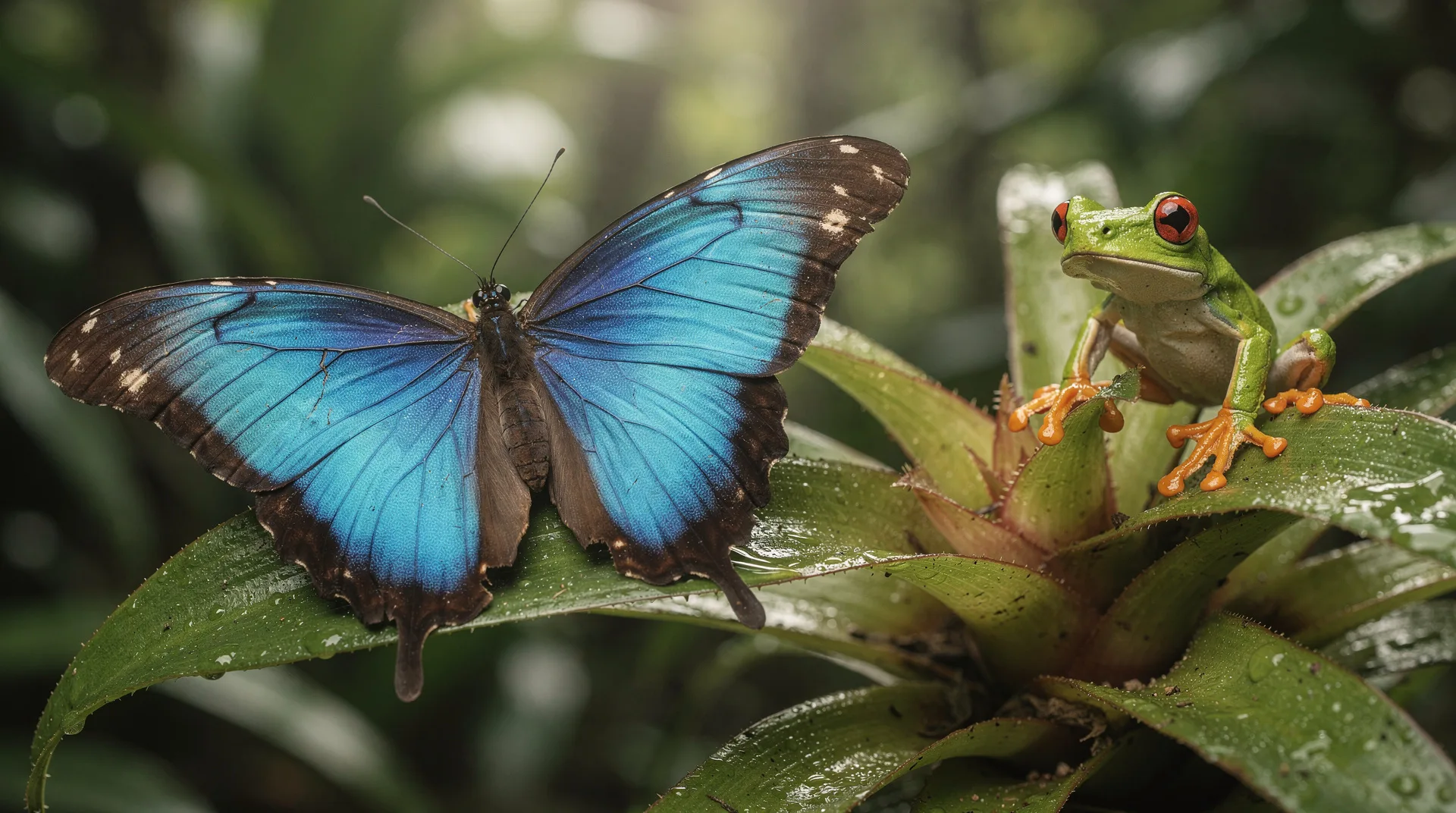
Butterflies and frogs in Costa Rica: where to see them
Where are the best places to see frogs and butterflies in Costa Rica?
La Paz Waterfall Gardens near Poás combines both in a single attraction. Monteverde's butterfly farm at Selvatura Park has one of the largest displays in Central America. For wild frog encounters, the Caribbean lowlands around Puerto Viejo and Cahuita deliver red-eyed tree frogs and poison dart frogs on night walks.
| Best all-in-one stop | La Paz Waterfall Gardens, ~90 min from San José |
| Best wild frog encounters | Caribbean lowlands: Puerto Viejo, Cahuita, Sarapiquí |
| Best glass frogs | Monteverde, Arenal, San Gerardo de Dota (above 400m) |
| Cost | Curated attractions ~$15–55; guided night walks separate |
| Best season | May–November for peak amphibian activity |
| Time needed | Half a day per attraction; a full evening for a night walk |
Two groups that define tropical beauty
Ask returning visitors to name their most memorable Costa Rica wildlife encounters and the answers are surprising. Not jaguars — those are rare. Not howler monkeys — those are heard everywhere. Frequently: a red-eyed tree frog found at eye level on a wet night trail, or a Blue Morpho butterfly erupting from the undergrowth and banking across a sunlit clearing.
Costa Rica has over 1,200 butterfly species — more species per square kilometre than almost anywhere else on Earth — and over 160 species of amphibian, including some of the most visually extraordinary frogs in the world. Neither group requires a remote expedition to find. A butterfly garden or a guided night walk in virtually any part of the country delivers close-up encounters that are accessible to all ages and fitness levels.
This guide covers the curated attractions (butterfly farms, frog exhibits), the wild encounters (night walks, waterfall sites), and how to plan your time around both.
Butterfly encounters: farms, gardens, and wild sightings
Blue Morpho — the flagship species
The Blue Morpho (Morpho peleides and related species) is the butterfly most visitors associate with Costa Rica. The male’s brilliant metallic blue upper wings, spanning up to 20 centimetres, are produced not by pigment but by microscopic light-refracting structures in the scale surface — structural colouration that changes with viewing angle. When a Blue Morpho closes its wings, it disappears entirely against leaf litter, showing only the camouflaged brown underside.
Blue Morphos live in lowland and mid-elevation rainforest and cloud forest edges throughout Costa Rica. They are particularly abundant in humid forest near rivers. Wild encounters are more common in the wet season (May–November) when fresh adults are emerging. Butterfly farms maintain breeding colonies year-round.
Monteverde butterfly garden at Selvatura Park
Selvatura Park in the Monteverde zone hosts the Santa Elena Cloud Forest Butterfly Garden, one of the largest enclosed butterfly exhibits in Costa Rica. The exhibit contains over 30 species, including the Blue Morpho, Malachite, Owl Butterfly, and several Heliconius species. The garden design uses plants specifically selected to attract adults and provide larval food sources, creating a self-sustaining breeding environment.
The butterfly garden is part of Selvatura’s broader experience, which includes hanging bridges over the cloud forest canopy, a hummingbird garden, a sloth and wildlife exhibit, and the Jewels of the Rainforest insect collection — over 1,000,000 mounted specimens from a Belgian entomologist’s private collection. A single Selvatura day pass covers most of these.
a cloud forest and butterfly farm full-day tour in Monteverde — from $95La Paz Waterfall Gardens — the all-in-one experience
La Paz Waterfall Gardens, located about 90 minutes from San José near the Poás Volcano, is technically a paid private nature park rather than a national park, but its quality is exceptional. The butterfly observatory here holds 16,000 square metres of enclosed butterfly garden — one of the largest in the world — housing over 50 species in a walk-through dome surrounded by flowering plants.
Adjacent to the butterfly garden are: a hummingbird garden with multiple feeders attracting eight species of hummingbird simultaneously; a Serpentarium with over 30 non-venomous and venomous snake species; a frog exhibit (Ranario) with 15 frog species including multiple poison dart frogs and glass frogs; and a wildcat sanctuary housing ocelots, pumas, and jaguarundis. The five La Paz waterfalls are accessed via a 3.5 km trail that descends and returns by aerial tram.
Entrance to La Paz costs around $55 for adults and $38 for children (2026 prices) — not cheap, but it covers everything including the aerial tram. It represents excellent value as a single activity for families or travellers with limited time.
Rainforest Adventures aerial tram (Pacific) — Jacó area
The Rainforest Adventures Pacific tram operates in the hills behind Jacó, providing an aerial gondola ride through secondary rainforest canopy that delivers butterfly and bird encounters without walking. The tram is specifically designed for families and visitors with mobility limitations who want a canopy perspective without the exertion of a hanging bridge walk.
a rainforest aerial tram tour at Jacó Beach — from $85The surrounding forest contains high butterfly diversity, particularly during the wet season (May–October) when fresh broods are emerging. The tram area also has a serpentarium and wildlife exhibits on-site.
Wild butterfly encounters
Wild butterfly encounters are most productive at stream crossings and muddy banks, where male butterflies aggregate to drink minerals in a behaviour called “mud-puddling.” A single wet riverbank in the Osa Peninsula or Sarapiquí lowlands can hold dozens of morphos, swallowtails, and Heliconius species simultaneously.
Fruiting trees and overripe fruit are also productive — several species are attracted by fermented juice and can be observed at close range. Ask your guide to lead you to any rotting fruit source on the trail.
Frog encounters: what species and where
Costa Rica’s frog diversity
160+ amphibian species represents an extraordinary concentration — more species than exist in all of Europe. The variety spans from poison dart frogs smaller than a thumbnail to the giant smoky jungle frog (Leptodactylus pentadactylus), a massive burrower that can weigh half a kilogram. Between these extremes sits an astonishing diversity of tree frogs, glass frogs, rain frogs, and burrowing toads that collectively occupy every moisture-gradient from seasonal dry forest to the wettest cloud forest.
Red-eyed tree frog (Agalychnis callidryas)
Costa Rica’s most photographed amphibian is remarkably easy to find on a night walk in the Caribbean and southern Pacific lowlands. The species breeds in ponds and slow streams, and males call from vegetation above water. During the breeding season (May–November, coinciding with rains), calling aggregations near water can contain hundreds of males, each with the characteristic “chak” call.
By day, red-eyed tree frogs rest on the underside of large leaves with eyes sealed and limbs tucked, appearing as a green bump. At dusk they activate, moving to calling positions and displaying the brilliant red eye for which they are named.
Glass frogs (Centrolenidae family)
Costa Rica has over 14 glass frog species. All are small (2–3 cm) and lime-green, with the distinctive transparent belly that reveals the beating heart and liver. They live above streams in cloud forest and lower montane zones, calling from overhanging vegetation on warm nights after rain.
Glass frogs are specific to humid forest above approximately 400 metres. Monteverde, Arenal, and the San Gerardo de Dota valley all produce reliable glass frog sightings on guided night walks. The experience of seeing a frog the size of a fingertip with all its organs visible through its skin is one of those moments that stops conversation.
Strawberry poison dart frog (Oophaga pumilio)
The strawberry poison dart frog is Costa Rica’s most abundant and visible poison dart frog species — and one of the most variable animals in the world. On the mainland Caribbean slope, the standard form is brilliant scarlet-red with blue-black legs. On Bocas del Toro islands in Panama (just across the border), the same species occurs in green, blue, yellow, and nearly black forms. The Costa Rica mainland form is the classic strawberry dart frog.
Unlike most frogs, they are day-active. Caribbean lowland forest — particularly the Sarapiquí area, Tortuguero environs, and the Puerto Viejo–Cahuita zone — is excellent for strawberry dart frogs. They are particularly visible on the forest floor after rain, and experienced guides can find a dozen individuals in a single hour.
Green-and-black poison dart frog (Dendrobates auratus)
Widespread throughout both Pacific and Caribbean lowlands, the green-and-black poison dart frog is the most commonly encountered dart frog on guided forest walks across much of Costa Rica. The bright metallic-green pattern with black markings serves as an honest signal of toxicity — this species produces batrachotoxin (derived from dietary arthropods) that deters predation. They are harmless to handle in the short term but prolonged skin contact is discouraged.
The Ranario at Monteverde Conservation League
The town of Santa Elena in the Monteverde area has a dedicated frog exhibit — the Ranario — operated by the Monteverde Conservation League. Twenty-five species of frog are maintained in naturalistic terrariums designed to replicate different Costa Rican habitat zones: cloud forest, lowland Caribbean, Pacific dry forest. The exhibits include several glass frog species, multiple poison dart frogs, and nocturnal red-eyed tree frogs under reversed lighting so they are active during visitor hours.
The Ranario is genuinely excellent — not a tourist trap. Guides at the exhibit explain conservation biology, the decline of amphibian populations worldwide (Costa Rica has lost several species to chytrid fungus), and what the conservation community is doing about it. Entry is approximately $15–20 for adults.
Planning combined butterfly and frog experiences
For a single day in San José or the Central Valley: La Paz Waterfall Gardens is the clear choice. It covers butterfly garden, frog exhibit, hummingbird garden, waterfall hike, and wildlife sanctuary in one site.
For a day in Monteverde: combine the Selvatura butterfly garden (morning) with the Ranario frog exhibit (afternoon) and a night walk (evening). Three complementary experiences, all within a short distance of Santa Elena.
For the best wild encounters: spend two nights in the Caribbean lowlands (Puerto Viejo or Cahuita) and dedicate one evening to a night walk specifically for frogs and amphibians. This is the authentic wild version of what the curated attractions replicate.
Best months for butterfly and frog watching
Wet season (May–November): Peak season for both groups. Frogs breed in rainy conditions and are maximally vocal and visible. Fresh butterfly broods emerge throughout the season. Rain reduces walking comfort but dramatically increases amphibian activity — the best frog encounters happen within 30 minutes of a rain shower ending.
Dry season (December–April): Butterfly farms and exhibits are fully operational year-round (internal humidity is controlled). Wild butterfly encounters are also possible, particularly at mineral-licking sites. Wild frog activity is reduced in the Pacific lowlands during the driest months (January–March), but Caribbean coast sites and high-altitude areas maintain year-round frog activity.
Frequently asked questions about butterflies and frogs in Costa Rica
Are poison dart frogs dangerous to touch?
Costa Rica’s poison dart frog species are toxic, not venomous — the distinction matters. They deliver toxins through skin secretions if touched and then if the toxins are ingested (touching your eyes or mouth afterward). Brief contact with a single frog is unlikely to cause serious harm to an adult, but handling is strongly discouraged and unnecessary. Observe, photograph, and move on.
Can I photograph butterflies at butterfly farms?
Yes — butterfly farms are one of the best photography opportunities in Costa Rica. The enclosed environment means subjects are contained, lighting is predictable (diffuse through greenhouse panels), and butterflies are accustomed to human presence. A macro lens (90–100mm) produces superb results. Wild butterfly photography requires patience and fast autofocus at mudding sites.
What is the best single attraction for families with young children?
La Paz Waterfall Gardens is the most family-friendly option — accessible trails, covered exhibits, excellent on-site restaurant, and a diversity of animals that keeps children engaged throughout a full-day visit. The aerial tram provides an alternative to walking for tired younger children.
Do I need a guide for wild frog watching?
A guide makes a major difference. Wild frogs, particularly glass frogs and smaller dart frogs, are extremely easy to walk past without noticing. An experienced guide can find glass frogs in total darkness by call and position, and can identify species differences that appear negligible to the untrained eye. For night walks in particular, a guide is essentially mandatory for productive encounters.
How many butterfly species can I realistically see in a day?
At a well-managed butterfly farm, you might observe 20–40 species in a morning. On a full-day walk in good wet-season lowland forest with a guide, 50–80 species is realistic for a dedicated observer. Costa Rica’s record single-site day lists exceed 200 species, but these require expert-level identification skills and many hours.
Is there a specific season for Blue Morpho butterflies?
Blue Morphos are present year-round but most abundant in the wet season (May–November). Multiple broods emerge following seasonal rains, and adult lifespan is only 115 days, so populations cycle continuously. Butterfly farms maintain year-round specimens under controlled conditions.
Where can I see the most butterfly species in a single day?
The most species-rich single-day option combines La Paz Waterfall Gardens (butterfly garden + frog exhibit, Central Valley) with a riverside walk near the Sarapiquí or Tarcoles rivers in the afternoon. Alternatively, any full day in Corcovado National Park with a guide produces extraordinary insect diversity alongside the park’s mammal and bird spectacle. For a structured butterfly-focused day from Jacó or Manuel Antonio, the aerial tram combined with a mangrove kayak tour hits multiple habitats where different butterfly communities live.
Are there poisonous caterpillars in Costa Rica?
Yes — several Costa Rican caterpillar species have urticating (sting-producing) hairs or spines that cause painful skin reactions. Avoid touching any brightly coloured caterpillar. Saddleback caterpillars and several flannel moth larvae are the main species requiring caution. None are life-threatening, but the reaction can be uncomfortable for 24–48 hours. Butterfly farms contain only farmed species and pose no contact risk.
Can I visit the Monteverde area without having to choose between butterfly garden and frog exhibit?
Most visits include both without difficulty. The Selvatura butterfly garden is in the cloud forest near Santa Elena, while the Ranario frog exhibit is in town — about 10 minutes apart. A morning at Selvatura’s hanging bridges and butterfly garden, followed by a visit to the Ranario in late afternoon, is a practical day structure. Evening night walk options in Monteverde complete the full spectrum of tropical invertebrate and amphibian life.
Related guides
The night walk experience deserves its own preparation — nocturnal wildlife guide covers how to get the most out of an after-dark walk, what species to expect, and how to photograph them. Wildlife photography tips provides detailed camera and ethics advice specific to Costa Rica’s macro subjects. For the broader ecological context, Costa Rica wildlife overview explains why Costa Rica hosts such concentrated amphibian and insect diversity.
Bird watching by region can be combined with butterfly watching at the same sites — Sarapiquí, Cahuita, and the Osa Peninsula overlap significantly between birders and lepidopterists. For a family-focused trip combining butterfly gardens with other accessible wildlife experiences, see the family activities guide or the 10-day family itinerary.
Curated attraction or wild encounter: how to choose
The honest trade-off between farms/exhibits and wild encounters is worth stating plainly. Curated attractions like Selvatura’s butterfly garden or La Paz’s Ranario guarantee sightings — you will see dozens of species up close, regardless of weather, time of day, or luck. This makes them the right choice for travellers with limited time, families with young children who can’t manage a late-night trail, or anyone who wants reliable photography conditions.
Wild encounters, particularly guided night walks in the Caribbean lowlands, offer something a farm cannot replicate: the specific thrill of finding an animal in its actual habitat, doing what it does when nobody is watching. The trade-off is unpredictability — a slow night happens, and species that are guaranteed at a farm might simply not appear on a wild walk.
The strongest itineraries don’t choose one over the other; they budget for both. A curated stop early in the trip (La Paz or Selvatura) sets expectations and teaches identification skills that make the later wild encounter more rewarding, since you’ll recognise a red-eyed tree frog or a Blue Morpho instantly rather than needing your guide to point out every feature.
Camera settings and technique for close-up subjects
Both butterflies and frogs reward similar photography technique, though the settings differ. For butterflies at farms, a macro lens in the 90-105mm range with an aperture around f/8-f/11 balances depth of field against the diffuse greenhouse light; a monopod helps steady the shot without spooking a settled subject with sudden movement.
For frogs on a night walk, expect to shoot with a flash or a guide’s headlamp as your only light source — a small off-camera flash diffused with tissue or a plastic diffuser avoids the harsh reflections that a direct on-camera flash produces on wet skin. Glass frogs in particular photograph best with backlighting that reveals the translucent belly; ask your guide to position their light behind the frog rather than in front of it.
a guided night walk through Monteverde’s cloud forest — from $30