April weather in Costa Rica: the dry season's last chapter
What is the weather like in Costa Rica in April?
April is the last full dry-season month on the Pacific coast. Guanacaste becomes extremely hot (36-38°C midday) and very dry. Manuel Antonio and Jacó stay largely rain-free through April with the transition beginning in late April. First green season rains often arrive by late April or early May. Prices drop noticeably compared to January-March, making April excellent value for Pacific coast travel.
What April actually looks like
April is Costa Rica’s transitional month — the last chapter of the dry season, when the Pacific coast is still mostly rain-free but showing signs of the change to come. It is a month that splits into two distinct halves: the first two weeks feel like a continuation of March, and the second half of April sees the first scouts of the green season arriving, particularly in Guanacaste and the northern Pacific.
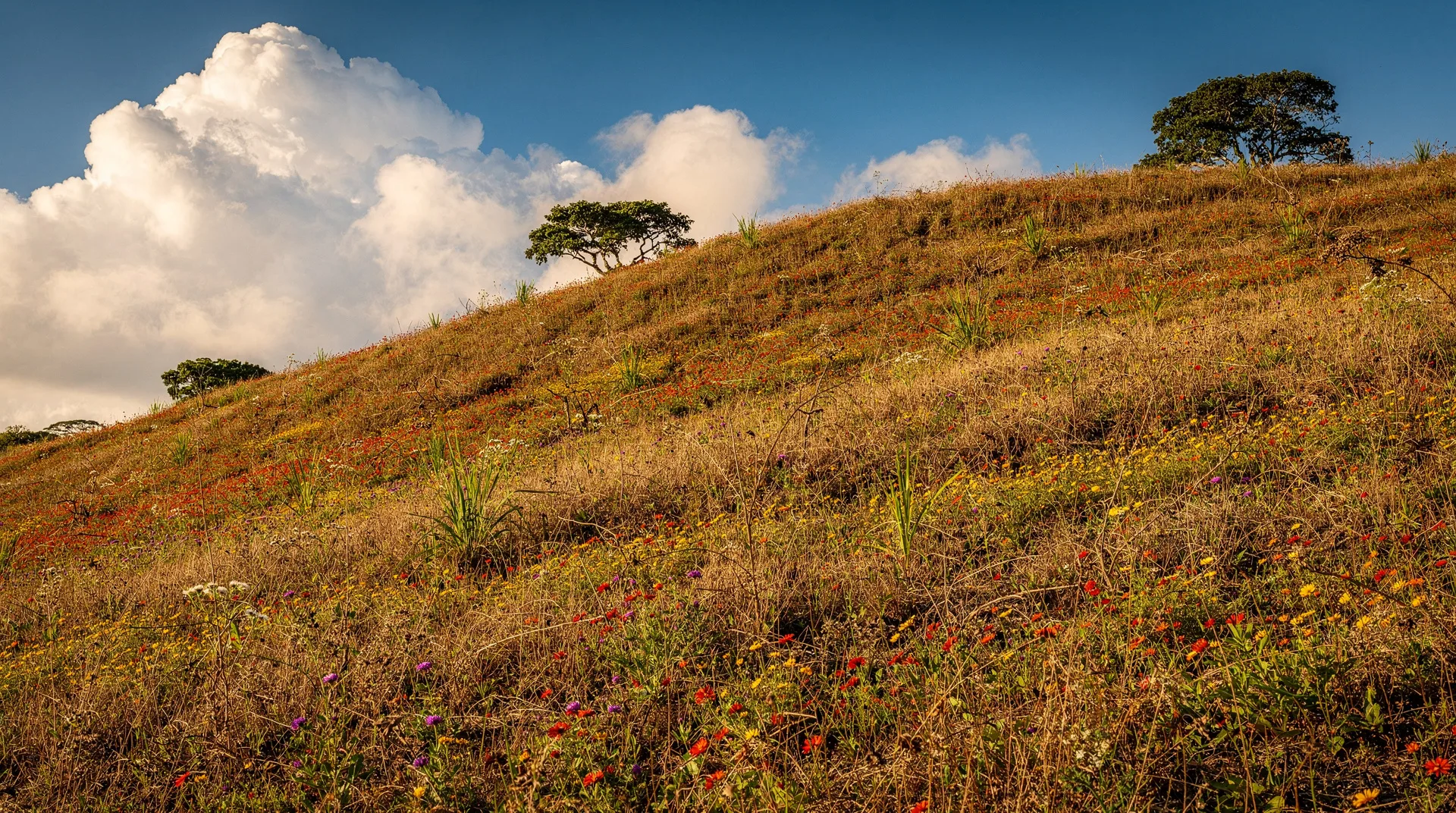
For travellers, April is one of the most interesting months to visit because it sits in a seasonal and commercial sweet spot. Prices are lower than January-March but weather is still largely dry. The landscape in Guanacaste is at its most extreme — golden, parched, and very hot — which has its own dramatic aesthetic, even if shade is essential at midday.
This guide breaks April down region by region, with honest notes on heat, budget, quetzal season, and what to expect as the first rains begin.
| Season | Last month of dry season; rains arrive late April |
| Guanacaste heat | 36–40°C midday — plan mornings before 10am |
| Central Pacific | Still mostly dry, lower crowds than Jan-Mar |
| Highlands | Quetzal nesting season begins |
| Prices | around 15–25% below January (outside Semana Santa) |
Guanacaste in April: extreme heat, very dry
Guanacaste in April is the Costa Rican climate at its most intense. Rainfall is effectively zero in most of the province — Tamarindo, Liberia, Nosara, Sámara, and the Papagayo peninsula all record near-zero monthly totals. What changes from March is the heat: April is typically Guanacaste’s hottest month before the cooling effect of the first rains in May.
Midday temperatures in Liberia and the interior of Guanacaste regularly reach 38-40°C on still days. On the coast, the sea breeze moderates conditions to 32-35°C, but the UV index is extreme. Any outdoor activity scheduled for 10am-3pm will be uncomfortably hot without shade and water.
The practical adaptation: Guanacaste in April works best with an early morning structure. A 6:30am beach walk, a morning snorkelling trip departing at 7am, or a Rincón de la Vieja day hike starting at 7:30am all work well before the heat peaks. Midday is pool and shade time. Late afternoon (4-6pm) brings another pleasant window as the heat backs off slightly.
The Papagayo winds, which strengthen Guanacaste’s coast from December through March, begin to subside in April. This means calmer seas on the more exposed Guanacaste beaches, better snorkelling conditions, and more comfortable catamaran tours.
Tamarindo in April is quieter than January-March but still lively. Surf conditions remain consistent with northwest swells providing waves at Tamarindo beach and Playa Langosta. It is a legitimate surfing month despite the heat.
Tamarindo surf: learn and practice surfing — from $50Central Pacific in April: still reliable
The Central Pacific zone — Jacó, Quepos, Manuel Antonio — is more consistent through April than Guanacaste. Rain is rare in early April and begins transitioning only in late April, with the main green season establishing in May.
Manuel Antonio National Park in April benefits from lower crowds than January-March. The park’s daily cap of 600 visitors is less likely to be hit on weekdays. Wildlife sightings are excellent — the dry forest at Manuel Antonio is thinner than in green season, making monkeys, sloths, and coatis easier to spot.
Temperatures at Manuel Antonio in April: 28-32°C at the coast. Comfortable mornings for hiking (the trail circuit is 3-4 hours), with the Pacific beach accessible for swimming in a calmer sea than the green season. The area’s short rainy season transition means that occasional showers are possible by late April, particularly in the afternoon, but these are brief and warm.
For the Uvita and Marino Ballena area, April marks the tail end of the December-March humpback whale season (northern hemisphere whales). Early April still sees whale activity; by mid-to-late April, the northern population has departed. April is a very good time for Caño Island snorkelling — visibility remains high and the sea is calm.
Southern Pacific and Osa in April: excellent access
The Osa Peninsula and Drake Bay in April represents some of the best access conditions of the year. The dry season roads are at their most manageable, the Sirena station in Corcovado National Park is fully operational, and wildlife viewing is excellent.
April wildlife highlights in Corcovado: all four monkey species active, tapirs and peccaries easily spotted around the Sirena station, scarlet macaws flying overhead in noisy pairs, and the outstanding birding that Corcovado delivers year-round. The creek crossings on the La Leona and Los Patos entrance trails are at their lowest and easiest in April.
The tourism logistics are worth planning: guides for Corcovado must be booked in advance (the park mandates certified guides), and the Sirena ranger station has accommodation that requires reservation months ahead. See our Corcovado National Park guide for booking details.
One consideration: April sees the beginning of the green season transition in some parts of the southern Pacific, particularly toward the end of the month. The Osa Peninsula has less defined seasons than Guanacaste, and April can occasionally produce afternoon showers even in a typical “dry season” year.
Caribbean coast in April: unpredictable
The Caribbean coast in April does not follow the Pacific seasonal calendar. Puerto Viejo, Cahuita, and Tortuguero are in a transitional period — the February-March relative dry window is ending, and the longer rainy period (May-August) is approaching.
April on the Caribbean can be variable: some days are sunny and dry, others bring sustained rain. It is not the best Caribbean month, but it is not the worst either. For Tortuguero specifically, the canal ecosystem is extraordinary year-round — birds, caimans, river turtles, and river otters are present regardless of rain. Sea turtle nesting season has not yet begun (that starts in July for green turtles).
If you are combining Pacific and Caribbean in an April trip, lead with the Pacific for guaranteed conditions and visit the Caribbean with flexible expectations.
Highlands and cloud forest in April
April is one of the most important months for highland visitors — it marks the start of quetzal nesting season in the cloud forests of San Gerardo de Dota and Monteverde. The resplendent quetzal’s nesting season runs from roughly April through June, with the peak typically in May. Male quetzals in breeding plumage — with their extraordinary 60-90cm tail feathers — are most reliably seen from April onward.
San Gerardo de Dota is the premier quetzal destination. This cloud forest valley sits at 2,100-2,400m altitude, meaning temperatures of 10-18°C during the day and near freezing at night in early April. Pack layers for highland visits regardless of the Pacific coast heat.
Our quetzal watching guide covers the exact spots and timing in detail. April visits should book accommodation in San Gerardo de Dota (limited rooms, fill quickly in quetzal season) at least 4-6 weeks ahead.
The Monteverde cloud forest is also excellent in April. The dry season has reduced mist somewhat, making visibility through the forest better than November-January. Bird activity is high as breeding season ramps up across the cloud forest.
Monteverde and Santa Elena: cloud forest bird-watching tour — from $65Budget reality in April
April is where the Pacific coast starts offering meaningful savings versus January-March. The transition is not immediate — Easter week (Semana Santa) in April is actually a surge period. Semana Santa is Costa Rica’s biggest domestic holiday, and the week around Easter sees beaches fill with domestic tourists. Hotels in coastal areas raise prices during Semana Santa and availability becomes very tight.
Outside of Semana Santa, April accommodation prices are typically 15-25% lower than January for Pacific coastal properties. By late April, some properties are already shifting to green season rates (typically 30-40% below January peak).
Travel costs by style in April (outside Semana Santa):
| Travel style | Daily budget per person |
|---|---|
| Backpacker (hostels, sodas, public bus) | $48-65 |
| Mid-range (2-3 star hotels, shared shuttles) | $105-155 |
| Comfort (eco-lodges, private transfers) | $220-320 |
| Luxury | $400-700+ |
These are still higher than green season rates but represent real savings versus January.
What to do in April: best activities by region
Guanacaste: Early morning beach activities before the heat peaks; sunset catamaran tours; Rincón de la Vieja day hike (start very early — 7am); snorkelling off Playa Conchal (calm seas in April); kitesurfing at Playa Copal.
Central Pacific: Manuel Antonio National Park wildlife walk (weekday mornings for lower crowds); Catamaran tours from Jacó; Mangrove kayaking at Isla Damas near Quepos; Marino Ballena early-season whale watching (first half of April only).
Osa and southern Pacific: Corcovado day hike from Drake Bay or Los Patos; Caño Island snorkelling (excellent visibility); Drake Bay bird watching; sport fishing out of Puerto Jiménez.
Highlands: Quetzal spotting at San Gerardo de Dota (April through June nesting season); Volcán Poás visit (book SINAC reservation 4 weeks ahead); Monteverde forest hike before the afternoon winds strengthen.
Caribbean: Flexible itinerary around weather; Cahuita National Park snorkelling; Puerto Viejo cacao and chocolate tours.
April at Arenal and La Fortuna
La Fortuna in April sits in the late dry season, but the Arenal zone’s microclimate means it receives some rainfall year-round from both Pacific and Caribbean systems. April is drier than May-November at La Fortuna but not as rain-free as Guanacaste.
The La Fortuna waterfall is at its lowest water volume of the year in April — still impressive, but the dramatic cascade of July-October is not present. Hot springs (Tabacón, Eco Termales, Baldi) are booked solidly through early April as peak-season visitors make their final runs, then ease off. Late April is an excellent time to visit the hot springs with shorter waits and transitional pricing.
Canyoning and the hanging bridges circuit at Mistico Arenal operate normally throughout April. The Arenal Volcano cone is still frequently cloud-covered — the morning viewing window remains the best strategy.
La Fortuna makes an excellent base for April: it sits at a comfortable 300-500m altitude that moderates the extreme heat of the Guanacaste coast, prices are dropping, and the activities do not significantly change between January and April.
April wildlife highlights
April is an underrated month for wildlife across Costa Rica:
Quetzal nesting begins: The first weeks of April mark the start of the resplendent quetzal nesting season in the Talamanca highlands. Pairs establish nesting cavities in dead trees, and the male’s extraordinary tail plumes (up to 90cm in breeding season) are at their finest. San Gerardo de Dota provides the most reliable sightings. See our full quetzal watching guide for precise locations.
Whale season transition: The December-March northern humpback season is winding down through early April off Marino Ballena and Uvita. Some whales linger into mid-April. There is a gap in the offshore Uvita whale calendar between the northern season ending and the southern season beginning in August. In April, dolphin activity continues throughout the year.
Dry forest birds: Guanacaste’s bird diversity in April includes both resident species and late-lingering migrants. The drying trees that expose bird activity in January-March are at their maximum effect in April — tanagers, trogons, and parrots are easily observed.
Amphibians beginning activity: As the first rains arrive in late April, poison dart frogs and glass frogs begin emerging from dry-season refuge. The transition week when the first rains fall on Guanacaste produces extraordinary amphibian activity.
April comparison: Pacific coast vs Caribbean
A useful April planning framework is to treat the Pacific coast and Caribbean coast as two separate decisions:
Pacific coast in April: Reliably dry (especially first 3 weeks), very hot in the north, excellent for beach and snorkelling, fewer crowds than February, prices transitioning. Best choice for first-time visitors who want guaranteed weather.
Caribbean coast in April: Unpredictable, transitioning from its February-March dry window toward May-August wet period. Some beautiful days but rain possible. Worthwhile if you are flexible and the Caribbean culture and beaches (Puerto Viejo, Cahuita) are your priority.
For most April visitors, combining Pacific coast (primary) with a short Caribbean addition (2-3 days, flexible) captures the best of both. Fly into San José, drive or shuttle to the Pacific, then add a Caribbean loop at the end with open weather expectations.
Semana Santa planning
Semana Santa — Holy Week before Easter — is the single biggest domestic holiday in Costa Rica. The exact dates shift each year (Easter is a floating holiday), but it falls somewhere between late March and mid-April. During this week:
- Coastal hotels in Guanacaste, Manuel Antonio, and Jacó can charge peak-season rates regardless of the broader April pattern
- Road travel becomes slow, especially the San José-Jacó highway on the Friday before Easter
- National parks get significantly busier with domestic visitors
- Reservations become essential for anything that requires booking — accommodation, park entry, restaurants
If your dates overlap with Semana Santa, book everything a minimum of 6-8 weeks ahead and expect a livelier, more crowded atmosphere than typical April. If you have flexibility, the week after Easter (when domestic tourists return home) is often one of the most pleasant times to visit popular destinations — the dry season weather holds, but the crowds dissipate.
April vs March vs May: the shoulder-month comparison
| March | April | May | |
|---|---|---|---|
| Guanacaste rainfall | Near zero | Near zero, first rains late month | Regular afternoon rain begins |
| Guanacaste heat | Hot | Hottest month of the year | Cooling slightly as rains start |
| Central Pacific | Dry | Mostly dry, transition late month | Green season established |
| Prices vs January | 5–10% lower | 15–25% lower | 30–40% lower (green season) |
| Quetzal viewing | Pre-nesting | Nesting begins | Peak nesting |
| Crowds | High (peak season tail) | Lower, except Semana Santa | Low |
April sits in the sweet spot between March’s lingering peak-season crowds and May’s full green-season rains — if your priority is dry weather with meaningfully lower prices, April (outside Semana Santa) is usually the better trade-off than either neighbour. See our best time to visit guide for the full year-round comparison.
Frequently asked questions about April weather in Costa Rica
Does it rain in Costa Rica in April?
On the Pacific coast, April is still mostly dry — particularly in the first two to three weeks. Guanacaste experiences near-zero rainfall through the month. The Central Pacific begins its green season transition in late April, with occasional afternoon showers. The Caribbean coast in April is variable, transitioning out of its February-March dry window.
Is April too hot to enjoy Costa Rica?
April is Costa Rica’s hottest month in Guanacaste, with midday temperatures reaching 36-40°C. This is intense but manageable if you structure your day correctly: outdoor activities before 10am or after 4pm, shade and water midday. Coastal breezes help on the beach. The Central Valley (San José, Heredia) at altitude is a comfortable 22-27°C throughout April.
Is April good for seeing quetzals?
Yes — April marks the beginning of the quetzal nesting season in the highlands. San Gerardo de Dota and Monteverde are the primary locations. The peak is May through June, but April sightings of males in breeding plumage are reliable with a morning guide walk. Book accommodation in San Gerardo de Dota well in advance.
How busy is Manuel Antonio National Park in April?
April is significantly quieter than January-March at Manuel Antonio, except during Semana Santa week when it can be very crowded. Weekday visits in April (excluding Easter week) often have the park at 30-50% capacity compared to its January weekend peaks. This makes April an excellent month for a more relaxed Manuel Antonio experience.
What are prices like in April compared to January?
Outside of Semana Santa, April accommodation prices are typically 15-25% lower than January at Pacific coast properties. By the third week of April, some properties begin transitioning to green season pricing (30-40% below January). Flights are often lower than the January peak as well. April with proper timing (avoiding Easter week) is genuinely good value.