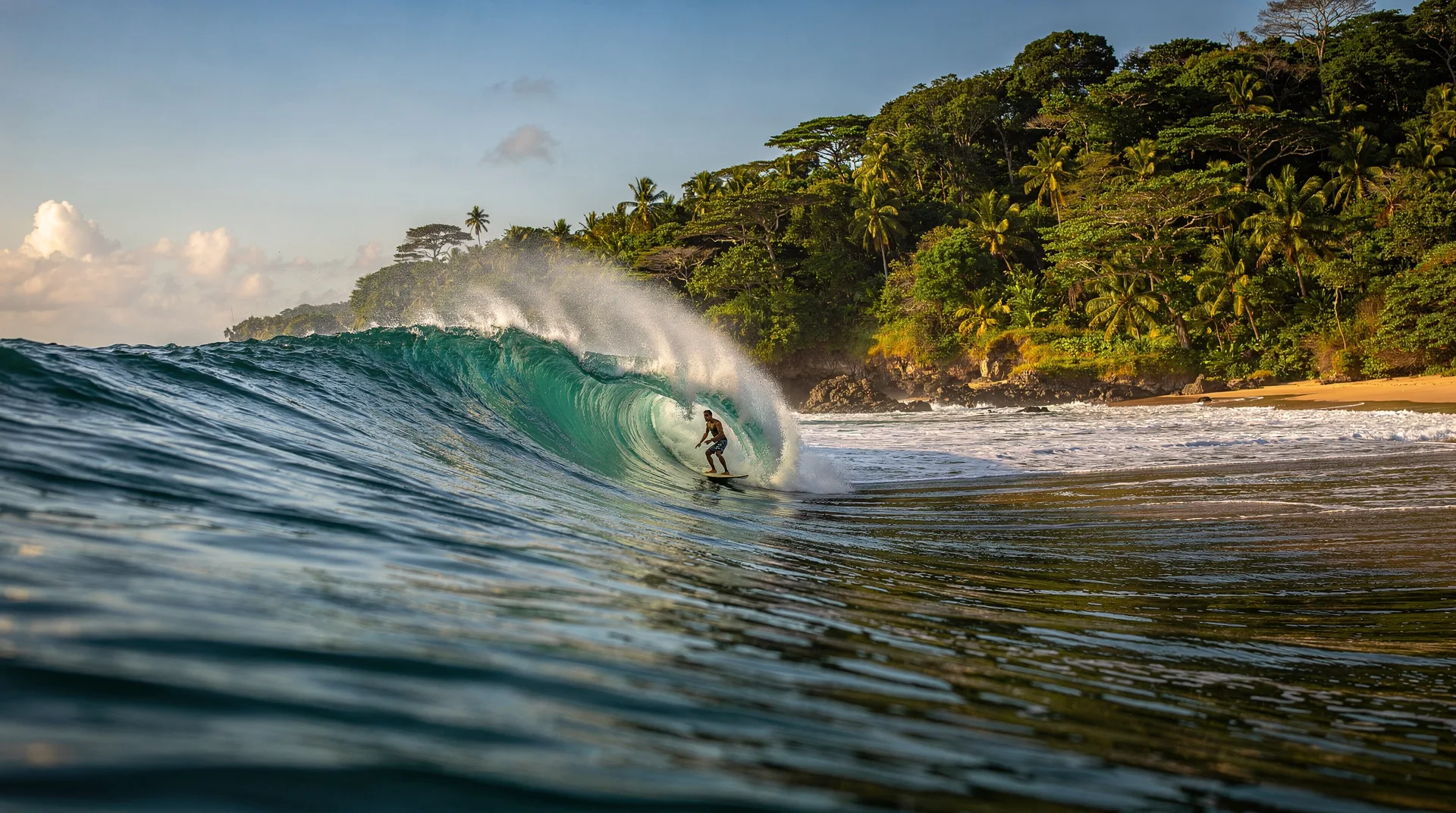
Pavones: chasing the world's longest left-hand wave
What is Pavones?
Pavones is a remote point break on Costa Rica's southern Pacific coast with left-hand rides exceeding 3 minutes on good days — one of the world's longest. It is advanced-only surf and requires significant logistical effort to reach.
Pavones: the wave at the end of the road
There are longer waves in the world — Chicama in Peru, Skeleton Bay in Namibia, a handful of river-mouth points in Indonesia. But very few point breaks combine Pavones’s length with the accessibility of a road you can actually drive to. Mostly.
Pavones sits on the Golfo Dulce in Costa Rica’s far southern Pacific, about 40 kilometres south of Golfito and 350 kilometres from San José. The road from Golfito to Pavones is partially paved, partially rutted dirt, and includes river crossings that wash out entirely in heavy rain. The village at the end is small, electricity is intermittent, and the internet connection is unreliable. The grocery selection consists of what fits on a small supply boat.
All of that is the point. Pavones filters out the casual tourist. The people who make it here came for one reason: the left.
| Where | Golfo Dulce, far southern Pacific, ~40km south of Golfito |
| Level | advanced surfers only |
| Best months | July-October (peak south swell) |
| Getting there | drive from San José (full day) or fly to Golfito + boat |
| Stay | around $80-180/night, book well ahead in swell season |
The wave: what makes Pavones exceptional
The point break mechanics
Pavones is a left-hand point break that peels along a cobblestone rivermouth and rocky point for distances that, on a good day, can genuinely last 3 minutes of riding. Documented rides of over 800 metres exist in surf lore, and while conditions that produce them are not daily occurrences, they are real and they happen with some regularity during peak swell season.
The wave breaks in sections. The initial take-off near the point is fast and hollow — the entry section that filters out the weak-willed. If you make the first section, the wave opens up into a long, peeling wall that allows extended bottom turns, top turns, and carves without the wave closing out on you. The final section near the rivermouth slows and fattens before the wave dies in deep water. The whole sequence is unlike anything you’ll find at a beach break.
The bottom
Mixed cobblestone and sand, with deeper water on the outside and progressively shallower as you approach the inside sections. Unlike a reef break, Pavones won’t put you directly on coral if you fall wrong — but the cobbles are unpleasant to wipe out on, and the current running along the point can drag you quickly into the inside sections during bigger swells.
Swell requirements
Pavones needs a significant south or southwest swell to light up properly. The wave faces southwest and is sheltered from north swells by the Osa Peninsula geography. South swells from July through October generate the best conditions. Anything below 4 feet and the point section doesn’t really work — the wave needs swell energy to activate the long run. The 6–10 foot range is where Pavones is at its most remarkable.
Who can surf Pavones
This is not a wave for novices, intermediates, or surfers who are still working on their pop-up. The entry section at the point on a solid swell is critical, fast, and unforgiving. You need to:
- Be able to paddle strongly and read lineup priority confidently
- Handle an overhead wave from take-off through a full run without falling
- Navigate a sometimes-crowded take-off zone where locals, expats, and travelling surfers compete for position
- Manage the current and know how to paddle back out efficiently after long rides
If you need to think about your pop-up, Pavones will frustrate you. Come here after you’ve spent time at Nosara or Santa Teresa and you’re reliably riding waves above overhead.
The local dynamic
Pavones has a small permanent surf community — a mix of Tico locals from nearby villages and foreign surfers who settled decades ago when the wave was still unknown. These regulars control the lineup on big days and operate a hierarchy that visitors need to respect.
The etiquette expectation is simple but firm: don’t drop in, don’t paddle around people deeper on the wave, and wait your turn at the point. A visitor who shows good manners and demonstrates ability will be welcomed into the rotation. One who snakes the wrong person will find the session becomes unpleasant quickly.
Pavones vs the rest of the southern Pacific: how it compares
| Break | Wave type | Level | Crowd |
|---|---|---|---|
| Pavones | left-hand point break | advanced only | small, localised lineup |
| Dominical | beach break, heavier | advanced/intermediate | moderate |
| Playa Hermosa (Jacó) | powerful beach break | advanced | moderate-high |
| Santa Teresa | mixed beach breaks | all levels | high, well-served by schools |
The takeaway: if you want a wave that rewards patience and local respect over convenience, Pavones is unmatched. If you want lessons, board rentals, and a forgiving learning curve, look to Santa Teresa or a dedicated surf camp instead — Pavones offers neither.
What to pack for a Pavones trip
Bring everything you might need — the village has no surf shop and limited supplies. A step-up board for the bigger swell days (many travelling surfers underestimate how much bigger Pavones breaks than it looks from the beach), reef booties or at minimum a pair of old sneakers for walking the cobblestone entry, extra fins and a leash (losing your only leash here means missing sessions), and reef-safe sunscreen since pharmacy stock is unreliable. Cash is essential — card machines are scarce and the nearest reliable ATM is in Golfito. Bring US dollars or colones in small denominations for boat transfers, meals, and tips.
Getting to Pavones
From San José
Budget a full day. Drive south on the Costanera Sur (the Pacific coastal highway) through Quepos and Uvita, continuing south through Palmar Norte to Golfito. This segment alone is 5–6 hours. From Golfito, the road to Pavones deteriorates progressively — about 40 kilometres of increasingly rough dirt and gravel with river crossings. In the dry season, any vehicle makes it. In the wet season, 4WD is essential and some crossings become impassable for days after heavy rain.
Fly to Golfito
Sansa operates flights from San José to Golfito (roughly 50 minutes, $90–120 one-way). From Golfito airport, hire a boat to Pavones across the Golfo Dulce (30–40 minutes, $25–40) or arrange a shuttle through your accommodation. This is the recommended approach for a first visit.
Via Puerto Jiménez (Osa Peninsula)
Some itineraries combine Pavones with a visit to the Osa Peninsula and Corcovado. Cross the Golfo Dulce by boat from Puerto Jiménez to Golfito, then proceed south to Pavones. This adds complexity but allows a remarkable multi-day route combining jungle, wildlife, and surf.
Accommodation in Pavones
Options are limited and should be booked well in advance, especially during the July–October swell season.
Tiskita Jungle Lodge is the best-known property — remote eco-lodge with simple but comfortable rooms, fruit farm setting, and proximity to the wave. Rates $120–180 per night including meals.
Casa Siempre Domingo is a smaller B&B popular with travelling surfers — basic, comfortable, walking distance from the point. Around $80–100 per night.
La Cusinga Lodge (Uvita, 4 hours north) provides a solid base for exploring the southern Pacific with better infrastructure if Pavones accommodation feels too spartan.
The southern Pacific surf context
Pavones sits within a broader southern Pacific surf corridor that deserves understanding. Dominical, two hours north, provides heavier beach break surf for advanced surfers and the occasional longboarding opportunity. Playa Hermosa near Jacó (not the Guanacaste Playa Hermosa) is one of Costa Rica’s most powerful beach breaks and is used regularly by the national surf team.
Pavones, Dominical, and the left-hand points scattered through the south Pacific make up an informal advanced-surf circuit. Experienced surfers spending 2–3 weeks in Costa Rica sometimes plan a route: fly into San José, surf Jacó on the way south, spend 3–4 days at Dominical, then push to Pavones for the final chapter.
See our dominical and southern Pacific surf guide and surf seasons by region for deeper context.
Building a wider trip around the wave
Because Pavones rewards patience, the smartest plans treat it as one chapter rather than the whole story. Reading the tide and surf conditions guide before you go will help you understand how the point behaves as the water moves, and the best surf beaches in Costa Rica roundup shows where the rest of the country fits around this one. If your skills are not yet at the level the point demands, the beginner surf spots guide is the honest place to start, and a few days of coaching with a group or private surf lesson in Tamarindo — from $50 can make the difference between struggling and enjoying a bigger wave later. For the wider picture of the north, the Tamarindo surf guide and the Nosara surf guide cover good places to build confidence, and the Jacó surf guide describes a more powerful option closer to San José.
Getting to the far south takes planning. The driving in Costa Rica guide and the road conditions by region page explain what to expect from the roads, while internal flights with Sansa and Aerobell and the rent a car or not comparison help you decide how to cover the distance. Weather matters just as much as swell here, so the microclimates explained guide is worth a read, along with the green season pros and cons if you plan to travel during the wetter months.
Surfers who want a longer itinerary can look at the 10 days surf trip on the Pacific or the 12 days south Pacific deep route, and the Uvita destination page and Puerto Jiménez page are useful stops along the way. Finally, how to read the swell and why spots are getting crowded is a useful reality check before you commit to a date, and the Costa Rica beach safety guide covers currents and rip awareness that apply directly to a point like this one.
What to do when the swell is flat
Pavones is genuinely remote. When the swell goes flat (which it does between swells even in peak season), entertainment options are minimal. Options include:
- Hiking in the forest that borders the beach — various trails wind inland through lowland rainforest
- Swimming in the Golfo Dulce, which has unusually calm water and good snorkelling near the rocky outcrops
- Taking a boat trip to explore the mangrove channels north of the village
- Reading, hammock time, and genuinely disconnecting — the internet rarely allows for more anyway
The nearby Osa Peninsula and Corcovado National Park are theoretically a day trip but realistically require 2–3 additional days given the logistics. If you’re combining Pavones with Corcovado, build a dedicated itinerary rather than treating it as a side trip.
For wildlife and nature activities combined with a southern Pacific surf trip, the Corcovado National Park guide covers logistics for that wilderness.
No direct GYG tours for Pavones
Unlike most Costa Rica surf destinations, Pavones has no dedicated GetYourGuide tour inventory — the remoteness and advanced-only nature of the wave means commercial tour packages don’t really exist. This is a self-planned destination. Your surf knowledge, local accommodation contacts, and ability to read a swell forecast are your primary tools.
The nearest GYG surf experiences are in Tamarindo (north) and the Uvita/Dominical cluster. If you’re looking for a guided surf experience to complement a Pavones trip, consider beginning or ending your journey at Tamarindo where instruction and guided surf sessions are well-organised.
Tamarindo surf: learn and practice surfing — from $50Frequently asked questions about Pavones
Why is Pavones considered one of the world’s longest left waves?
The geometry of the point and the cobblestone bottom combine with the southwest swell angle to produce a wave that peels continuously for an extraordinarily long distance — documented rides exceed 3 minutes. Most waves in the world either close out, break up, or lose energy within 30–60 seconds. Pavones on a solid south swell can run for 5–10 times that duration.
What months are best for Pavones?
July through October is the prime window, coinciding with peak Southern Hemisphere winter swells. August and September are often the most consistent. The wave can fire in April–June as well when early south swells hit. December–March is the off-season — too small for the point to work properly.
Can beginners visit Pavones even if they don’t surf the main wave?
Yes. There is a small beach area near the point that produces gentler, broken waves suitable for beginners on smaller days. However, this is not why people travel to Pavones, and the infrastructure for beginners (schools, lessons, board rentals) is essentially non-existent. If you’re a beginner, visit the southern Pacific for its ecology and nature, not its surf.
Is the road to Pavones really bad?
In the dry season (December–April), the road is rough but passable in any vehicle. In the wet season, sections flood and wash out. The critical variable is whether there has been heavy rain in the 24 hours before your drive. Call your accommodation for a road condition check before departing from Golfito.
How long should I plan for a Pavones surf trip?
Minimum 4–5 days to account for travel time, settle into the pace, and catch at least one proper swell. Experienced surfers often plan 7–10 days to catch the full swell cycle. Leaving after 2 days because the swell hasn’t arrived yet is a common and costly mistake — check the forecast before booking non-flexible transport.
Is Pavones safe?
Yes, in the general sense. The village is extremely small and crime is minimal. The beach and surf zone are the main safety consideration: advanced waves with current and cobble bottom require self-awareness and surfing within your ability.
Should I bring my own board or rent locally?
Bring your own if you have one you trust, ideally a step-up for the bigger days. Rental options in Pavones are limited to what a handful of local surfers and lodges keep on hand, and quality varies. If you’re travelling from elsewhere in Costa Rica and don’t want to fly with boards, some Golfito-area shuttle operators can arrange rentals in advance — confirm with your accommodation before you arrive rather than hoping to find something on the ground.
Related guides
For the broader southern Pacific surf picture, see Dominical and southern Pacific surf. The surf seasons by region guide explains the swell dynamics that power Pavones in detail. Advanced surfers combining Pavones with other challenging breaks should also read the Witch’s Rock and Ollie’s Point guide for a northern Pacific contrast. See the Osa Peninsula destination overview for nature activities to pair with a surf trip to this remote corner of Costa Rica.