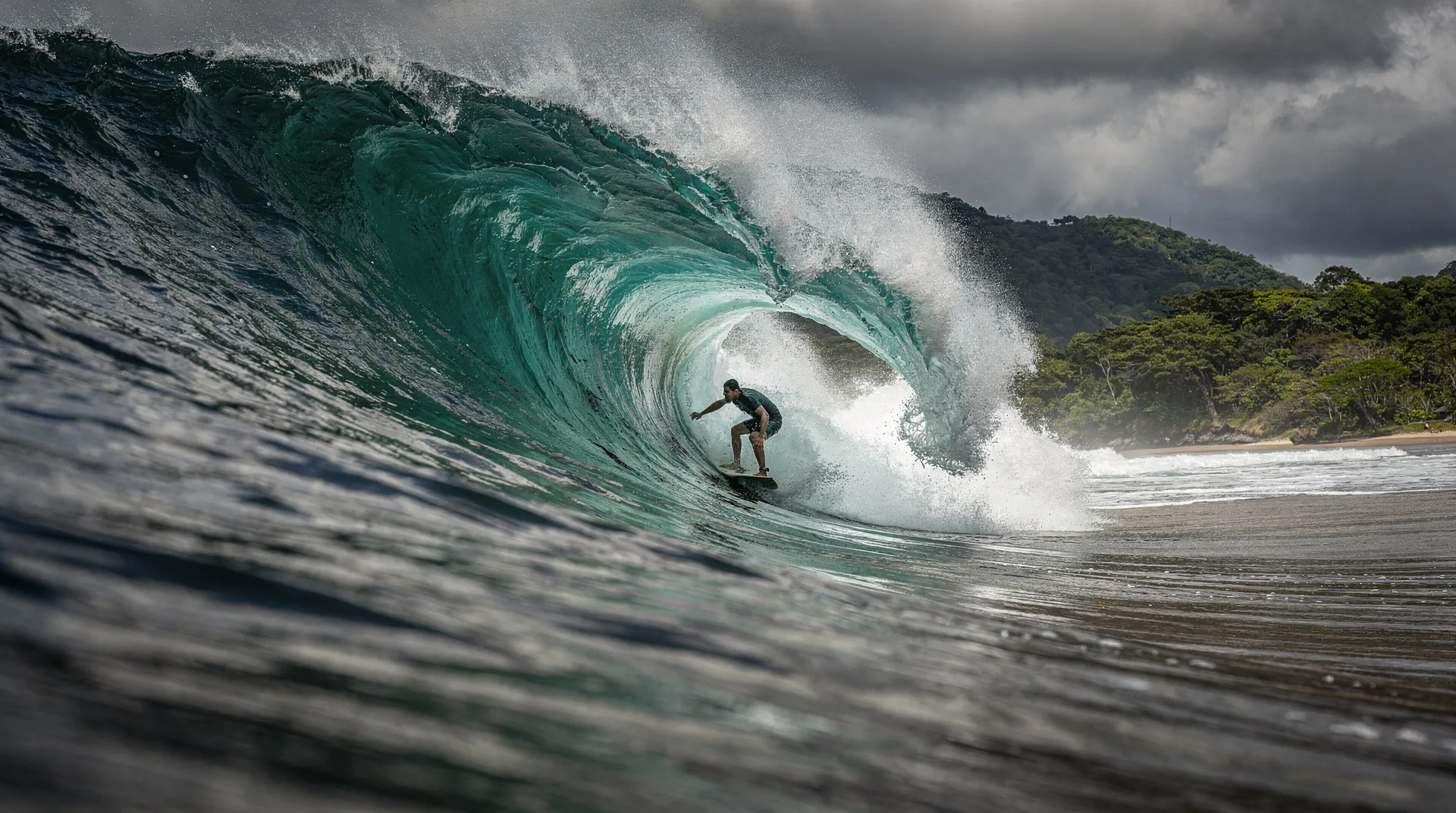
Dominical and the southern Pacific surf coast explained
Dominical vs Uvita for surf?
Dominical has a heavy, powerful shorebreak suited to advanced surfers only. Uvita offers gentler beach breaks and is more accessible to intermediate surfers. Neither competes with Tamarindo or Nosara for beginner instruction infrastructure.
The southern Pacific coast: a different surf experience
The stretch of Pacific coast between Jacó and Pavones — roughly 200 kilometres of coastline — is arguably the least covered chapter of Costa Rica’s surf story. Tamarindo and Nosara get the Instagram traffic. Santa Teresa gets the lifestyle magazine spreads. But the southern Pacific, anchored by Dominical on the north end and Pavones on the south, has been quietly producing some of the country’s most powerful and consistent surf for decades.
Dominical is the hub most travellers encounter on a southern Pacific trip, positioned roughly 40 kilometres south of Quepos on the Costanera Sur highway. The beach itself runs about 1.5 kilometres and is flanked by jungle on both sides. Uvita sits 18 kilometres further south, at the entrance to Marino Ballena National Park — better known for whale watching than surfing, but with beach break options that work for intermediate-level surfers on the right days.
Understanding how these two beaches differ in character will help you choose the right base and set the right expectations.
| Where | Dominical (40 km south of Quepos) and Uvita (18 km further south) |
| Skill level | Dominical: advanced only. Uvita: intermediate-friendly |
| Cost | Lessons $45-80; board rental $15-25/day |
| Best swell window | April-October (south swell), July-August most consistent |
| Getting there | Costanera Sur (Ruta 34); 3.5 hrs from San José, 40 min from Quepos |
Dominical: power, shorebreak, and the advanced-only reality
The wave character
Dominical is a beach break with a reputation for heaviness. The shorebreak here can produce thick, slab-like waves that dump fast and hard — not ideal for learning, and not even particularly enjoyable for intermediate surfers on bigger days. The shore dump alone has injured surfers who underestimated it approaching the water.
On smaller days (2–3 feet), Dominical can be fun and manageable for surfers with solid experience. On 4-foot-plus days, the wave moves into territory that requires strong paddling, good judgment about sets, and the ability to handle wipeouts in churning whitewater.
The best peaks at Dominical shift with the sands, but the north end near the river mouth typically produces longer left-handers on south swells, and the middle section offers more variable peaks.
Who should surf Dominical
Advanced surfers and strong intermediates who’ve surfed overhead waves consistently. If your home break is a heavy beach break and you handle that situation confidently, Dominical will feel familiar. If your home break is a gentler pointbreak or you mostly surf waist-to-chest high, Dominical on any day with real swell will be a challenge.
There’s an additional honest warning: Dominical’s shore dump has caused spinal injuries in tourists who didn’t take it seriously. Never enter the water at Dominical casually. Always watch the waves for 10 minutes before paddling out, assess the current and closing-out pattern, and pick your entry point carefully.
Surf schools and instruction
Despite its reputation, Dominical does have surf schools. Sunset Surf Dominical and Dominical Surf Academy both offer lessons on appropriate (small) days. If you want instruction in the southern Pacific, Dominical can work — but only when the surf coach tells you conditions are appropriate. If they cancel your lesson because the surf is too powerful, trust that judgment.
Group lessons: $45–55 per person. Private: $65–80. Board rentals: $15–25 per day.
Uvita: surf some of the best waves of Costa Rica 8 days — from $1495The 8-day southern Pacific surf experience
The GetYourGuide-listed 8-day southern Pacific surf experience based from the Uvita/Dominical area gives surfers a structured window into the coast’s best breaks, with local guide knowledge helping navigate which breaks to hit and when. This kind of guided format is particularly useful for the southern Pacific where swell-reading and break knowledge is harder to acquire quickly.
Uvita: the alternative for intermediate surfers
The wave character
Uvita’s beach breaks — primarily along Playa Uvita and Playa Ballena within the marine park — are less powerful and less hollow than Dominical’s. The continental shelf configuration here creates more drawn-out swells that break in gentler sections. On a 3-4 foot day, Uvita can produce genuinely enjoyable waves with rideable walls and manageable shore entry.
Uvita is not a famous surf destination and it shouldn’t be oversold. The waves are inconsistent in shape compared to Guanacaste’s better breaks. But as an intermediate surf option within a broader Uvita trip focused on whale watching and marine park activities, it adds value.
Who should surf Uvita
Intermediate surfers who are already visiting Uvita for other reasons and want some time in the water. Surfers making a dedicated surf trip should allocate Uvita as a day between more serious sessions elsewhere, not as a primary destination.
No dedicated surf schools operate in Uvita. You’ll rent a board from a shop in town and self-guide. The beach access is simple and the water generally safer than Dominical.
The broader southern Pacific surf map
Playa Hermosa (north of Dominical, near Jacó)
Not to be confused with the Guanacaste Playa Hermosa, this Playa Hermosa near Jacó is 15 kilometres north of Jacó on the Costanera. It’s one of the most powerful beach breaks in Costa Rica and home to the annual VC Pro surf competition. Seriously hollow right-handers that the national team trains on. Advanced and expert surfers only. For more context, see the Jacó surf guide.
Boca de Barú
Between Dominical and Uvita, this rivermouth break fires on specific swell angles — a relatively quiet discovery that rewards early exploration on surf forecasting days when the south swell is running. A 2WD vehicle can access the track in the dry season.
Pavones (far south)
The crown jewel of the southern Pacific — the left-hand point break with 3-minute rides that put Pavones in global surf legend territory. Advanced only, remote, and worth a dedicated trip. Full details in the Pavones guide.
Dominical vs Uvita: the direct comparison
| Dominical | Uvita | |
|---|---|---|
| Wave power | Heavy, hollow shorebreak | Gentler, more drawn-out |
| Best for | Advanced surfers, strong intermediates | Intermediate surfers, casual sessions |
| Surf schools | Yes, on appropriate days | None dedicated — self-guided rental |
| Non-surf draw | Jungle, rivermouth exploring | Marino Ballena National Park, whale watching |
| Amenities | Small, surf-town character | More developed — banks, pharmacies, supermarkets |
Beyond surfing: what else fills a southern Pacific day
A southern Pacific trip built purely around surf sessions leaves out some of the region’s best features. Uvita’s marine park access makes it easy to combine a dawn surf with an afternoon boat trip — the full Marino Ballena National Park guide covers the whale watching logistics. Inland from both towns, waterfall hikes and the Costa Rica marine life guide cover snorkelling alternatives on flatter days. Travellers continuing south toward Drake Bay and the Osa Peninsula often treat Dominical or Uvita as a one- or two-night stopover rather than a full base — the Costanera makes this an easy add-on rather than a detour.
Equipment and board rental considerations
Bringing your own board on a southern Pacific trip is worth considering more seriously here than on a Guanacaste trip, since the rental fleet in Dominical and Uvita is smaller and less specialised than in Tamarindo or Santa Teresa. If you already surf a shortboard confidently, a slightly higher-volume board than you’d use at home handles Dominical’s power better and is more forgiving on the paddle-out through the shorebreak. Airlines increasingly charge $100-200 each way for board bags on international routes, so factor this against local rental costs of $15-25 per day — for trips under two weeks, renting locally is usually the better value unless you have a specific board you’re unwilling to be without.
Getting to the southern Pacific coast
The Costanera Sur highway (Route 34) now runs continuously from Jacó to Palmar Norte, making the drive significantly faster than it was pre-2010. From San José to Dominical is approximately 3.5 hours. From Quepos to Dominical is 40 minutes.
From Tamarindo or Nosara (Guanacaste), the southern Pacific requires crossing the Puntarenas–Paquera ferry and driving south — budget 5–6 hours total. It’s a significant transit but the contrast between the crowded Guanacaste scene and the wilder southern coast makes it worthwhile.
4WD is recommended for Dominical to Pavones (if you continue south), especially in the wet season. The main Costanera is paved and standard-vehicle friendly.
Where to stay
Dominical: Hacienda Barú Lodge is the ecological standout, positioned on a wildlife refuge with good bird watching and comfortable bungalows ($140–180). Costa Paraíso is a mid-range beachside option ($100–140). Tortilla Flats is the surfers’ backpacker standby with $20 dorms and surfboard storage.
Uvita: Hotel Toucan is solid mid-range ($90–130). La Cusinga Lodge deserves special mention — an eco-lodge perched on a forested headland above the ocean, with outstanding ocean views and birding. $200–280 per night. Small and often booked out months ahead.
Dominical to Uvita combined stay: Many travellers split time between a cheaper Dominical surf hostel and a night or two at a Uvita eco-lodge. The 18-kilometre connection takes 20 minutes by car.
Food and amenities
Dominical is small but has genuine surf-town character. Soda Nanyoa for local casado meals. Café Mono Congo for strong coffee and breakfast. San Clemente Bar and Grill is the surf-culture gathering point — cold beer, good fish tacos, and a wall of historic surf photos.
Uvita has more amenities than Dominical despite being smaller as a surf destination — the marine park tourism brings better restaurant supply. Uvita Town has supermarkets, pharmacies, and banks that Dominical lacks.
Surfing and whale watching combined
One of the genuinely distinctive offerings of the southern Pacific is pairing surf with whale watching. Humpback whales visit Marino Ballena National Park in two seasons: August to October (southern hemisphere humpbacks) and December to April (northern hemisphere humpbacks). A morning surf at Dominical followed by an afternoon boat trip into the marine park is a memorable combination that you simply can’t replicate in Guanacaste.
The Marino Ballena National Park guide covers the whale watching logistics in full. For the surf trip planning side, also read surf seasons by region to understand when the southern Pacific is at peak power.
Uvita: surf some of the best waves of Costa Rica 8 days — from $1495Frequently asked questions about Dominical and southern Pacific surf
Is Dominical safe for intermediate surfers?
On small days (2–3 feet), a confident intermediate who’s surfed beach breaks before can manage Dominical. On anything above 4 feet, it requires genuine experience. Always observe the wave pattern before entering, and exit without attempting to dive through the shorebreak if the surf is large — walk out along the sand to the calmer entry point.
Can I learn to surf at Dominical?
Yes, with a proper instructor on appropriate days. Lessons are offered at local schools who know which days are safe for beginners. Do not self-guide into Dominical as a first surf experience. On days instructors deem unsuitable, there is no lesson — which is the correct answer.
How does Dominical compare to Santa Teresa?
Both are powerful beach breaks, but Santa Teresa has a wider variety of break types and more gentle sections within the same beach stretch. Dominical is more uniformly heavy. Santa Teresa has far better surf infrastructure (schools, equipment, camps). Dominical is better suited to experienced surfers seeking a wilder, less commercial experience.
What’s the best time of year for Dominical?
The south swell season from April through October, with July and August typically the most consistent. Winter swells (November–March) can produce fun surf but are less reliable.
Is Uvita worth adding to a surf trip?
As a day or two within a broader southern Pacific itinerary, yes. As a standalone surf destination, no. Come to Uvita for the marine park, stay for a surf session, and move on or south.
How far is Dominical from Manuel Antonio?
About 40 kilometres south — roughly 45 minutes by car on the Costanera. Many travellers combine Manuel Antonio (2–3 days) with Dominical (1–2 days) on a southern Pacific swing.
Related guides
The Pavones guide is essential reading for the southern end of this surf corridor. The surf seasons by region explains the swell dynamics that power this entire coast. The Jacó surf guide covers the nearest major surf hub to the north. Browse the Uvita destination page for whale watching, national park, and accommodation details that complete a southern Pacific trip.