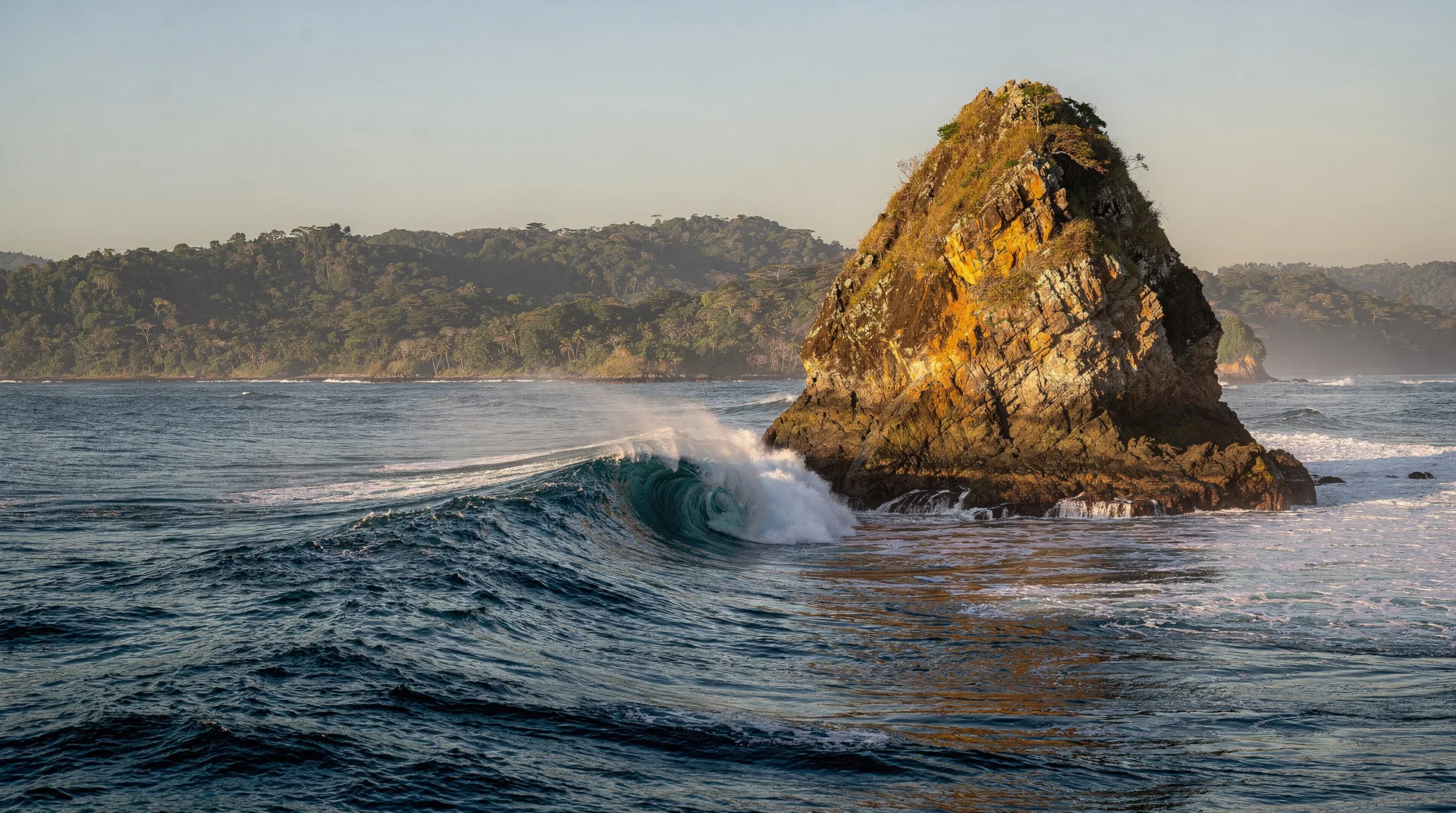
Witch's Rock and Ollie's Point: the Santa Rosa boat-access breaks
How to access Witch's Rock?
Boat from Playas del Coco or Ocotal, through Santa Rosa National Park (permit required). Advanced surfers only — 4-foot minimum mandatory, coral reef bottom. No road access. Day trips depart at 5–6am and cost $80–120 per person including SINAC park fee.
The pilgrim breaks of northern Guanacaste
Witch’s Rock and Ollie’s Point are not the most famous waves in Costa Rica — that honour belongs to Pavones. But for advanced surfers visiting the northern Pacific, these two breaks represent a specific kind of aspiration: remote, boat-access waves inside a protected national park, requiring genuine capability to surf and genuine planning to reach.
Both breaks sit within or adjacent to Santa Rosa National Park in northern Guanacaste — Costa Rica’s first national park, established in 1971 and covering more than 49,000 hectares of dry forest, coastline, and biological significance. The surf access regulations that govern these breaks exist primarily to protect the park ecosystem and limit the human impact on what is otherwise a largely undisturbed Pacific coastal zone.
This guide covers both waves, the logistics of access from Playas del Coco or neighbouring beaches, honest assessments of who should surf here, and what to do when the swell is too big for your level.
| Where | Santa Rosa National Park, boat from Playas del Coco or Ocotal |
| Cost | Around $80–120/person, incl. SINAC park fee |
| Level | Advanced only (Ollie’s more forgiving than Witch’s) |
| Best season | November–March, north/northwest swell |
| Booking | 3–5 days ahead on a confirmed swell |
Witch’s Rock (Roca Bruja)
The wave
Witch’s Rock is a beach and reef break combination at a remote cove called Playa Naranjo, inside Santa Rosa National Park. The break takes its name from the large offshore rock formation — a dramatic volcanic boulder field that juts from the ocean and creates the swell shadow and refraction that gives the wave its character.
The main break at Witch’s Rock is a hollow left-hander that breaks over a mixed sand and rock bottom. On a solid swell (4–6 feet), it produces steep, punchy sections that barrel on the reef sections and give way to a longer sand-bottom wall further inside. On bigger days (6–8 feet), the take-off becomes critical and the reef consequence becomes real.
The right-hander that forms on the opposite side of the cove breaks over a more forgiving sand bottom and is marginally more accessible to advanced intermediates — but even this option requires solid wave-reading ability and paddling strength to navigate the offshore swell zone.
Character and reputation
Witch’s Rock entered global surf consciousness partly through the 2002 surf film “Endless Summer II” sequel “Step into Liquid” and partly through its inclusion in various “top breaks in Central America” lists. The reality is consistent: on the right swell, it delivers world-class hollow surf in an extraordinary natural setting. On the wrong swell — too small, too big, or wrong angle — it’s flat, closeout, or dangerous.
The swell window that produces the best Witch’s Rock conditions is the north and northwest swell season from November through February. During Guanacaste’s dry season, the Santa Rosa coastline picks up North Pacific swells that create the hollow beach break conditions the wave is known for. South swells in the green season can also produce sessions but the angle is less optimal for the main break.
Who should surf Witch’s Rock
Advanced surfers who can comfortably paddle out and ride overhead waves with confidence. The offshore take-off zone requires reading the swell properly — paddling out directly into the impact zone without local knowledge is a common beginner’s error that results in immediate punishment.
Experienced intermediates (able to surf consistently overhead) can enjoy the sand-bottom sections on days when the wave is running 3–5 feet without excessive consequence.
Do not paddle out at Witch’s Rock if:
- You are still working on your pop-up
- You’ve never surfed a reef break before
- You cannot reliably read lineup priority
- The swell is over 6 feet and you haven’t surfed big waves before
The consequence of getting it wrong is a heavy wipeout onto rock or a difficult paddle against current in open water without easy shore access.
Board and gear considerations
A step-up board (a shortboard with slightly more volume and length than your everyday board) is the right call for Witch’s Rock on anything overhead — it paddles into the wave earlier and handles the punchier sections with more control. Bring at least two boards if possible; the reef sections at Witch’s Rock and the cobblestone bottom at Ollie’s both carry real risk of dings or a snapped board, and there is no surf shop at either location. A reef-safe leash plug repair kit and extra wax are worth packing, since the nearest shop is back in Coco.
Ollie’s Point
The wave
Ollie’s Point sits roughly 10 kilometres north of Witch’s Rock, closer to the Nicaraguan border, at a location accessed only by boat. The wave is a long right-hand point break that peels over a cobblestone and rock bottom — very different from the punchy beach break character of Witch’s Rock.
Ollie’s right-hander is significantly longer and more structured. On a good north swell, the wave peels from a defined take-off point and runs 200–400 metres before ending in a channel. The sections are more workable than Witch’s Rock — longer, more predictable, and more forgiving in the sense that you get more time to set up turns. However, the take-off itself is critical and the cobble bottom is unforgiving on falls.
The wave was reportedly named after Oliver North, the US military figure who used the area during the 1980s — a detail of history that sits oddly alongside the beauty of the break but has stuck as local surf lore.
Swell requirements and seasonality
Ollie’s Point works best on northwest and north swells from October through March. The point orientation catches north energy efficiently and the refraction around the headland produces clean, organised lines. In the green season, south swells hit the break at a less optimal angle and produce shorter, less impressive rides.
The dry season window (November–March) produces some of the cleanest Ollie’s Point sessions — light offshore winds in the morning, consistent north swell, and the extraordinary dry forest setting of Santa Rosa changing from grey-brown (peak dry) to green as the rains arrive in April.
Seasonality at a glance
| Period | Swell | Conditions | Verdict |
|---|---|---|---|
| Dec–Feb | Consistent N/NW | Offshore mornings, clean lines | Most reliable window |
| Nov & Mar | N/NW, building/fading | Good but less consistent | Solid secondary option |
| Apr–Jun | Transitional | Variable, first rains | Hit or miss |
| Jul–Oct (green season) | South swells | Less optimal angle, choppier boat ride | Only for flexible trips |
If your trip dates are flexible and Witch’s Rock or Ollie’s Point is a priority, build the visit around December through February rather than fixing the date first and hoping the swell cooperates.
How to access Witch’s Rock and Ollie’s Point
The boat from Playas del Coco or Ocotal
The standard access point is Playas del Coco (Coco Beach), about 35 kilometres from Liberia. Operators running surf day trips to Santa Rosa NP depart from Coco’s dock at 5–6am — the early start is necessary because the one-way trip to Naranjo (Witch’s Rock) takes 45–60 minutes by panga (small open boat) and you need to be in the water by first light to catch the best morning conditions.
The journey from Coco to Ollie’s Point is 1.5–2 hours.
Day trip cost: $80–120 per person, typically including the SINAC (national park) entrance fee of approximately $15–20.
Most operators require a minimum group of 3–4 surfers to make the trip viable. Solo surfers should ask operators to connect them with other groups departing on the same swell day.
The SINAC permit requirement
Santa Rosa National Park requires an entry permit for surf access through Playa Naranjo — the administrative hub. This is not a casual detail: the park actively enforces the permit requirement and boats without permits can be turned back. Reputable surf operators handle the permit as part of their service. If you’re arranging your own panga, confirm the permit situation before departure.
The permit system also limits daily visitor numbers to both breaks, which is by design — it is what keeps Witch’s Rock and Ollie’s Point from becoming the commercial circus that accessible breaks like Tamarindo become in high season.
Land access — technically possible, practically inadvisable
A rough dirt road runs through Santa Rosa National Park to Playa Naranjo. In the dry season, 4WD vehicles can technically reach the area after a 7–8 kilometre drive on extremely rough track from the park entrance. In the wet season, this route is impassable.
Most surfers who have attempted land access report that the 4WD track is so punishing that it’s genuinely easier (and cheaper considering vehicle risk) to take the boat. Park rangers also generally prefer the boat-access system as it aligns with visitor management goals.
What to expect on the day
Boats depart at dawn, and the rhythm of a Witch’s Rock or Ollie’s Point day is: boat ride in rising light, arrive at the break for early morning session, surf 3–4 hours, eat lunch packed from Coco, optional afternoon session if swell is good, return by 3–4pm.
The lunch break is spent at Playa Naranjo — a remote, beautiful beach backed by dry forest. Wildlife encounters (howler monkeys, iguanas, white-tailed deer) are common along the tree line. The isolation of the location makes the day feel unlike any commercial surf excursion.
Bring: enough water for the full day (no services at the break), reef-safe sunscreen, a rash guard, cash for the operator (credit cards rarely accepted on the dock), and snacks.
If you’re not ready for Witch’s Rock
Being honest with yourself about your level matters more here than at almost any other Costa Rica break — the consequences of paddling out over your head are real. If you’re still progressing, the beginner surf spots guide and the best surf beaches guide cover forgiving, sand-bottom breaks where mistakes cost you a wipeout, not a reef injury. A week or two at a surf camp building wave-reading skills and paddle fitness is a better investment than an ambitious Witch’s Rock day that ends in a rescue.
Advanced intermediates who want a taste of boat-access adventure without the full commitment can also look at Nosara’s surf scene as a lower-consequence base with a similarly serious surf culture.
No direct GYG inventory for Witch’s Rock
Unlike Tamarindo or Jacó, Witch’s Rock and Ollie’s Point do not have dedicated GetYourGuide listings. The break is managed through small local operators based in Coco and Ocotal — find them through your accommodation in the area, surfing forums, or the Santa Rosa park administration.
For surfers planning a northern Guanacaste trip that combines Witch’s Rock with instruction-based days, Tamarindo’s surf schools (particularly Witch’s Rock Surf Camp, which takes its name from the break) offer guided day trips to Naranjo as part of week-long programs.
Tamarindo surf: learn and practice surfing — from $50Combining Witch’s Rock with a broader Guanacaste surf trip
Most surfers visiting Witch’s Rock use Tamarindo or Playas del Coco as their base. Tamarindo is closer to the surf schools and has more accommodation variety; Coco is slightly closer to the boat departure point and has a livelier nightlife scene.
A well-structured 7–10 day northern Guanacaste surf trip might look like: 3 days Tamarindo (warm-up, school sessions, Langosta); 1 day Avellanas or Playa Negra (intermediate progression); 2–3 days based in Coco (dive-site proximity + 2 surf days at Witch’s Rock/Ollie’s on swell days); 1–2 days transition south toward Nosara.
On a flat or oversized day, the swell-free hours are well spent on the water in a different way: from Coco, an evening snorkel session at sunset — from $95 makes a calm counterpoint to a dawn surf mission, and from Tamarindo, a boat trip through the estuary mangroves — from $45 is an easy rest-day option for tired shoulders.
The Tamarindo surf guide covers the base camp details. The Playas del Coco destination page covers accommodation and logistics in Coco. The surf seasons guide explains the November–March north swell window that makes Witch’s Rock most consistent.
Frequently asked questions about Witch’s Rock and Ollie’s Point
Can intermediate surfers surf Witch’s Rock?
Advanced intermediates — able to comfortably ride head-high+ unbroken waves, read lineup priority, and handle reef consequence — can manage Witch’s Rock on smaller days (3–4 feet) on the sand-bottom sections. On any day above 5 feet, it is firmly in advanced territory. Be honest with your operator about your level; they will guide you to the appropriate section.
What is the best time of year to surf Witch’s Rock?
November through March for the north swell window. December, January, and February are typically the most consistent months. The dry season also provides offshore winds and excellent visibility for the boat ride. South swell season (May–October) can produce sessions but the angle is less ideal.
How far in advance should I book the boat trip?
On a specific swell day during a good window, boats fill up. Contact operators 3–5 days ahead when you can see a swell on the forecast. Outside peak season, same-day or next-day arrangements are often possible by asking around the Coco dock.
Is the boat ride rough?
In calm conditions, the ride is comfortable enough even in a small panga. During the green season when swells are larger and wind choppier, the 45-minute ride to Naranjo can be quite rough. If you are prone to motion sickness, take medication before the trip.
What happens to the boat if the surf is too big?
Experienced operators will not land their boat at Naranjo if the surf is dangerously large. This is the right call. If you’ve booked a trip and conditions are deemed unsafe, you typically get a refund or reschedule. Don’t pressure operators to proceed in conditions they’ve assessed as dangerous.
Is Ollie’s Point easier to surf than Witch’s Rock?
In some respects, yes. The longer, more structured right-hand point gives riders more time to read sections and set up turns compared to the quick, punchy lefts at Witch’s Rock. However, the cobblestone bottom at Ollie’s is harder to fall on than the sand sections of Naranjo. Both require advanced capability; neither is a beginner option.
Is there any surf near Playas del Coco itself?
The Coco bay beach doesn’t produce good surf — the bay is too sheltered. The diving around the Catalina Islands is excellent from Coco (see our diving guide), and Playa Hermosa Guanacaste is 10 minutes south with a more protected bay break on appropriate small days.
Related guides
The surf seasons by region guide explains the north swell window that makes Witch’s Rock work. The Santa Rosa National Park guide covers the broader park context — historically significant and ecologically rich beyond the surf. The Tamarindo surf guide is the base-camp companion for most surfers combining Tamarindo with a Witch’s Rock day. For advanced break comparisons, see Pavones on the opposite end of the country.