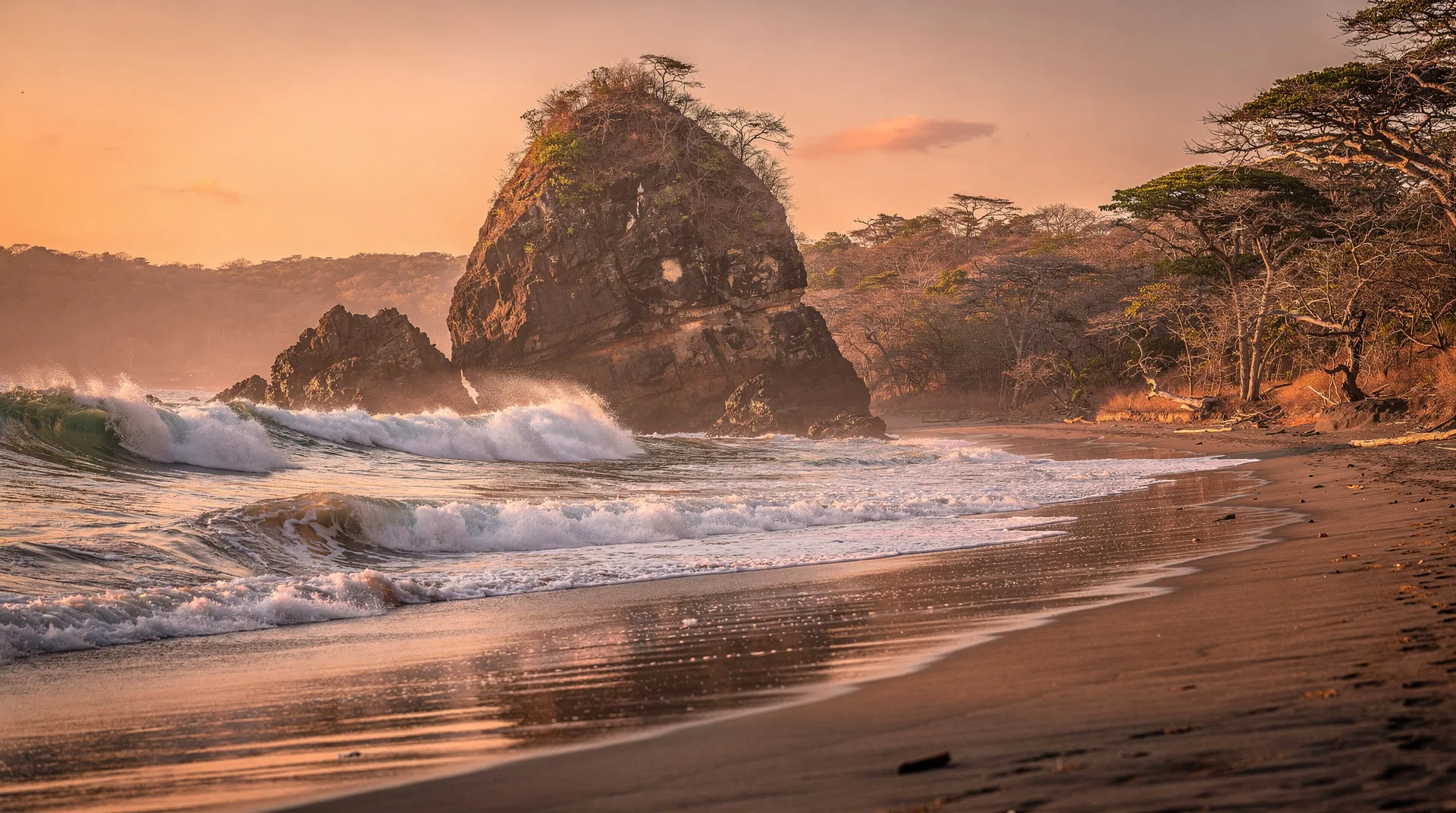
Santa Rosa National Park: dry forest, history, surf, and Guanacaste's wild north
What's special about Santa Rosa National Park?
Santa Rosa is Costa Rica's oldest national park and protects the largest remaining piece of tropical dry forest in Central America. It contains the La Casona hacienda — site of three decisive battles in Costa Rican history — plus the famous Witch's Rock surf break, nesting beaches for four sea turtle species, and one of the best dry-season wildlife concentrations in the country.
Costa Rica’s oldest park: where history and ecology meet
Santa Rosa National Park was the first protected area established in Costa Rica, created in 1971. It was founded primarily to protect La Casona — a historic hacienda that has served as the site of three separate battles critical to Costa Rican and Central American history. The ecological and historical importance of the park cannot be separated, making Santa Rosa unique among Costa Rican parks in having a genuinely significant cultural heritage alongside its natural features.
The park covers 53,000 hectares within the larger Guanacaste Conservation Area (a UNESCO World Heritage Site). It extends from the dry Guanacaste plain to the Pacific coast, encompassing the Murcielago Annex to the north — an isolated coastal section accessible separately. The park protects the largest remaining piece of tropical dry forest in Mesoamerica, a critically threatened ecosystem that has been reduced by over 98% from its original extent across Central America.
Santa Rosa is undervisited compared to the major park destinations. There are no luxury lodges, no zip lines, no hot spring spas adjacent to the entrance — it is a working national park in the older sense, focused on conservation and natural experience over tourist amenity. This is a feature for some travellers, a barrier for others.
| Entry fee | Around $15 per person |
| Hours | Tuesday–Sunday, 8am–4pm (closed Mondays) |
| From Liberia | 35–40 minutes, paved road |
| Best for | History, dry forest wildlife, surf breaks, sea turtles |
| Vehicle | 2WD fine to La Casona; 4WD for beach roads |
La Casona: the historic heart of the park
La Casona (The Big House) is the original hacienda building at the centre of the park’s cultural significance. It has been the site of three historically defining moments:
1856 — Battle of Santa Rosa: During William Walker’s attempt to conquer Central America, the Battle of Santa Rosa on March 20, 1856 saw Costa Rican forces rout Walker’s mercenary army in 14 minutes. This victory — celebrating the 19th birthday of the man who would become President Juan Rafael Mora Porras — is one of the most celebrated moments in Costa Rican national identity. The hacienda courtyard is where the final confrontation occurred.
1919 — Tinoco overthrow: La Casona was again a staging ground during the political upheaval that ended Federico Tinoco Granados’ dictatorship.
1955 — Figueres vs Somoza: When Nicaraguan-backed forces invaded Costa Rica in 1955 after the abolition of the military, La Casona served as a command post for the defending forces.
The original casona building was destroyed by arson in 2001 — widely believed to be the work of poachers angry at park rangers’ enforcement. It was meticulously reconstructed and reopened in 2002, now housing a museum that presents the ecological and historical significance of the park. The museum is modest but genuinely informative.
Visiting La Casona: Open Tuesday through Sunday. The museum and hacienda grounds take about 1 to 1.5 hours. The surrounding yard and garden have good bird activity — great horned owls roost in the trees adjacent to the building.
The tropical dry forest ecosystem
Dry forest is the rarest, most threatened tropical forest type globally. Unlike rainforest, it experiences a pronounced dry season (December to April in Guanacaste) during which most trees lose their leaves. In February and March, Santa Rosa looks more like a savannah than a tropical forest — golden, parched, with dramatic flowering trees standing bare against blue sky.
This seasonal extreme creates a wildlife concentration that is paradoxically better for viewing than dense evergreen forest. Without leaf cover, animals are visible at distances impossible in rainforest. Water sources become magnets — the few remaining puddles and streams attract every species in the park simultaneously.
Dry season wildlife:
- White-tailed deer are very common and visible in open areas
- Peccary herds of 20 to 50 individuals move between water sources
- Coatis form large groups in the drier forest sections
- Armadillos are easier to spot in leaf-free conditions
- Coyotes — rare elsewhere in Costa Rica — inhabit the savannah edges of Santa Rosa
Rainy season: The forest transforms completely in May, turning vivid green within days of the first rains. The bird diversity increases dramatically as migratory species arrive. Turtle nesting on the beaches peaks from July through December.
Sea turtle nesting: Playa Naranjo and Playa Nancite
Santa Rosa protects two important Pacific turtle nesting beaches:
Playa Nancite (olive ridley mass nesting): One of only a few beaches in the world where the olive ridley sea turtle conducts its mass nesting event, the arribada. During an arribada, thousands of females synchronously emerge to nest over a period of 3 to 7 days, usually on nights around the new moon or last quarter moon, August through December. Playa Nancite is a research station beach — public access is restricted to permit holders and scientific visitors, coordinated with the park administration in Santa Rosa.
Playa Naranjo: A more accessible beach (12km from the park entrance by dirt road + 7km walk) used by olive ridleys, Pacific greens, leatherbacks, and hawksbills at various times of year. Access is possible with a park permit, though the distance makes it a full-day commitment without a 4WD.
Witch’s Rock and Ollie’s Point: surf legend
Santa Rosa encompasses two of the most famous surf breaks in Costa Rica, both accessible only by boat from Playa del Coco or Tamarindo with a park permit:
Witch’s Rock (Roca Bruja): A solitary black rock emerging from the ocean about 2km offshore from Playa Naranjo. The reef break here produces long, powerful right-hand waves that require genuine surfing competence — typically recommended for intermediate to advanced surfers. The wave breaks over a rocky bottom and can produce barrels in optimal conditions. The setting — a lone volcanic rock in turquoise water surrounded by the Santa Rosa coastline — is as dramatic as surfing locations get.
Ollie’s Point: A right-hand point break on the northern coast of the park (near the Murcielago Annex), accessible only by boat. Named after Oliver North, who allegedly used the beach as a supply point during the Iran-Contra affair (the park’s airstrip was later found to have been used in the operation). The wave is powerful, consistent in dry season, and beloved by experienced surfers who make the boat journey specifically for it.
Both breaks are within national park boundaries. All visitors to these beaches must have a park permit and arrive by licensed boat operator — private boat access is regulated. The boat trips typically originate from Playa del Coco, about 1.5 hours south.
No dedicated GYG surf tour currently operates for Santa Rosa’s surf breaks. The closest practical option is learning surf basics in Tamarindo (which lies 2 hours south) and arranging a Santa Rosa boat trip locally from Playas del Coco.
Tamarindo surf: learn and practice surfing — from $50Entry fees and practical information
Entry fee: $15 per person (main Santa Rosa sector). Collected at the entrance station.
Opening hours: Tuesday through Sunday, 8am to 4pm. Closed Mondays.
Main park entrance: Located on the Panamerican Highway (Highway 1), 35km north of Liberia. The entrance is clearly signed.
Road conditions: The main park road to La Casona is paved. Roads beyond La Casona to the beaches are unpaved and require a 4WD in rainy season.
Camping: Camping is available at designated sites near La Casona and on Playa Naranjo (with a longer drive and hike). Reserve through SINAC in advance.
Hiking trails within reach of La Casona
Most visitors underestimate how much walking Santa Rosa offers close to the main entrance, without needing the long beach roads. The Indio Desnudo trail (about 1 hour round-trip) loops through dry forest near La Casona and is the easiest introduction to the ecosystem, well-marked and shaded in parts even during dry season. The Los Patos trail extends further and is more likely to reward with peccary or coati sightings if walked in early morning. Both trails are self-guided and require nothing beyond the park entry fee, sturdy shoes, and water — there is no shade relief on the more open savannah stretches, so timing your walk for early morning or late afternoon matters in the dry season heat.
If you want more dry forest than a trail walk gives you
Santa Rosa is a place to walk and look, not to be entertained, so some travellers leave wanting a second, more active taste of the same landscape. Elsewhere in Guanacaste you can explore dry-forest terrain from a vehicle, for example on an ATV ride through dry forest country — from $110 , which pairs well with a quiet morning at the park. Our ATV tours by region guide compares the options. If someone in your group is more interested in wildlife than history, a guided outing combining sloth spotting and a waterfall — from $120 is another way to fill a second day in the area. For tips on spotting animals once you are on the trail, see the wildlife photography tips and wildlife watching ethics guides.
Planning the season around your priorities
Your reasons for going should drive the timing. History and museum visitors are well served at any time of year, since La Casona is indoors and the drive is easy. Wildlife watchers will usually prefer the dry months, when bare trees and scarce water make animals easier to find. Birders and travellers who like a green, lively landscape may prefer the first months of the rains. Check the best time to visit Costa Rica and the dry season pros and cons guides, plus the green season pros and cons, to weigh the trade-offs. The microclimates explained guide shows why Guanacaste behaves so differently from the rest of the country. If you are renting a vehicle, our driving in Costa Rica and road conditions by region pages help you judge the unpaved sections, and the Guanacaste province page gives broader context for the region.
Combining Santa Rosa with a Guanacaste beach base
Most visitors treat Santa Rosa as a day trip from a beach base rather than a standalone destination, and the logistics support that. From Tamarindo or Playas del Coco, the drive to Santa Rosa runs 1 to 1.5 hours via Liberia, making it a comfortable half-day or full-day addition to a Guanacaste beach holiday. Our Guanacaste beach guide and best Pacific beaches guide cover the resort towns that pair naturally with a Santa Rosa day trip, and the costa rica wildlife overview situates the park’s dry forest species within the country’s broader wildlife picture.
Wildlife in the dry forest: a birding standout
Santa Rosa’s avifauna is extraordinary for dry-forest specialists — birds you will not find in the wetter national parks:
- White-throated magpie jay (the gregarious, brilliant blue-and-white corvid of Guanacaste)
- Turquoise-browed motmot (bright, calm, easy to observe)
- Lesser ground-cuckoo (rare, secretive, dry forest specialist)
- Orange-fronted parakeet flocks
- Crested caracara — the “Mexican eagle” is common throughout the grassland sections
- Laughing falcon (with its extraordinary resonant call)
- Black-headed trogon (dry forest representative of this family)
For birders, Santa Rosa offers species unavailable anywhere else in Costa Rica outside the dry northwest. Combining it with Palo Verde National Park (the wetland park to the southeast) covers both the dry forest avifauna and the waterbird spectacle in one Guanacaste circuit.
Getting there from Liberia
From Liberia (LIR airport): 37km north on Highway 1. A straight, paved drive of about 35 to 40 minutes.
From Tamarindo: 1.5 hours via Liberia on Highway 1.
From San José: 4 hours via Highway 1 (Panamerican Highway north).
Public buses on the San José–Peñas Blancas route pass the park entrance — ask the driver to stop at “Santa Rosa.”
Frequently asked questions about Santa Rosa National Park
Is Santa Rosa worth visiting over Rincón de la Vieja?
They offer different experiences and are not mutually exclusive if you have time. Rincón de la Vieja has the volcanic features (mud pools, fumaroles, thermal spas) that Santa Rosa lacks. Santa Rosa has the historical heritage, the dry forest ecosystem, and the coastal beaches with sea turtles that Rincón lacks. If you can only choose one: Rincón de la Vieja is more spectacular and easier to combine with tourism amenities. Santa Rosa is better for birders, history enthusiasts, and travellers who value more remote, less-developed parks.
Can I see an arribada of olive ridley turtles?
Public access to Playa Nancite (the main arribada beach) is restricted due to research and conservation priorities. Occasional permitted visits are possible through coordination with the park administration — contact SINAC’s Guanacaste Conservation Area office months in advance if this is a specific goal. The less-controlled olive ridley beaches at Ostional Reserve (between Nosara and Santa Cruz) are more publicly accessible during arribada events.
Is there accommodation near the park?
There are no lodges inside Santa Rosa or immediately adjacent to the entrance. Liberia (35km south) has a full range of accommodation from budget to mid-range. Camping inside the park is available as described above.
How does Santa Rosa differ from the other Guanacaste parks?
Santa Rosa (dry forest, history, surf beaches), Rincón de la Vieja (volcanic activity, thermal features), and Palo Verde (wetland birds) together represent the three main ecological and tourism experiences of Guanacaste. Santa Rosa is the least tourist-developed of the three and requires the most self-sufficiency.
Do I need a 4WD to visit Santa Rosa?
Not for the main sector — the road to La Casona and the entrance is paved. You only need 4WD if you plan to continue beyond La Casona to Playa Naranjo or Playa Nancite, where the roads are unpaved and can be rough, especially in rainy season.
Is Santa Rosa suitable for a half-day visit?
Yes, and it’s the most realistic option for most visitors. La Casona, the museum, and the Indio Desnudo trail together make a satisfying 2 to 3 hour visit that fits well alongside a beach day elsewhere in Guanacaste. The beach sections require a much longer commitment and are better suited to visitors with a full day and the right vehicle.
Where to fit Santa Rosa in your itinerary
Santa Rosa works as either a standalone day trip from Liberia or as part of a northern Guanacaste loop that combines it with Rincón de la Vieja and Palo Verde. The 5-day Guanacaste resort itinerary can include a Santa Rosa day for visitors particularly interested in history or dry forest birding. For surf-focused visitors, see our Witch’s Rock and Ollie’s Point guide for logistics on accessing the park’s surf breaks from Coco or Tamarindo.