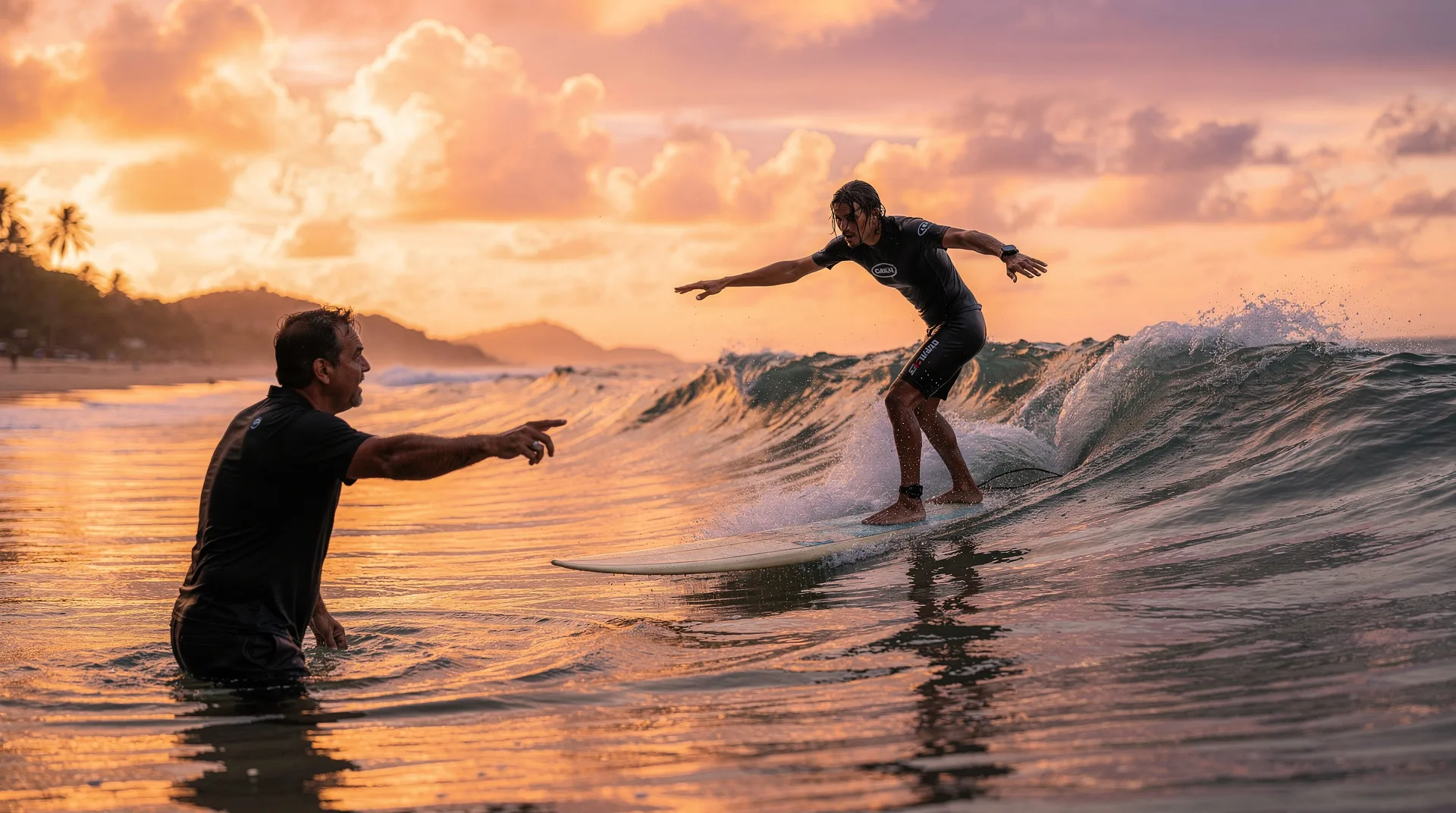
Tamarindo surf guide: learn, ride, repeat
Is Tamarindo good for beginners?
Yes — gentle reform waves at Tamarindo Beach plus dozens of surf schools make it Costa Rica's most beginner-friendly surf town. Consistency is strong year-round, though the crowd factor rises sharply in December–April.
Tamarindo is Costa Rica’s most accessible surf town — a genuine strength for beginners and a genuine crowding problem at peak hours.
| Best for | Beginners, families, first-timers |
| Main break | Playa Tamarindo (gentle reform waves) |
| Step-up breaks | Langosta, Playa Avellanas, Playa Negra |
| Group lesson cost | Around $40–55 per person |
| Getting there | ~1hr from Liberia (LIR), 4-5hrs from San José |
Why Tamarindo keeps pulling surfers back
Few places in Costa Rica blend accessibility, consistency, and beginner friendliness as effectively as Tamarindo. The main beach curves around a broad bay on the northern Nicoya coast of Guanacaste, about an hour’s drive from Liberia’s international airport (LIR). Swell arrives year-round, the water stays warm at 27–29°C, and the town has built an entire economy around teaching people to stand up.
That convenience comes with trade-offs. Tamarindo is busy — more Airbnb than fishing village — and the main beach can feel crowded with whitewash lessons. But the breaks themselves are varied enough that intermediate and advanced surfers find their corners too, especially during the dry-season south swell of May through October.
This guide covers every wave, school, and seasonal consideration you need to plan a surf trip here, honest about both the highlights and the kook traps.
The main breaks around Tamarindo
Tamarindo beach (Playa Tamarindo)
The heartbeat of beginner surfing in Guanacaste. The southern end of the main beach produces long, peeling reform waves — waves that break once, flatten into a channel, then reform with enough power to pop up on but without the hollow punch that intimidates newcomers. On a typical swell day, this section sees 1–3 foot waves with a forgiving close-out that lets you ride into the shallows.
The northern end gets slightly more power where the estuary mouth creates a sandbar. This section attracts intermediate surfers looking for a small but punchy right-hander. Don’t paddle into this zone during lessons — it gets territorial at peak hour.
Playa Langosta
A 20-minute walk south of town, or a quick ride on a golf cart, Langosta is Tamarindo’s step-up option. The right point at the south end fires up on larger swells (4 feet+) and offers long, workable walls that reward surfers who can generate speed and project turns. The beach break between the rocks provides shorter, hollow sections — not for beginners, but excellent for intermediates consolidating their repertoire.
Langosta is far less crowded than the main beach and worth the walk on any day the swell is head-high or above.
Playa Avellanas (day trip)
About 25 minutes south by car — or an hour on unpaved road — Avellanas hosts Little Hawaii, one of Guanacaste’s most respected beach break peaks. Consistent hollow left and right-handers up to 6 feet, virtually no instruction crowd, and a local crew that expects you to know the etiquette before paddling out. This is not a beginner break. Intermediate surfers with solid pop-up, able to read lineup, and comfortable in shore dump will love it.
Playa Negra (further south)
An hour’s drive from Tamarindo, Playa Negra hosts one of Costa Rica’s classic right-hand reef breaks. Head-high to overhead barrelling rights over a boulder reef — advanced surfers only. The wave breaks fast, the take-off is critical, and a wrong move lands you on rock. Bring your own board; rentals here are sparse.
When to surf Tamarindo
Year-round consistency
Tamarindo gets rideable surf every month of the year, which is one reason it dominates tourist itineraries. Residual north swells arrive through boreal winter (December to February), producing smaller but fun 2–4 foot surf. Even in the flattest weeks, 1–2 foot runners allow lessons to run daily.
South swell season (April to October)
The best weeks for Tamarindo’s more advanced breaks come from the south and southwest swells generated in the Southern Ocean, peaking through June, July, and August. Expect consistent 4–6 foot surf on Langosta and Avellanas. The “veranillo” — a mini-dry period within the green season — typically hits late June to mid-July and delivers glassy morning sessions with strong swell. This is the real surfer’s window.
Flat spells and wind
December to March can produce extended flat periods of a few days, especially when the Papagayo winds kick in hard. These northerlies push chop across the bay and make the main beach onshore and messy by 10am most mornings. Dawn patrol (before 7am) during Papagayo season is the antidote. The reward for early rising is glass water and zero competition in the lineup.
Surf schools and lessons in Tamarindo
Group lessons: $40–55 per person
Every surf school in Tamarindo offers 2-hour group sessions that include board and rash guard. The instruction format is universally similar: beach briefing, foam board, gentle waves, whitewash practice, then progressing into small green-water waves if the student progresses. Quality varies significantly between operations.
Reputable schools include Witch’s Rock Surf Camp (the original Tamarindo school, still reliable after 25 years), Banana Bay Surf School (smaller groups, good instructor-to-student ratio), and Blue Surf Sanctuary (focuses on the yogic/surf lifestyle combination). Avoid any school that lines up more than 6 students per instructor — control disappears and learning slows.
Tamarindo surf: learn and practice surfing — from $50Private lessons: $65–85 per hour
Private lessons accelerate progress significantly. An experienced coach can spot whether your pop-up issue is timing, arm position, or weight distribution in a way that group sessions cannot. A 2-hour private on a good day at Langosta’s right will teach you more than three group lessons at the main beach.
Board rentals
Budget $15–25 per day for a foam softboard, $20–30 for a used hard board. Most schools rent by the hour as well. Shops along the main road include Witch’s Rock, Blue Surf, and several unnamed beachside stalls. Compare boards before committing — foam boards are fine for beginners, but intermediate surfers benefit from a genuine thruster or fish shape.
Getting to Tamarindo
Fly into Liberia (LIR) — the closest airport, about 1 hour away. Rental cars from LIR are abundant and most roads into Tamarindo are now paved, though a short dirt section remains on the Nosara fork. From San José (SJO), budget 4–5 hours including the Santa Cruz connection or take the Sansa internal flight from SJO to Tamarindo’s small airstrip (25 minutes, roughly $80 one-way).
Shuttles from Liberia start at $35 per person. GrayLine and Interbus both serve the route. For day trips to Avellanas or Playa Negra, a rental car or local taxi driver hired by the half-day (about $60) is the most efficient option.
Where to stay in Tamarindo
The town has accommodation at every price point. For surfers, proximity to the beach matters more than luxurious extras.
Budget: El Pueblo Hostel and Pura Vida hostel both sit within walking distance of the main break and offer surfboard storage, board wash-down areas, and local tip-sharing among guests. Dorms from $18–25 per night.
Mid-range: Hotel El Jardín del Edén is a reliable mid-range pick with a good pool, $120–160 per night. Cala Luna Boutique Hotel is a step up in quality, better for couples, $180–230.
Surf camps with accommodation: Witch’s Rock Surf Camp packages combine accommodation, lessons, and guided sessions from roughly $700–1,100 per week depending on room type and lesson frequency. Their instructors know every break in the area and run small groups.
Where to eat in Tamarindo
La Bodega for solid breakfast burritos and local fruit plates. Seasons by Shlomy for upscale dinners without the tourist markup. El Coconut for reliable seafood on a terrace. Nogui’s, a Tamarindo institution, serves cold beers and consistent ceviche at fair prices — queue at lunch.
Avoid the beachfront restaurants with laminated picture menus and touts outside. They are consistently overpriced for what you get.
What to skip
Sunset tours marketed to surfers. Several companies package catamaran sunset cruises alongside surf lessons as a day combo. The catamaran trip is pleasant but takes you off the water in the late-afternoon glass-off, which is often the best surf window of the day. Keep them separate.
Surfboard storage on motorcycles or golf carts without proper racks. Fins snap and decks crack. Walk your board to the beach or pay the $5 golf cart rack fee.
The main beach during school hours (9am–12pm). It becomes a foam-board obstacle course. Paddle to Langosta or take the afternoon session instead.
A note on local etiquette
Tamarindo’s lineup has been well-trafficked for decades, and the local surf community — a mix of Tico surfers from the area and foreign expats who settled here — expects basic courtesy. Give way on set waves if someone is already up. Don’t snake. Don’t drop in. If you’re a beginner, stick to the whitewater zone and graduate into the lineup gradually. The respect you show on day one will earn you goodwill for the rest of your trip.
For more context on timing your visit around peak surf conditions, see our surf seasons by region guide and our Guanacaste destination page.
Tamarindo: horseback to Tamarindo Beach — from $60If Tamarindo isn’t quite the right fit
Tamarindo’s strength — accessibility and beginner infrastructure — is also its main drawback for anyone chasing quieter or more powerful waves. If crowding is a dealbreaker, Nosara offers more consistent intermediate waves with fewer people in the water, about 2 hours south.
For advanced surfers specifically, the boat-access breaks at Witch’s Rock and Ollie’s Point reward the extra cost and effort with far less crowded lineups than anything reachable by road from Tamarindo. And if you’re weighing Tamarindo against Costa Rica’s other beginner towns before booking flights, the beginner surf spots guide puts it side by side with Sámara and Jacó.
For anyone planning a full week of coaching rather than daily drop-in lessons, see the surf camps guide — Witch’s Rock’s own camp is based here, and the packaged week often works out better value than booking lessons day by day.
Frequently asked questions about Tamarindo surf
How big do waves get at Tamarindo beach?
The main beach typically runs 1–4 feet, occasionally reaching 5–6 feet on strong south swells in June–August. Langosta point can hold 6–8 foot sets on exceptional days. The main beach is never truly hollow — it’s a soft, slow-breaking reform wave ideal for learning.
Is Tamarindo crowded for surfing?
Yes, especially from December to April. The main beach fills up with lessons between 8am and noon, and the lineup gets competitive on smaller days. Dawn patrol (before 7am) and afternoon sessions (after 3pm) are noticeably less crowded. In May–November, crowd pressure drops significantly.
Can I surf Tamarindo year-round?
Yes. There is always rideable surf somewhere near Tamarindo at any time of year. The gap months of March–April can see brief flat spells, but even then, a drive to Playa Negra or Avellanas usually turns up swell. May–October is the most consistent period for surf over 4 feet.
Do I need to book surf lessons in advance?
During peak season (December–March) and on weekends, yes — popular schools fill up. Walk-ins are possible in the green season. Booking 48 hours ahead is a safe rule throughout the year.
What surf level do I need for Playa Avellanas?
Intermediate at minimum. You should be comfortable paddling through chest-high shore break, reading lineup priority, and riding unbroken green waves confidently. Beginners should not paddle out at Avellanas on any day the swell is over 3 feet.
Are there female-focused surf programs?
Yes. Witch’s Rock Surf Camp and Blue Surf Sanctuary both run women-only weeks seasonally, featuring smaller group ratios and coaching that addresses female-specific surf mechanics. Check current schedules on their websites.
How far is Tamarindo from Nosara?
About 2 hours by road — the route via Sámara is fully paved. Many surfers use Tamarindo as a base for day trips or combine a few nights in each spot on a 7–10 day Pacific surf itinerary.
What is the water temperature in Tamarindo?
Consistently 27–29°C year-round. You do not need a wetsuit at any time of year. A rash guard is essential for UV protection during long sessions — the Guanacaste sun is extremely strong, and equatorial UV burns fast even on overcast days.
Related guides
Tamarindo works best as part of a wider surf exploration of the Pacific coast. The beginner surf spots guide compares Tamarindo to Sámara and Jacó for first-time surfers. The Nosara surf guide covers the next step up in wave quality 2 hours south. For a full seasonal picture, read our surf seasons by region breakdown before booking flights.