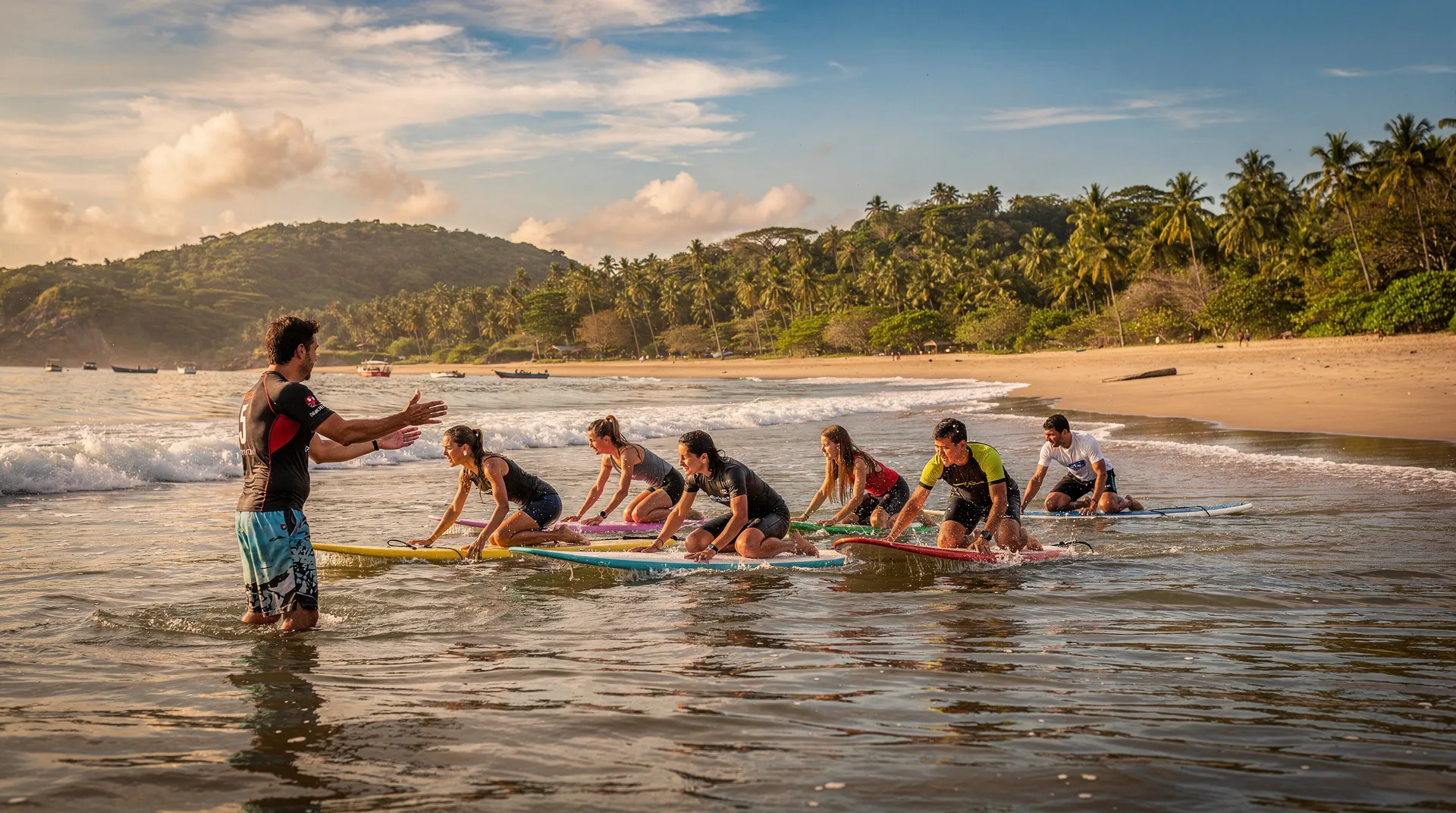
Best beginner surf spots in Costa Rica: honest picks by level
Best beaches to learn to surf in Costa Rica?
Tamarindo for infrastructure and consistency, Sámara for the gentlest protected bay, Jacó for accessibility from San José. Playa Hermosa (Guanacaste) works on small days. Avoid Santa Teresa and Dominical for first lessons.
Choosing your first Costa Rica surf break: what actually matters
Not all beginner surf advice is equal. The internet is full of lists that rank breaks by aesthetics or destination fame rather than actual learnability. This guide prioritises the factors that genuinely matter for someone taking their first or second surf lessons:
- Wave character: Slow-breaking, forgiving whitewash or reformed waves, not heavy shorebreak.
- Bottom: Sand-bottom beaches without reef or rock hazards in the impact zone.
- Instruction quality: Certified instructors, appropriate board selection, managed class sizes.
- Currents: Manageable rip currents that don’t require advanced swimming.
- Accessibility: Getting there shouldn’t require a 4WD, a ferry, and a prayer.
Costa Rica scores highly on all these factors at the right spots — and there are genuinely excellent beginner waves along multiple stretches of the Pacific coast. The mistake is conflating “famous surf destination” with “good place to learn,” when the correlation is often the opposite.
| Best overall | Tamarindo — infrastructure and consistency |
| Gentlest wave | Sámara — reef-protected bay |
| Most accessible | Jacó — 2.5hrs from San José |
| Group lesson cost | around $40-55 for 2 hours |
| Avoid for first lessons | Santa Teresa, Dominical, Pavones |
If you are still deciding where to base yourself, the destination pages for Tamarindo, Sámara and Jacó cover lodging, food and how each town feels once you step off the beach.
Tamarindo: Costa Rica’s best overall beginner surf base
Tamarindo is the country’s most developed surf school destination for a combination of reasons: the main beach break produces gentle, slow-breaking reformed waves that are ideal for first-timers; the wave is consistent year-round; and the town has invested decades into surf instruction infrastructure.
The wave
The southern end of Playa Tamarindo is where most lessons happen. The wave breaks first well offshore, losing significant power as it rolls toward the beach, arriving as a slow, pushy reform that gives beginners 3–5 seconds of ride before it dies in shin-deep water. The first lesson experience of standing up and riding a reformed wave into the beach without drama is more likely here than at most other Pacific beaches.
The bottom is sand throughout the lesson zone, with no rocks or reef to worry about. The shore entry and exit is calm.
Schools
Tamarindo has the most surf schools of any Costa Rica beach. Witch’s Rock Surf Camp (25+ years experience), Banana Bay, Blue Surf Sanctuary, Iguana Surf, and numerous smaller operations all offer beginner programs. Group lessons run $40–55 per person for 2 hours. Private lessons $65–85.
The competition keeps quality up — schools with poor instruction lose students quickly in a market this competitive.
Tamarindo surf: learn and practice surfing — from $50Honest caveats
The main beach gets crowded with lessons between 8am and noon in peak season (December–April). Thirty foam boards in the whitewash zone simultaneously is an experience. Avoid the morning school rush by booking afternoon lessons or very early sessions. The town itself is the most commercialised surf destination in the country — not the tranquil Costa Rica of the brochures.
Best months for learning: year-round possible. December–April for stable sunny weather; May–October for slightly bigger waves that progress intermediates faster.
Once you have a few lessons behind you, the Tamarindo surf guide explains the neighbouring breaks, and Witch’s Rock and Ollie’s Point shows what the famous boat-access waves look like — worth knowing about, though well beyond beginner level. Reading the tide and surf conditions guide before you book also helps you understand why your instructor picks one hour over another.
Sámara: the most gentle and protected beginner beach
Sámara is the single best beach in Costa Rica for true first-timers who want the gentlest possible introduction. Located on the mid-Nicoya coast 2 hours south of Tamarindo, Sámara’s protected bay is shielded by a reef that breaks up approaching Pacific swell before it reaches the shore, creating a calm, beginner-friendly wave environment almost year-round.
The wave
The Sámara surf is genuinely gentle — 1–3 feet, slow-breaking, and exceptionally forgiving. There’s no shore dump, no rip current drama, and very little consequence for mistakes. Children and complete non-swimmers adapting to the ocean for the first time find Sámara far less confronting than Tamarindo’s main beach.
The trade-off: Sámara won’t excite intermediate surfers and won’t teach progression beyond basic pop-up and riding whitewash. It’s the ideal first-timer environment and a limited second-timer environment.
Schools
Carrillo Surf School and several smaller operations in Sámara offer beginner lessons from $40–50 per person. The town is significantly quieter than Tamarindo and the lessons reflect that — smaller groups, more one-on-one time, slower pace.
Getting there
Sámara is about 3.5 hours from San José by car (south on Route 23, then the Nicoya Peninsula road). The road is now fully paved. A direct bus from San José operates daily (about 5 hours). This is the practical downside — Sámara requires more travel than Tamarindo or Jacó for visitors based in the capital.
Honest caveats
Sámara is not ideal if you want to progress beyond absolute beginner after your first few sessions — the wave is too gentle to develop real surfing skills. Visit Sámara for your first 3–4 lessons, then move north to Tamarindo or Nosara for real progression.
Sámara also suits families with cautious children, since the calm water that helps a first-timer helps a nervous child too. The kid-safe beaches guide and the wider Nicoya Peninsula beaches overview put the bay in context with other calm options nearby, and the Sámara destination page covers the town itself.
Jacó: the accessible option for San José visitors
Jacó earns its place on the beginner list primarily through geography. At 2.5 hours from San José on the paved Route 27, it’s the most accessible Pacific surf beach from the capital — a day trip is entirely feasible, a weekend trip straightforward.
The wave
The central section of Jacó’s main beach produces 2–4 foot reformed waves on standard swell days — suitable for beginner lessons. It’s slightly heavier and more powerful than Tamarindo’s main break, which is both a mild downside for first-timers (more consequence) and a mild upside for second-timers (more progression stimulus).
The beach is wide, with multiple entry points, and the lesson zones are managed away from the heavier southern section.
Schools
Surf Synergy Jacó, Carve Surf School, and Jacó Surf Academy all provide structured beginner programs. Lesson prices match the market: $45–55 group, $65–85 private. The higher competition means quality schools have refined their systems.
Jacó: surf lesson with certified instructor — from $50 Jacó Beach: learn to surf - surf for families — from $55For families specifically
Jacó is particularly well set up for family surf experiences. The wide, flat beach entry, designated lesson zones, and family-focused school packages make it the most practical choice for parents learning alongside children. Foam boards, rash guards, and patient coaching are standard at all the main schools.
Honest caveats
Jacó’s town character — nightlife, casinos, commercialism — is not for everyone. It’s a beach town that prioritises entertainment alongside surf. If you want nature and tranquility alongside your lessons, Tamarindo or Sámara will suit you better.
Whatever beach you pick, learn the local water rules before your first session. The beach safety guide explains rip currents and how to ask locals about conditions, which matters at a busy Pacific beach like Jacó.
Playa Hermosa (Guanacaste): the gentle neighbour of Coco
Playa Hermosa in Guanacaste (not the advanced one near Jacó) sits on a protected bay between Playas del Coco and Ocotal, close to Liberia airport. On small days — which are common December through April during the Papagayo wind season — the bay shelters from the north and produces calm, 1–3 foot waves ideal for lessons.
The wave
Protected enough to reliably produce gentle conditions for beginners when the north swells are running, Playa Hermosa Guanacaste is a good supplementary option for travellers staying in the Coco or Papagayo resort area. It is not a destination surf beach — the wave is inconsistent in quality and shape — but it works as a lesson venue when conditions align.
Schools and lessons
Several schools operate in the Coco area and teach at Hermosa on appropriate days. Expect to pay standard rates ($45–55 group lessons) with transport included if you’re based in a Papagayo hotel.
Honest caveats
This is not a first-choice destination for a dedicated surf trip. The wave is too inconsistent and the resort atmosphere too polished to feel like a genuine surf town. It serves travellers who are already in the area for other reasons (Rincón de la Vieja, nearby diving, resort stay) and want to add a surf session.
The Playas del Coco destination page and the Playa Hermosa Guanacaste page describe the area in more detail, and the Guanacaste beach guide helps you compare the surrounding beaches if surfing is only one part of the stay.
Beaches to avoid for beginners
The following beaches are frequently mentioned in general Costa Rica travel content but are genuinely unsuitable for beginner surfing:
Santa Teresa: Powerful beach break with fast, heavy waves. Lessons happen here, but the learning curve is steep and the consequences of mistakes are real. Come after you can already ride unbroken waves.
Dominical: Heavy shorebreak. Shore dump alone has injured tourists. Not a beginner environment.
Playa Hermosa (near Jacó): This is the powerful one — national team training break, advanced only. Do not confuse with Guanacaste’s Playa Hermosa.
Pavones: Advanced-only point break. The concept of a beginner lesson here is essentially fictional. The Pavones longest left guide explains why it draws experienced surfers only.
When you are ready to see why these breaks are rated as they are, the Santa Teresa surf guide and the Dominical and southern Pacific surf guide describe their conditions in detail.
Salsa Brava (Puerto Viejo): Expert-only reef break. Heavy, shallow coral, not for anyone below advanced.
Building a learning progression in Costa Rica
Here’s a realistic progression framework for a dedicated surf learning trip:
Days 1–2 (Sámara or Tamarindo): Complete beginner lessons in whitewash. Pop-up technique, paddling, basic ocean reading.
Days 3–5 (Tamarindo or Jacó): Moving into green unbroken waves. Learning to read lineup, basic turns, paddling technique refinement.
Days 6–8 (Nosara or Jacó step-up): Intermediate-level peaks. Longer rides, beginning turns, reading the lineup for position.
Day 9+ (Santa Teresa or Avellanas): Introduction to more powerful waves with a coach. First real shortboard sessions.
This kind of structured progression in 10 days, with good coaching, produces surfers who can genuinely surf — not just stand up once.
If you would rather have the route planned for you, the 10 days surf trip on the Pacific itinerary strings together beaches in a sensible order. The Nosara surf guide and the Nosara destination page are useful for the middle step of the progression above.
Surf lesson pricing across the main beginner spots
| Location | Group lesson | Private lesson | Board rental/day |
|---|---|---|---|
| Tamarindo | $40–55 | $65–85 | $15–25 |
| Sámara | $40–50 | $60–80 | $15–20 |
| Jacó | $45–55 | $65–85 | $15–25 |
| Playa Hermosa (GUA) | $45–55 | $65–80 | $15–20 |
All lessons include foam board and rash guard as standard at reputable schools.
Frequently asked questions about beginner surf spots in Costa Rica
How old do you need to be to learn to surf in Costa Rica?
Most schools accept children from 6–7 years old for beginner lessons in calm conditions. There’s no upper age limit — surfing is learned successfully well into the 60s when introduced correctly in appropriate waves. Schools with family programs can accommodate multiple generations in one session.
Do I need to be able to swim to take surf lessons?
Strictly speaking no — lessons happen in shallow water and instructors supervise directly. However, being a confident swimmer significantly reduces anxiety and improves learning. Anyone who is afraid of deep water should be transparent with their instructor before the session begins.
Is it worth taking lessons versus trying to self-teach?
In Costa Rica’s Pacific conditions, yes unambiguously. Self-teaching in the ocean is slower, more dangerous, and often ingrains bad habits that are harder to correct later. Two good lessons with a qualified instructor will put you years ahead of the self-taught approach.
Which beach has the safest entry for non-swimmers?
Sámara, by a significant margin. The protected bay and gentle slope mean you’re in waist-deep water for the entire lesson zone. Tamarindo’s lesson section is also very safe. Avoid self-guided beach entry at any Pacific beach without first asking a local about current conditions.
Can I rent a board without taking a lesson?
Yes, board rentals are available at all the main locations. If you’re a beginner renting without instruction, stick to a large foam board (8–9 feet minimum) and stay in the whitewash zone close to shore until you understand the ocean environment.
What’s the best time of day for beginner lessons?
Morning (7–10am) universally. Wind is lightest, crowds are thinnest, and fatigue is lowest. Afternoon sessions are offered by most schools but you’ll often contend with onshore wind (particularly in the dry season) and the cumulative fatigue of a warm afternoon.
What to expect from your first two lessons realistically
Most reputable schools structure the first lesson around whitewash riding: paddling technique, the pop-up motion practiced on sand, then repeated attempts catching broken waves into shore. A realistic first-lesson outcome is standing up 3-8 times over two hours, with rides lasting a few seconds each. The second lesson usually builds on this — instructors start positioning you slightly further out to catch waves just as they break, which produces longer, more controlled rides.
Don’t expect to be surfing green (unbroken) waves after two lessons; that typically takes 5-10 sessions of consistent practice. If you’re planning a short trip and want a genuine sense of progression rather than a single souvenir photo, budget for at least 3-4 lessons across consecutive mornings at the same school — instructors who see you repeatedly can correct specific habits rather than starting from scratch each time.
Related guides
The Tamarindo surf guide covers the top beginner destination in full detail. The Jacó surf guide covers the central Pacific option. For timing your trip around swell and wind conditions, the surf seasons by region guide is essential reading.
Once you’re ready to progress, the surf camps in Costa Rica guide covers week-long programs that accelerate intermediate development. For a full skill-level breakdown once you’re past absolute beginner, see best surf beaches by level, and if you’re travelling with young children, our best family beaches guide covers calm-water options beyond the surf lesson zones.