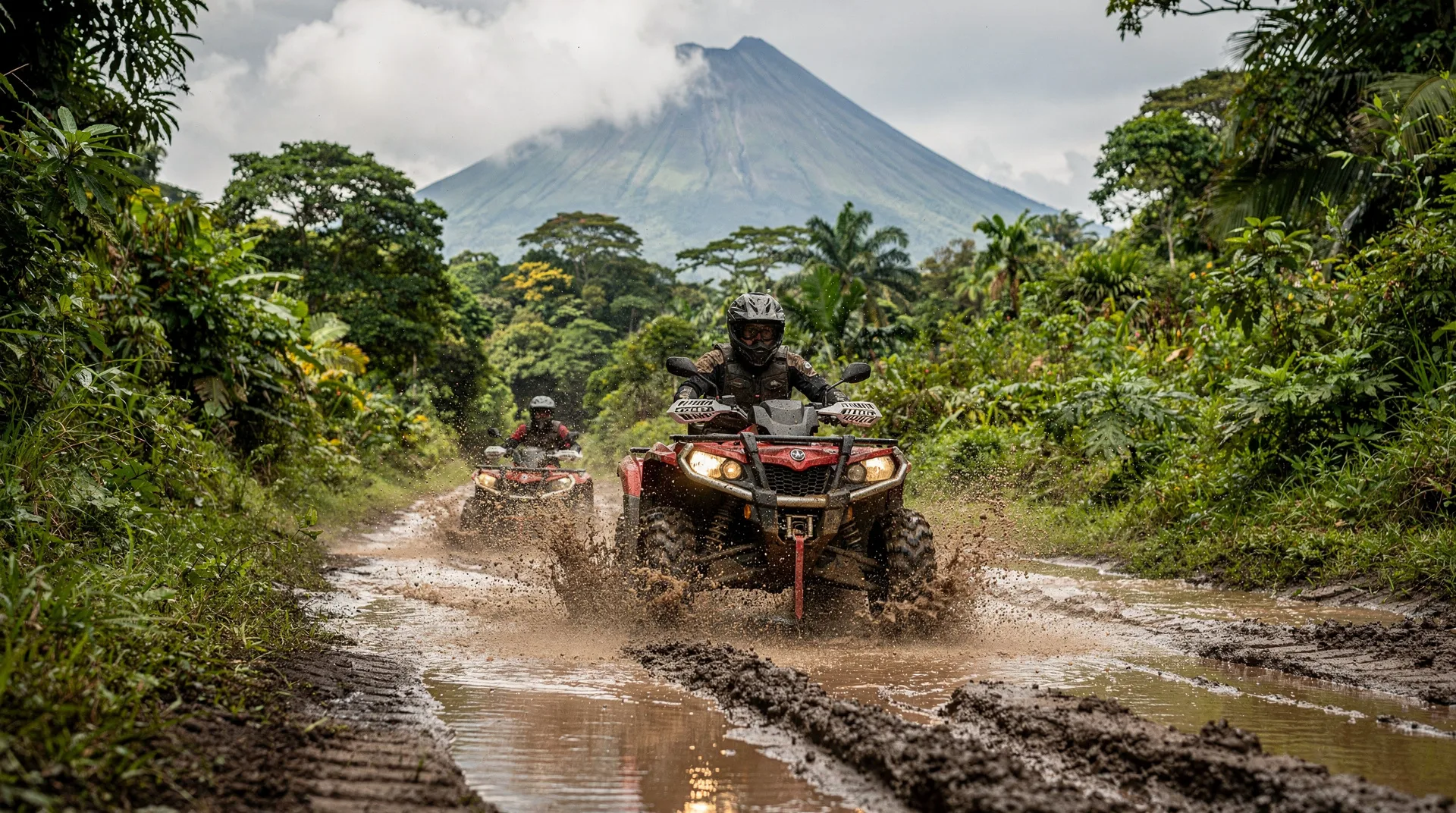
ATV tours in Costa Rica: the best regions and what to expect
Best ATV tour regions?
Guanacaste dry forest, Uvita coast, La Fortuna jungle. Each offers a completely different landscape — from Pacific beach hopping to volcanic forest tracks. Prices range $95-165 per person.
ATV riding in Costa Rica: terrain, operators, and honest advice
Costa Rica’s road network is famously rough. Outside the main highways, gravel tracks wind through jungle, volcanic foothills, dry forest, and coastal lowlands — and much of that terrain is exactly what makes ATV touring genuinely worthwhile rather than just a novelty. You can reach viewpoints, river crossings, and remote beaches that would take hours on foot and are inaccessible by standard rental car.
The activity attracts a wide range of visitors — families with teenagers, couples looking for a half-day adrenaline hit, and seasoned off-roaders who want to use the machines as a legitimate way to explore remote terrain. What changes significantly is the landscape, and that is what this guide organises around.
If you are still deciding where to base yourself, the destination pages for La Fortuna, Uvita and Guanacaste province show what else each area offers around the ATV circuits. Our best time to visit Costa Rica guide helps you match the season to the landscape you want.
| Where | Guanacaste dry forest, La Fortuna/Arenal jungle, Uvita southern Pacific |
| Cost | around $95-175 per person depending on region and duration |
| Time needed | 3-6 hours depending on the circuit |
| Best for | teens and adults comfortable with basic vehicle coordination |
| Best time | morning departures (6:30-9am) minimise rain risk in wet season |
Guanacaste: dry forest and beach hopping
Guanacaste on Costa Rica’s northern Pacific coast has a landscape unlike anything else in the country. From December to April, the dry season turns the forests golden and brown, leaving wide open sightlines across low dry-forest hills, river valleys, and Pacific headlands. ATV tours here navigate across that terrain and often combine beach access with forest tracks.
La Cruz and Papagayo region
The region around La Cruz, inland from Playa Hermosa and close to the Nicaraguan border, has some of the most extensive dry-forest ATV circuits in the country. The terrain alternates between open savannah, dry forest, and river floodplains. Wildlife sightings are common — white-faced capuchins, coatis, and iguanas are regularly seen on the tracks.
La Cruz, Guanacaste: ATV tour in tropical dry forest — from $110The Guanacaste dry-forest circuit covers around 25-30 km of mixed terrain and takes approximately three hours. Price is around $110 per person. Guides point out wildlife and explain the ecological differences between dry and wet tropical forest, which adds genuine educational value.
Santa Cruz: mountains and coast
Santa Cruz’s ATV circuit combines higher elevation forest tracks with descents to Pacific beaches. The variation in terrain is significant — you climb through scrubby hillside vegetation before dropping to sea-level beach access that is only reachable by ATV or on foot. Some operators add a beach swim break of 30-40 minutes.
Guanacaste: ATV beach and mountain adventure — from $120Price is around $120-130 per person for the four-hour experience. The dual terrain — forest and coast — makes this a strong choice if you want to see genuine landscape variety in a single session.
Brasilito: zipline and beach combination
Brasilito, close to Playa Conchal in northern Guanacaste, is the hub for a popular combined ATV and zipline package. The ATV portion covers coastal tracks with views across Bahía Brasilito to Isla Catalina, followed by a zipline circuit and optional beach time at Playa Conchal — one of Costa Rica’s most visually striking beaches, named for its white shell-fragment sand.
Guanacaste: ATV and zipline adventure with beach hopping — from $165The combination package runs $165-175 per person and takes five to six hours. It is the priciest Guanacaste option but packs in three distinct activities. Families with teenagers consistently rate it as one of the best-value full-day experiences in the north Pacific region.
La Fortuna and the Arenal region
La Fortuna’s ATV tours navigate a very different environment: dense jungle tracks, volcanic soil, and views toward Arenal Volcano. Because the Arenal watershed receives consistent rainfall throughout the year, the terrain is lush and green regardless of when you visit — which means this region looks spectacular even in the dry season when Guanacaste’s forests are brown.
Arenal jungle and river circuit
The main La Fortuna ATV circuit covers approximately 20-25 km through jungle tracks and volcanic foothills, crossing rivers (typically shallow enough for the ATVs at most times of year) and reaching elevated viewpoints with sightlines toward the volcano on clear mornings.
La Fortuna de Arenal: volcano, river, and forest ATV tour — from $95 Diamante Eco Adventure Park ATV tour — from $95Price is around $95-105 per person for a three-hour tour. This is the most affordable ATV experience among the major Costa Rica hubs, which reflects the relatively straightforward terrain rather than any compromise in quality. Operators include hotel pickup from La Fortuna town. If the volcano itself is the main draw of your stay, pair the ride with our Arenal Volcano National Park guide and the Arenal ziplines overview.
The volcano views are genuine but weather-dependent. Arenal is covered by cloud for much of the year — early morning departures (7-8am) offer the best chance of clear sightlines. If the volcano is obscured, the jungle track is still a worthwhile experience in its own right.
Uvita and the southern Pacific coast
Uvita, near Marino Ballena National Park on the southern Pacific coast, offers ATV touring in a setting quite distinct from either Guanacaste or Arenal. The southern Pacific receives heavy rainfall year-round, and the result is deeply green primary and secondary forest descending to the coast. The ATV circuits here are closer to jungle trail riding than the open-terrain experiences in Guanacaste.
Uvita coast and buggies circuit
Uvita’s main ATV and buggy circuit combines open buggies (two-person side-by-side vehicles as well as standard single-rider ATVs) with coastal tracks through secondary forest and river crossings. The route often incorporates views across the Marino Ballena whale tail formation from elevated positions in the hills above town.
Uvita: ATV & buggies adventure tour — from $95Price is around $95-110 per person for a three-hour circuit. The buggy option (side-by-side) is a good choice for couples or parents and children who want to ride together rather than independently. The Uvita circuit tends to be muddier and more technical in wet season (May-November), which adds to the adventure for those who want it. The same stretch of coast is home to Marino Ballena National Park, which makes a calm companion day to the noise and mud of the ATV circuit.
How to choose the right ATV experience
Consider the landscape you want: Guanacaste for open dry-forest views and Pacific beaches; Arenal for volcanic jungle and river crossings; Uvita for lush southern Pacific coastal forest.
Consider time of year: Guanacaste is driest and most photogenic December-April. Arenal is reliable year-round. Uvita’s muddy green-season tracks are genuinely more exciting for experienced riders.
Consider combination packages: The Brasilito ATV plus zipline package in Guanacaste, and the many Arenal canyoning-plus-ATV combinations, offer good value if you want to fill a full day with back-to-back activities. For a broader sense of how ATV touring compares in intensity to other adrenaline options, see our extreme adventure routes overview and bungee jumping options guides.
Consider who is riding: Solo ATVs require basic coordination and enough physical strength to steer over rough ground. Children under 12 are typically required to ride as passengers in buggies rather than solo. Minimum age for solo riding is usually 16 with a valid driving license (some operators allow 14 with parental accompaniment).
Safety and practical notes
ATV operators in Costa Rica are required to hold ICT certification. That said, the quality of machines varies significantly. Before setting off:
- Inspect the ATV for functioning brakes (test before leaving the staging area), working kill switch, and secure helmet fit
- Ask whether insurance coverage for third-party damage is included (most operators carry basic liability)
- Confirm whether the quoted price includes fuel (it should, but it is worth asking)
- Listen to the safety briefing fully, including what to do if the vehicle tips or stalls in water
Wear long sleeves and trousers regardless of the heat — gravel spray on open skin is uncomfortable, and sun exposure on a slow-moving ATV is more intense than it feels. Closed-toe shoes are required at all operators; sandals will be refused.
Pricing summary
| Region | Operator type | Duration | Price per person |
|---|---|---|---|
| Guanacaste dry forest (La Cruz) | Solo ATV | 3 hours | $110 |
| Santa Cruz mountains and coast | Solo ATV | 4 hours | $120 |
| Brasilito + zipline + beach | ATV + zip combo | 5-6 hours | $165 |
| La Fortuna jungle | Solo ATV | 3 hours | $95 |
| Uvita coast and buggies | ATV or buggy | 3 hours | $95-110 |
Private group pricing (4+ people, advance booking) is typically 10-15% below the listed per-person rate. Ask directly with the operator at time of booking.
Best ATV tour combinations by base location
The strongest ATV experiences per base location:
If you are staying in La Fortuna: The 3-hour Arenal jungle circuit in the morning pairs with an afternoon visit to Mistico hanging bridges or hot springs. A morning canyoning trip (ending by 1pm) can also combine with an afternoon ATV if the operator has afternoon departure slots. Desafio and other La Fortuna operators co-ordinate these combinations.
If you are staying in Tamarindo or Playa Flamingo: The Santa Cruz mountain-and-coast circuit or the Brasilito ATV-plus-zipline combo are within 30-45 minutes. The Brasilito full-day package gives you beach hopping, off-road terrain, and a zipline circuit in a single day — appropriate if you want to minimise logistics.
If you are staying in Liberia: Access to both the Guanacaste dry-forest circuit (La Cruz area, 30 minutes north) and the Rincón de la Vieja National Park zone (45 minutes east). Some operators run ATV tours that approach the Rincón volcanic zone for terrain variety.
If you are staying in Manuel Antonio or Uvita: The Uvita coast and buggy circuit is 15-30 minutes from most Manuel Antonio accommodations. It is the shortest-logistics ATV option for Pacific coast visitors and a natural afternoon activity after a morning Manuel Antonio National Park visit.
If you are staying in Monteverde: Surprisingly good ATV access — the rough terrain around Santa Elena and the Monteverde foothills is excellent for off-road riding. Several local operators run circuits through dairy farms and forest patches with volcano views. This is less frequently marketed than the zipline and cloud-forest experiences, making it a less-crowded option.
Frequently asked questions about ATV tours in Costa Rica
Do I need an international driving license for ATV tours?
For organised tours on private off-road circuits, a driving license of any kind is not technically required — you are on private land and the operator’s insurance covers the activity. For tours that cross public roads (some circuits in Guanacaste do), operators typically ask to see a valid driving license, international or national.
What is the best age for ATV tours with children?
Most operators set minimum age at 16 for solo riding and allow children 5-15 as passengers in buggies or double ATVs. The Brasilito combo package and Uvita buggy option are the most family-friendly because the buggy seating allows parent and child to ride side by side.
How physically demanding is ATV riding?
Less than most people expect. Steering on flat or gently rolling terrain requires modest upper-body effort. Rougher terrain with rocks, ruts, and river crossings requires more active physical engagement to keep the vehicle on course. Anyone in reasonable health can complete the standard circuits. People with neck, shoulder, or lower-back injuries should consult a doctor first.
Can I do an ATV tour if I have never driven one?
Yes. Every operator provides a 10-15 minute orientation on throttle, braking, and steering before setting off. The circuits are designed for first-timers. If you are deeply uncertain, opt for the buggy (side-by-side) option in Uvita or Brasilito — it is mechanically simpler and less physically demanding than a solo ATV.
What should I wear?
Closed-toe shoes (mandatory), long trousers if possible, and a top that you do not mind getting muddy or dusty. A light jacket is useful in the morning in Arenal even in dry season. All operators provide helmets. Goggles are provided or available to borrow at most sites.
Are ATVs bad for the environment?
The organised circuits use established tracks and do not create new disturbance to primary forest. However, some unlicensed operators do run routes through sensitive habitat. Using an ICT-certified operator and staying on designated tracks is the responsible approach.
ATV tours in the rainy season: what to know
Costa Rica’s rainy season (May-November) transforms ATV touring in ways that differ significantly by region.
In Guanacaste, the dry-forest landscape that is photogenically golden in dry season turns green almost overnight when the rains arrive in May. ATV circuits through wet dry-forest are more engaging — river crossings are deeper, tracks are muddier, and the landscape looks completely different. Beach access points sometimes close due to wet-season beach conditions (wave patterns change, and some coastal tracks become slippery clay). Operators adjust routes.
In La Fortuna, the rainy season makes relatively little difference because the Arenal zone is wet year-round. Tracks in the jungle around the volcano are muddy regardless of season — this is part of the experience rather than a problem.
In Uvita, the southern Pacific coast receives some of the heaviest rainfall in Costa Rica (4,000+ mm annually in places). Rainy-season ATV tours through the coastal jungle are excellent — vivid green, waterfall-fed streams crossing the tracks, and far fewer tourists. The mud is genuine, and operators encourage it.
One practical note: in very heavy rain, lightning is a real consideration. Responsible operators pause tours if lightning is observed within a few kilometres. This is not a cancellation — it is a 30-minute shelter stop until the lightning passes, after which tours typically resume. Plan your ATV tour for morning departures (6:30-9am) to minimise the chance of afternoon thunderstorm impact.
The environmental footprint of ATV tours
ATV tours are not the most environmentally benign activity in Costa Rica, and intellectual honesty requires acknowledging this. Fuel consumption, track erosion, noise impact on wildlife, and emissions are genuine concerns.
The distinction that matters is between organised commercial circuits on established tracks versus improvised or unregulated tours that create new routes through sensitive habitat. The operators listed in this guide run on established circuits that have been in place for years — the erosion damage, such as it is, was done when the tracks were first created. Running the same tracks repeatedly does not meaningfully increase habitat damage once the initial disturbance is absorbed.
Choosing ICT-certified operators who use established circuits, maintain their machines properly, and observe minimum distances from wildlife (responsible operators in Guanacaste actively interpret dry-forest ecology rather than just driving through it) significantly reduces the activity’s environmental impact.
Renting an ATV independently versus booking a tour
Several operators in Guanacaste and La Fortuna offer ATV rentals without guide escort. Hourly rentals in tourist zones like Tamarindo run $40-80 per hour. This is an option worth examining honestly.
For: More flexibility, independent pace, potentially lower cost for long sessions.
Against: You are navigating without local knowledge of conditions, road crossings, and private land boundaries. Mechanical breakdowns leave you alone on a potentially remote track. Insurance coverage for independent rentals is often limited or absent. The guide’s wildlife interpretation and ecological context are eliminated.
Honest assessment: Guided tours are better value for visitors who are not experienced off-road drivers and unfamiliar with the specific terrain. Independent rentals make sense for experienced off-road riders who want to explore at their own pace in a defined tourist zone (Tamarindo beach area, for example). Not for jungle or mountain circuits.
What happens if there’s an accident or breakdown
Reputable operators carry third-party liability coverage as standard, but personal accident coverage is often limited or an add-on — check your travel insurance covers off-road adventure activities before you book, since some policies exclude ATV riding specifically.
If a machine breaks down mid-circuit, guided groups carry a support vehicle or a second guide who can radio for a replacement; solo rentals without a guide have no such backup, which is the strongest practical argument for booking a guided tour over an independent rental in jungle or mountain terrain. Minor spills into mud or shallow water are common and rarely cause injury beyond bruising, provided the safety briefing (helmet fit, kill switch location, throttle control) was followed.
Related guides
Getting between these regions is part of the planning: see driving in Costa Rica and road conditions by region before you commit to a long transfer, and check travel insurance for Costa Rica to confirm off-road activities are covered. If you are combining ATV with other activities in La Fortuna, the canyoning in Arenal guide is the natural companion. For a side-by-side comparison of adventure activities in terms of intensity and experience, see zipline vs canyoning vs hanging bridges. Full pricing across all major Costa Rica adventure categories is covered in our adventure tour pricing guide.