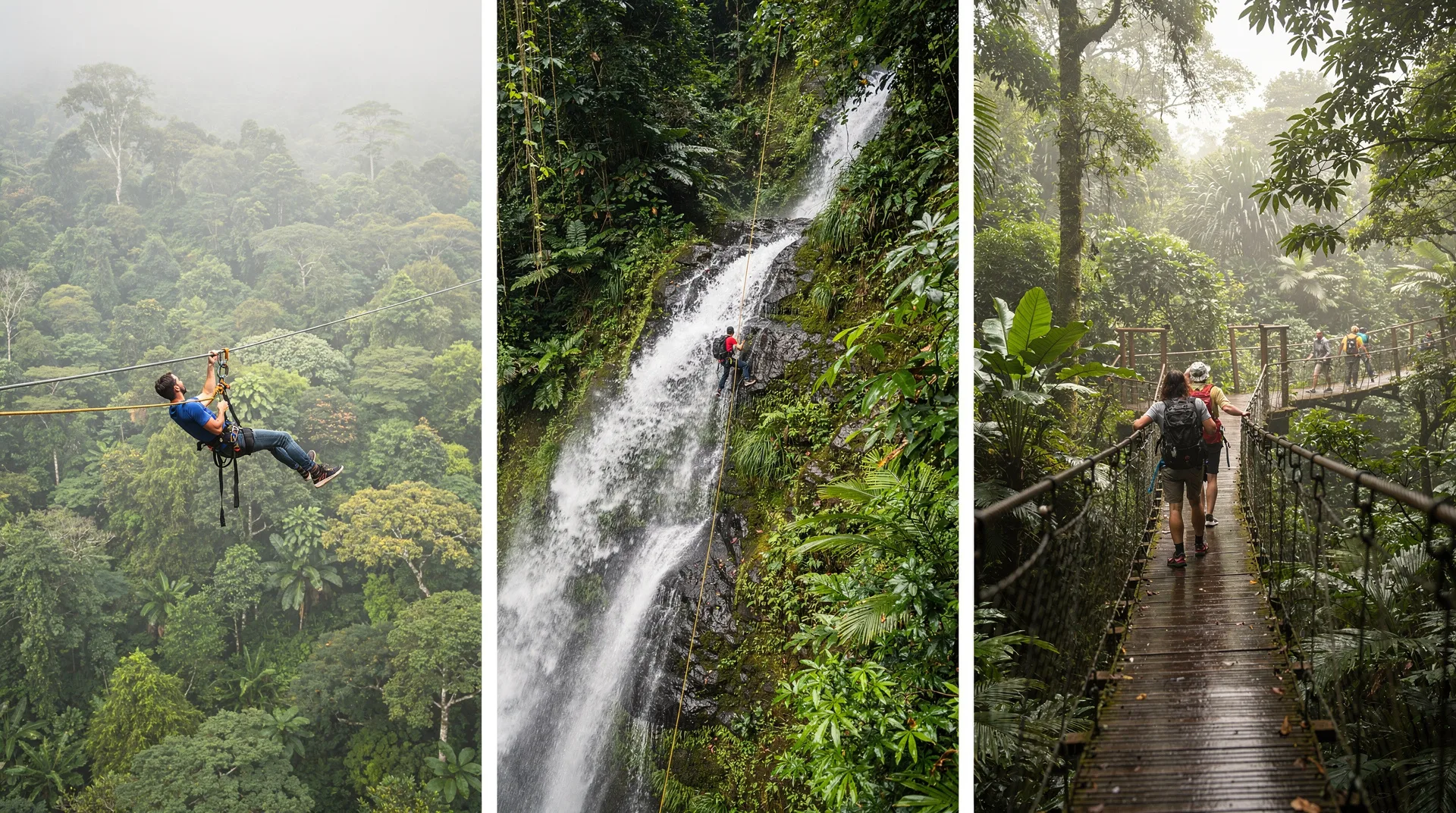
Zipline vs canyoning vs hanging bridges: which to choose in Costa Rica
Zipline vs canyoning vs hanging bridges?
Think of it as a triangle: ziplines for pure speed and aerial thrills ($60-110), canyoning for extreme wet-and-wild rappelling ($100-135), hanging bridges for immersive nature walks with vertigo ($26-75). Each suits a different visitor.
Three activities, three completely different experiences
Costa Rica’s adventure tourism industry has spent four decades refining three signature activities: ziplines (canopy tours), canyoning (waterfall rappelling), and hanging bridge walks. They are frequently lumped together as “outdoor adventures” by travel agents and resort brochures, but they deliver fundamentally different experiences to fundamentally different types of visitor.
This guide breaks down exactly what each involves, what it costs, where the best examples are, and — honestly — who should pick which one.
| Pick ziplines if | You want speed and aerial views with minimal effort |
| Pick canyoning if | You want genuine physical adventure and don’t mind getting soaked |
| Pick hanging bridges if | You want wildlife and calm, all-age nature immersion |
| Where | Arenal/La Fortuna and Monteverde |
| Certification to check | Current-year ICT plaque, PCMG (ziplines) or SRT (canyoning) |
Ziplines: speed above the canopy
A zipline tour in Costa Rica is not a single zip — it is a circuit of cables, typically 8-20 individual lines, ranging from 100 meters to over a kilometre in length. You are clipped into a trolley on a steel cable and slide across the canopy at speeds that can reach 60-80 km/h on the longest runs.
The experience is primarily about speed, height, and aerial views across the jungle canopy. You are above the trees looking down, rather than in the forest looking around. On longer cables, you can see across river valleys, volcanic peaks, and (in Monteverde) cloud-forest ridges that disappear into mist.
Best zipline options in Arenal and Monteverde
Monteverde offers the most famous zipline operations in Costa Rica. The cloud-forest setting creates a dramatic backdrop — cables running through mist across a forest canopy that sits at 1,500 metres elevation.
Monteverde: thrilling zip line canopy tour — from $60The thrilling Monteverde zipline circuit runs approximately 2.5 hours and includes multiple cables, a hanging bridge walk, and a Tarzan swing. Price starts around $60-70 per person.
For a more intense Monteverde experience with the longest cables (including a 1.5 km Superman cable that has you flying face-down over the canopy):
Monteverde: extreme zipline tour — from $70In Arenal, the hanging bridges at Mistico Park can be combined with a zipline circuit. The Arenal zipline operators typically incorporate volcano views alongside jungle cables.
Who ziplines are for: Anyone who wants the sensation of speed and aerial views with minimal physical exertion. Ziplines are the most accessible of the three activities — they require no strength, minimal coordination, and almost no athletic ability. Older adults, young children (most operators allow ages 5+), and non-athletic visitors can all participate comfortably.
Price range: $60-110 per person for a full circuit.
Canyoning: descending into the jungle itself
Canyoning (also called canyoneering or waterfall rappelling) is the inverse of ziplines in almost every way. Instead of flying above the canopy on a cable, you descend into the jungle’s wet interior on a rope alongside waterfalls, wading through river canyons, and jumping into deep pools.
The physical engagement is much higher. You control your own descent speed using a rappelling device, which requires arm and core strength. The environment is wet, sometimes cold, and often surprisingly loud as you rappel alongside full-volume waterfalls.
The premier canyoning destination in Costa Rica is La Fortuna, where three established operators — Lost Canyon Adventures, Pure Trek, and Gravity Falls — run separate canyon routes with different characteristics.
La Fortuna: canyoning and waterfall rappelling experience — from $110 Mistico hanging bridges + transportation + naturalist guide — from $75A canyoning experience at Pure Trek or Lost Canyon includes 4-30 rappels depending on the route, river wading, natural water slides, and cliff jumps. The full experience runs four to five hours including briefing.
Arenal Volcano: waterfall jumping & extreme canyoning — from $135Gravity Falls specialises in the most dramatic single drop in the region: a 60-meter free rappel alongside a full-volume waterfall. The surrounding landscape is dripping, green, and genuinely spectacular.
Who canyoning is for: Visitors who want genuine physical engagement, enjoy heights when they are actively managed rather than passive, and want to feel immersed in the jungle rather than above it. Children from age 7-10 can participate at most operators (check minimum ages). People with shoulder, back, or knee problems should consult a doctor first.
Price range: $100-135 per person for a half-day.
Hanging bridges: slow immersion in the forest
Hanging bridges (puentes colgantes) are a network of suspension footbridges at canopy height — typically 30-60 meters above the forest floor — that allow you to walk through the treetops at bird’s eye level. Unlike ziplines, you are moving slowly. Unlike canyoning, you are dry. The bridges are the contemplative option: binoculars in hand, looking for tanagers, toucans, and the occasional sloth.
The physical experience is straightforward — you are walking, with occasional vertigo from the swaying of longer bridges over steep gorges. Sturdy footwear and a reasonable head for heights are the only requirements.
The two premier hanging bridge experiences in Costa Rica are:
Mistico Arenal Hanging Bridges Park: Seven bridges (four hanging, three fixed) in secondary cloud forest adjacent to Arenal Volcano. The self-guided circuit takes 2-3 hours at a relaxed pace, and the forest quality is high enough that wildlife encounters — birds, monkeys, and sloths — are common.
La Fortuna: Místico Arenal hanging bridges admission ticket — from $26Admission starts at $26 for self-guided, rising to $55-75 with a certified naturalist guide who dramatically improves your wildlife-spotting rate.
Monteverde hanging bridges: Various operators in the Monteverde zone run cloud-forest bridge circuits. The Selvatura Park option combines bridges, a butterfly garden, and a sloth/frog exhibit in a single visit. The Curi-Cancha Reserve runs smaller, quieter bridge circuits with consistently good quetzal sightings in season (March-June).
Who hanging bridges are for: Nature lovers, birdwatchers, families with very young children, older adults, and anyone who wants to experience the forest canopy without significant physical exertion or adrenaline. Also excellent for a morning activity before a more demanding afternoon.
Price range: $26-75 for admission plus guide.
Side-by-side comparison
| Factor | Ziplines | Canyoning | Hanging bridges |
|---|---|---|---|
| Physical demand | Very low | High | Very low |
| Adrenaline level | High (speed) | Very high | Low to medium |
| Nature immersion | Low | Medium | Very high |
| Min. recommended age | 5-7 | 7-12 | All ages |
| Duration | 2-3 hours | 4-5 hours | 2-3 hours |
| Price per person | $60-110 | $100-135 | $26-75 |
| Best for | Speed thrills, aerial views | Extreme wet adventure | Birdwatching, wildlife |
| Weather dependency | Low | Medium (flash floods) | Very low |
Combining activities
Most visitors to Arenal or Monteverde have time for two of the three activities, and they pair naturally:
Ziplines + hanging bridges: Pairs well for a single location, giving you both speed and contemplation. Selvatura Park in Monteverde combines both. In Arenal, Sky Adventures runs a cable-and-bridge combo.
Canyoning + hot springs: The classic La Fortuna day — canyoning in the morning, hot springs at Tabacón or Eco Termales in the evening. The physical exertion of canyoning makes the hot springs feel genuinely restorative.
Hanging bridges + wildlife: Add a night tour at Mistico or in the Monteverde cloud forest to extend the bridge walk into a full-day wildlife experience.
ATV + ziplines: Works well in Guanacaste where ATV operators and zipline parks are close together. See our ATV tours by region guide for specifics.
Location guide: Monteverde vs Arenal
Both Monteverde and Arenal have all three activities, but the settings differ fundamentally:
Monteverde sits at 1,500 metres in cloud forest. The atmosphere is misty, temperate (15-20°C), and more contemplative. Ziplines here run through clouds; bridges swing over green ridges. The birdwatching quality is exceptional — Monteverde is one of the top birding destinations in the Americas.
Arenal sits at 600 metres in humid volcanic jungle near a lake. It is warmer (25-30°C), wetter, and more dramatic in scale. The volcano provides a constant backdrop when clear. Canyoning is better here due to the higher-volume waterfalls. ATV options are more developed.
If you have three nights at each location, do the hanging bridges and ziplines in Monteverde and the canyoning and ATV tours in Arenal. That combination delivers the best of each site’s strengths.
Sample 3-day adventure plan
For visitors who want all three activities without overloading any single day, this sequencing works well and respects the physical recovery canyoning demands:
| Day | Activity | Why this order |
|---|---|---|
| Day 1 (Arenal) | Hanging bridges (Mistico Park) + volcano views | Low exertion, eases you into the region, good wildlife warm-up |
| Day 2 (Arenal) | Canyoning (Pure Trek or Lost Canyon) | Save the most physically demanding activity for a day you can rest after |
| Day 3 (Monteverde) | Zipline circuit + Curi-Cancha or Selvatura bridges | Travel day built in; ziplines are low-effort after the transfer |
This order also matches best time to visit logic — morning slots are more weather-reliable for canyoning, so book Day 2’s canyoning tour first and build the rest of the itinerary around it. See our green season pros and cons and dry season pros and cons guides if you’re planning around weather risk specifically.
The safety certification behind all three activities
All three activities in Costa Rica — ziplines, canyoning, and hanging bridges — are regulated under the ICT’s adventure tourism certification framework. Understanding what that certification covers helps you ask better questions before booking.
What ICT certification covers: Site inspection (anchors, cable condition, equipment storage), guide qualifications (minimum training hours, first aid certification), emergency response plan (evacuation protocol, nearest hospital contact), and insurance requirements. Certification must be renewed annually with an on-site inspection.
What ICT certification does NOT cover: The competence of individual guides beyond minimum requirements, the quality of the ecological interpretation offered, and the ratio of guides to guests (ICT sets minimum ratios but not optimal ones).
The better question to ask: “When was your last ICT inspection, and what level certification are you holding?” Full certified status versus provisionally certified versus uncertified tells you more than the certificate alone. Operators who are transparent about this are generally safer than those who deflect.
For ziplines specifically, the PCMG (Parque de Aventura y Canopy Monteverde) standard is worth knowing — it requires minimum cable thickness, maximum speed on terminal landings, and specific harness standards that go beyond ICT minimum requirements. Selvatura and Sky Adventures in Monteverde both meet this standard.
For canyoning, the international standard is the SRT (Single Rope Technique) certification for guides — ask specifically whether your guide holds SRT certification. All three main Arenal operators (Lost Canyon, Pure Trek, Gravity Falls) train their guides to this standard.
For hanging bridges, no technical guide certification beyond a basic naturalist guide license is required — the activity’s low risk profile means guide certification is primarily about ecological knowledge rather than safety systems.
The honest verdict: what most visitors actually enjoy most
This may be the most useful thing in this guide: a frank assessment of which activity visitors actually describe most positively in retrospect.
In conversations with Costa Rica visitors and in review analysis, the patterns are consistent:
Most likely to exceed expectations: Canyoning. Visitors who book canyoning with genuine uncertainty often describe it as the highlight of their trip, not just one activity among many. The combination of physical engagement, environment, and the subjective experience of controlling your own descent next to a full-volume waterfall in a tropical canyon creates memories that ziplines — for all their excitement — rarely match.
Most likely to be underwhelming: Ziplines, if you are an adventurous person who has ziplined before anywhere in the world. The first zipline anywhere is thrilling. The fifteenth, even at Monteverde, produces diminishing returns. If you have ziplined before, the hanging bridges or canyoning will give you more genuinely new experience.
Most consistently appropriate across age groups and fitness levels: Hanging bridges. The Mistico Arenal park specifically gets consistently high marks from every age group from 6 to 75. The wildlife spotting element gives it depth that a purely physical activity cannot replicate. A good naturalist guide transforms a nature walk into something genuinely extraordinary.
Frequently asked questions about adventure activity comparisons
Which activity gives the most bang for the money?
Canyoning offers the most intensive experience per hour and the highest adrenaline-to-price ratio. Hanging bridges offer the most wildlife encounter potential per dollar. Ziplines are the best value if your priority is aerial thrill with minimal effort.
Can children do all three?
Hanging bridges: yes from any age (in a carrier for infants). Ziplines: typically from age 5-7 depending on operator weight minimums. Canyoning: from age 7-10 depending on operator, though 10+ gives a more comfortable margin.
Is Monteverde worth the drive for ziplines?
The road to Monteverde is unpaved for the final section (gravel, manageable in a standard car in dry season, recommended 4WD in wet season). If ziplines are your primary reason for going, consider the Arenal options and save Monteverde for its cloud-forest and wildlife experiences, which have no equivalent elsewhere in Costa Rica.
Are all three activities available year-round?
Ziplines and hanging bridges: yes, year-round (operations pause in extreme weather only). Canyoning: year-round, but operators may modify routes in heavy rain. Flash flooding can close canyon routes for a day or two after heavy storms in the rainy season.
What should I do if I am afraid of heights but want to try something adventurous?
Hanging bridges involve height — some bridges sit 60 meters above gorges — but the movement is slow and you can pause anytime. Many people with mild height anxiety find them manageable. Ziplines create an initial heart-rate spike at launch but the sensation quickly normalises. Canyoning is paradoxically less anxiety-inducing for many people because the technique focus overrides the height awareness. None of the three is a guaranteed comfort zone for someone with significant acrophobia.
Physical accessibility: which activities work for different bodies
Costa Rica’s adventure industry has made meaningful progress on accessibility, but not uniformly across activity types.
Ziplines are the most accessible. Most operators can accommodate wheelchairs to the launch platforms, with staff assisting transitions into the harness for those with lower-body mobility limitations. The activity itself requires no leg use — arms are needed for braking only, and staff can assist. Upper weight limits (typically 120 kg) are the most common exclusion. Visitors with recent shoulder surgery should verify harness placement with operators before booking.
Hanging bridges require walking on uneven terrain to access most bridge systems. Mistico Arenal Park has the most accessible trail network of the major bridge parks, with sections of improved gravel path. Full wheelchair access to all bridges is not available at any major site — some bridges and approach sections involve steps and steep sections. Visitors with limited mobility can typically access 2-4 of the 7 Mistico bridges without difficulty.
Canyoning requires full physical mobility — harness fitting, rope control, and active body positioning during descent are all essential. This is the least accessible of the three for visitors with physical limitations. Minimum weight (typically 40-45 kg) and maximum weight (100-120 kg) both apply due to equipment calibration.
Multilingual guide availability
Costa Rica’s major adventure operators cater to an international visitor base. English is universal at the main Arenal and Monteverde operators. Spanish is of course available everywhere. Beyond these two:
Portuguese-speaking guides are available at select La Fortuna operators (Brazil is a major source market for Costa Rica tourism). German-speaking guides are available at some Monteverde operators. French-speaking guides are less common but can be arranged with advance notice at larger operations like Selvatura Park.
If guided commentary in your language is important, specify this when booking and confirm the guide assignment before your tour date. Do not assume that booking online guarantees a guide in your language.
Booking logistics: how far ahead should you book?
Hanging bridges rarely sell out — same-day or next-day booking is usually fine outside major holiday weeks, and self-guided admission at Mistico or Selvatura is walk-up in most cases. Ziplines at the large parks (Sky Adventures, Diamante, Selvatura) fill their morning slots first in dry season; booking 2-3 days ahead secures the preferred early-morning time when light and temperature are best. Canyoning has the tightest capacity of the three — Pure Trek, Lost Canyon, and Gravity Falls each run limited daily departures, and during January-March and July-August peak weeks, popular morning slots can sell out a week or more in advance.
If your trip dates are fixed and canyoning is a priority, book it as soon as your Arenal dates are confirmed rather than leaving it for a spontaneous decision once you arrive — it is the activity most likely to be unavailable on short notice.
Children’s experiences: what works at what age
This question deserves more specificity than the minimum-age figures alone provide.
Ages 5-7: Hanging bridges (with an adult holding their hand on the suspension sections), and the gentlest ziplines at operators like Selvatura where some cables are short enough to be low-risk. Not suitable for canyoning at any operator.
Ages 8-10: Still too young for genuine canyoning (exception: Lost Canyon’s specific route allows 8+ with strong parental guidance). Ziplines at most operators are fine — weight minimums (typically 25-30 kg) are the constraint, not age per se. Hanging bridges are fully accessible and often the highlight for this age group if naturalist guides are pointing out animals.
Ages 11-14: All three activities are in range depending on specific operator minimums. Pure Trek canyoning allows age 7 but the sweet spot for genuine enjoyment is 11+. Ziplines are fully accessible and often the favourite at this age. Hanging bridges may feel “too easy” compared to siblings’ zipline experiences — pair with the naturalist guide option for the wildlife discovery element.
Ages 15+: Full access to all three activities at most operators. This age group tends to prefer canyoning and extreme ziplines over hanging bridges unless they have a serious birdwatching interest.
If none of the three quite fits
Some visitors want more speed than ziplines or more solitude than a popular bridge park offers. Bungee jumping and paragliding are both available near Monteverde and the Central Valley for a different kind of adrenaline, and caving and spelunking gives a genuinely different underground alternative to the canopy-focused activities covered here. For a quieter, guide-led alternative to Mistico’s crowds, the Curi-Cancha Reserve guide covers a smaller Monteverde-area circuit with strong quetzal sightings.
a combined canyoning and whitewater rafting day near Arenal, for visitors who want the wet-and-wild option without choosing between the two — from $155Related guides
For detailed pricing on all Costa Rica adventure activities, see how much do adrenaline tours cost. For multi-day adventure itineraries that include all three activity types, the extreme adventure routes guide covers Pacuare, canyoning, and Corcovado combinations. Full canyoning operator comparisons are in our canyoning in Arenal guide.