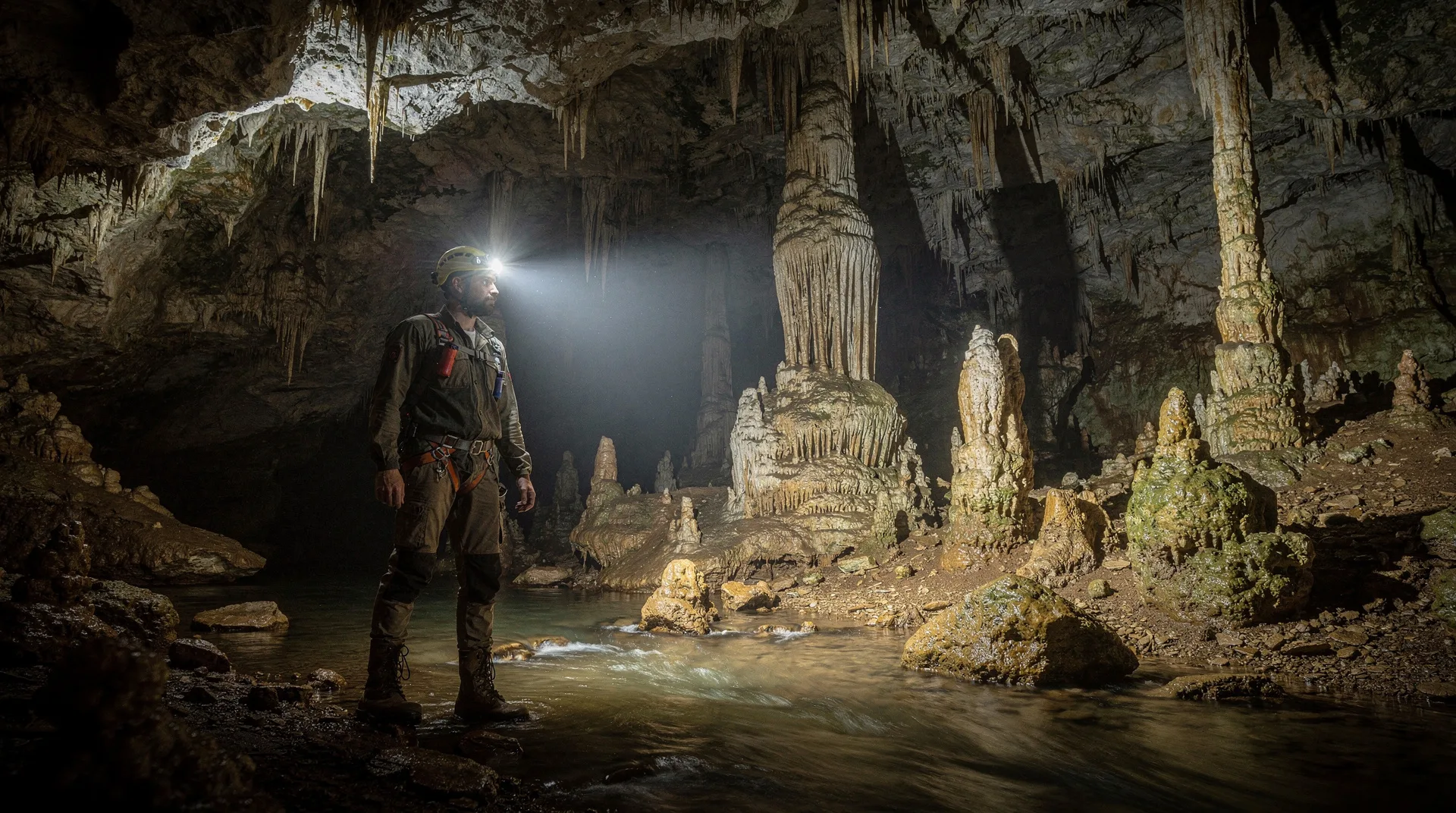
Caves in Costa Rica: Barra Honda, Venado, and where to spelunk
Caves to explore in Costa Rica?
Barra Honda National Park in Guanacaste has 42 caves including Terciopelo (guided descent by rope). Venado Caves near La Fortuna offer a more accessible 2.7 km walking tour through limestone formations.
Costa Rica’s cave systems: what actually exists
Caving and spelunking are genuinely underrated in Costa Rica. Most visitors focus on ziplines, rafting, and wildlife — but the country’s cave systems offer something completely different: geology, silence, and a disorienting sense of entering another world below the surface.
Two sites dominate the legitimate caving landscape: Barra Honda National Park in Guanacaste and Venado Caves in the Arenal region. Both involve very different experiences. Barra Honda is rugged, rope-assisted spelunking in a national park. Venado is a guided walking tour through an impressive limestone system with commercial infrastructure.
This guide covers both in detail, plus what you need to know about guided access, safety, and seasonal considerations.
Barra Honda National Park
What makes Barra Honda significant
Barra Honda National Park in northwestern Guanacaste protects a limestone plateau riddled with at least 42 known caves — and almost certainly more that have not been fully explored. The plateau rises 423 meters above the surrounding Nicoya Peninsula lowlands, visible from miles away as a forested mesa above flat cattle country.
The cave network formed over millions of years as groundwater dissolved the limestone bedrock. The result is a system of interconnected chambers, shafts, and galleries with some of the most impressive speleothem (stalactite and stalagmite) formations in Central America, including some that have been growing for over 300,000 years.
The park’s cave ecology is equally remarkable. Several species of cave-adapted bats use the system as roost sites. Cave fish and invertebrates adapted to the permanent darkness have been documented in the deeper chambers. In 1967, Costa Rican speleologists discovered human remains and pre-Columbian artifacts in the Nicoa Cave — evidence of indigenous use of the caves as burial sites.
Which caves are accessible
Of the 42+ known caves, only a handful are accessible to guided tourist groups:
Terciopelo Cave: The most visited and most impressive. The name means “fer-de-lance” (the venomous snake) — named for the cave’s dark coloration, not because the snakes actually inhabit it. A 17-meter rope descent gets you to the first major chamber, and the tour continues through a series of rooms with exceptional formations. Stalactites named for their resemblance to sharks’ teeth, fried eggs, and popcorn kernels have been documented here.
Santa Ana Cave: Accessible without rope descent (via a rock scramble entrance), with good bat populations and moderate formation density. Slightly easier for visitors with mild rope anxiety.
La Trampa and El Laberinto: More technical caves requiring longer descents. Typically only offered to visitors with prior caving experience, by prior arrangement.
Access to all caves requires a SINAC-certified park guide — solo entry is not permitted. Guides are available at the park entrance on a walk-in basis in the morning but booking ahead is strongly recommended, especially December-April.
Logistics for Barra Honda
Getting there: Barra Honda is located near the town of Nicoya in Guanacaste. By car from Liberia, the drive takes approximately 1.5 hours. From Tamarindo, about 1.5 hours. From San José, approximately 4 hours. There is no direct public transport to the park entrance — the nearest bus stop is in Nicoya town, 13 km away.
Best time to visit: The dry season (December-April) is strongly preferred. Cave entrances on the limestone plateau involve outdoor hiking before the descent. In the rainy season, trails become slippery and some cave entrances can partially flood. Some caves close entirely during heavy rains.
Tour duration: The standard Terciopelo Cave tour takes 3-4 hours including the hike from the park entrance (1.5 km uphill on exposed limestone) and the cave descent itself. Start early — by midday the exposed plateau becomes uncomfortably hot.
Cost: Park entrance is approximately $12-18 (SINAC standard fee for national parks, verify current rate). The mandatory guided cave tour is charged separately: approximately $15-30 per person depending on which cave and group size.
Equipment provided: Harnesses, ropes, and helmets for Terciopelo descent are typically provided by the park guides. Wear long trousers (protection against scraping on cave walls) and closed-toe shoes. The cave interior is cool (around 22-24°C) relative to the hot exterior.
Venado Caves
Why Venado is different
Venado Caves (Cuevas de Venado) near San Rafael de Guatuso in the Arenal zone offer a completely different caving experience. Where Barra Honda is a national park with raw, rope-assisted spelunking, Venado is a privately managed cave system with a 2.7 km guided walking route through a comfortable passageway height (you do not need to crawl).
The caves formed in limestone substrate that was uplifted by volcanic activity associated with the Arenal region. They are approximately 50 million years old. The route passes through chambers with significant stalactite and stalagmite formations, cave streams, fossil-bearing rock sections, and resident bat colonies that number in the thousands.
The commercial infrastructure (lighting in some sections, wooden walkways over streams, established tour route) makes Venado more accessible to a broader range of visitors — families with children, visitors with mild claustrophobia who want a structured environment, and those who want cave geology without the rope-descent challenge.
What to expect on the Venado tour
Tours run 1.5-2 hours and cover the 2.7 km circuit at a comfortable walking pace. The guide points out specific formations and explains the geological history. Sections of the cave involve wading through knee-deep underground streams — waterproof boots are provided, but wear shorts or quick-dry trousers.
The bat colonies are extraordinary. In some chambers, the ceiling moves — thousands of bats roosting in close formation, periodically disturbed into flight by the tour group’s movement. The sound and the smell are distinctly elemental.
Minimum age for the standard tour is typically 5-6 years. Claustrophobic sections are brief — most of the route has comfortable standing height.
Getting there: Venado is located approximately 45 minutes north of La Fortuna on the road toward San Rafael. The caves are signposted from the main road. A rental car is the most practical option; the road is paved to within a few kilometres of the site.
Cost: Approximately $22-30 per person including boots and guide. Book ahead in dry season as the operator limits group sizes for ecological reasons.
Practical tip for visiting from La Fortuna
Venado Caves pair naturally with a morning visit to Caño Negro Wildlife Refuge (an additional 45 minutes north), which is one of the best birdwatching sites in Costa Rica. A circular route from La Fortuna — Venado Caves in the morning, Caño Negro boat tour in the afternoon — covers both in a single day.
See our destinations page for La Fortuna for the full picture of activities in the Arenal region.
Other cave mentions: what does not qualify as organised spelunking
Several other cave sites exist in Costa Rica but fall outside organised tourist access:
Barra Honda’s unexplored caves: The park has identified over 42 cave entrances but only a fraction are charted and safe for guided access. Entering uncharted caves without a guide and proper equipment is genuinely dangerous — no lighting, no safety lines, and documented fatalities in unsecured cave systems in Central America.
Río Frío cave system (Caribbean lowlands): Documented by biologists, not accessible to tourists.
Lava tubes near Arenal: Occasional references appear in local tour marketing to “lava tubes” near La Fortuna. These are largely informal hiking options rather than structured caving experiences. If offered by a tour operator, ask about guide certification and safety equipment before booking.
Safety essentials for any cave experience
Never enter caves without a certified guide: Even at commercial sites, the risk of becoming disoriented in cave systems is real. Guide certification means familiarity with the specific route and emergency evacuation procedures.
Hydration and food: Caves are physically demanding even when cool — the humidity, difficult terrain, and concentration required are exhausting. Bring water and a snack for any tour over 2 hours.
Light sources: Guides carry primary and backup lighting at Barra Honda. At Venado, the caves have partial installed lighting. Carry your own headlamp as backup regardless.
Breathing: In some chambers with large bat colonies, ammonia levels from guano can be elevated. This is rarely dangerous but can cause mild irritation. Guides at Venado and Barra Honda are trained to limit group exposure time in affected chambers.
Biosecurity: Fungal diseases affecting bat populations (notably White-Nose Syndrome, which is not yet in Costa Rica but is a concern) are spread by contaminated clothing and equipment between cave sites. If you have visited caves in North America recently, wash or replace cave-specific clothing before visiting Costa Rica’s caves.
Frequently asked questions about caving in Costa Rica
Is Barra Honda suitable for children?
The 17-meter rope descent at Terciopelo Cave requires a harness and is not recommended for children under 12. Santa Ana Cave, accessible without a rope descent, is suitable for confident children from around age 8. The outdoor hiking trail at Barra Honda is accessible from age 6 with appropriate footwear.
Can I visit Barra Honda on my own without a guide?
No. SINAC regulations require a certified guide for all cave access. The park rangers enforce this at the entrance. Guides are available at the park entrance station but should be booked in advance during dry season.
Is it hot inside the caves?
Counterintuitively, caves at these sites maintain a relatively constant temperature of 22-25°C regardless of external weather. On a 35°C Guanacaste dry-season day, the cave descent at Barra Honda feels refreshingly cool. The outdoor hike to the cave entrance is the hot part.
What wildlife will I see inside the caves?
Bat colonies are the primary wildlife feature at both Venado and Barra Honda. Cave-adapted invertebrates (cave crickets, cave beetles) are present in lower light zones. Barra Honda’s Nicoa Cave contains documented cave fish. On the approach to Barra Honda, dry-forest wildlife including white-tailed deer, coatis, and iguanas are commonly seen.
Are there any caves I can visit without a tour operator?
No accessible cave site in Costa Rica is safe or legally open to independent access. All cave visits require registered guides. This is both an ecological protection measure (bats are highly sensitive to disturbance) and a safety requirement.
Cave ecology: what lives in Costa Rica’s caves
The biology of cave systems is remarkably complex, and both Barra Honda and Venado host communities of cave-adapted species that are worth understanding before you visit.
Bats: Costa Rica has 113 species of bats — the highest density of bat species per unit area of any country in the world. Cave-roosting species at Barra Honda include the great fruit-eating bat (Artibeus lituratus) and several species of emballonurid bats that form massive colonies. At Venado, the free-tailed bat (Tadarida brasiliensis) colonies in the thousands produce the characteristic pungent ammonia atmosphere in the deeper chambers. Bat guano in cave systems supports entire food chains: cave beetles, cockroaches, mites, and cave-adapted harvestmen all feed on guano. These invertebrates in turn feed cave-adapted spiders.
Fish and aquatic organisms: The groundwater flowing through Barra Honda’s cave system supports populations of cave-adapted freshwater shrimp and the documented presence of endemic cave fish in the deepest water-filled chambers. These organisms are photophobic (light-avoidant) and may be entirely blind. They represent millions of years of isolated evolution and are uniquely vulnerable to contamination from above-ground pollution entering the karst system.
Geological formations: The stalactites (growing down from cave ceilings) and stalagmites (growing up from cave floors) at Barra Honda include some formations that have been growing for over 300,000 years, accumulating calcium carbonate from dripping groundwater at a rate of approximately 1 millimetre per decade. The oldest formations at Barra Honda predate modern Homo sapiens by over 100,000 years. This geological context gives the caves a time-scale perspective that most landscapes cannot offer.
Barra Honda beyond the caves: the surface trail system
Many visitors focus entirely on the cave descent and miss Barra Honda National Park’s excellent above-ground trail system. The plateau surface — called the “sombrero” for its distinctive flat-topped profile — offers dry-forest hiking with exceptional views across the Nicoya Peninsula and the Gulf of Nicoya.
The Sendero Ocelote (Ocelot Trail) is a 3.5 km circuit that traverses the plateau surface through dry-forest habitat. Wildlife on the surface includes white-tailed deer, coatis, nine-banded armadillos (abundant), and the iguanas that give the park its secondary reputation. The trail passes several cave mouths — locked grates visible from above — that provide context for the underground network below.
La Piedra Mesa viewpoint (reachable in 30 minutes from the park entrance) offers a 360-degree view across the Nicoya Peninsula, the Gulf, and on very clear mornings, the Pacific Ocean to the west and the interior mountain ranges to the east. This surface hike pairs naturally with the cave descent on the same day.
Allow 5-6 hours total for the full Barra Honda experience: 1.5 km hike to the cave entrance (including the surface viewpoint detour), 3-4 hours for the cave descent and tour, and return hike. Start by 7am to be back before the afternoon heat peaks.
Photography inside caves: practical guidance
Photographing inside Barra Honda or Venado requires specific techniques that differ from normal photography.
Equipment: A wide-angle lens (18-35mm equivalent) works better than telephoto for cave photography — you are often close to your subject (formations) and want to show the chamber scale. A tripod is essential for long exposures in low light. Flash photography alone produces flat, unnatural images and disturbs bat roosts. An off-camera flash or additional light source at a 45-degree angle creates much better texture rendering on stalactites.
Settings: In low light with a tripod, ISO 800-1600 with f/8 and 1-4 second exposures gives good depth of field and detail. In fully lit sections of Venado, standard exposure is possible.
Bat photography: At Venado, the bat colonies are photographable with a fast lens (f/1.8-2.8) at high ISO (3200+) when the bats are in flight. This requires shutter speeds of 1/250 or faster to freeze wing movement. A guide who knows when bats are most active in each section is invaluable.
Respect protocols: At Barra Honda, park guides enforce a no-flash rule in some of the most sensitive chambers with long-growing formations. At Venado, guide discretion applies to bat photography near maternity colonies. Always follow guide instructions over photography priorities.
Barra Honda vs Venado: quick comparison for undecided visitors
| Barra Honda (Terciopelo) | Venado Caves | |
|---|---|---|
| Physical demand | High (rope descent, hot hike) | Low-moderate (walking tour) |
| Minimum age | ~12 (rope descent) | ~5-6 |
| Duration | 3-4 hours | 1.5-2 hours |
| Cost | $12-18 entry + $15-30 tour | ~$22-30 all-in |
| Best region base | Nicoya / Guanacaste beaches | La Fortuna / Arenal |
| Formations | Exceptional, 300,000+ year-old | Significant, plus large bat colonies |
| Guide requirement | Mandatory (SINAC) | Mandatory (operator) |
If you are based in Guanacaste and want an adventurous, physically engaging cave descent, Barra Honda is the better fit. If you are based around La Fortuna and want a family-friendly walking tour with dramatic bat colonies, Venado wins on convenience and accessibility.
Caño Negro: rivers and lagoons bird, flora and fauna tour — from $95Planning a cave visit around the rest of your trip
Caves work best as a change of pace inside a longer itinerary rather than a trip in themselves. Because the surface hike at Barra Honda is exposed, it helps to read our dry season pros and cons and green season pros and cons before fixing a date, and to check the packing list for footwear and clothing that suits both a hot trail and a cool, damp chamber.
Combining Barra Honda with Guanacaste
If you are staying on the Guanacaste coast, Barra Honda slots in as a half-day away from the sand. Bases such as Tamarindo, Nosara and Sámara all put the park within a morning’s reach by car, and Liberia is the natural gateway if you are arriving by air. The wider Guanacaste province page explains how these bases fit together, and the 5 days in a Guanacaste resort itinerary shows where a cave morning can replace a beach morning without breaking the rhythm of the trip. Other protected areas in the same dry-forest region, such as Santa Rosa National Park and Palo Verde National Park, make good companions if you want to turn one cave day into a nature-focused few days.
Combining Venado with the Arenal zone
Around La Fortuna, a cave tour sits comfortably beside the other activities of the area. If you like getting wet and muddy, canyoning in Arenal is the obvious partner, and the zip-lining vs canyoning vs bridges comparison helps you decide how to spread your days. For those who want the full list of high-adrenaline options, see the extreme adventure routes guide. A canyoning outing such as a canyoning trip through the river’s waterfalls — from $120 pairs well with an underground morning, since both reward comfortable quick-dry clothing. To finish the day gently, a visit combining a waterfall, the volcano views and thermal pools — from $95 is an easy way to rest tired legs, and our Arenal hot springs overview compares the options. The Arenal Volcano National Park guide covers the surface trails if you have a spare half-day.
Wildlife, ethics and families
Bats are the stars underground, and they are sensitive animals. Our wildlife watching ethics guide explains how to behave around roosting animals, while the nocturnal wildlife guide explains what else comes alive once the light fades above ground. Parents weighing the harness descent against the gentler walk should read family travel tips for Costa Rica, and teenagers who want something more physical than a beach day will find more ideas in activities for teens. If you also plan to visit the northern volcano country, the Rincón de la Vieja National Park guide is a useful companion, and travel insurance for Costa Rica is worth reading before booking any rope-assisted activity.
Related guides
The Barra Honda region also sits close to the Nicoya Peninsula’s beach communities — see our Nicoya Peninsula beaches guide for combining a cave visit with coastal time in Sámara or Playa Carrillo. For the full Arenal region, the La Fortuna destination guide covers the complete activity menu around the volcano. See how much do adventure tours cost for a full pricing overview across all major adventure categories.