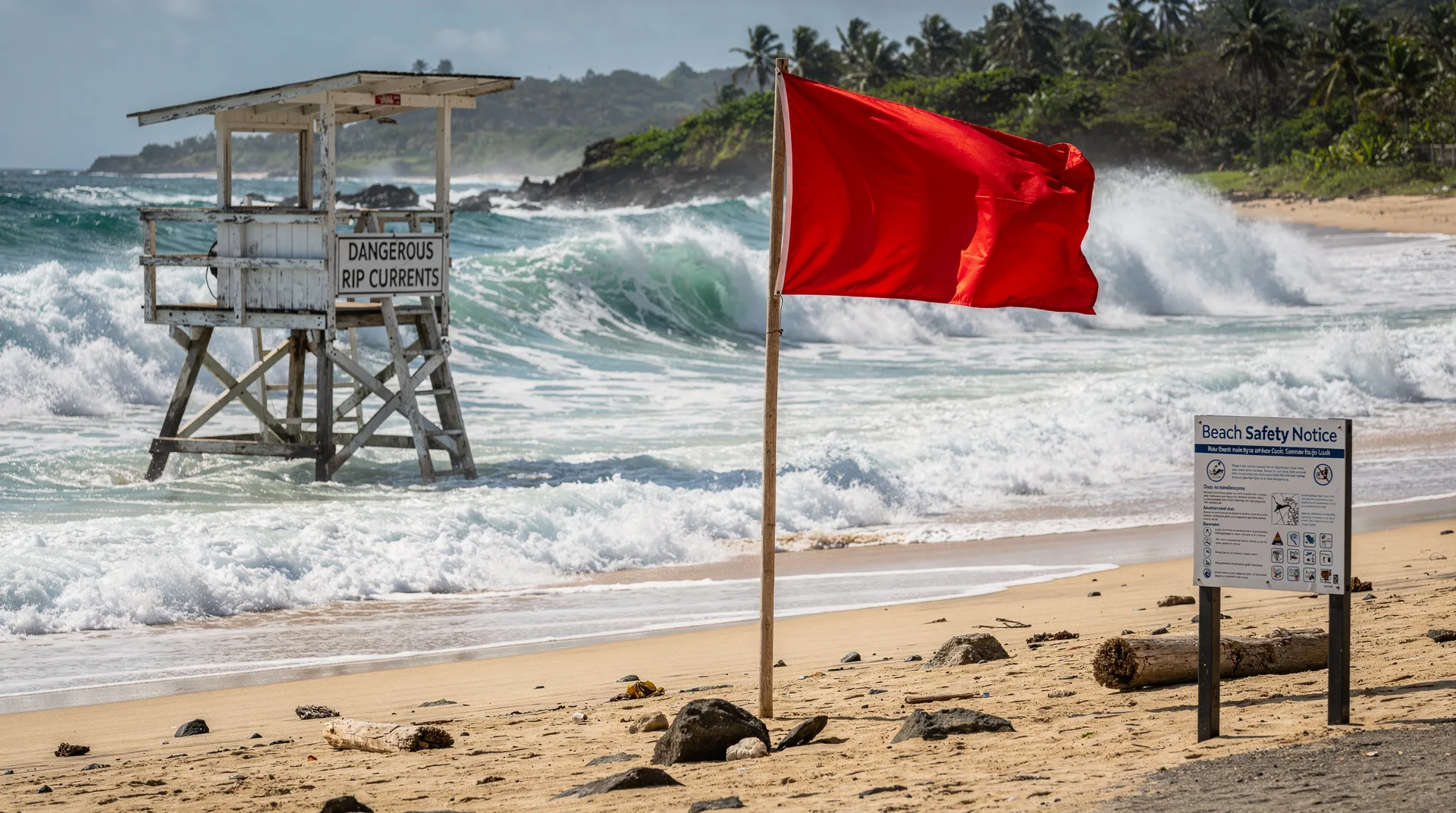
Costa Rica beach safety: riptides, flags, and drowning prevention
Are riptides a real risk at Costa Rica beaches?
Yes — over 80% of drownings in CR are tourists; flag system explained.
This is not a scare piece — it is the practical knowledge that turns an unfamiliar ocean into a manageable one. Fifteen minutes with this guide before your first beach day is the single highest-value thing you can do to keep your trip safe.
| Main risk | Riptides — over 80% of Costa Rica drownings are tourists |
| Flag system | Only present at major tourist beaches (Tamarindo, Jacó, Manuel Antonio) |
| No flags? | Ask hotel staff or a local surf shop before swimming |
| Emergency number | 911 (Guardacostas coast guard) |
| Highest-risk beaches | Espadilla Norte, Jacó, Dominical, Brasilito river mouth |
The numbers that every visitor to Costa Rica should know
According to the Cruz Roja Costarricense (Costa Rican Red Cross) and the OIJ (Organismo de Investigación Judicial), approximately 50-70 people drown at Costa Rica’s beaches every year. Over 80 percent of those victims are tourists, not residents.
The ratio is the most important number in this guide. Ticos — Costa Rican nationals — know which beaches to avoid, know how to read the water, and ask locals before swimming. Tourists, arriving with no local knowledge, swim at beautiful beaches that happen to have violent riptides, and some of them do not come back.
This guide gives you the knowledge that local residents absorb over a lifetime. It will take you 15 minutes to read. It may save your life or the life of someone in your family.
What a riptide is and why it is dangerous
A riptide (or rip current) is a narrow, fast-moving channel of water that flows from the beach back out to sea, cutting through the surf zone. It forms when waves push water onto the beach and that water has to go somewhere — it channels through a break in the sandbar or reef and flows outward. Riptides can reach speeds of 2-3 metres per second. An Olympic swimmer’s maximum sustained sprint speed is approximately 2 metres per second. You cannot outswim a riptide.
Riptides do not pull you under. They pull you out — away from shore. Drownings happen when panicked swimmers exhaust themselves fighting the current by swimming directly back to shore (against the flow) until they cannot swim at all.
How to survive a riptide:
- Do not fight the current by swimming directly toward shore.
- Swim parallel to the beach (90 degrees to the rip current flow) until you feel the current release you. This typically takes 20-50 metres.
- Once out of the current, swim at an angle back to shore.
- If you cannot swim out, float, conserve energy, signal for help.
This sounds simple. It is not — panic overrides rational thought. The practice of visualising this response before entering the water genuinely helps.
Identifying riptides before you enter the water
Riptides are visible from the beach if you know what to look for:
Look for:
- A channel of choppy, discoloured water (often darker or brownish/foamy) extending from the beach outward.
- An area where waves are not breaking — a gap in the surf zone — while waves break on both sides. The gap is where the rip is flowing out.
- Foam, seaweed, or debris moving steadily seaward from a specific point on the beach.
- A break in the regular wave pattern with a visible outward-flowing current.
Stand on an elevated point (a hotel balcony, a beach ridge) for 5 minutes and watch the water before entering. The wave pattern reveals the rip channels. Many experienced beach visitors do this routinely; it takes a few minutes and is one of the most effective safety measures available.
The beach flag system in Costa Rica
Costa Rica uses a colour-coded flag system at beaches that have Red Cross coverage. However — and this is critical — most Costa Rica beaches have no flags and no lifeguards. The flag system exists at major tourist beaches (Tamarindo, Jacó, Espadilla Norte at Manuel Antonio). It does not exist at most other beaches.
Flag colours:
- Green flag: Swimming is safe. Conditions are calm.
- Yellow flag: Caution. Moderate conditions — only confident swimmers should enter.
- Red flag: Dangerous conditions. No swimming. This flag is not a suggestion.
- Purple/violet flag: Marine life present (jellyfish, dangerous fish). Enter with caution or not at all.
If there are no flags — and at most beaches there are no flags — you are on your own. Ask at your hotel or a local business near the beach: “Is it safe to swim here today?” Ticos will tell you honestly.
The most dangerous beaches in Costa Rica
The following beaches have recorded the highest rates of drowning incidents and are explicitly identified in Red Cross and MINAE safety communications:
Playa Espadilla Norte (Manuel Antonio)
This is perhaps the most dangerous combination in Costa Rica: one of the most famous beaches in the country, immediately adjacent to a major national park, with powerful and shifting riptides. The beach looks calm and inviting. It is not. Multiple drownings occur here each year. The beach inside the national park (Playa Manuel Antonio) is substantially safer. Never swim at Espadilla Norte in rough conditions.
Playa Jacó
Jacó beach has a long history of riptide incidents, compounded by the beach’s popularity and the presence of alcohol from the town’s nightlife. The central section of the beach is particularly prone to forming strong rip channels after rainfall increases the river flow at the northern end. Swim in the flagged zone only, with lifeguard presence.
Playa Dominical
Dominical is an internationally recognised surf break. It is not a swimming beach. The shore break is heavy, the rips are constant, and the beach has no lifeguard. Keep children out of the water here entirely.
Playa Brasilito
Less famous than the above, but the northern end of Brasilito near the river mouth forms riptides that are not obvious from the beach. Swim in the southern, sheltered section.
Puerto Viejo Caribbean coast
While the Caribbean is often calmer than the Pacific, the Atlantic swell during November-February creates rips and shore breaks on Puerto Viejo’s exposed beaches (Playa Puerto Viejo, Playa Cocles) that should not be underestimated.
If you are staying in or near Manuel Antonio, Jacó, Dominical or Puerto Viejo, the beaches above are the ones to treat with the most caution; the surf-focused pages such as the Dominical and southern Pacific surf guide describe the same water from a surfer’s point of view, which is a useful reminder of how much power it carries.
For a fuller regional picture of which stretches of coast tend to run calmer or rougher, the best Pacific beaches guide and best Caribbean beaches guide both flag swimming conditions alongside the usual scenery notes — read them together with this page rather than choosing a beach on looks alone.
The safest beaches for swimming in Costa Rica
The following beaches have the calmest, most consistent swimming conditions:
- Playa Conchal: Protected bay, gradual bottom, calm water in dry season.
- Playa Hermosa Guanacaste: Sheltered bay, calm year-round.
- Sámara: Reef-protected bay, one of the safest in the country.
- Las Catalinas (Playa Danta): Cove-sheltered, very calm.
- Manuel Antonio main beach (inside park): Horseshoe shape provides protection.
- Punta Uva (Caribbean): Reef-sheltered, calm in mornings.
- Playa Carrillo: Reef-protected, sheltered bay.
Choosing calm water does not mean giving up on variety. Many of these bays sit close together on the Guanacaste coast, so a day of hopping between several sheltered beaches on a guided outing — from $650 lets you swim where conditions suit you and skip any stretch that looks rough on the day. Towns such as Sámara, Playa Conchal and Las Catalinas make natural bases for this approach. If you would rather stay out of the surf entirely on a rough day, a horseback ride along the shore near Tamarindo — from $60 is a way to enjoy the coastline without swimming. The hidden beaches guide is worth a read too, but remember that remote and quiet usually also means no flags, no lifeguard and slower help.
For families with children, see the complete best family beaches guide. Guanacaste in particular has several sheltered bays clustered close together, which the Guanacaste beach guide breaks down beach by beach — useful if you are based in that region and want to beach-hop between calm-water options rather than committing to one spot.
Car break-ins: the other major safety risk at beaches
The most common crime affecting tourists at Costa Rica beaches is not assault — it is car break-in at beach parking areas. This is pandemic across the Pacific coast, particularly at national park trailheads, remote beaches, and poorly supervised parking areas.
Rules that prevent the majority of incidents:
- Never leave visible valuables in a car. Not under a towel, not in the glovebox, not in a bag on the seat. If someone can see it, assume it will be taken.
- Do not leave cameras, laptops, passports, or money in a car at a beach parking area, ever.
- Lock the car and activate any alarm, even for a 5-minute walk to check the beach.
- Consider carrying valuables in a waterproof pouch to the beach rather than leaving them in the vehicle.
- At many busy parking areas (Manuel Antonio, Cahuita), private guards operate for a $2-5 fee. This does not guarantee safety but significantly reduces risk.
Jellyfish, sea lice, and marine hazards
Portuguese man-of-war (agua mala): An occasional visitor to Guanacaste beaches, particularly after northerly winds. These are visible from the beach — a blue-purple float with trailing tentacles. Do not touch even stranded specimens on the beach (the tentacles remain active). Exit the water if any are present. The sting causes a burning rash and, in rare cases, allergic reaction. Treatment: rinse with seawater (not fresh water), remove tentacles without touching, apply cold pack.
Sea lice: Microscopic jellyfish larvae that cause an itchy rash resembling prickly heat, primarily on covered skin (under swimsuit edges). Common on Caribbean beaches after certain wind conditions. Usually resolves without treatment in 3-5 days.
Stingrays: Present at sandy-bottom beaches in the Pacific. The injury is a stabbing puncture to the foot from stepping on a buried ray. Prevention: shuffle your feet rather than stepping when entering shallow sandy water. Treatment: immerse the wound in hot water (as hot as tolerable) for 30-90 minutes — this denatures the protein-based venom.
Coral cuts: If snorkelling, never touch coral. Coral cuts are slow-healing due to marine bacteria. Treat immediately with hydrogen peroxide and keep clean. Sea infections in tropical water progress faster than temperate-water wounds.
Ocean currents and offshore conditions
Even at “safe” beaches, offshore conditions can change rapidly. Costa Rica sits in a region affected by:
Papagayo winds: Strong northeast winds that blast the Gulf of Nicoya and northern Guanacaste from November through April, creating dangerous chop and shore break even in sheltered bays. When Papagayo winds are blowing (identified by the sudden strong onshore breeze and white-capped water), swimming is significantly more hazardous even on normally safe beaches.
Pacific storm swell: Distant Pacific storms generate long-period swell that arrives on the Costa Rica coast with little warning. A beach that is calm in the morning can have 2-metre shore break by the afternoon. Always check conditions morning-of rather than planning based on the previous day’s observation.
How conditions shift through the year
Ocean conditions in Costa Rica are not constant, and the same beach can be genuinely safe in one season and genuinely dangerous in another.
| Period | Pacific coast | Caribbean coast |
|---|---|---|
| Dec–Apr (dry season) | Papagayo winds create chop in Guanacaste; generally calmer swell elsewhere | Calmer overall; a good window for swimming |
| May–Jul (early green season) | Building swell, afternoon storms | Still relatively calm |
| Aug–Oct (peak green season) | Larger, more consistent swell — strong surf season | Occasional swell events |
| Nov–Feb | Transitional, variable | Atlantic swell increases rips and shore break |
The practical takeaway: “safe” and “dangerous” are not fixed labels for a given beach — always check same-day conditions rather than relying on a beach’s general reputation, especially outside the driest months.
Swimming with children: extra precautions
Children drown faster and more silently than adults, and Costa Rica’s beach conditions raise the stakes further. A few rules worth treating as non-negotiable: keep young children within arm’s reach in any ocean water, not just “in sight” — a riptide can move a child faster than an adult can react from the sand. Choose from the sheltered, reef- or bay-protected beaches listed above rather than surf beaches, even if the surf beach looks calmer on a given day.
Brief older children on the “swim parallel, don’t fight it” riptide response before they enter the water, the same way you would brief them on any other safety rule — rehearsed knowledge holds up better under panic than instructions given in the moment. And treat any beach with no flags and no lifeguard, which is most of them, as requiring closer supervision than a beach back home would.
The kid-safe beaches guide goes deeper on which stretches suit young swimmers, and the broader safety in Costa Rica guide places beach risks alongside everything else worth knowing. It is also sensible to read up on travel insurance for Costa Rica before you go, since remote beaches can be far from care, and on surf seasons by region to understand when the swell is likely to be at its largest.
Recommended resources for beach safety information
- Cruz Roja Costarricense: The national Red Cross publishes seasonal beach safety warnings. Their website (cruzroja.or.cr) has a beach safety section updated during peak season.
- MINAE / SINAC: The national parks authority posts specific warnings at park beaches including Manuel Antonio and Marino Ballena.
- Hotel reception: Your most reliable and immediate source of local beach safety knowledge. Ask every time you plan to swim at an unfamiliar beach.
- Local surf shops: In surf towns, the shop staff know the current conditions better than any website. Ask about rips, current, and any incidents in the past 24 hours.
Frequently asked questions about Costa Rica beach safety
Is there a coast guard in Costa Rica?
Yes — Guardacostas is Costa Rica’s coast guard service. They operate rescue vessels from major ports and respond to ocean emergencies. Response times vary significantly by location; at remote beaches on the Osa Peninsula or Caribbean coast, rescue response may take 30-60 minutes. This is not a criticism — it is a geographic reality, and it underscores the importance of self-rescue knowledge (knowing how to escape a riptide) and not swimming alone at remote beaches.
What should I do if I see someone in a riptide?
Do not enter the water to attempt a rescue unless you are a trained lifeguard. The majority of double-drownings in Costa Rica occur when an untrained bystander attempts a rescue and is themselves pulled out. Instead: shout for help, call 911 (Costa Rica’s emergency number), throw anything that floats (a cooler, a bag, a boogie board), and provide loud direction to the swimmer (swim parallel to shore, don’t fight the current).
Is it safe to swim at night in Costa Rica?
No — this should be avoided entirely. Night swimming removes the ability to read conditions, increases the risk of marine life encounters, and eliminates any possibility of rescue if something goes wrong. The bioluminescent bays that some tours offer (Jacó area) are observed from a boat, not by swimming.
Are there shark attacks in Costa Rica?
Shark attacks are extremely rare in Costa Rica — fewer than 5 documented incidents in the past 20 years, and most involved provocation or spearfishing activity. The bull sharks that visit the Bat Islands (Santa Rosa National Park) are the only species known to be genuinely aggressive to humans in Costa Rican waters. Do not spearfish near them. Reef sharks, nurse sharks, and the whale sharks that visit the Pacific are not dangerous.
Does Costa Rica have emergency services at beaches?
Major tourist beaches (Tamarindo, Jacó, Manuel Antonio) have Red Cross stations with basic rescue equipment during peak season. Most beaches have nothing. The national emergency number is 911. In remote areas, cell coverage may be absent; having a downloaded offline map with the nearest emergency services location is genuinely useful.
What medical facilities are available near beaches?
The main CAJA (Caja Costarricense de Seguro Social — public health) hospital for the Guanacaste coast is in Liberia. A private clinic (Clínica Bíblica affiliate) operates in Tamarindo and Playas del Coco. For Manuel Antonio and Central Pacific, Quepos has a CAJA hospital. The Caribbean coast has a hospital in Puerto Limón city (40 minutes from Puerto Viejo). Serious injuries at remote beaches require transport to San José.
Where to check before you go
See our tide and surf conditions guide for how to read Costa Rica tide tables and check swell forecasts before planning a beach day. For family-specific beach safety, see the best family beaches guide which ranks beaches specifically by swimming safety criteria. If you are curious about the Bat Islands bull sharks mentioned above, the Bat Islands bull sharks guide covers that specific site and how diving operators manage the risk.