Zip line safety and pricing in Costa Rica: the honest guide
Are Costa Rica ziplines safe?
ICT-certified operators use double anchors, redundant steel cables, and standardised harness checks. Ask to see the ICT certification plaque before boarding. The industry has a strong safety record — incidents occur almost exclusively at non-certified operators.
The reality of zipline safety in Costa Rica
Costa Rica operates one of the world’s largest concentrations of commercial zipline circuits per capita. The country has hundreds of operators, ranging from the large established parks at Monteverde and La Fortuna to small rural operations running three cables in a secondary forest clearing. This diversity is part of what makes the country so appealing to adventure travellers — but it also creates a genuine question about standards.
The short answer is that the major, well-reviewed operators are genuinely safe. The longer answer is that safety in this industry depends entirely on which operator you choose, and there are meaningful differences between certified and non-certified providers.
This guide explains the certification system, what to look for before booking, how to read operator equipment, realistic pricing for what you get, and what to do if something feels wrong.
| Where | Monteverde & Arenal/La Fortuna have the largest circuits |
| What to check | Current-year ICT certification plaque |
| Cost | Around $45–165/person depending on circuit size |
| Weight limits | Typically 15–25 kg minimum, 110–120 kg maximum |
| Cancellation | Lightning only; light rain tours proceed |
ICT certification: what it means and why it matters
The Instituto Costarricense de Turismo (ICT) is the Costa Rican government tourism authority responsible for certifying adventure operators. For canopy and zipline operators, ICT certification requires:
- Annual equipment inspections by certified engineers
- Cable testing to minimum load standards (typically 12-16 times the rated weight capacity)
- Double anchor systems at every platform (two independent attachment points)
- Redundant braking systems (primary and backup brakes)
- Harness certification to international standards (EN 363 or equivalent)
- Guide training to minimum contact hours and certification
- Operator liability insurance
- Emergency response procedures on file
ICT-certified operators display a physical certification plaque at their reception area or entry point. This plaque is renewed annually — an expired plaque is as concerning as no plaque at all.
How to check certification before booking
Before paying or boarding any zipline in Costa Rica:
- Ask to see the ICT certification plaque. Any legitimate operator will show it without hesitation.
- Check the date — it should be current year (2026 at time of writing).
- If an operator tells you the certification is “in process” or “at the office,” treat this as a red flag.
- For additional verification, the ICT website (ict.go.cr) maintains a searchable database of certified operators.
The largest operators — Sky Adventures, 100% Aventura, Selvatura, Ecoglide, Diamante, Midworld — all hold current ICT certification and renew annually.
Double anchors and cable safety: what you’re looking at
When you arrive at a platform, you’ll see the cable mechanism and the guides will connect your trolley (pulley) to the cable. Here’s what to check for yourself:
The trolley: Should be a purpose-built zipline pulley with sealed bearings, not a DIY modification. Major operators use Petzl or Kong trolleys, both of which are European CE-certified.
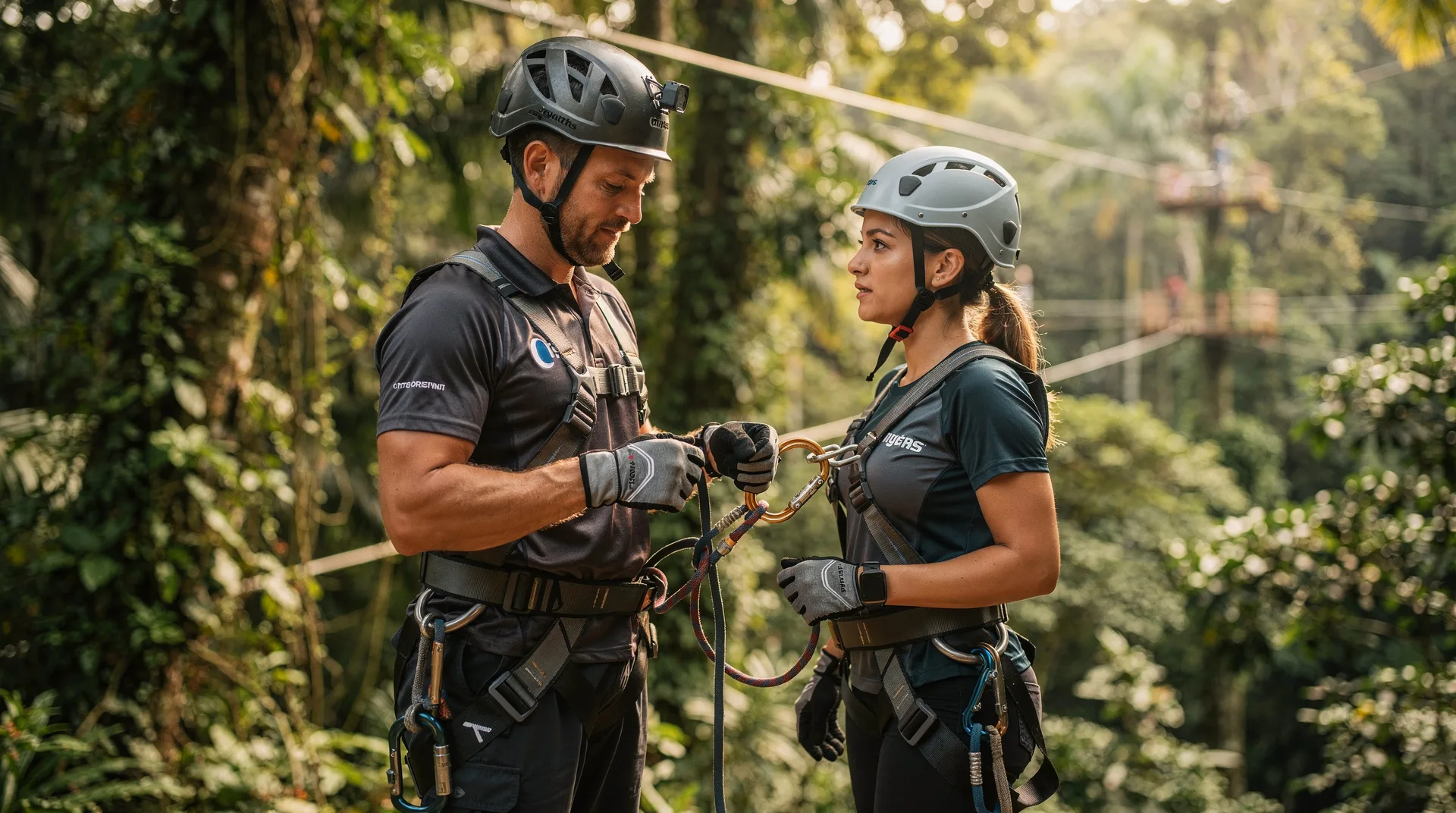
Double attachment: You should be connected to the cable at two points before the previous person leaves the platform. If guides are connecting you with a single carabiner to a single anchor point, ask why. Redundant attachment is the standard.
The harness: A proper zipline harness distributes weight across both legs and the waist/hip area. If you’re handed a harness that looks like a single waist strap, decline and ask for the correct equipment. Full-body harnesses (chest + leg loops) are now standard at certified operators.
Braking system: Most circuits use a passive braking system (thickening of the cable near the landing platform combined with a hand-operated friction brake that the guide controls). Premium operators use active braking systems. The guide should demonstrate the braking procedure and explain the backup.
Weight limits: why they matter and what operators enforce
Weight limits on ziplines are not arbitrary. They’re engineering specifications based on:
- Cable rated load capacity (the cable breaks at X kg but is rated for a fraction of that)
- Trolley bearing load ratings
- Braking system efficiency at the maximum rated speed
- Platform structural ratings
Standard weight limits:
- Maximum: 110-120 kg at most certified operators
- Minimum: 15-25 kg (varies by operator and cable configuration)
Operators at the high end (Sky Adventures, 100% Aventura) consistently enforce these limits with pre-tour weighing if a guide has any concern. This is not discrimination — it is the engineering requirement.
If you’re near the maximum limit, be honest with yourself and the operator. Some cables in the same circuit have lower limits than others; a guide who knows you’re at 115 kg can route you on the appropriate cables and skip the ones rated to 110 kg.
Age limits: what’s realistic and what’s enforced
Most operators advertise a minimum age of 3-5 years. The practical minimum is often higher:
- Children under 4 typically lack the physical coordination to control a brake handle or follow platform instructions reliably
- Children between 4-7 years often ride in tandem with a guide on certain cables
- The Superman cable configuration typically has a minimum of 7-8 years
- Tandem arrangements add weight — both the child and guide must fit within the cable’s rated limit
The maximum age is not typically restricted, but participants must be in reasonable physical health and capable of moderate walking between platforms on uneven terrain. The walk between platforms at Sky Adventures Arenal, for example, includes inclines of 10-15 degrees over uneven root-strewn ground.
Consult your doctor before booking if you have a heart condition, history of stroke, recently repaired fractures, advanced spinal conditions, or if you’re in the third trimester of pregnancy. Operators will ask these questions during booking — answer honestly.
Pricing guide: what you’re paying for across different operators
Zipline pricing in Costa Rica runs from $45 at small rural operators to $165 for all-day combo passes at large parks. Here’s an honest breakdown of what the price reflects:
Under $60
Typically: small operators with 3-7 cables, maximum height under 60 m, shorter cable lengths, guides who are local and may have variable English proficiency. These operators may or may not hold ICT certification. Always check.
Not necessarily bad — some small operators offer excellent value and are genuinely safe. But the due diligence falls more heavily on you.
$60-85
The mid-range where you find quality operators like Ecoglide at Arenal ($75-85) and the entry-level Monteverde canopy tours. These operators hold ICT certification, have proper equipment, trained guides, and run circuits with 8-12 cables at meaningful heights.
Monteverde: thrilling zip line canopy tour — from $60$85-110
The flagship canopy experience range. Sky Adventures Monteverde, Sky Adventures Arenal, and the Diamante zipline-aerial pass fall here. You’re paying for: certified equipment at the premium end of the spec range, gondola access at some properties, smaller group sizes, well-trained bilingual guides, and comprehensive safety infrastructure.
Jacó Beach: zipline canopy tour — from $75$110-165
All-day combo passes (Diamante, Selvatura full day) or extreme experience packages at 100% Aventura. The price reflects additional activities bundled with the zipline (butterfly garden, hanging bridges, wildlife sanctuary, ATV) rather than a single more expensive zipline experience.
Canopy zipline eco-adventure tour Braulio Carrillo — from $95 the Diamante Eco Adventure Park all-day pass, combining zipline, hanging bridges and a wildlife refuge in one ticket — from $165Price tier comparison at a glance
| Price tier | Cable count | Height | Certification confidence | Best for |
|---|---|---|---|---|
| Under $60 | 3–7 cables | Under 60m | Verify directly | Budget travellers, casual thrill |
| $60–85 | 8–12 cables | Meaningful heights | High (Ecoglide, entry Monteverde) | Best value certified circuit |
| $85–110 | 10–15+ cables | Premium spec | Very high (Sky Adventures, Diamante) | Flagship canopy experience |
| $110–165 | Combo pass | Multiple activities | Very high | Full-day, first/only adventure day |
Weather and cancellation policies
Lightning is the only consistent cancellation trigger for zipline operators. High winds are a secondary concern — operators make judgment calls about wind strength on an open cable.
What operators will generally not cancel for:
- Light rain or mist (ziplines operate in rain — you will get wet)
- Cloud cover
- Temperature drops
What you should do in bad weather:
- Never pressure a guide to launch in conditions they’ve flagged as marginal
- Ask explicitly about the cancellation and rebooking policy before departure
- Most certified operators offer either a full refund or rebooking for lightning cancellations
December through April (dry season) has the fewest weather-related cancellations. May through November (green season) sees more afternoon electrical activity in highland areas — morning slots are more reliable.
What to do if something feels wrong
If you arrive at an operator and something concerns you — equipment looks worn, guides are dismissive of questions, you can’t see an ICT plaque — trust your instinct and leave. You’ll lose a booking deposit or prepayment, but this is the right call.
What to raise specifically:
- “Can I see the ICT certification?”
- “What is the maximum rated weight for this cable?”
- “Can you show me the backup braking system?”
- “Is there a dedicated emergency procedure for this circuit?”
Legitimate operators answer these questions confidently. Operators who become defensive, dismissive, or evasive in response to safety questions are telling you something important.
The Tarzan swing: a special safety note
Many circuits include a Tarzan swing — a free-fall drop where you’re released from a fixed point and swing on a pendulum. The Tarzan swing is usually the element that generates the most anxiety in advance and the most exhilaration afterward.
The key safety point: you must not be released until the previous person has cleared the swing arc. Watch what the guide checks before releasing each participant. The check should include: are the previous person’s feet clear? Is the landing area clear? Is the participant’s hand clear of the release mechanism?
If a guide rushes this sequence under group pressure, it’s appropriate to slow down and ask them to repeat the check. A Tarzan swing incident from a collision is rare but not theoretical.
Insurance and what happens if something goes wrong
Even at fully certified operators, injuries occasionally happen — most commonly minor harness burns, ankle strain on landing, or the occasional collision on shared cables. Standard travel insurance policies frequently exclude “extreme sports” as a category, and some insurers classify ziplining under that exclusion even though the injury risk profile is closer to a guided activity than genuine extreme sport. Confirm your policy explicitly covers canopy tours before you travel — see our travel insurance guide for what language to look for in a policy.
Certified operators carry their own liability insurance as an ICT certification requirement, which covers incidents caused by equipment failure or guide error, but it does not replace your own travel medical coverage for injury treatment and evacuation costs.
Ziplines vs other adrenaline activities
If safety concerns are pushing you toward or away from ziplines specifically, it helps to see where the activity sits relative to alternatives. Our adventure comparison guide breaks down ziplines against canyoning and hanging bridges in detail, but the short version: ziplines are the lowest physical-exertion, highest-speed option of the three, with an excellent safety record at certified operators.
For visitors who want a similar aerial thrill with a different mechanic, bungee jumping and paragliding are both available in Costa Rica under separate certification frameworks, and the ATV tours by region guide covers a ground-based alternative that pairs well with a zipline day in Guanacaste.
The honest bottom line on Costa Rica zipline safety
The industry has an excellent safety record at certified operators. The major parks — Sky Adventures, 100% Aventura, Selvatura, Ecoglide, Diamante, Midworld — collectively process hundreds of thousands of riders annually with an incident rate that is genuinely low.
The incidents that do occur are almost entirely concentrated at non-certified or recently opened operators who haven’t invested in proper equipment and training. The ICT certification system exists precisely to create a clear distinction between these tiers.
Your due diligence comes down to three things: check the certification plaque, read recent reviews (Google and TripAdvisor both show equipment concerns in negative reviews if they exist), and trust your instinct when you arrive on-site.
Frequently asked questions about zip line safety and pricing
Which Costa Rica zipline operator is the safest?
All ICT-certified operators meet the same baseline standard. Among the large operators, Sky Adventures, 100% Aventura, Selvatura, Ecoglide, and Diamante have all maintained certification for multiple years without significant incidents. “Safest” among certified operators is less meaningful a distinction than “certified vs non-certified.”
How do I verify an operator’s ICT certification online?
Visit ict.go.cr and navigate to the licensed operator database (operadores turísticos). Search by name or location. The database is in Spanish but navigable with basic translation tools.
What happens if it rains during my zipline tour?
Tours continue in light to moderate rain. Operators provide gloves, and the cables function normally in wet conditions. You will get wet. Pack a dry bag for your phone. If electrical activity begins, guides will shelter the group until it passes or, if sustained, facilitate an orderly return to the base.
Is a GoPro safe on a zipline?
A properly mounted chest or helmet GoPro is permitted at most certified operators. Confirm the mount type is acceptable before your tour — some operators prohibit wrist mounts and handheld cameras. Unmounted cameras are never permitted on cables.
Are ziplines in Costa Rica accessible for people with disabilities?
Some operators offer adapted circuits for specific mobility limitations. Sky Adventures Arenal, in particular, has accommodated visitors with prosthetic limbs and certain wheelchair users on modified portions of their circuit. Contact the operator directly to discuss specific requirements — blanket answers are not useful because accessibility depends on the specific disability.
Should I pay extra for travel insurance that covers zipline accidents?
Yes. Standard travel insurance often excludes “extreme sports.” Ensure your policy explicitly covers zip lining and canopy tours before departure. World Nomads, SafetyWing, and Allianz all offer policies that include adventure activities — read the fine print on the specific activities list.
What is the cheapest legitimate zipline in Costa Rica?
Entry-level certified operators in the San José area, Jacó, and smaller regional towns offer circuits from $55-65. The Braulio Carrillo canopy tour near San José is a legitimate, certified option in the $70-75 range that’s convenient for visitors who are only in San José and want a canopy experience without driving to Monteverde or Arenal.
Related guides
For operator-specific information at the main Costa Rica zipline destinations, see our guides for Monteverde ziplines, Arenal ziplines, Diamante Eco Adventure Park, and Selvatura Park Monteverde.
For a broader activity comparison — when ziplines are the right choice vs canyoning or hanging bridges — see our adventure comparison guide and adventure tour pricing overview.