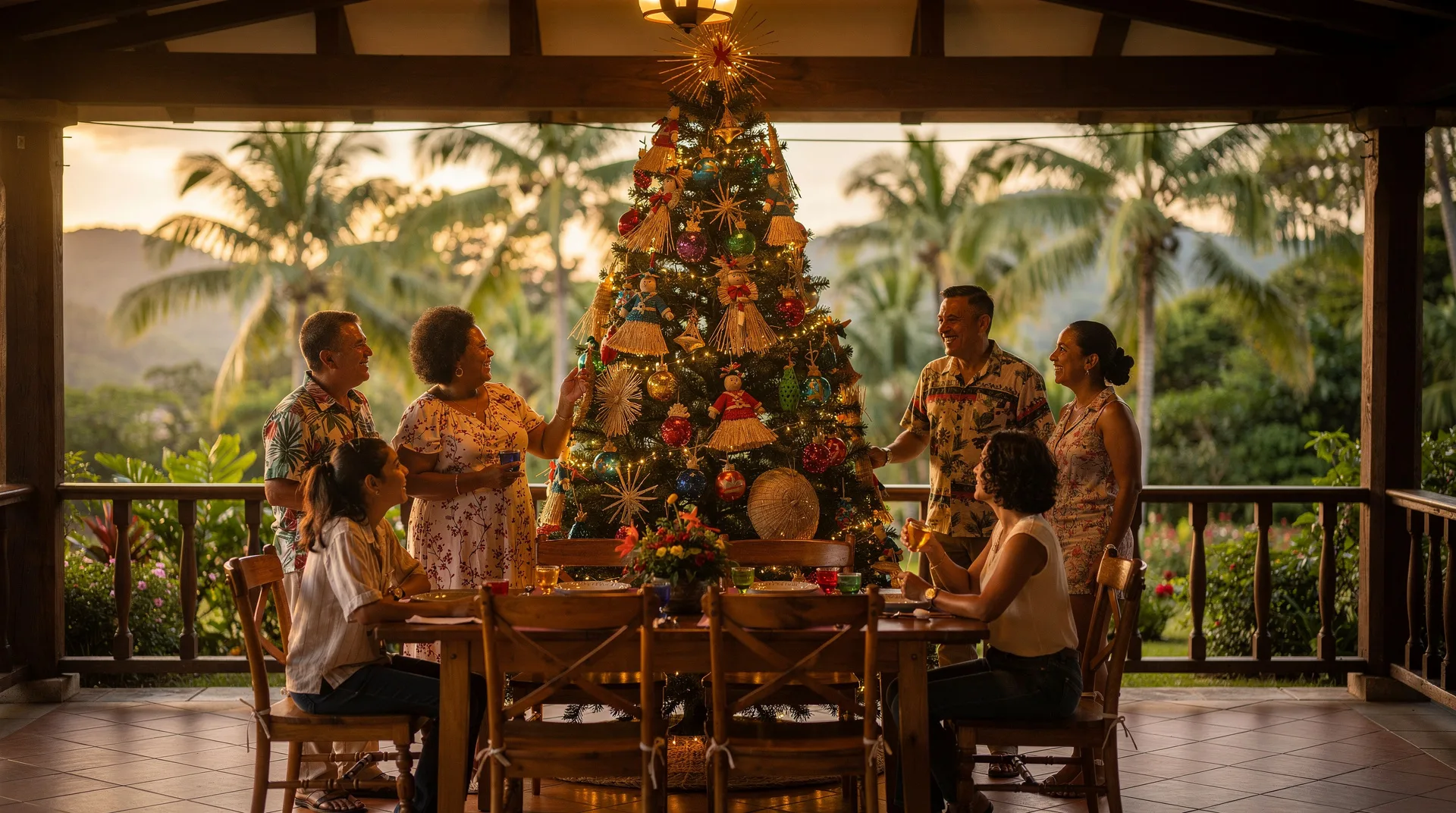
Christmas in Costa Rica: our tradition
The December we didn’t go home
The first time we spent Christmas in Costa Rica was an accident. Our flight home from San José had been overbooked, we had accepted the airline’s offer of a travel voucher and a rescheduled departure for January 2, and we suddenly had ten unexpected days in a country we had not expected to see in December.
What followed was the best Christmas any of us had experienced in years. We have been back for two more since — in 2023 and again this year — and the experience has deepened each time in the way that repeat visits to any place you love tend to deepen. You stop being a tourist observing traditions and start being someone who has opinions about whose tamales are better.
| When | December 16-24 (Posadas), tamales concentrated in the week before |
| Best base | San José or Cartago for the cultural side |
| Weather | Driest on the Pacific, wetter and less predictable on the Caribbean |
| Cost | Highest of the year, especially Dec 20 – Jan 5 |
| Book by | 3-4 months ahead for Christmas week |
The tamale: Costa Rica’s central Christmas ritual
In most of Latin America, the tamale is a year-round food. In Costa Rica, it is specifically and almost exclusively a Christmas food. The tamal tico — as distinct from the Mexican, Guatemalan, or Salvadoran versions — is made with masa (corn dough) filled with seasoned rice, pork or chicken, peppers, olives, and sometimes raisins, wrapped in banana leaves and steamed in groups. The process is labor-intensive and communal — making tamales is a family event.
The tamalada, the day (or days) of tamal-making, typically happens in the week before Christmas. Extended family gathers at the matriarch’s house. The production runs on a division of labor that has been refined over generations: someone makes the masa, someone prepares the filling, the children are tasked with gathering and preparing the banana leaves (a job that sounds simple and is not), the experienced hands do the wrapping. The whole enterprise takes hours and produces dozens — sometimes hundreds — of tamales.
We have been invited to two tamaladas since we started spending Christmases here. The second one, at the home of a family connected through our La Fortuna lodge contacts, was an event that lasted from 9am to 6pm and produced 200 tamales for the family’s extended Christmas gatherings. The kitchen was run by a woman in her seventies who had made tamales since she was eight years old and had opinions on every step of the process that she shared freely and with great precision.
The finished tamal, eaten for breakfast with black coffee on Christmas morning, is one of the things we now genuinely miss when we spend December elsewhere. If tamales spark your interest in Tico food more broadly, our gallo pinto and traditional dishes guide covers the everyday side of the cuisine, and our cuisine by region guide explains how the tamal fits into a wider regional food picture.
Las Posadas: nine nights of procession
The Posadas — derived from the Spanish word for inn or lodging — are nine nights of ritual celebration running from December 16 through December 24, representing Mary and Joseph’s search for shelter in Bethlehem. In Costa Rica, particularly in smaller cities and pueblos, Las Posadas involve neighborhood processions with candles, traditional songs (villancicos), and gatherings at designated homes.
We witnessed our first Posada in Cartago, the highland colonial city southeast of San José, where the tradition is particularly well preserved. A procession of perhaps eighty people moved through the neighborhood streets behind two children dressed as Mary and Joseph, carrying candles, singing call-and-response villancicos in the cold mountain air (Cartago sits at 1,440 meters and December nights are genuinely cold). The procession ended at a home whose residents opened their doors to everyone — candles were set aside, hot tamales and ponche (a warm fruit punch with cinnamon) appeared from the kitchen, and the gathering became a neighborhood party that lasted past midnight.
The Posadas are not a performance for tourists. We were welcomed at Cartago’s because a local couple we had met at a café heard we were curious about the tradition and extended an invitation. This kind of access is available if you approach it with genuine curiosity and without a camera in your face.
Smaller pueblos outside Cartago and San José hold their own Posadas on staggered nights through the nine-day cycle, and the scale tends to be more intimate than the capital’s. If your Spanish is basic, that is fine — the villancicos are call-and-response and easy to hum along to even if you cannot follow every verse, and being handed a candle and pulled into the procession line requires no vocabulary at all.
San José: Irazú Volcano, Cartago city & Orosi Valley tour — from $110San José’s Christmas market scene
San José in December is a different city from San José in August. The city center — normally a place that divides travelers sharply between those who find it gritty and interesting and those who find it grimy and skip it — becomes festive in ways that are hard to explain without having been there.
The Paseo Colón and the Parque Morazán area host Christmas markets with craft vendors, pupusas, churros, and enough holiday decoration to make the usually traffic-throttled streets feel genuinely celebratory. The National Theater (Teatro Nacional), Costa Rica’s most beautiful building, runs special holiday programming in December — performances of traditional Costa Rican music and dance that sell out weeks ahead but are worth the advance booking.
The Mercado Central, which operates year-round, transforms its character in December: vendors set up additional stalls, Christmas goods appear alongside the usual fruits, vegetables, and butchers, and the general noise and energy level increases in ways that feel celebratory rather than merely busy.
San José in December rewards early morning visits before the heat (December is the driest month but still warm in the city) and late evening walks when the Christmas lighting is at its best.
December weather: the travel planning reality
It is worth being direct about what December weather means for the trip experience.
The Pacific coast — Guanacaste, Manuel Antonio, Uvita, the Nicoya Peninsula — is at its driest and most reliable in December. This is the start of the peak season for a reason: the trade winds have pushed the rainy season away, the light is clear, the ocean calms significantly for the northern Pacific in particular. Tamarindo in December is beautiful. Nosara is beautiful. Manuel Antonio is at its most photogenic.
The Caribbean coast is a different story. December is a shoulder period for the Caribbean — neither the September-October dry window nor the June-July relative stability. Rain is likely, and the Caribbean microclimate is always less predictable than the Pacific.
The central valley — San José, Cartago, Heredia — is temperate and comfortable in December. Cloud cover is common in mornings, clearing by midday. Rain is infrequent.
For the month-by-month detail behind this, our December weather guide breaks it down region by region, including the specific rainfall averages we are summarizing here.
San José: guided city tour with National Theater visit — from $45What makes December special beyond the holidays
The combination of peak-season weather and the cultural festivities makes December one of the best months to be in Costa Rica for a specific kind of traveler: someone who wants excellent wildlife conditions (Leatherback turtles begin arriving at Las Baulas NP in October and are active through February; Northern Hemisphere humpbacks arrive in Costa Rica’s Pacific from December through March; dry season bird migration peaks), great Pacific beach weather, and access to cultural traditions that are not performative.
The one significant tradeoff: prices. December — specifically December 20 through January 5 — is Costa Rica’s single most expensive travel period. Hotels add holiday supplements, tour operators are booked solid, the Paquera ferry fills completely on the weekends before Christmas. Book everything (and we mean everything) three to four months ahead if you want to spend Christmas week in the popular destinations.
For travelers with flexibility to arrive December 1-18 or depart by December 19, you get most of the weather benefit without the full holiday premium.
Our tradition now is to arrive in the first week of December and stay through the 26th. We catch the start of the Posadas, we eat tamales on Christmas morning, and we leave before the January school holiday rush when local family tourism is at its most intense.
For full December weather context, see our best time to visit Costa Rica guide.
The country at Christmas is something different. We keep coming back because the difference is good.