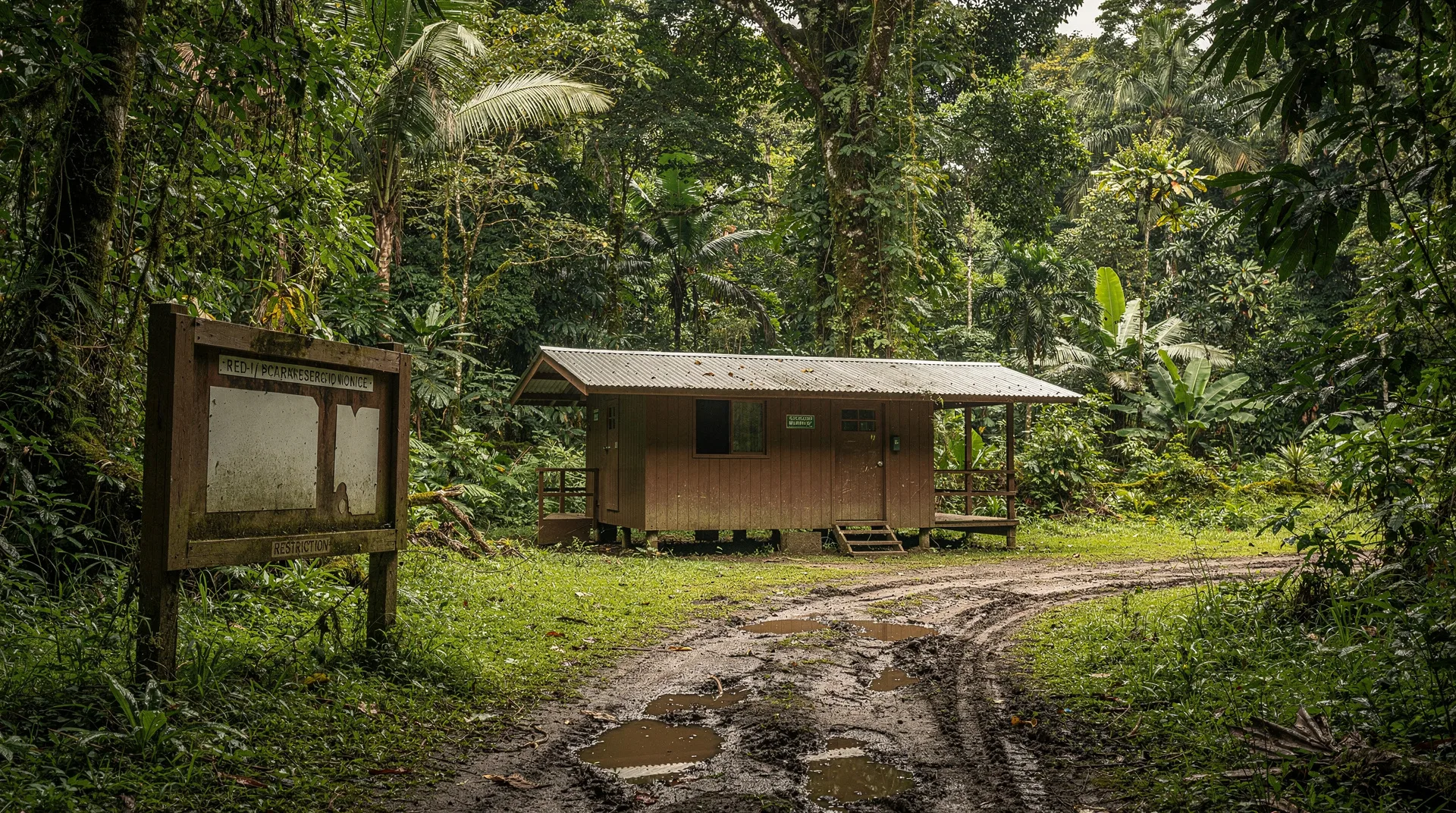
Corcovado restrictions update
The rule that was always there, now actually enforced
Corcovado National Park has required certified guides for independent visitors since 2014 — a rule that SINAC enacted following a series of incidents in which independent travelers became lost in the park’s 424 square kilometers of dense primary rainforest, requiring ranger rescue operations. For several years after the rule was written, enforcement was inconsistent: rangers at the Sirena and San Pedrillo stations might wave through a confident-looking hiker without checking guide credentials.
By 2024, that window has closed. The guide requirement is enforced at every entry point. Visitors without a certified guide are turned away. This is not a gray area and it is not worth testing.
This post explains what the current rules mean in practice, how to book a certified guide, what the visit now costs at honest all-in pricing, and the specific logistics that catch visitors off guard.
| Guide requirement | Mandatory since 2014, enforced at every entry point |
| Park entrance | around $15/person/day (foreign visitors) |
| Guide fee | around $25-45/person in a group, more for private |
| Sirena quota | 190 visitors/day, fills months ahead in peak season |
| Base towns | Drake Bay or Puerto Jiménez |
The certified guide requirement in detail
SINAC maintains a registry of certified guides (guías de turismo naturalista) who are authorized to lead groups into Corcovado. The certification requires completion of a training program, passing examinations in first aid and natural history, and registration with the Tourism Institute (ICT). The list of certified guides is publicly available but changes regularly as new guides qualify and others let certifications lapse.
Several categories apply:
Day visits from Drake Bay: the most common itinerary for visitors based at Drake Bay lodges. A certified guide accompanies a group of typically 4-8 visitors from the San Pedrillo or La Leona station trailhead, spending 4-7 hours inside the park. The guide fee (not included in park entrance) typically runs $25-45 per person in a group, or $80-120 for a private guide for one or two people.
Day visits from Puerto Jiménez via La Leona: a longer approach from the Osa Peninsula’s Pacific-side capital, typically involving a 4x4 taxi or rental vehicle to the Carate landing strip, then a 45-minute walk along the beach to La Leona station. The same guide requirement applies.
Overnight stays at Sirena research station: the most immersive Corcovado experience — spending one or two nights at the Sirena ranger station, which has bunk accommodation and meals, allows you to be in the park at dawn and dusk when wildlife activity is highest. Advance booking through SINAC is required months ahead. A certified guide is mandatory for the hike from any entry point to Sirena.
The park has set daily visitor quotas at each entry point. Sirena is the most restricted: 190 visitors per day across all entering parties. La Leona and San Pedrillo have lower quotas. During peak months (January through April), these quotas fill entirely — sometimes months in advance for Sirena.
Drake Bay: Corcovado NP and Sirena Station tour — from $135What this means for the traveler planning now
The pre-planning requirement for Corcovado in 2024 is significantly higher than it was three years ago. This is worth being explicit about, because the park’s reputation (the most biodiverse place on earth per area, 2.5% of the world’s species in 0.001% of the land area) attracts travelers who discover the logistics only after they have booked flights.
The practical sequence for a day visit:
- Choose your access point (Drake Bay side via San Pedrillo or Osa side via La Leona/Carate).
- Book accommodation in Drake Bay or Puerto Jiménez as your base.
- Contact a certified guide — either through your lodge (most good lodges in Drake Bay have guide relationships) or through the SINAC-listed guide directory.
- Confirm park entry for the date — guides handle this coordination, but clarify who is booking the park slot and when.
- Pay the park entrance fee ($15 per person for foreign visitors) and the guide fee separately.
For Sirena overnight stays, begin this process three to four months ahead during high season. We are not exaggerating: Sirena accommodation sells out completely between January and March for January through April dates.
Corcovado NP: Sirena day tour Drake Bay-Corcovado — from $145The guide quality argument
The mandatory guide rule was controversial when introduced and remains somewhat controversial among the independent travel community, which values the ability to explore without escort. Our view on this, after conversations with guides, rangers, and researchers who work in the park, has evolved over the years.
The guides who have the SINAC certification for Corcovado are, on average, excellent. The park’s density of observable wildlife — tapir, peccary, scarlet macaw, all four Costa Rican monkey species, anteater, jaguar tracks if you are lucky, multiple snake species — is only partly accessible to the untrained eye. Our first visit to Corcovado, before the enforcement became consistent, involved walking past what our guide (we had hired one voluntarily) identified as a fer-de-lance at four meters distance. We had not seen it. Without the guide, we would have walked into it.
The guide’s role is not just navigational and safety-oriented. The quality of the natural history interpretation — which animals to watch for and why, how to understand the forest structure, what the sounds mean — is directly correlated with guide quality. The best Corcovado guides are people who have spent years in this specific forest. They know the seasonal patterns, the resident individuals (a specific tapir who frequents the Sirena area in mornings, for example), the microhabitats where specific species concentrate.
Budget the guide not as an imposed cost but as part of the experience price. It is money well spent. For context on what makes Corcovado’s wildlife density so unusual, our monkey species of Costa Rica guide covers all four species you have a real chance of seeing here in a single day, something almost nowhere else in the country offers.
Corcovado: three days and two nights — from $695The seasonal closures: an important caveat
The Sirena station occasionally closes — particularly in September through November — for maintenance and due to weather-related access issues (the beach approach from La Leona can be impassable at high tide during heavy swell, and wet season flooding affects some internal park access).
If you are planning a Corcovado visit between September and November, verify directly with your guide and with SINAC that the specific entry points you are planning to use are open. Do not rely on booking confirmations alone — cancellations due to weather are a real possibility and the best guides will tell you this upfront.
This is also the shoulder-to-green-season window when prices soften and crowds thin, so the tradeoff is real on both sides: lower certainty of access against a genuinely quieter park and better lodge availability in Drake Bay and Puerto Jiménez. Travelers with flexible dates and a willingness to build in a buffer day or two often do well visiting in this window specifically because of the reduced crowding, provided they treat the closure risk as real rather than theoretical.
The Las Pailas trail at Sirena — which provides the best access to the interior of the park — has also had periodic closures for erosion repair. Ask your guide specifically about trail conditions in the weeks before your visit.
Getting to Drake Bay and Puerto Jiménez
The logistics of reaching either base town for Corcovado deserve attention because they are non-trivial.
Drake Bay: no road connects Drake Bay to the rest of the highway system reliably. Access options are: a Sansa or Aerobell domestic flight from San José (50 minutes, $90-130 per person), or a combination of bus/taxi to Sierpe and a boat up the Río Sierpe and along the coast (2.5-3 hours total, $15-25 per person in a shared boat). The boat option is beautiful and is recommended if your schedule allows. The flight is faster and avoids the river crossing swell, which can be rough.
Puerto Jiménez: accessible by road from San José (approximately 7-8 hours via Ciudad Cortés and Palmar Norte, through beautiful but exhausting driving) or by Sansa flight (50 minutes). The road is the honest choice only if you are doing the Osa Peninsula as part of a longer southern Pacific itinerary.
For the comprehensive planning guide to the Osa Peninsula and Corcovado, including the best lodges, guide recommendations, and what to bring for the rainforest, see our Corcovado National Park guide and Drake Bay destination page.
The park is worth every restriction. The rules exist because it is extraordinary, and extraordinary things require protection.
Building Corcovado into a wider trip
Because the rules reward early planning, it helps to decide where Corcovado sits in your trip before you book anything else. If you are still weighing the park against the country’s other famous reserve, our comparison of Manuel Antonio vs Corcovado lays out what each one gives you, and the Manuel Antonio National Park guide is the easier, more flexible option if the logistics here feel like too much.
Getting to the Osa usually means a domestic flight or a long road day, so read our overview of internal flights with Sansa and Aerobell and the notes on road conditions by region before you choose. If you are thinking about driving, driving in Costa Rica covers what to expect, and the rent a car or not guide helps you decide whether a vehicle is worth it at all for this part of the country.
Once the base town is settled, the rest of the trip tends to fall into place around it. The 12 days adventure itinerary from Corcovado to Pacuare and the 12 days south Pacific deep itinerary both show how travelers fit the park in alongside other regions, without rushing the days that matter most.
Two other reads are worth your time. Our how the Osa Peninsula changed our trip planning post explains why we now build itineraries around the Osa rather than squeezing it in, and the new park fees 2024 post covers the wider changes to how national parks charge and manage visitors. For the practical side of staying safe in the rainforest, see safety in Costa Rica and the wildlife watching ethics guide, which is a good primer on how to behave once your certified guide has led you onto the trail.
If you would rather have a tour operator handle the paperwork and the guide, a two-day, one-night Corcovado trip — from $425 is one way to take the coordination off your plate.