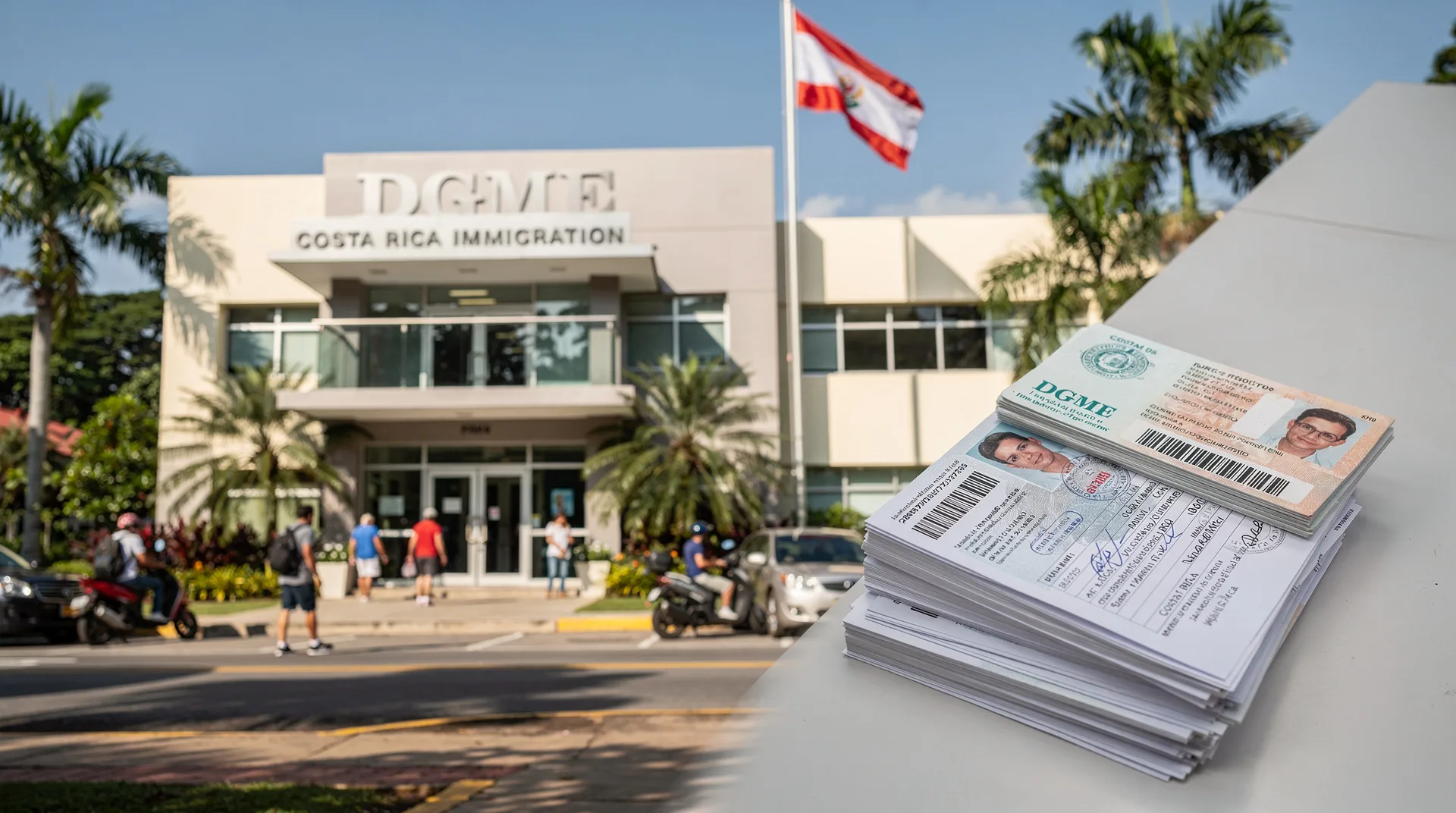
Immigration and permanent residency update 2022
The questions we keep getting about staying longer
A significant portion of the readers who find this site through our planning content are not only planning a trip — they are thinking about something more permanent. The question arrives in variations: “We are retired — can we live in Costa Rica?” “My partner and I want to spend a year or two there — what does that look like legally?” “What is the residency process actually like?”
We have addressed the digital nomad visa in a separate post. This one focuses on the two classic long-term residency pathways: the pensionado program (for retirees receiving pension income) and the rentista program (for those with documented passive income). We wrote this at the end of 2022, when several changes to costs and processing had made the older information circulating online out of date. We have updated it since, but the 2022 baseline is the foundation. If you’re only planning a short trip and not a move, our visa and entry requirements guide is the one you actually need.
| Pensionado threshold | $1,000/month certified pension income |
| Rentista threshold | $2,500/month certified passive income |
| Realistic total cost | $1,200–3,500 in prep costs (lawyer, apostilles, translation) |
| Realistic processing time | 8–14 months, not the 3–6 officially quoted |
| Path to permanent residency | After 3 years of temporary status |
Pensionado residency: what it requires
The pensionado (or jubilado) residency category is designed for retirees receiving guaranteed pension income from a government or private pension. The income requirement as of 2022: a minimum of $1,000 per month in certified pension income. This is relatively low by international standards for residency programs, which is one reason Costa Rica has attracted a substantial North American and European retiree community.
The income can come from Social Security (US), Canada Pension Plan, UK pension, or equivalent government programs. It can also come from a certified corporate pension — a company retirement plan that guarantees fixed monthly payments. What it cannot come from is investment returns or rental income; those fall under the rentista category, which has different income thresholds.
Documentation required for the pensionado application:
- Certified pension award letter (apostilled)
- Bank statements showing regular pension deposits for 12 months
- Birth certificate (apostilled)
- Criminal background check from country of residence (apostilled)
- Marriage certificate if bringing a spouse (apostilled)
- Passport copies
- Two passport-sized photos
- Completed DGME immigration forms
- Health insurance with Costa Rica coverage
The apostille process is the most time-consuming element for most applicants. US documents require either a federal apostille (for FBI background checks) or state-level apostilles (for birth and marriage certificates), each of which takes 4-12 weeks depending on the issuing state.
Rentista residency: the income threshold
The rentista residency category covers people with documented passive income who do not have a pension. The income requirement as of 2022: a minimum of $2,500 per month in certified passive income from outside Costa Rica.
“Passive income” in this context is interpreted fairly broadly by Costa Rican immigration: it includes investment income, interest income, rental income from properties outside Costa Rica, dividends, royalties, and similar sources. What it excludes is active employment income — if you are working remotely for a foreign employer, you would use the digital nomad visa rather than the rentista.
The certification requirement is the specific challenge for rentistas: the income must be documented not just through bank statements but through certified letters from the institutions generating the income. A brokerage account, for example, needs a certified letter from the brokerage confirming the monthly distribution amount. This letter needs to be apostilled in many cases, which requires coordination with institutions that are not always familiar with the process.
Several people in our network have found that consolidating passive income sources into a single certified instrument — a fixed-term investment product with a guaranteed monthly distribution — simplifies this documentation significantly.
How the colón’s strength affects your budgeting
Both thresholds are set in US dollars, but your day-to-day cost of living once resident is priced in colones — and the exchange rate has moved meaningfully over the past several years. We cover the mechanics in our post on why the colón fell against the dollar, but the practical implication for prospective residents is straightforward: a stronger colón means your dollar-denominated pension or passive income buys less locally than it did when the exchange rate was more favorable to the dollar. Build a buffer into your budget rather than assuming historical colón prices will hold.
Costs: the honest accounting for 2022
The official application fees charged by DGME (the Costa Rican immigration authority) are modest — a few hundred dollars at most. The real costs are in professional services and document preparation.
Immigration lawyer fees: $800-1,500 for a standard pension or rentista application, depending on complexity and the number of family members included. This is not optional if you want the application to move efficiently; the documentation requirements are specific enough that self-navigation frequently results in rejected packets that restart the clock.
Document apostille costs: these depend on how many documents need apostilling and from which countries. For a US couple, plan $150-300 for the document authentication costs, plus $15-20 per document for notarization.
Translation costs: all documents in a language other than Spanish must be translated by a certified Costa Rican translator. Plan $30-60 per document.
Health insurance: required as part of the application and ongoing. A couple over 60 might pay $200-400 per month for Costa Rica coverage through a private provider.
CAJA enrollment: once residency is granted, residents are expected to enroll in the Caja Costarricense de Seguro Social (CAJA), the public health system. Contributions are income-based but typically run $50-150 per month for pensioners. CAJA coverage, while not equal to private care for specialist services, provides meaningful basic health coverage.
Total out-of-pocket preparation costs for a single applicant: typically $1,200-2,500. For a couple: $1,800-3,500, depending on document complexity.
Processing times: the honest reality
This is the area where the most optimistic information circulating online tends to diverge most sharply from reality.
DGME published processing time targets in 2022 of approximately 3-6 months from complete application submission to residency card issuance. In practice, the timeline for many applicants was 8-14 months. This is not a new problem — Costa Rican immigration processing has historically moved slowly — but the post-pandemic backlog worsened it considerably in 2021-2022.
During the processing period, applicants live in Costa Rica on a consecutive 90-day tourist visa extension arrangement, which involves leaving and reentering the country every 90 days (a “border run”) or applying for a prorroga (extension) through DGME. Both are legal and commonly used.
The border run is simpler: cross into Panama or Nicaragua for a day, get your passport stamped, return. The land crossings at Paso Canoas (Pacific) or Peñas Blancas (Caribbean side) are functional, if not glamorous. Most people make the crossing in a day. Some people genuinely enjoy the break — a day in David, Panama, or in Liberia, Nicaragua, is interesting travel in its own right.
San José: Irazú Volcano, Cartago city & Orosi Valley tour — from $110What residency actually gets you
Once granted, Costa Rican temporary residency (which pensionado and rentista status confers initially) gives you the right to live in the country indefinitely, to open a local bank account without the tourist limitations that frustrate longer-stay visitors, to own property with the same rights as citizens, and to access CAJA healthcare.
After three years of temporary residency, you can apply for permanent residency. After seven years, citizenship is available — though many long-term expats do not pursue citizenship.
Day-to-day money matters change once you are resident. Our guides to money and currency and ATM and cash tips cover the practical side, and travel insurance is worth reading even if your residency application already requires health coverage.
One thing residency does not automatically do: it does not give you the right to work locally for Costa Rican employers. The pensionado and rentista categories are for people whose income comes from outside Costa Rica. If you want to work locally — open a business, take employment — you need additional permits.
Residency also does not, by itself, mean you should buy property. That is a separate decision with its own risks, and we address it directly in should you buy property in Costa Rica — read it before you sign anything, regardless of how settled you feel once residency is granted.
The expat community landscape in 2022
By the end of 2022, Costa Rica had an established expat community of an estimated 60,000-80,000 North Americans and Europeans, concentrated in the central valley (Escazú, Santa Ana, Atenas), the Pacific beaches (Tamarindo, Nosara, Jacó, Manuel Antonio), and the mountain communities of the central plateau. Atenas, a small town in Alajuela province, has been consistently promoted as an ideal retirement community — temperate climate, proximity to San José, well-developed expat services.
The community infrastructure is real: English-speaking doctors (many US and European-trained), bilingual legal professionals, banks familiar with foreign accounts, expat-oriented grocery stores with familiar imports, and English-language social organizations. Whether you want to integrate into Tico life or replicate a suburban North American lifestyle with a better climate, the infrastructure for either choice exists.
For people considering this path, we suggest spending a research trip of two to three weeks in the areas you are considering before committing to the application process. The community that looks appealing on Facebook forums can feel different when you have lived in it for a week.
Planning your research trip
A research trip works best when it tests daily life rather than sightseeing. Base yourself in San José or Heredia province for the central valley, then compare it with a beach town such as Tamarindo or Jacó. Notice how far you are from a hospital, a supermarket and a pharmacy, because those distances matter far more at 70 than they do on holiday.
Before you go, read our best time to visit guide and the microclimates explained guide. A town that feels perfect in the dry season can feel very different in the green season, and the central valley, the Pacific coast and the mountains each have their own weather. Our driving in Costa Rica guide and rent a car or not will help you decide how mobile you want to be while you test each area.
Costa Rica: private transportation service — from $220Where to go for current information
Immigration rules, fees, and processing times change. The information here reflects 2022 conditions with updates where we have made them. For current requirements, the authoritative sources are:
- DGME (Dirección General de Migración y Extranjería): migracion.go.cr — the official immigration portal, in Spanish.
- Association of Residents of Costa Rica (ARCR): arcr.net — English-language resource specifically for expats navigating the immigration process.
- CRHP or similar legal services: several Costa Rica-based immigration law firms publish regular updates; a reputable one that comes up frequently in expat forums is worth bookmarking.
For the digital nomad visa rather than permanent residency, read our separate post on digital nomad visa and life in Costa Rica. And for a sense of what your monthly budget needs to look like once you’re actually living here rather than visiting, our 2023 affordability analysis is the closest thing we have to a real cost baseline.
The process is not fast and it is not simple. But for the right person — someone who has identified Costa Rica as the place they want to be, and who has the patience for bureaucracy — the outcome is a legal right to live in one of the world’s most biodiverse and politically stable countries. Many people have decided that is worth it.