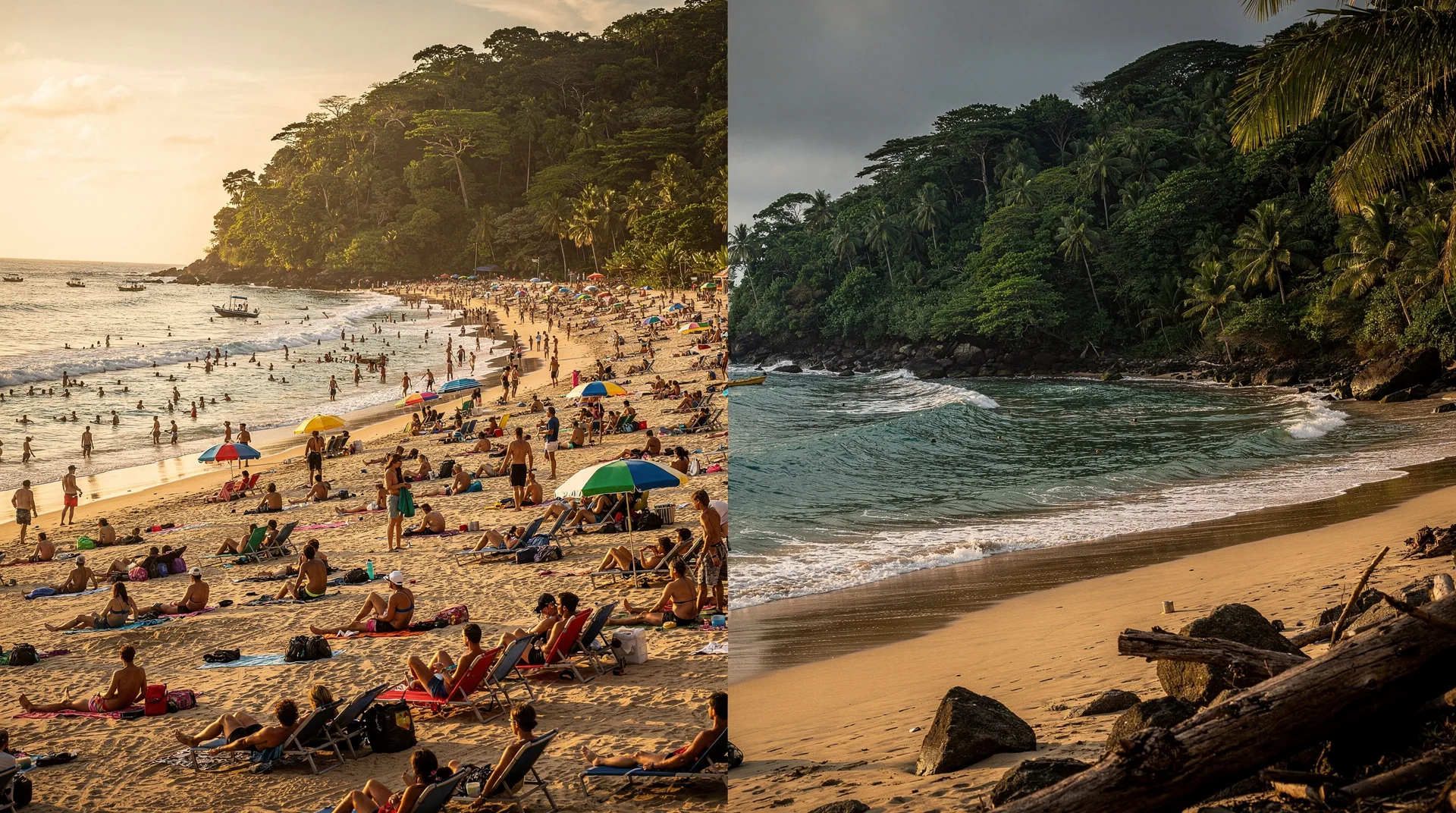
Spring break crowds and alternatives
The crowding that hits every March
Mid-March through late March is, consistently, the most crowded period in Costa Rica’s most popular destinations. Spring break — the North American university calendar driving a concentrated surge of travelers — coincides with the peak of dry season, the best beach weather of the year, and the end of the peak-season travel window that began in December. The result is that destinations like Manuel Antonio, Tamarindo, La Fortuna, and Monteverde are running at maximum capacity during a two-to-three week window that produces some of the year’s most frustrating visitor experiences.
We know this from years of data. We also know that the experience during this window depends enormously on where exactly you go — and that some of the alternatives available in March are, objectively, better experiences than the crowded alternatives.
This is the practical guide to March in Costa Rica if you cannot avoid the window.
| Peak crowd window | Mid-to-late March |
| Worst hit | Manuel Antonio, Tamarindo, La Fortuna, Monteverde |
| Quieter alternatives | Southern Pacific (Uvita), Caribbean coast, Guanacaste interior |
| Booking lead time | Park reservations + car rental 6-10 weeks ahead |
| Weather | Still dry season, best beach conditions of the year |
Manuel Antonio in mid-March: the honest situation
Manuel Antonio National Park has a daily visitor cap — the park closes when the reservation quota fills, which during spring break happens on weekday mornings and essentially every weekend before noon. The cap is a feature, not a bug: it prevents the park from being destroyed by overuse. But it means that visitors who have not reserved in advance either do not get in or wait for afternoon slots when wildlife activity is lower.
The town of Manuel Antonio — the strip of hotels, restaurants, and tour operators that lines the road from Quepos down to the park entrance — is at maximum density during spring break. Traffic is at its most frustrating. The beaches outside the park (Playa Biesanz, the public beach area) are busy. The restaurant wait times extend.
If you have booked ahead and have your park reservation, Manuel Antonio in March is still worth it. The park is genuinely beautiful; the sloths and monkeys are not deterred by tourist volume. But the experience is more managed and less spontaneous than in quieter months.
If you have not booked ahead and are arriving in mid-March hoping to improvise, adjust expectations accordingly.
Manuel Antonio: catamaran cruise to Biesanz Bay with lunch — from $95Tamarindo in mid-March: louder, not worse
Tamarindo is built for its own version of spring break. The town’s infrastructure — bars, restaurants, surf schools, waterfront hostels — is designed at a scale that absorbs large groups of young travelers without significant degradation to the experience. If you are in Tamarindo for the social scene, spring break is actually a reasonable time: the energy is high, the beach is busy in the way that beach towns are meant to be busy.
The issue is price. March is peak within peak: accommodation prices are at their highest, and the better-value mid-range hotels are frequently full months ahead. If you are arriving without a reservation, you are competing for the rooms that were not pre-booked — which tends to mean higher prices for lower quality.
The surf quality in March is typically good but not exceptional. The south swells that produce Tamarindo’s best waves are an April-October phenomenon; March is late dry season and the swell tends to be more variable.
The quiet corners of Tamarindo’s beach — further north toward Playa Langosta, accessible by walking the beach at low tide or driving the parallel track — are meaningfully less crowded than the main town beach even during spring break. If you are in Tamarindo in March, walk north.
The alternatives that work better in March
Here is where we get specific. These are destinations we have verified are genuinely quieter during spring break and deliver comparable or better experiences.
Monteverde in March: the cloud forest towns of Monteverde and Santa Elena receive overflow from the beach destinations but remain more manageable than the Pacific coast. The reserve itself requires advance booking but is not sold out in the way that Manuel Antonio is. The weather in March is drier than in green season — fog is lighter, trails are better. And the wildlife in March is excellent: quetzals are in the early phase of breeding season, the birding is exceptional. Our specific recommendation: Curi-Cancha Reserve as an alternative or complement to the main Monteverde Reserve.
Uvita and the southern Pacific in March: Uvita in March is at the end of peak season — still dry, still sunny, but with noticeably fewer spring-break travelers than the established northern beach towns. Marino Ballena is less crowded than Manuel Antonio at comparable prices. The northern humpback whale population is still present in March. If you are flexible about your Pacific beach destination and do not need the social infrastructure of Tamarindo, the southern Pacific in March offers the same weather at lower crowd density.
Uvita: whale & dolphin watching boat trip w/ drinks — from $95Caribbean coast in March: the Caribbean coast (Puerto Viejo, Cahuita, Manzanillo) runs on a different seasonal calendar from the Pacific. March on the Caribbean is in the wetter half of the year, but the rain on the Caribbean is different from Pacific green season rain — shorter bursts, often in the afternoon, with enough dry windows for beach time.
The crowd level is dramatically lower than the Pacific in March. Puerto Viejo’s culture — Afro-Caribbean music, limonense cuisine, a genuinely different vibe from the Pacific beach circuit — offers something that spring break crowds at Manuel Antonio cannot. A one-week Caribbean circuit in March (Tortuguero, Puerto Viejo, Cahuita, Manzanillo) is genuinely excellent.
Guanacaste interior: Rincón de la Vieja and Cañas Dulces area: the Guanacaste interior — away from the coastal tourist circuit — sees almost no spring break traffic. Rincón de la Vieja National Park in March is dry, accessible, and running at manageable visitor volumes. The Las Pailas thermal trail is one of the best day-hike experiences in the country: volcanic mud pots, fumaroles, hot streams, and the sudden clearing at the Río Negro canyon that produces a view most visitors never see. The lodges in the Cañas Dulces area offer genuine eco-lodge experiences at prices well below equivalent quality on the coast.
Rincón de la Vieja Las Pailas thermal trail tour — from $90The practical logistics of March alternatives
Renting a car for a March alternative itinerary is strongly advised. The alternatives that work best in March — Monteverde, southern Pacific, Caribbean — are not difficult to reach by shuttle, but the flexibility to leave a crowded destination and find a quieter beach requires your own transport.
March car rental is peak pricing — budget the high end of our 2026 pricing update car rental table. Book the car at least six weeks ahead; the compact 4WD fleet is the first to sell out.
If you are committed to Manuel Antonio for family reasons (kid-friendly beach, established infrastructure, the park’s reputation), book the park reservation the moment your itinerary is fixed. Manuel Antonio reservations for March open 30 days ahead and fill within days. Check the SINAC portal at 6am on the day they open.
Cahuita NP guided hike with snorkel and lunch — from $85Where to read next before you commit
Before fixing dates, it helps to read the detail behind each choice. Our Manuel Antonio National Park guide explains how the park works and why entry planning matters, and the Manuel Antonio destination page covers the town and the stay options around it. For the beach scene, the Tamarindo destination page shows what the town offers beyond the main strip.
If you are leaning toward the quieter side of the trip, the Marino Ballena National Park guide and the Uvita whale watching season guide show what the southern Pacific looks like in practice. For cloud-forest days, the Monteverde destination page and the Curi-Cancha Reserve guide help you choose between reserves. Travelers drawn to the Caribbean can start with the Cahuita destination page, and anyone hunting for empty sand should look at our list of hidden beaches.
On transport, the rent a car or not guide and the shuttle services overview will help you decide how much flexibility you need when a stop turns out busier than expected. If the crowds still worry you, our honest look at tourist traps is a useful companion read.
If you have kids: the March-specific considerations
Families traveling during North American spring break face a specific version of this problem: school-calendar dates are fixed, and the crowded window is often non-negotiable. If that is your situation, a few adjustments help. Book the Manuel Antonio park reservation the day your dates are confirmed, not “closer to the trip” — March slots for families with young children (who need the earlier, cooler morning entry times) go first.
Consider basing the trip around one crowded, high-value stop (Manuel Antonio, properly reserved) and one quieter region where children can decompress without lineups — Uvita’s beaches and the Guanacaste interior both work well for this, and neither requires the same advance-booking pressure as the Pacific’s headline towns. Shuttle and rental car demand also peaks with the school calendar; book both well before the six-week mark if traveling with car seats or specific vehicle requirements, as suitable inventory sells out first.
Why we still recommend March travel, with adjustments
March travel in Costa Rica is not a mistake. It is the end of the best weather season, the parks are open, the wildlife is excellent, and the country is at its most accessible. What requires adjustment is destination selection and booking lead time.
The travelers who have the worst spring break experiences in Costa Rica are those who arrive assuming that spontaneous planning will work as it would in a lower-demand period. It will not. Manuel Antonio with no reservation is not a plan. Tamarindo with no hotel in March is not a plan.
The travelers who have excellent March experiences are those who have planned specifically for the conditions: park reservations, car rental, accommodation booked eight to ten weeks ahead, and — ideally — a mix of one popular destination (which they have managed properly) and one quieter alternative (which they discovered because they read ahead).
For full seasonal guidance across all months and regions, read our best time to visit guide and our post on why we recommend shoulder season.
The country is worth visiting even in the crowded window. It just requires knowing what you are walking into.