Why we still recommend shoulder season
The argument we keep making
We have been recommending shoulder season travel to Costa Rica for years, and the argument gets stronger as peak-season prices and crowds increase. If you have any flexibility in your travel dates — and many people have more than they think — April and May represent the best combination of conditions available in any month.
We are going to make this case as specifically as possible, because “shoulder season” as a concept gets invoked vaguely by travel writers who mean different things by it. Our version is precise: late April through late May is the optimal window, and here is why.
| Window | Late April – late May |
| Savings | ~25-30% on hotels and car rental vs. peak |
| Weather trade-off | Afternoon rain (Pacific), hot mornings in April |
| Best regions | Monteverde, Arenal, Tortuguero |
| Booking lead time | 2-3 weeks vs. 6-8 weeks in peak season |
The weather reality in late April and May
The Costa Rican dry season runs roughly December through April on the Pacific coast. May is the traditional start of the rainy season. What this means in practice is more nuanced than the binary dry/wet framing suggests.
In late April, the Pacific coast (Guanacaste, Manuel Antonio, Uvita) is still predominantly dry but beginning to see occasional afternoon thunderstorms — the leading edge of the green season. Mornings are clear. Afternoons become less predictable as the month progresses. Temperatures in Guanacaste peak sharply in April — this is the hottest month in Nicoya and Guanacaste, with beach areas hitting 35-38°C in the afternoon. Many travelers find the heat in April more challenging than the rain in May.
In May, the pattern shifts further: morning sunshine is typical for the Pacific coast, with rain arriving in the afternoon. These are not all-day rains — they are often dramatic tropical downpours of one to three hours, followed by clearing and a cooling that makes the evening genuinely pleasant. The landscape in May is transforming: the gold-brown dry-season hillsides of Guanacaste turn vivid green within weeks of the first rains.
The cloud forest at Monteverde and Santa Elena in April-May is in its most productive birding window. Quetzals are actively nesting from March through June; April and May offer reliable sightings without the January-March peak-season crowds at the reserves. The mist that characterizes the cloud forest is thicker in May, which is either atmospheric (it is) or inconvenient (sometimes). We prefer to think of it as the former.
What the prices actually look like
The shoulder season price drop is significant and worth documenting with specifics.
In a representative mid-range hotel in La Fortuna — the kind of place that runs $135-160 per night in January — the same room in May is typically $95-115. That is a 25-30% reduction on the accommodation line item alone.
Rental car prices track peak-season demand closely. The same compact 4WD that runs $95-110 per day in March is available for $65-80 in May. Over a 10-day trip, this translates to $150-300 in savings on the car alone.
Tour prices are less variable — most operators price their tours at consistent rates year-round — but availability is dramatically better. Booking a full-day Corcovado tour in January requires six to eight weeks of advance lead time and guide competition. In May, two to three weeks is usually sufficient, and the guides we book in May tell us consistently that the park is quieter and the animals less habituated by daily tourist volume.
Our rough estimate for a couple on a 10-day mid-range trip: saving $800-1,400 by choosing May over January is realistic. At the higher end of the accommodation and transport savings, it approaches $1,800.
Río Celeste National Park hike — from $95What you actually give up
Honest accounting requires acknowledging the tradeoffs.
Afternoon rain on the Pacific: in May, afternoon rain is likely most days on the Guanacaste coast and the central Pacific. You will get wet at some point. If your travel style requires reliable afternoon beach time, May is not optimal.
Caribbean timing: May is in the wetter half of the Caribbean calendar. Unlike the Pacific, where rains are afternoon-concentrated, the Caribbean in May can receive rain at any time. Puerto Viejo in May is green and lush and beautiful in a specific way, but it is also frequently wet. The Caribbean sweet spot is September-October (the dry window) or the first half of February.
Guanacaste heat in April: late April in Nicoya and Guanacaste is very hot. This is not a problem if you are spending mornings in the water and afternoons in a hammock. It is an issue if your itinerary involves mid-day hiking at exposed sites.
Some lodges close: a small number of lodges in the most remote areas — some Drake Bay properties, some Monteverde smaller guesthouses — close for part of May through June for renovation. If you have a specific property in mind, check its seasonal operating schedule.
What you gain that you cannot get in high season
This is the part of the argument that goes beyond cost savings.
Wildlife that is available only in the green season: the first months of the green season trigger ecological events that high season travelers miss. Scarlet macaws, which are migratory within Costa Rica, are more concentrated at Carara and the central Pacific coast in the rainy season transition. Poison dart frogs, which breed with the rains, are visible and active in ways they are not in the dry season. River levels, which drop significantly in dry season, refill in May — the Sarapiquí and Pacuare rivers become better for rafting as the water rises.
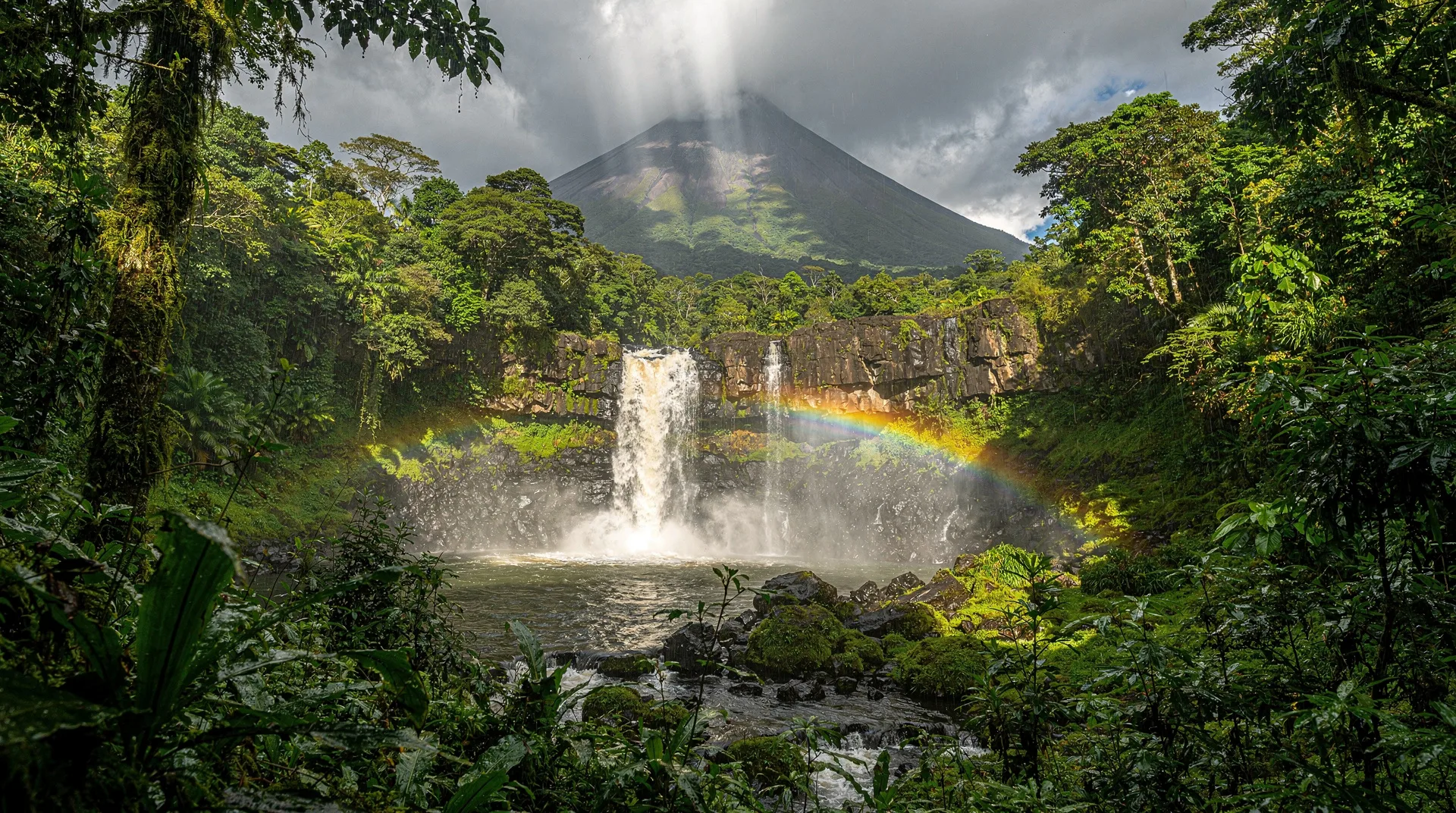
The landscape: Costa Rica in late April and May is visually different from January and February. The country is, in the truest sense, turning green. The burnt-orange hillsides of the Guanacaste dry forest become vividly alive. Waterfalls that are thin trickles in March are filling. The general explosion of green that follows the first rains is one of the most extraordinary things we have witnessed in repeated trips — it happens fast, within days of the first significant rainfall, and the visual change is dramatic.
Genuine interactions: there is a quality of interaction with local people and other travelers that is different in shoulder season. The guides are less rushed. The lodge owners have more time to talk. The sodas are not managing tables of twenty. This is not sentiment — it is a function of operational pressure that peak season creates and shoulder season removes.
La Fortuna/Arenal: rafting Class III & IV at Sarapiquí River — from $105The specific destinations that shine in April-May
Not every destination benefits equally from shoulder season timing.
Monteverde and Santa Elena: peak quetzal season, moderate crowds, ideal temperature. The cloud forest is at its most misty and atmospheric. Best timing in the shoulder window.
Arenal and La Fortuna: the waterfalls at La Fortuna are fuller with rising water levels. The hanging bridge trails at Místico are less crowded. Hot springs offer the same experience year-round. Good timing.
Tortuguero: green turtle nesting begins in late June and peaks in August, but the canals in May are full with rising river levels, producing excellent wildlife observation. Less crowded than the July-September turtle season. Good timing.
Guanacaste coast: the heat in April is challenging. Nosara and Tamarindo in late April are hot enough to concentrate activity to early morning and evening. May brings relief and quieter conditions but afternoon rain. Mixed timing depending on heat tolerance.
Osa Peninsula and Corcovado: May is good for Corcovado but requires checking guide and station availability. The Sirena station sometimes reduces capacity in the early rainy season. Verify with your guide before booking.
Shoulder season by region: quick reference
| Region | April–May verdict | Main trade-off |
|---|---|---|
| Monteverde | Best timing | None significant |
| Arenal/La Fortuna | Good timing | None significant |
| Tortuguero | Good timing | Pre-peak turtle season only |
| Guanacaste coast | Mixed | April heat or May rain |
| Osa/Corcovado | Good, verify access | Station capacity can shrink |
How this compares to spring break timing
If your calendar is fixed to March rather than the true late-April-to-May window, you are looking at a different trade-off entirely — March combines dry-season weather with the year’s most concentrated crowds, particularly around the North American spring break period. Our post on spring break crowds and alternatives covers how to navigate that specific window if late April is not an option for you. The core distinction: March buys you guaranteed dry weather at peak prices and peak crowds; late April-May buys you savings and quiet at the cost of afternoon rain risk.
Our recommendation
If you have travel flexibility and care about value, crowds, and the specific character of the landscape, late April through late May is our top recommendation for Costa Rica. Not over any other month — over January through March, which is objectively beautiful but expensive, crowded, and predictable.
The rain you will get in May is, in our experience, part of the trip rather than a problem. The afternoon storm that arrives while you are at the lodge produces a different light on the rainforest, a percussion of water on palm leaves, and a temperature drop that makes the evening genuinely comfortable. It is a different version of Costa Rica than the dry-season postcard, and in many ways it is the more honest one.
For the seasonal breakdown by month and by region, read our best time to visit guide and green season pros and cons.