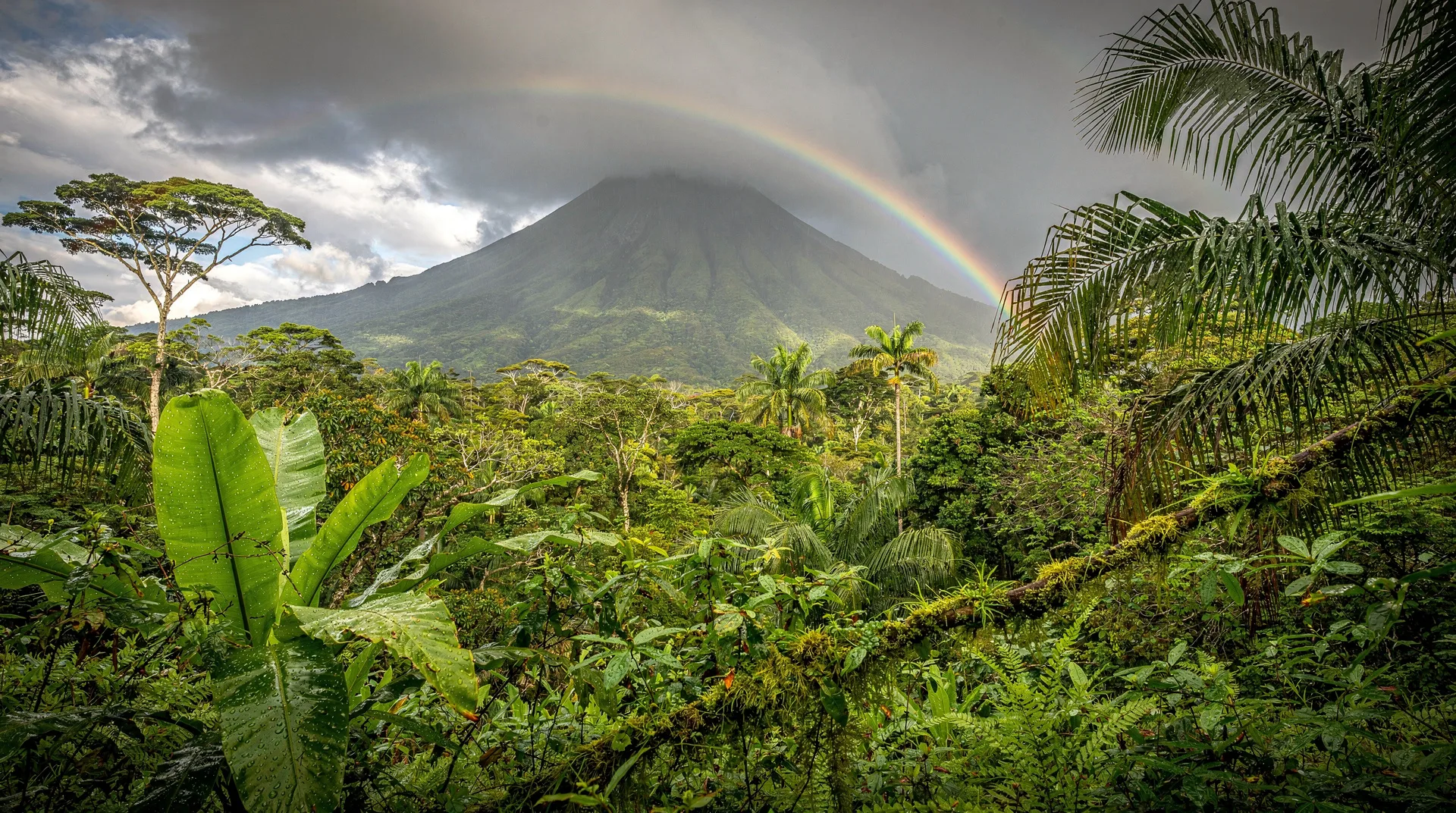
Green season Costa Rica: why it's worth considering
Is the green season in Costa Rica really worth visiting?
Yes — for most travellers. Prices drop 30-50%, national parks empty out, and the landscape is at its most dramatic. The rain pattern is typically sunny mornings with afternoon showers (2-4 hours), not all-day downpours. Wildlife peaks in August-October with turtles and whales. The main exceptions: the Osa Peninsula roads become difficult in September-October, and remote destinations require more planning.
The rebranding that is mostly accurate
The Costa Rican tourism board wisely rebranded “rainy season” as “green season” some years ago. Cynics will say it is marketing, but the name is genuinely accurate. The country from May through November is extraordinarily lush — waterfalls run full, the Guanacaste hillsides transform from brown to brilliant green within weeks of the first rains, and the jungle at destinations like La Fortuna and Monteverde hits a depth of colour that photographs cannot fully capture.
But “green season” does not mean rain-free. Anyone who books May-November without understanding the rain pattern is going to have a frustrating trip. This guide is about being honest: here is what the green season actually delivers, what it costs, what it gives you, and who should book it.
| When | May through November |
| Typical rain pattern | Sunny mornings, rain roughly 1–4pm |
| Savings | 30–50% on accommodation |
| Best wildlife | August–October (turtles, whales, birds) |
| Watch out for | Osa Peninsula roads, Sept–Oct heaviest rain |
How green season rain actually works
The critical piece of knowledge that changes everything for green season planning is understanding the diurnal rain pattern.
In most of Costa Rica’s Pacific lowlands and Central Valley, green season rain follows a consistent daily cycle:
- Morning: Sunny, often cloudless, warm.
- Late morning to early afternoon: Clouds build gradually.
- Afternoon (roughly 1-4pm): Rain arrives, sometimes heavy, often accompanied by thunder.
- Evening: Frequently clearing, with dramatic skies at sunset.
This pattern holds for most of the May-November period in Guanacaste, the Central Pacific, the Osa Peninsula, and the Central Valley. It is not every single day — some days stay clear, some days see rain earlier — but it is reliable enough to plan around. If you schedule your outdoor activities for the morning and your travel and relaxation for the afternoon, you will rarely feel like rain is ruining anything.
The Caribbean coast operates differently — see our microclimates explained guide for the full breakdown. In September-October, the Caribbean is actually at its driest while the Pacific is at its wettest.
What green season does to the landscape
The transformation from dry to green season is one of the most dramatic landscape changes of any tropical destination. Guanacaste’s cattle country goes from brown-gold scrubland to vivid green seemingly overnight. Waterfalls that are thin trickles in March become powerful cascades by June. The La Fortuna waterfall — a major attraction year-round — is at its most thunderous in the green season, with the pool below carrying that distinctive turquoise colour.
Rivers run high and fast, which matters for rafting. The Pacuare and Sarapiquí rivers are better for experienced rafters in green season because the volume increases class ratings slightly — class III-IV becomes more committed. See our Pacuare River rafting guide and Sarapiquí river rafting guide for water level context.
The cloud forest at Monteverde is arguably most atmospheric in the green season. Mist moves through the forest canopy, waterfalls appear on every trail, and the epiphytes and orchids that give cloud forests their character are at their most lush. The hanging bridges trail at Selvatura and the Monteverde reserve are extraordinary in May-November, though waterproof boots are worth bringing.
Immerse yourself in the Monteverde Cloud Forest — from $55The price difference is substantial
The green season accommodation savings are real and significant. Across most of Costa Rica’s popular destinations, expect:
| Destination | Dry season range | Green season range | Saving |
|---|---|---|---|
| Tamarindo mid-range hotel | $130-180/night | $80-120/night | ~35% |
| Manuel Antonio boutique lodge | $160-220/night | $100-140/night | ~35% |
| La Fortuna hot-springs resort | $200-300/night | $130-180/night | ~35% |
| Drake Bay eco-lodge | $180-260/night | $120-160/night | ~35% |
| Monteverde mid-range | $110-150/night | $70-100/night | ~33% |
For a couple on a 10-day trip staying in mid-range accommodation, the green season premium difference can amount to $400-700 in accommodation savings alone. That is a meaningful number. For a family of four, it can be transformative for the overall trip budget.
Some luxury properties do not discount as steeply — Nayara Springs and Tabacón near Arenal, or Lapa Rios near Puerto Jiménez, tend to run closer to 20-25% lower rather than 35-50%. But even at that level, the savings are real.
Wildlife: the green season is exceptional
Perhaps the most underrated advantage of the green season is how extraordinary the wildlife calendar is from July through October.
Sea turtles: Green turtles begin nesting at Tortuguero in July and peak in August-September. Leatherback turtles complete their El Grande lurch through Tortuguero from March through July. Olive Ridley turtles begin their spectacular mass arrivals (the arribada) at Ostional beach from August onward, continuing through December. See our Tortuguero turtle nesting guide for what to expect.
Humpback whales: The August-October window brings the southern hemisphere humpback population to the Marino Ballena and surrounding waters near Uvita. These southern whales are the primary attraction at the whale festival held annually in September. The whale watching season from Uvita explains the two-season whale calendar in detail.
Birds: Many species breed in the green season when insects are most abundant. The quetzal nesting season extends through June in the highlands around San Gerardo de Dota. Migrating birds begin arriving from North America in August-September, adding species to birding lists.
General wildlife density: The additional water sources in the green season concentrate terrestrial wildlife around ponds and streams, improving mammal sightings in some parks. Jaguar sightings (always rare) are marginally more likely in Corcovado during the wet season when they drink from temporary pools.
Turtle watching in Tortuguero, Costa Rica — from $45What you actually lose in green season
The green season is not without genuine trade-offs. Being honest about these matters.
Road access deteriorates: Some of Costa Rica’s most spectacular destinations sit at the end of unpaved roads that become difficult or impassable in heavy green season rain. The road to Drake Bay is the classic example — what is a rough but manageable track in February becomes a muddy, potentially vehicle-stranding problem in October. Similarly, parts of the Osa Peninsula circuit and some Caribbean coastal roads require 4WD with genuine clearance in the wet season.
If your plans include remote destinations, check road conditions ahead of time or budget for a 4WD rental regardless. Domestic flights (Sansa, Aerobell) to Drake Bay, Tortuguero, and Tambor become more attractive in green season precisely because they bypass the road issue.
Some activities are better in dry season: Snorkelling and diving visibility drops in the green season as rainfall stirs up sediment and river runoff clouds coastal waters. Around Playa Conchal, Caño Island, and the Catalinas diving sites, January-April offers visibility of 15-20 metres versus 5-10 metres in September-October. Beach activities are perfectly feasible in the green season mornings, but the afternoon rain pattern means you often need to be off the water by 1-2pm.
September-October can be very wet: While May-June and July are manageable, September and October are genuinely the wettest months on the Pacific coast. Guanacaste can receive 200-300 mm in a single October week. Road flooding is possible. On the most extreme days, even morning activities get rained out. September-October is best approached with maximum flexibility: have a plan and a backup plan.
Manuel Antonio in September and October: The park itself remains beautiful in green season — the wildlife does not care about the rain — but the beach inside the park can be grey and choppy on stormy days, which is less rewarding than the January version. Midweek visits in green season can be genuinely spectacular and quiet.
The veranillo: a green season bonus
One notable green season feature is the veranillo, a mini-dry spell that typically arrives in late June to mid-July. It usually lasts one to two weeks and brings a brief return of drier conditions to Guanacaste and parts of the Central Valley. The timing varies by year and is not guaranteed, but it is a reliable enough phenomenon to factor into planning if you have flexibility.
The veranillo makes early-to-mid July an interesting window: green season prices, but a decent chance of a week of clearer weather mid-trip. See our July weather guide for the full picture.
Green season strategy: how to plan well
The travellers who have the best green season experiences share a few habits:
Start activities early: Book tours, hikes, and outdoor activities for 7-9am starts. This captures the reliable morning sunshine and gets you ahead of the afternoon rain. Almost every tour operator in Costa Rica can arrange morning departures.
Build flexible afternoons: Treat afternoons as bonus time, not committed activity time. Read on the hotel terrace, visit a local soda for lunch, do a museum visit, or simply watch the rain from a covered viewpoint. The light during and after afternoon rain is extraordinary for photography.
Keep one or two rain days in the itinerary: Particularly in September-October, do not plan every day tightly. A flexible “buffer day” in each destination means a rained-out morning does not derail the whole itinerary.
Book accommodation with covered outdoor areas: Rain is not miserable if your lodge has a covered terrace, hammocks under a palapa, or a pool with a shaded bar. The best Costa Rica lodges are designed for the climate, not against it.
Pack appropriately: Lightweight waterproof jacket (not a heavy anorak), quick-dry clothing, and waterproof sandals or light hiking shoes that handle mud. A dry bag for electronics and a compact umbrella complete the picture.
Best green season months by profile
May-June: Best for combining decent weather with savings. The rains are establishing but not yet at their peak. Good for first-timers who want to try green season without the full commitment of October.
July (with veranillo): Excellent wildlife (turtle season starting, whale season beginning), possible clear spell mid-month, solid savings, and the rivers are running high for good rafting.
August: Peak turtle season in Tortuguero, start of southern humpback season off Uvita. Best wildlife month. Wettest period beginning on the Pacific but manageable with morning scheduling.
September: Cheapest month, Caribbean dry window (Puerto Viejo and Cahuita at their best), good whale watching off Uvita, peak turtle activity. Wettest Pacific month — requires flexibility but rewards patient travellers enormously.
October: Caribbean at its best (snorkelling visibility peaks), whale season active, waterfalls spectacular, prices still low. Pacific is wet but transition beginning. Strong month for Caribbean-focused itineraries.
November: The transition back to dry season. Second half of November often sees dramatically improving Pacific conditions, falling into the shoulder season sweet spot.
Green season and specific itinerary types
Families in green season
Families often assume green season is wrong for kids. In practice, the opposite is often true. National parks are quiet — no crowded narrow trails at Manuel Antonio, no waiting at the La Fortuna waterfall pool. Activity providers have more guide availability and smaller group sizes. Children often adapt better to the rain rhythm than adults do, particularly if they have a hotel pool to retreat to in the afternoon.
The one genuine concern for families is road conditions. If the itinerary requires unpaved roads (Drake Bay access, Monteverde gravel approach), a 4WD is essential. For families sticking to the primary circuits — La Fortuna, Monteverde, Manuel Antonio — green season travel is straightforward.
Honeymooners and couples in green season
Green season is excellent for couples who want atmosphere over volume. The Nayara Springs experience near Arenal is arguably more romantic when afternoon rain falls over the jungle and you are in a private plunge pool surrounded by birdsong. Candlelit dinners at boutique Manuel Antonio lodges with no other guests in the restaurant are a real green season luxury. The dramatic skies and dramatic waterfalls also make for more photogenic experiences.
For beach-centred honeymoons, green season works best on the Caribbean coast in September-October or on the Guanacaste coast in May-June. Late November into December is the ideal transition: beach quality improving daily toward dry season standards while accommodation costs remain closer to green season rates.
Surfers in green season
For surfers, green season is actually the better season on the Pacific coast. The May-October southern swells — generated by storms in the South Pacific — produce more powerful, more consistent waves than the winter northwest swells. Tamarindo’s beach break in July-August delivers better wave quality than January. Nosara’s Playa Guiones becomes a world-class wave during green season south swells.
The practical implication: surf-focused travellers should actively prefer green season on the Pacific side. The rain is irrelevant when you are already wet in the water, and the evening surf sessions on a clearing green season afternoon at Santa Teresa are among the best in the world.
Wildlife specialists in green season
For anyone whose trip centres on specific wildlife events, green season is often mandatory. The full wildlife calendar:
- July-October: Green sea turtles at Tortuguero (peak August-September)
- August-October: Southern hemisphere humpback whales at Marino Ballena and Uvita
- August-December (waning moon): Olive Ridley arrivals at Ostional beach
- October-February: Leatherback turtles at Playa Grande
- April-June: Resplendent quetzal nesting at San Gerardo de Dota (extending into green season)
For serious wildlife watchers, building an itinerary around these events automatically places you in green season for most of the most dramatic sightings. The wildlife calendar is covered in detail in our best time to visit Costa Rica guide.
Green season packing checklist
What you actually need for green season travel:
- Waterproof jacket with full hood: Not a poncho — a real jacket with sealed seams. The kind of rain you can get in September does not play around.
- Quick-dry clothing throughout: Merino wool or synthetic only. Cotton is unwearable after an afternoon downpour at 30°C.
- Waterproof bag or dry sack: For electronics, passport, and anything you do not want soaked.
- Waterproof hiking sandals or trail shoes: With drainage ports. Chacos or similar.
- Headlamp: More important in green season when late-afternoon rain pushes you inside and power outages, while rare, are more frequent.
- Insect repellent: The mosquito population increases in green season. DEET or picaridin for field activities, especially around Tortuguero and Caribbean areas.
- Anti-humidity bag for camera equipment: Green season humidity accelerates lens fungus. Keep lenses in sealed bags with silica gel packets.
Frequently asked questions about Costa Rica’s green season
Will it rain every day in green season?
On the Pacific coast, most green season days follow the diurnal pattern: sunny morning, cloud buildup, afternoon shower. Not every day brings heavy rain — some days stay clear, some days see lighter drizzle instead of a thunderstorm. September and October have the most consistent daily rain. May and early June tend to be more variable.
Is it dangerous to drive in green season?
Road conditions are more challenging but driving is not inherently dangerous. The main risks are unpaved roads that become muddy and require 4WD (Osa Peninsula, some Guanacaste routes), and occasional flooding on low-lying roads after very heavy rain. Always rent a 4WD for any itinerary involving unpaved roads. Waze and offline Maps are essential — they often route around flooding.
Can I still see wildlife in the green season?
Yes, and in some cases better. Turtle nesting, humpback whale watching, and many bird species are peak green season events. Land mammals are active year-round. The additional vegetation in green season means some animals are harder to spot in thick forest, but guided morning walks with a naturalist guide remain highly productive.
Is the green season good for surfing?
Yes. Pacific surf is generally better in green season — the May-October southern swells are larger and more consistent than the winter northwest swells. Tamarindo, Nosara, and Santa Teresa all get excellent waves. The Caribbean (Puerto Viejo) peaks December-February, which overlaps with the Pacific dry season.
What’s the biggest surprise for first-time green season visitors?
Most first-timers are surprised by how manageable the rain is. The afternoon shower pattern means you rarely feel like rain is ruining the day — it feels more like a daily tropical rhythm than a weather problem. The second surprise is how empty the national parks are: visiting Manuel Antonio on a Wednesday in October and having the trails almost to yourself is an experience that feels nothing like the same park in January.
Do I need travel insurance specifically because of green season weather?
Standard travel insurance is worth having any time of year in Costa Rica, but green season adds a specific reason: flight delays and cancellations from tropical storms are more likely between June and November, and some domestic Sansa or Aerobell flights to Drake Bay or Tortuguero can be weather-affected. A policy that covers trip delay and missed connections is a sensible addition for a green season itinerary that includes remote destinations.
Should first-time visitors avoid green season entirely?
No — May, June, and late November are genuinely excellent for first-timers, offering near-dry-season weather on the Pacific with meaningfully lower prices. The months worth more caution for a first trip are September and October, when rain is heaviest and road access to remote areas like the Osa Peninsula becomes least predictable. Our best time to visit Costa Rica guide breaks down the full month-by-month picture.