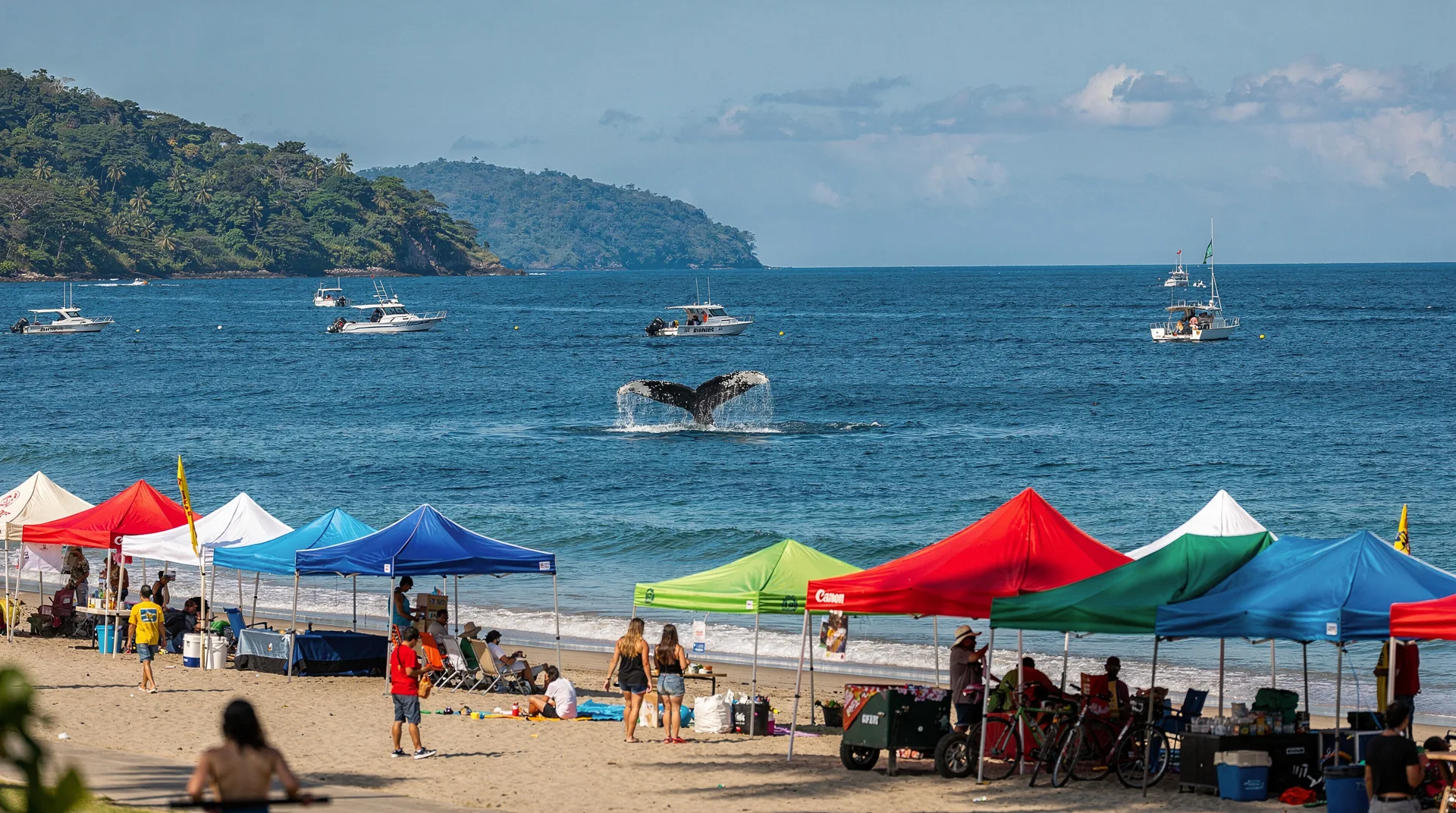
Uvita whale festival recap 2025
The week Uvita becomes something else
Uvita is, in most of the year, a quiet hub on the southern Pacific coast — a collection of supermarkets, sodas, dive shops, and budget hostels spread along the highway inland from the beach, with the extraordinary Marino Ballena National Park providing the reason to come. During the Festival de las Ballenas y Delfines, which takes place each September, the small town transforms into something that feels genuinely electric.
We had heard about the festival for years but had always arrived slightly before or after the event window. This year we built our September trip specifically around it. What follows is our honest account of the 2025 edition — what was excellent, what was crowded, and what the festival’s presence meant for the practical logistics of visiting Marino Ballena during the same week.
| When | Mid-September, long weekend (dates vary yearly) |
| Cost | Festival grounds free; Marino Ballena park entry ~$8 |
| Book ahead | Accommodation 6+ weeks; whale tours weeks out |
| Best for | Whale watching, local culture, Southern Hemisphere humpbacks |
| Weather | Green season — variable seas, pack a rain jacket |
The festival itself: what happens
The Festival de las Ballenas y Delfines is organized annually by the municipality of Osa and the park services in coordination with local operators. The 2025 edition ran over a long weekend in mid-September, timed with the Southern Hemisphere humpback whale population’s peak presence in the Bahía Ballena area (the southern whale population arrives in the bay from roughly August through October).
The land-based festival is centered on the Uvita beach area below the punta (the whale tail formation that gives Marino Ballena its geographic signature): a stretch of sand just outside the park boundary where live music stages are set up, artisan vendors line a path above the beach, conservation organizations host educational displays, and food stalls run everything from ceviches to grilled corn. Entry to the festival grounds is free, though the park entrance fee applies for anyone going further into Marino Ballena.
The music programming in 2025 was heavier on local Costa Rican acts than on international names — the kind of festival that is genuinely for the local community rather than designed to attract festival-circuit tourists. We found this a feature. The crowd on the Saturday evening we attended was perhaps 60% Tico families, 40% tourists, and the balance felt right. The music was loud, the food was good, the energy of several thousand people on a beach at sunset with humpback tails occasionally visible beyond the breakers was not something we had experienced before.
The whale watching in September: the actual reason to be here
Whatever brings you to Uvita in September, the whale watching is the main event. The humpback whales that arrive in the southern Pacific of Costa Rica between August and October are among the largest visitors to any Costa Rican ecosystem — adults at 35-40 tons — and September is reliably within the peak period.
We went out three times during our week in Uvita, with different operators, to compare.
The first trip produced the best encounter: a mother-calf pair close enough that we could hear the exhale at the surface — the whoosh of breath through a blowhole the size of a dinner plate — from fifteen meters. The calf was young enough that its barnacle coat had not yet fully developed; it was curious in the way that young animals sometimes are, swimming slowly alongside the boat for perhaps three minutes before the mother moved it away. The guide, a marine biologist from a local conservation organization, identified the mother from her tail fluke markings as an individual she had been photographing for six years.
Whale watching adventure in Uvita with expert guides — from $85The second trip produced multiple whale sightings — four different individuals over two hours — but at greater distance. Good for scope and understanding of the overall population density in the bay; not the intimate encounter of the first morning. Dolphins (spinner dolphins and common dolphins in two separate pods) were the highlight of the second trip.
The third trip was a grey day with choppy seas that produced short sightings and one person in our group who was very seasick. This is the September reality: the southern Pacific rainy season is in full swing and weather is variable. Pack a rain jacket for the boat, and if you are prone to seasickness, take medication before departing.
The festival crowd and what it did to logistics
In practical terms: Uvita in September during the festival weekend is a different experience from Uvita in a regular September week. The accommodation that had been available on short notice two days before the festival weekend was completely full by Thursday. We had booked our lodging six weeks ahead; others in our group who tried to add days after the fact could not find rooms within 30 minutes of the park.
The beach and park area were crowded in a way that September is not normally crowded — September is technically green season and Uvita is not a high-demand destination outside the festival period. The parking area was overwhelmed. The whale watching boat departures were fully booked on Saturday and Sunday morning. The sodas and restaurants along the main highway ran out of specific menu items by mid-afternoon.
If you want the festival experience and the whale watching, book both well ahead. The operators we spoke with confirmed that the better boats are booked weeks out around festival weekend each year.
Uvita: whale watching tour in Marino Ballena — from $80Comparing the two other snorkel/wildlife day trips from Uvita
If your week extends beyond the festival window, two other day trips from the Uvita base are worth weighing against another whale outing:
| Trip | Distance from Uvita | What you get | Typical duration |
|---|---|---|---|
| Caño Island snorkel | ~1.5-2hr boat | Coral reef, sea turtles, occasional dolphins | Full day |
| Drake Bay day trip | ~2hr boat/road | Osa Peninsula access, rainforest-meets-sea | Full day |
| Additional whale watching trip | Departs Uvita directly | Repeat encounters, different pods | Half day |
The whale tail: Marino Ballena’s geography
One thing the festival draws attention to that rewards proper appreciation is the geography of Marino Ballena itself. The punta — the sand and rock formation that extends into the sea and curves in a shape that from above closely resembles a whale tail — is one of those natural formations that photographs well but is more impressive in person because of the tidal dynamics.
At low tide, you can walk the full length of the punta from the beach to its tip, standing in shallow water on both sides with the Pacific open ahead of you. The formation is almost exactly 800 meters from the beach to the point. At high tide, the punta is partially submerged and the walk is not possible from the middle section onward. The timing of low tide relative to your visit is worth checking — the experience of walking the full punta is genuinely memorable and the whale watching is often good from the point itself at dusk.
Park entrance (with its 2024 fee update — currently $8 per person for foreign visitors) is required to access the punta from the Uvita beach side. The festival grounds are on the adjacent public beach and do not require park entry.
What the festival revealed about Uvita’s future
Uvita has been developing steadily for several years, driven by the combination of whale watching tourism, Caño Island access (the snorkel trips depart from Uvita and Drake Bay), and the growing reputation of the southern Pacific as an alternative to the Guanacaste resort scene. The festival, which draws visitors specifically rather than accidentally, is accelerating this development. For a full seasonal breakdown of when the whales are actually present — the festival is timed to the peak, but the window runs wider — see our Uvita whale watching season guide.
The infrastructure — roads, accommodation, restaurants — is improving but not yet at the level of Tamarindo or Manuel Antonio. This creates a transition period that, depending on your travel style, is either an opportunity (things are still accessible, prices are still reasonable, the crowds are still manageable) or a reason to come sooner rather than later.
For a comprehensive look at the whale watching season, the snorkel options, and what the park offers beyond September, see our Marino Ballena guide and Uvita destination page.
The festival is worth planning around. The whales are extraordinary. September is, despite the rain, one of the best months to be in Uvita if your priorities are wildlife and a local cultural experience rather than perfect beach weather.
Building a longer trip around the festival
Uvita works well as one stop in a wider southern Pacific route rather than a single-night detour. If you are arriving from the capital, our notes on airport-to-destination transfers and driving in Costa Rica will help you decide between a shuttle and a rental car, and road conditions by region is worth a look before you commit to a long day behind the wheel. Travelers who prefer to skip the driving altogether can compare options in our shuttle services overview.
From here the coast opens up in both directions. To the north, Manuel Antonio and Quepos make a natural pairing for a trip that mixes whales with rainforest trails. To the south, Drake Bay and the Osa side of the country reward anyone with the time to go deeper; our 12 days south Pacific itinerary shows one way to string it together, and Dominical is an easy neighboring beach town if you want a different pace for a night or two.
Reading the sea before you book
The three outings we took made one thing clear: whale watching is as much about the water as the animals. Before you pay for a boat, it helps to understand tide and surf conditions, because the same swell that sends surfers into the water can make a small boat uncomfortable. Our broader Costa Rica marine life guide explains what else you might see out there, and the wildlife watching ethics page covers how a responsible operator behaves around a mother and calf, which is a good test when you are choosing between boats.
If you want to see how a shorter, quieter visit compares, our shoulder season thoughts and dry season pros and cons put September in context, and the green season pros and cons page is the honest version of what the rain really means for a trip like this. Pack sensibly with the help of our packing list.