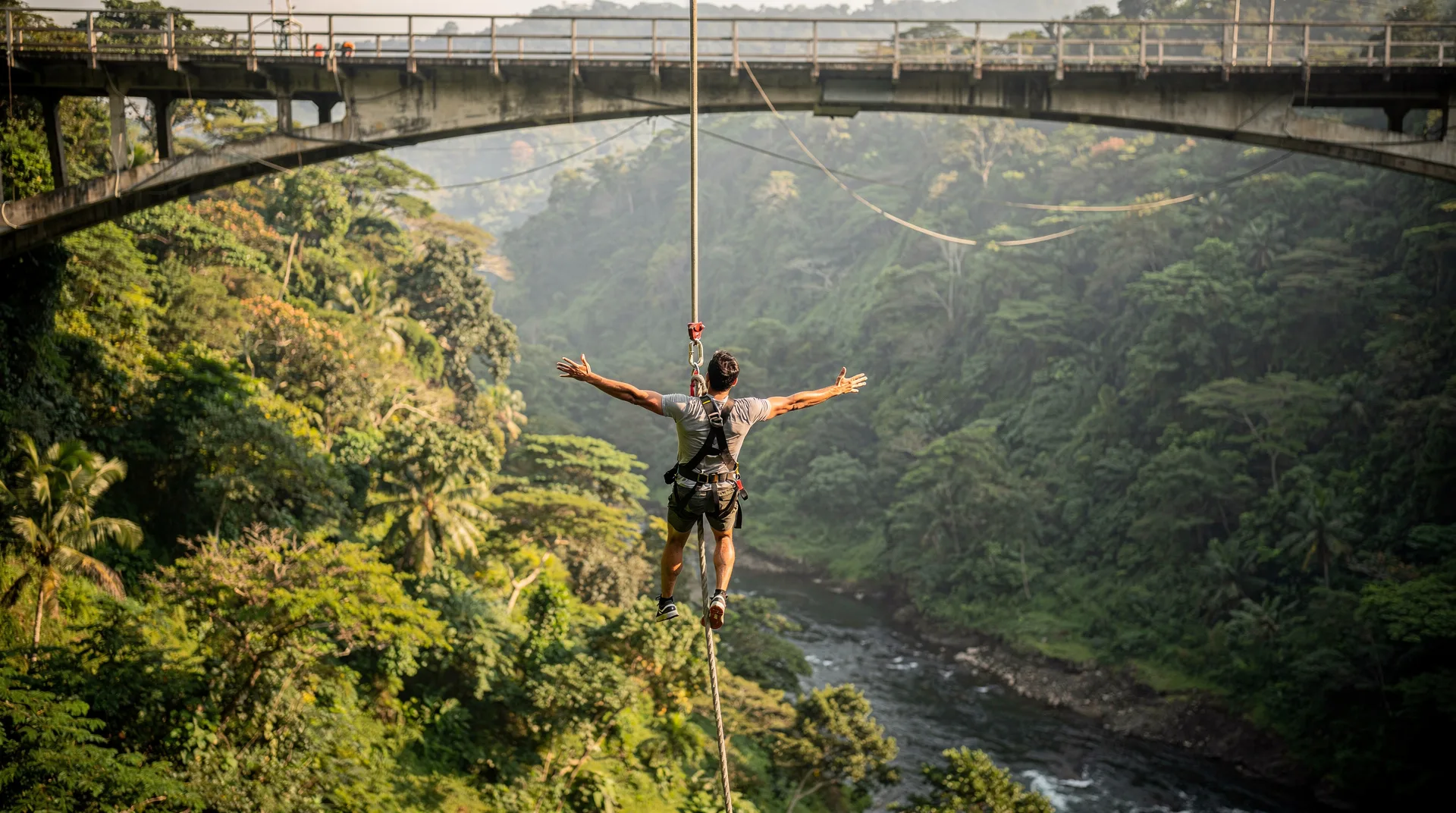
Bungee jumping in Costa Rica: the only real option explained
Bungee jump in Costa Rica?
Costa Rica has one established bungee jump operator: Costa Rica Extreme, on a 80-meter highway bridge near Naranjo, Alajuela. Price is approximately $75-90 per jump. They are the only dedicated operator in the country.
| Where | Naranjo bridge, Alajuela, ~70km / 90min from San José |
| Cost | Around $75–90 first jump, $50–60 second jump |
| Time needed | 10–15 minutes at the platform |
| Getting there | Rental car or private taxi (~$80–100 one-way); no reliable public transport |
| Booking | Direct with the operator, 2–3 days ahead in dry season |
The honest picture of bungee jumping in Costa Rica
Search “bungee jumping Costa Rica” and you will encounter a fair amount of outdated information, closed operators, and a couple of legitimate services that have been running quietly for years. This guide cuts through the noise.
Costa Rica has one established, consistently operating bungee jump operator: Costa Rica Extreme (Bungee Costa Rica), based at a bridge on the highway near Naranjo in the province of Alajuela. There is no cliff-edge jump into a crater, no jungle canopy drop, no multi-operator market as you would find for canyoning or ziplines. It is one location, one operator, and one genuinely extreme bridge jump.
That straightforwardness is actually reassuring — it means the operator has built their entire business on making this single jump safe and repeatable, which translates to well-maintained equipment and experienced staff.
Costa Rica Extreme: what it involves
The jump site is a concrete highway bridge approximately 80 meters above a river gorge. The bridge is functional — vehicles pass on the far side while the jump platform is operated at the edge. The gorge below is forested, the river visible at the bottom.
The jump itself is a standard forward bungee: you stand at the edge of the platform, lean forward, and fall. The cord decelerates you over several bounces before you are lowered to a raft in the river below where staff retrieve the cord and bring you back up.
The experience from decision-to-jump to return to the platform takes around 10-15 minutes. Most of that is setup, safety check, and the post-jump winch return. The jump itself is over in seconds.
What is included: Bungee cord, full harness, safety check, staff guidance, and retrieval. Video and photo packages are available for an additional fee ($25-40) — the footage is taken by a staff member on the raft below, giving you an unusual angle from below while you are mid-bounce.
Location and how to get there
The bridge is located near Naranjo, in the Central Valley, approximately 70 km west of San José along the Pan-American Highway (Route 1). By car from San José, the drive takes around 90 minutes, and the turnoff is well signposted.
From La Fortuna, the bridge is roughly 2 hours southeast. From Monteverde, it is approximately 1.5 hours. The location is genuinely convenient for visitors travelling between the Central Valley and the Pacific coast, making it a logical stop on a route from San José to Jacó, Manuel Antonio, or Monteverde.
There is no reliable public transport to the site. A rental car or private taxi from San José (around $80-100 one-way) are the practical options.
Costa Rica: walk adventures & hiking - one day tours — from $95Safety standards at Costa Rica Extreme
The operator uses a standard bungee cord (not elastic rope) with a rated load significantly above the maximum participant weight. Cords are inspected and replaced on a fixed maintenance schedule. The harness system is dual-ankle attachment with an additional chest safety line — the ankle attachment is primary, the chest line secondary redundancy.
Before your jump, staff will weigh you (the cord selection depends on your weight — too light or too heavy changes the rebound dynamics) and check harness fit at three separate attachment points. Weight range for the jump is 40-100 kg.
Costa Rica Extreme has operated for over 25 years. No fatalities or serious injuries are on record. The longevity is itself a meaningful safety signal — operators with poor safety records do not sustain two decades of operation.
ICT certification for aerial and extreme sports is not as formalised as for river rafting or canyoning. Verify current operating status before booking by calling or messaging directly; the operator maintains a website and active social media with current information.
What the experience actually feels like
People who have done bungee jumping at multiple locations often report that the anticipation before the jump is the most intense part — standing at the edge of an 80-meter drop above a river gorge, preparing to lean forward, is psychologically demanding in a way that ziplines and canyoning are not.
The jump itself eliminates rational thought. The freefall phase lasts around 2-3 seconds before the cord reaches tension, and the deceleration and rebound produce a floating sensation quite different from the sharp shock people sometimes expect. Most first-timers are surprised by how smooth the bounce-back feels.
The post-jump phase — hanging upside down above the river while the raft approaches — is either peaceful or mildly alarming depending on your temperament. The winch back to the platform is slow and steady.
Emotional aftereffect: Most jumpers describe an extended adrenaline high — elevated heart rate, shaking hands, and a strong urge to tell everyone what they just did — that lasts 20-40 minutes post-jump. This is biochemically normal. Plan a relaxed next few hours rather than driving immediately if you feel strongly affected.
Pricing
| Item | Price (approximate) |
|---|---|
| Single jump | $75-90 |
| Second jump (same day) | $50-60 |
| Video package | $25-40 |
| Photo package | $15-25 |
Prices should be confirmed directly with the operator, as they adjust periodically. There is no GYG listing for this activity as of April 2026 — booking goes directly through the operator’s website or by phone/WhatsApp.
Who should not jump
Bungee jumping puts significant forces on the neck, spine, and eyes during the deceleration phase. Medical contraindications include:
- Recent back or neck surgery or chronic spinal conditions
- Detached retina or glaucoma (the eye pressure spike during deceleration can be damaging)
- Pregnancy
- Recent joint surgery in ankles, knees, or hips (the ankle harness places stress on these joints)
- Heart conditions or uncontrolled high blood pressure
- Epilepsy
The weight minimum (40 kg) exists because below this weight the cord dynamics are unreliable. The maximum (100 kg) is a harness and cord safety rating. Both limits are firm.
Combining the jump with a broader trip
The Naranjo bridge location works best as a dedicated half-day excursion from San José, as a stop between the Central Valley and the Pacific coast, or for visitors basing themselves in Alajuela or the Central Valley region.
From San José, the combination of a bungee jump at Naranjo followed by a drive to Manuel Antonio for a two-night stay is practical and covers 200 km of Costa Rica’s interior in a single day.
For visitors who want multiple extreme activities in a single trip, our extreme adventure routes guide covers a 7-10 day circuit that includes Pacuare River rafting, canyoning in Arenal, and a Corcovado trek. The bungee jump fits cleanly as a Central Valley day add-on within that itinerary.
If you are comparing the bungee jump against other adrenaline options, our paragliding guide covers Costa Rica’s aerial adventure alternatives, and the canyoning in Arenal guide covers the country’s best waterfall rappelling experiences.
Second jumps and group experiences
One feature of the Costa Rica Extreme operation that distinguishes it from some international bungee operators: repeat jumps on the same day are available at a significantly discounted rate ($50-60 for a second jump on the same day, versus the full price for the first jump).
This has an interesting effect on the social dynamic of visiting groups. A party of four friends, where one or two initially plan only to watch, often ends up with all four jumping — the post-jump enthusiasm of the first jumper is genuinely infectious, and the discounted second-jump rate removes the financial barrier to spontaneous additional participants.
For the observer perspective: the bridge arrangement at Naranjo puts spectators on one side while the jump platform is on the other. This means watchers have a clear, unobstructed view of the jump and the bouncing return — actually a better visual angle than the jumper themselves has. Groups where some jump and some watch report both perspectives being genuinely satisfying aspects of the experience.
How bungee jumping fits within Costa Rica’s extreme sports landscape
Costa Rica has developed an unusually diverse extreme sports offering relative to its size. Understanding where bungee jumping sits within that ecosystem helps with prioritisation.
On the adrenaline-per-unit-time scale, bungee jumping is the most intense brief experience available — perhaps 20-30 seconds of pure high-arousal freefall and rebound, bookended by anticipatory stress. Canyoning delivers sustained moderate adrenaline over 4-5 hours. Rafting delivers periodic intense moments with stretches of calm between rapids. Paragliding delivers a continuous moderate-high arousal state for 15-40 minutes.
For visitors who have limited time for adventure activities and want to concentrate the experience — who want the maximum emotional intensity in the minimum time — bungee jumping is the rational choice. For visitors who prefer sustained engagement and the development of a skill within the activity (controlling a rappel, reading river water), canyoning or rafting deliver more.
The bungee is also the most purely social activity of Costa Rica’s adventure options. The shared experience of watching someone you know stand at the edge and jump — and then watching them bounce back grinning — creates a specific type of shared memory that extended activities do not. It is a discrete, dramatic event that the whole group witnesses simultaneously.
Frequently asked questions about bungee jumping in Costa Rica
Is bungee jumping safe in Costa Rica?
Costa Rica Extreme has operated without serious incidents for over 25 years, which is a meaningful safety record. As with all extreme sports, there is inherent risk — the key is verifying that equipment is maintained, staff are experienced, and you meet the health criteria. Do not jump with unlicensed operators or improvised setups.
How far is the Naranjo bridge from San José?
Approximately 70 km, or 90 minutes by car on the Pan-American Highway. It is not accessible by public bus without a long walk from the highway.
Do I need to book in advance?
Weekends are popular and advance booking of 2-3 days is advisable in dry season (December-April). Weekdays often allow same-day or next-day booking. Confirm current availability by WhatsApp or email.
What happens if I get to the edge and cannot jump?
No reputable operator will force you to jump. If you decide at the last moment not to proceed, you will be unclipped safely and no refund is typically available (jump fee is charged at booking or on arrival), but the staff will not pressure you to jump. This happens regularly and is treated without drama.
Can I watch someone else jump?
Yes — a designated observation area on the opposite side of the bridge allows companions to watch and photograph. This is actually a meaningful part of the experience for groups where some want to jump and some do not.
Is this the only bungee jump in Costa Rica?
As of April 2026, Costa Rica Extreme at the Naranjo bridge is the only consistently operating dedicated bungee operator in the country. Occasional pop-up operations have appeared at other locations but do not maintain regular schedules or verifiable safety records.
Is the jump above water?
Yes — the gorge below contains the Río Grande de Tárcoles tributary. You do not hit the water (the cord is calibrated well above the waterline), but the visual context is a forested river canyon, not empty air over land.
The psychology of the edge: what bungee jumping shares with other extreme sports
Bungee jumping occupies a specific psychological niche that separates it from almost every other adventure activity in Costa Rica. Ziplines build to a launch that feels impulsive and fast. Canyoning keeps you focused on technique throughout the experience. Rafting puts you in the middle of an event you are managing collaboratively. Bungee jumping gives you several seconds at the edge of a bridge, fully aware of what you are about to do, with nothing to distract from the decision.
That pre-jump interval is what most people remember most vividly. The jump itself is over before conscious thought catches up. The pause at the edge — where you are physically capable of stepping back but choosing not to — is the actual psychological event. This is what makes bungee jumping an experience of genuine voluntary courage rather than just sensation-seeking.
From a neurological standpoint, the pre-jump stress response (elevated cortisol, adrenaline surge, heightened sensory awareness) peaks at the edge and triggers a paradoxical sense of calm in many people once the commitment is made. Psychologists studying extreme sports behaviour note that the “moment of commitment” in high-risk activities produces a distinctive neurological shift — the decision stops the anxiety. The jump, counterintuitively, is often the least stressful moment.
Historical context: bungee jumping arrives in Costa Rica
Commercial bungee jumping arrived in Costa Rica in the late 1990s, shortly after the global popularisation of the activity following the famous Oxford University Dangerous Sports Club first modern bungee jump in 1979 and New Zealand’s commercial development of the activity through AJ Hackett in the late 1980s.
Costa Rica Extreme opened its Naranjo bridge operation in the mid-1990s, making it one of the earliest established bungee operations in Central America. The choice of a highway bridge over a river gorge — rather than a custom-built tower or cliff — is typical of early Central American bungee operations, which generally adapted existing infrastructure rather than building purpose-built facilities.
The site has remained essentially unchanged since its early years. The bridge is the same bridge. The gorge is the same gorge. The operation has refined its safety equipment and procedures over three decades of operation, but the physical context is the same one that the first commercial jumpers used.
Comparing bungee jumping to high-platform ziplines
A question that comes up often: how does the bungee jump compare to Costa Rica’s longest, highest ziplines in terms of the physical and psychological experience?
Similarities: Both involve leaving a high platform voluntarily. Both involve a brief but intense physical sensation. Both are over before they feel like they have begun.
Differences: A zipline cable controls your trajectory — you move along a predetermined line. A bungee cord allows free fall with only one constraint (the cord stopping your descent). The visual experience differs dramatically: on a zipline you are looking forward and across; in a bungee jump you are looking down and then up. The physical force profile differs: a zipline creates lateral g-forces and wind sensation; a bungee creates a vertical deceleration force as the cord stretches.
The psychological experience is also different. Ziplines at their most extreme (Monteverde’s 1.5 km Superman cable) create a sense of speed and freedom. The Naranjo bungee creates a more concentrated sense of commitment and freefall. Most people who have done both describe them as complementary rather than equivalent.
What the Naranjo setting adds to the experience
The bridge at Naranjo is a working highway bridge, which means the bungee experience happens in an unexpectedly human-made, functional setting rather than a wilderness context. Vehicles pass on the adjacent lanes. The gorge below is forested but not remote — the highway sound is audible. This is not a pristine wilderness jump.
Whether that reduces or adds to the experience depends on the person. For some, the contrast between the ordinary (a highway bridge) and the extraordinary (an 80-meter drop) amplifies the experience. For others, it feels more commercial and less integrated with Costa Rica’s natural environment.
If the setting matters to you and you prefer a more natural context, the paragliding options at Caldera or Dominical deliver aerial experience in a more scenic coastal setting. If you want pure adrenaline and the setting is secondary, the Naranjo bridge delivers.
Related guides
For the full picture of extreme and adventure activities in Costa Rica, see how much do adrenaline tours cost. Our paragliding guide covers Costa Rica’s other aerial adventure option. For multi-day adrenaline circuits, the extreme adventure routes guide shows how to combine the country’s best experiences into a single itinerary.
What to wear and bring
Closed-toe athletic shoes are required — sandals, flip-flops, and heeled shoes are not permitted at the platform, since the ankle harness needs a secure fit. Wear fitted clothing rather than loose garments that could catch on the harness straps; avoid skirts or dresses. Leave loose jewellery, watches, and anything in shirt pockets in the car or a locker — the inverted hang after the jump will empty any unsecured pocket into the gorge below. Sunglasses on a retention strap are fine; without a strap, expect to lose them mid-bounce. Cash or card for the jump fee (many small operators in Costa Rica still prefer cash) and a change of clothes if you plan to continue travelling afterward round out the practical packing list.
Timing your visit around dry vs green season
Season affects the bungee experience less than it affects most Costa Rica activities, since the jump platform and cord are unaffected by rain the way a river-rafting trip or a canopy zipline can be. That said, dry season (December-April) brings clearer views into the gorge and better road conditions on the approach from San José, while green season (May-November) can mean a wetter, more slippery platform and reduced visibility of the river below, though the operator still runs on the same schedule.
Weekend crowds are heavier in dry season, especially around Easter and the December holidays, when 2-3 days’ advance booking is genuinely necessary rather than a formality. Weekday green-season visits often allow same-day booking with essentially no wait at the platform.
a canyoning and waterfall rappelling adventure near Arenal — from $110Is one operator really enough?
A fair question for visitors used to countries with multiple bungee operators to compare. The honest answer is that a single well-run, 25-plus-year operator with a clean safety record is a stronger signal than a market with several competing options of uneven quality — bungee jumping is not an activity where more choice is automatically better, since the entire experience depends on rigorous, consistent equipment maintenance rather than route variety the way ziplining or canyoning benefit from multiple providers.
If your goal is simply “bungee jump in Costa Rica,” Costa Rica Extreme is not a compromise pick; it is the market. If your goal is variety across multiple aerial adventure formats, pairing it with paragliding or a canyoning day near Arenal gives you the breadth a single bungee operator can’t.