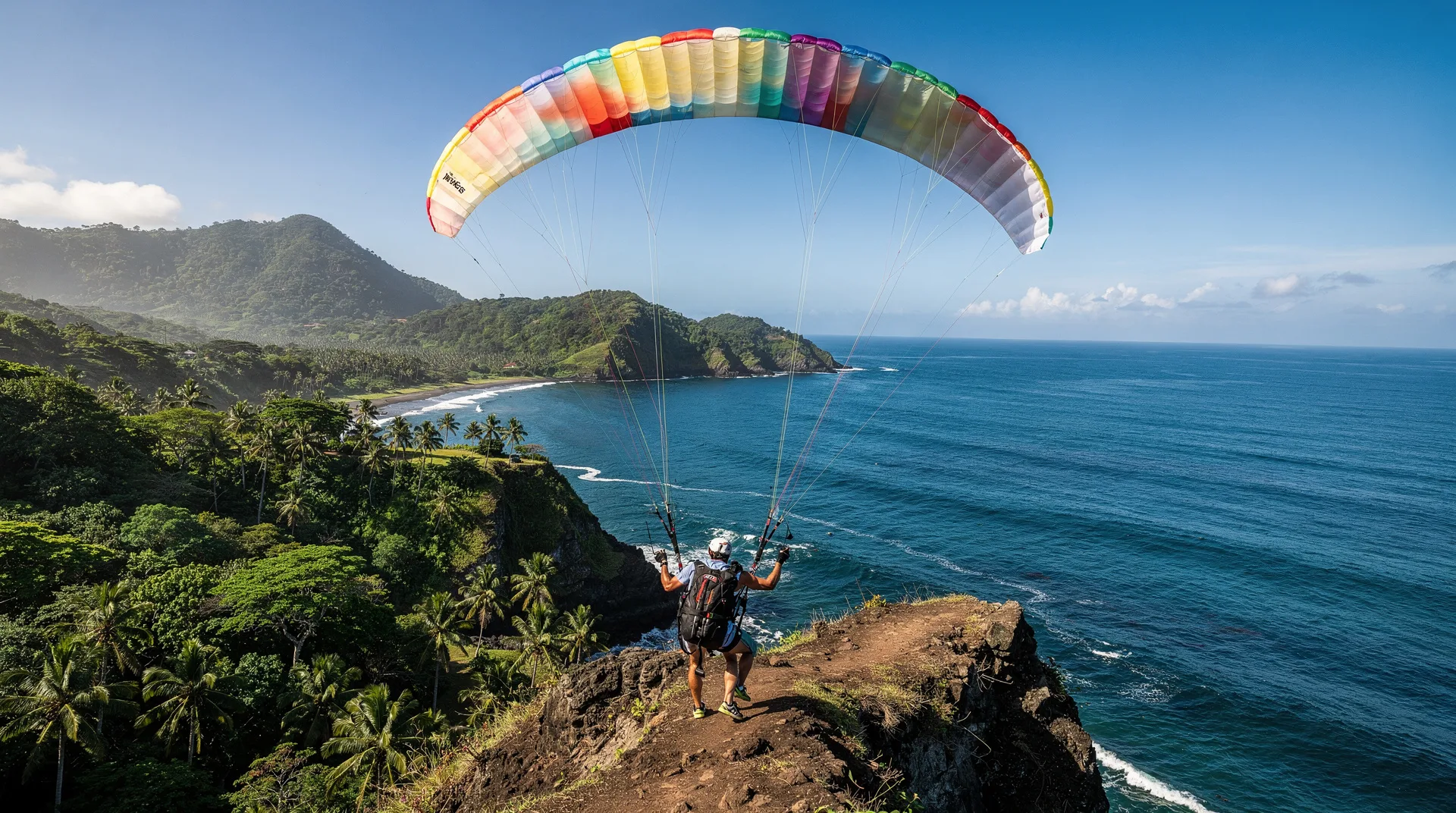
Paragliding in Costa Rica: where to fly and what it really costs
Where to paraglide in Costa Rica?
The main sites are Caldera (central Pacific, near Jacó), Dominical (southern Pacific), and Turrialba (Central Valley). Best conditions run December through April. Tandem flights cost $100-180 per person.
Paragliding in Costa Rica: what you need to know first
Paragliding in Costa Rica is a legitimate but niche activity. Unlike ziplines or canyoning, which have well-developed tourism infrastructure and dozens of operators, paragliding remains small-scale — a handful of operators at a handful of sites, most of them driven by passionate local pilots rather than large tourism companies. That creates an intimate, authentic experience but also means the verification burden falls more on the visitor.
This guide covers the three primary sites, how to verify a safe operator, what tandem flights cost, and which months offer the most reliable flying conditions.
| Where | Caldera (near Jacó), Dominical (southern Pacific), Turrialba (Central Valley) |
| Cost | around $100-180 per tandem flight |
| Time needed | half a day (flight plus drive/briefing) |
| Getting there | self-drive or transfer; no GYG listing for paragliding itself |
| Best time | December-April (dry season, reliable thermals) |
Why paragliding in Costa Rica is underrated
Costa Rica has excellent thermal conditions from December through April along the Pacific coast and in the central highlands. The trade winds that make the dry season so pleasant for beach travellers also create reliable lift for paragliders — smooth thermals rising off heated hillsides during mid-morning, with cross-country flying possible for experienced pilots.
The scenery from altitude is exceptional. Flying from Caldera on the central Pacific coast, you have the Tárcoles River estuary below, the Puntarenas peninsula in the middle distance, and the Nicoya Gulf extending to the horizon. From Dominical, you fly above the southern Pacific jungle coast looking toward Marino Ballena National Park and the whale tail beach formation.
Site 1: Caldera (central Pacific, near Jacó)
Caldera is the most accessible paragliding site for visitors staying in Jacó, Manuel Antonio, or San José. The launch site sits in the hills above the Pacific coastal town of Caldera, approximately 90 minutes from San José and 30 minutes from Jacó.
The thermal conditions here are driven by the sea-land temperature differential — the Pacific coast heats up quickly in the morning, generating consistent lift off the dry hillsides. Flights run 15-30 minutes depending on conditions, with altitudes reaching 600-900 meters above the coast. The views during flight encompass the full sweep of the Gulf of Nicoya.
Operators: Jacó-based adventure operators occasionally arrange paragliding access at Caldera, though dedicated paragliding operators in Costa Rica do not have GYG listings as of April 2026. Verify operators directly. Look for membership in the Federación Costarricense de Deportes Aéreos (FCDA) — Costa Rica’s air sports federation — and ask to see the pilot’s license and equipment inspection records.
Best months: December-April. The site becomes unreliable from May onward as the intertropical convergence zone brings unstable conditions to the central Pacific.
Price: $120-160 for a tandem flight. Solo instruction courses start at $500-600 for a three-day beginner course.
For adventure context around the Jacó region — where paragliding can combine with other activities:
The Explorer waterfall tour (Jacó) — from $95Site 2: Dominical (southern Pacific)
Dominical occupies a stretch of southern Pacific coastline about 45 minutes south of Uvita. The hills above town rise sharply to 400-600 meters, creating excellent launch conditions above a dramatic jungle-and-beach coastline. Tandem flights from Dominical run 20-40 minutes and offer views south toward the Osa Peninsula and north toward the Manuel Antonio headland.
The flying season here extends slightly later into the year than Caldera due to different wind patterns — some operators fly through May. The rainy season (June-October) brings consistent afternoon thunderstorms that ground operations by midday.
A small community of resident paragliding pilots runs tandem flights from Dominical, typically bookable through local surf hostels or the operators’ own websites. Pricing is comparable to Caldera: $110-180 per tandem flight depending on duration and operator.
Key attraction: Dominical’s coastal geography creates consistent ridge-lift conditions — wind rises up the forested hillsides and provides smooth, thermal-free flying that some first-timers find less turbulent than pure thermal flying.
Site 3: Turrialba (Central Valley)
Turrialba, already well-known as the base for Pacuare River rafting (see our Pacuare River rafting guide), also has a small paragliding community that exploits the valley thermals above the Reventazón and Pacuare river corridors.
Flying here is more technical than the coastal sites — the valley topography creates variable conditions, and cross-country flying between valleys is possible on good days. It is primarily used by experienced pilots rather than first-time tandem visitors. Tandem flights are available but less frequently organised than at Caldera or Dominical.
The altitude advantage is significant: launch sites around Turrialba sit at 1,000-1,500 meters, which means longer flights and broader views across the Central Valley, the Irazú Volcano massif, and on very clear days, both Pacific and Caribbean coasts simultaneously.
Comparing the three sites at a glance
| Site | Distance from San José | Flight length | Best for |
|---|---|---|---|
| Caldera | ~90 min | 15-30 min | first-timers, easiest access from Jacó |
| Dominical | ~3.5 hrs (or 45 min from Uvita) | 20-40 min | smoother ridge-lift flying, surf pairing |
| Turrialba | ~1.5-2 hrs | 20-40+ min | experienced/licensed pilots, valley scenery |
Caldera edges out the other two on convenience alone: if you are based around Jacó or Manuel Antonio and only have one morning free, it is the default choice. Dominical suits travellers already spending several nights on the southern Pacific coast for surfing, since the paragliding slots neatly into a rest-day morning. Turrialba is the outlier — better scenery and altitude, but a thinner tandem operator base, so it rewards travellers with flexible dates more than those trying to lock in a single guaranteed flight.
Physical requirements and who should skip it
Beyond the weight limits already noted (roughly 40-110 kg depending on harness), tandem paragliding does not require fitness or prior aerial experience — the pilot does the flying. That said, a few groups should think twice: anyone with a recent cardiac event or uncontrolled heart condition, anyone in the later stages of pregnancy, and anyone with a significant fear of heights that goes beyond ordinary nerves (the launch run and the first few seconds of lift-off are the most intense part, and there is no way to abort mid-flight once airborne).
Motion sickness is rarely an issue since paragliding lacks the abrupt movements of a rollercoaster or a small aircraft in turbulence, but very anxious flyers should say so before booking — a good pilot will fly a gentler, less thermic route for a nervous passenger.
Safety verification: what to check before flying
Paragliding is inherently higher risk than ziplines or canyoning because equipment failure at altitude leaves few recovery options. The verification checklist matters:
Pilot certification: All tandem pilots in Costa Rica should hold a Bi-Place (P4B or equivalent) tandem rating. Ask to see the certificate or card.
Equipment inspection: Paragliders and harnesses undergo porosity and structural checks. Ask when the wing was last inspected and by whom. Equipment over six years old without recent inspection should prompt questions.
Meteorological briefing: A legitimate operator checks wind and weather conditions before each flight and will reschedule rather than fly in marginal conditions. Operators who dismiss weather concerns are a warning sign.
Insurance: Confirm that tandem passenger insurance is included in the price. This is not universal among smaller Costa Rican operators.
ICT registration: Aerial adventure operators with ICT registration have met a baseline safety standard, though not all paragliding operators have pursued this certification given the small scale of the activity.
What a tandem paragliding flight involves
For first-time tandem passengers:
You are clipped into a harness that connects to the pilot’s harness in front of them. The wing is laid out behind you, and on the pilot’s command you walk forward (or run a few steps if launching from a slope) until the wing generates enough lift to take you both into the air.
In flight, you sit in a reclined position with your legs hanging free. The sensation is more like floating than the engine noise of powered flight — you hear primarily wind and the fabric of the wing. The pilot controls direction with brake toggles; you are a passenger, not a co-pilot.
Landing is gentler than many people expect — you run a few steps as the wing deflates. The whole experience from launch to landing typically lasts 15-40 minutes depending on conditions.
Minimum weight is typically 40 kg (children over 12 are generally fine). Maximum weight is 100-110 kg depending on the harness system. Significant pregnancy and recent cardiac surgery are contraindications.
Combining paragliding with other activities
Given that paragliding from Caldera or Dominical is typically a half-day commitment (morning flight plus drive time), the afternoon is easily filled with complementary activities:
From Jacó/Caldera: Combine with a canopy zipline in the afternoon, or an evening bioluminescence kayak tour.
From Dominical: The town is a well-known surf destination — a morning paragliding flight followed by a surf lesson in the afternoon makes a full active day.
From Turrialba: Pair with a Pacuare River rafting day — the rafting is typically a full-day commitment, so schedule paragliding on a separate day. See our Pacuare rafting guide.
Hang gliding vs paragliding: which is available in Costa Rica
Visitors sometimes conflate hang gliding and paragliding. They are distinct activities:
Paragliding: A soft inflatable wing that packs into a backpack. The pilot sits or lies in a harness below the wing. Slower, more efficient in thermals, better cross-country capability. The primary aerial sport at Costa Rica’s coastal sites.
Hang gliding: A rigid delta-winged aircraft where the pilot lies prone under the wing. Faster than paragliding, less portable, historically dominant before paragliding’s development in the 1970s-80s.
As of April 2026, active hang gliding instruction and guided tandem hang gliding is not readily available in Costa Rica. The FCDA has registered hang gliders but the operator base for tourist hang gliding is minimal compared to paragliding. If hang gliding specifically is your interest, visiting dedicated hang gliding sites in Brazil (Pedra Bonita, Rio de Janeiro, with world-class tandem operations) would be the more effective choice.
For the aerial adventure tourism available in Costa Rica, paragliding tandem flights and the Naranjo bungee jump (see our bungee jumping guide) represent the primary options.
Paragliding vs ziplines: the aerial experience comparison
A common question from visitors considering their first aerial activity in Costa Rica: is paragliding meaningfully different from a zipline?
The short answer: Yes, fundamentally different.
A zipline is a cable-constrained experience. Your trajectory is fixed, your speed is determined by cable angle and your weight, and the sensation is one of controlled speed along a predetermined line. The thrill is primarily the speed and height — viscerally exciting but predictable.
Paragliding has no cable. The pilot controls direction and altitude using brake toggles. A skilled pilot can thermal (gain altitude by circling in rising air), soar along ridges, or glide across a bay. The sensation is genuinely flight rather than fast sliding. The silence (no engine, no cable friction) is characteristic and striking.
For first-time aerial visitors, a tandem paragliding flight over the Pacific coast at Caldera or Dominical delivers an experience with no equivalent in Costa Rica’s zipline portfolio. The views, the freedom of movement, and the silence distinguish it completely.
Frequently asked questions about paragliding in Costa Rica
Is paragliding dangerous?
All aviation carries some inherent risk. Tandem paragliding with a certified, experienced pilot in appropriate weather conditions has a strong safety record globally. The risk increases significantly with uncertified operators, poor weather, or aged equipment — all of which can be screened out with due diligence before booking.
Do I need any experience?
None. As a tandem passenger, you follow the pilot’s instructions for the launch run and landing. No piloting knowledge is required.
Can I take photos in flight?
Yes — a chest-mounted GoPro or wrist-mounted camera works best. Keep a strap on any camera. Phone cameras in selfie mode work but phones slip easily from cold hands at altitude. Some operators offer a video service with post-processed footage.
What should I wear?
Comfortable clothing appropriate to the temperature. At Caldera and Dominical (sea level to 500 m), a T-shirt and light trousers are fine in dry season. In Turrialba at 1,000-1,500 m, a light jacket is advisable. Closed-toe shoes required.
Is there a GYG option for paragliding?
As of April 2026, dedicated paragliding tours are not listed on GetYourGuide for Costa Rica. Booking goes directly through operators. For adventure activities near the Jacó and central Pacific area where paragliding at Caldera combines naturally with other experiences:
Costa Rica: walk adventures & hiking - one day tours — from $95How far in advance should I book?
Paragliding operators in Costa Rica typically accommodate bookings with 24-48 hours’ notice during dry season. The limiting factor is not availability but weather — a confirmed booking can be postponed if morning conditions are unflyable, so have flexibility in your schedule.
What if it is cloudy?
Light cloud cover does not ground paragliding — in fact, cloud streets (lines of cumulus clouds formed by thermals) indicate good flying conditions. Dense overcast, approaching thunderstorms, or wind above 30 km/h are grounds to postpone. A good pilot will explain the conditions honestly rather than push to fly in marginal weather.
Which site should I pick if I’m only in Costa Rica once?
If your itinerary includes Jacó or Manuel Antonio, Caldera is the easiest add-on — closest to San José, shortest flights, and the most established tandem operators. If you are spending several nights around Dominical or Uvita for surfing or whale-watching, book locally there instead of adding a special trip to Caldera. Only choose Turrialba if you already have a rafting day planned there or hold your own pilot rating.
Can I bring a friend or is it strictly one passenger per pilot?
Tandem paragliding is one passenger per pilot per flight — the harness system is built for two people (pilot and passenger), not three. Groups of friends or family fly sequentially, one at a time, while the others wait on the ground. Budget extra time if your group is larger than two or three, since each flight plus the walk back up to the launch point takes a while.
Learning to fly: paragliding instruction courses in Costa Rica
Beyond tandem flights, Costa Rica has a small but active paragliding instruction community, primarily operating from the Caldera and Dominical sites. If you want to learn to fly rather than just experience a tandem, courses are available.
P1 (beginner) course: 2-3 days of ground handling and short solo flights under direct radio supervision from a training hill. Introduces the fundamentals of wing inflation, harness, and basic control. Cost: $350-500 depending on operator. You will not be making cross-country flights from this level, but you will have made genuinely solo flights.
P2 (novice): 6-10 days of progressive training on moderate sites. Students learn thermalling techniques, emergency procedures (spiral dives, big ears), and independent site assessment. Most international federations require approximately 25 solo flights for P2 completion. Cost: $800-1,200.
Full courses at international schools: Most serious paragliding training in the region happens in Colombia (where the Roldanillo site near Cali is one of the world’s best training environments) and in Brazil (at Asa Branca). Costa Rica has the sites for instruction but fewer instructors and less developed training infrastructure than these dedicated paragliding hubs.
If learning to fly is your primary goal, Costa Rica is a starting point rather than an optimal training destination. If you want a tandem flight as part of a broader adventure trip, Costa Rica’s sites are perfectly adequate.
The paragliding community in Costa Rica
The FCDA (Federación Costarricense de Deportes Aéreos) is the governing body for all air sports in Costa Rica, including paragliding, hang gliding, and ultralight aircraft. Member pilots are insured under the federation’s policy and have passed competency assessments.
The active paragliding community is small — perhaps 50-80 active pilots in the country — and concentrated in San José (where several pilots commute to Caldera or Turrialba for flying weekends) and the coastal communities near Dominical and Uvita. The community is welcoming to visiting pilots who hold equivalent ratings from their home country’s federation.
If you are a licensed paraglider visiting Costa Rica and want to fly independently (not tandem), contact the FCDA for site conditions, current regulations, and introductions to local pilots who can assess conditions before you launch.
Weather patterns for paragliding: a technical overview
For those interested in the meteorology driving paragliding conditions in Costa Rica:
Pacific coastal sites (Caldera, Dominical): The dry season (December-April) is governed by the northeast trade winds, which bring stable, cloud-free conditions to the Pacific slope. Sea-breeze thermals develop over the heated coastal hills from around 9am and peak by 1-2pm. These thermals are consistent and smooth in dry season. From May, the Intertropical Convergence Zone (ITCZ) migrates north and brings afternoon thunderstorms, cumulus overdevelopment, and unpredictable convective conditions that make flying hazardous.
Central Valley (Turrialba): Valley thermals are driven by differential heating between the valley floor and surrounding ridges. The wind direction shifts between morning (valley breeze from lower elevations) and afternoon (upvalley breeze). This creates a reliable 9am-12pm thermal window in dry season. Afternoon conditions deteriorate rapidly as cumulus develop over the Cordillera Central.
Cloud base: December-March dry season typically shows 2,000-3,000 meter cloud base over the Pacific coast, giving substantial altitude range for paragliders. During the transition season (April-May and November), cloud base drops and conditions become less predictable.
Related guides
For a full comparison of adrenaline activities by price and intensity, see how much do adrenaline tours cost. The bungee jumping guide covers Costa Rica’s other aerial extreme activity. If you want a multi-day adventure circuit that combines aerial, water, and jungle experiences, the extreme adventure routes guide is the logical next read.