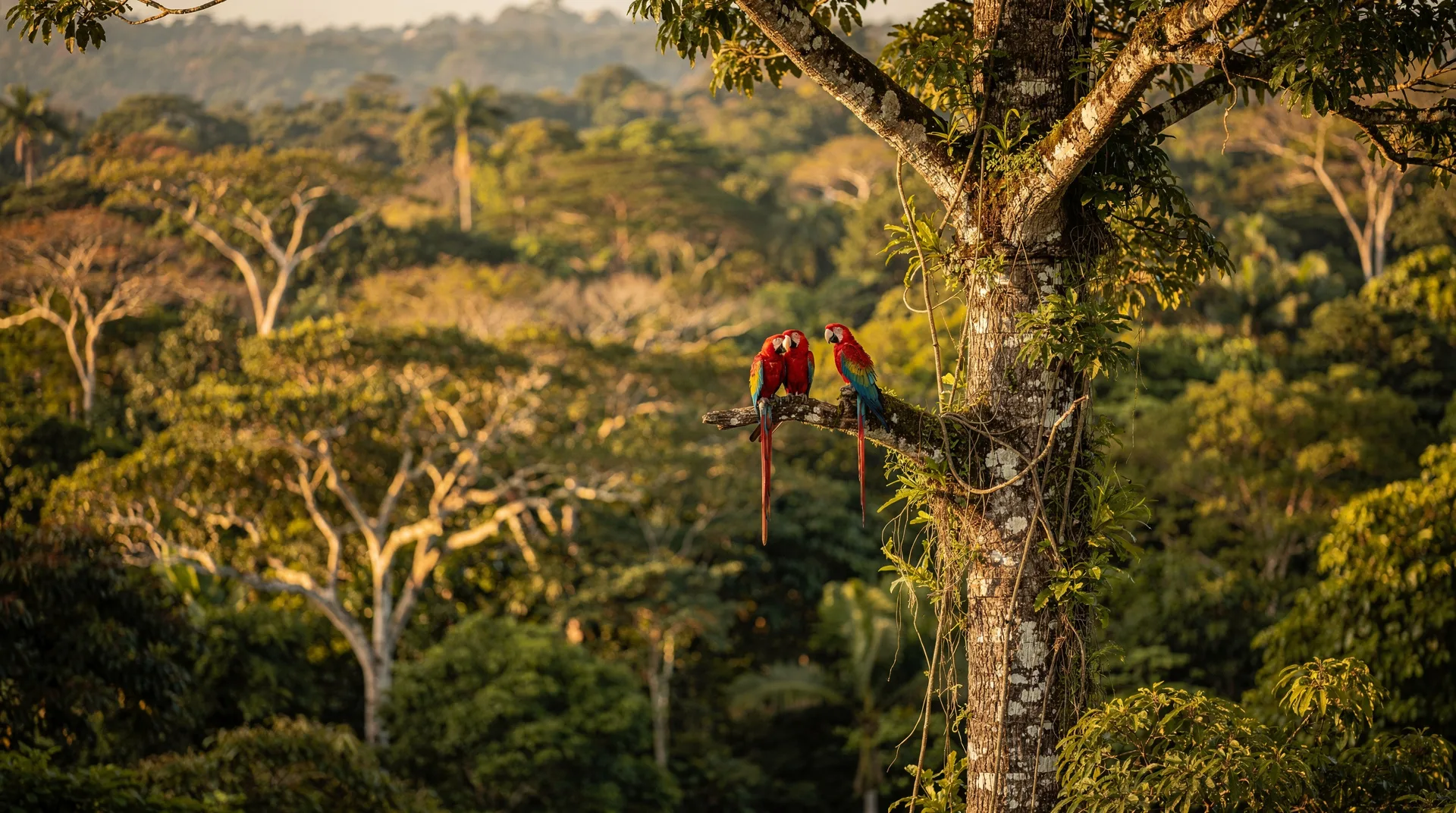
Carara National Park: scarlet macaws, crocodiles, and the best wildlife day trip from San José
Best place near San José to see scarlet macaws?
Carara National Park, without question. The park sits at the boundary of the dry and wet forest zones, supporting the largest scarlet macaw population on Costa Rica's Pacific coast. Macaws roost in flocks on the Río Tárcoles at dusk and return from the coast at dawn — the twice-daily spectacle is one of the easiest wildlife experiences to plan in the country.
Where the dry forest meets the rainforest — and macaws steal the show
Carara National Park occupies a narrow strip of Pacific coast forest between Jacó (20km south) and Orotina (30km north), bisected by the Río Tárcoles at its northern boundary. At 5,242 hectares, it is one of the smaller national parks in Costa Rica, but it punches far above its weight for accessible wildlife — particularly for visitors based in San José or travelling the main Pacific coast corridor.
The park’s ecological significance lies in its transitional position. Carara sits at the meeting point of the tropical dry forest ecosystem (which extends north through Guanacaste) and the wet tropical forest ecosystem (which continues south to the Osa Peninsula). This biological transition zone creates unusual species diversity — plants, birds, and animals from both ecosystems occur here, producing a species list that exceeds what you might expect from such a compact area.
The headline attraction is the scarlet macaw. Carara supports one of the largest and most accessible Pacific coast macaw populations in Costa Rica. Unlike the small groups seen at Manuel Antonio or the distant flocks of Corcovado, Carara’s macaws are predictably visible in large numbers at specific times of day — making them uniquely plannable for travellers who want a near-guaranteed wildlife experience without deep jungle logistics.
The scarlet macaw: when and where to see them
Scarlet macaws at Carara follow a remarkably consistent daily pattern that makes timing your visit straightforward:
Dawn roost departure (6:30 to 8:00am): The macaws spend nights roosting in the tall trees along the Río Tárcoles. At dawn, flocks of 10 to 50 or more birds depart the river roost and fly inland to feed, passing over and through the park. The noise is extraordinary — a cacophony of squawks that signals their presence long before they come into view.
Dusk return (4:30 to 6:00pm): In the late afternoon, the macaws reverse their flight, returning from feeding areas across the Nicoya Peninsula and coastal forest to roost along the Tárcoles. The best vantage point for this return flight is the Tárcoles Bridge, on the highway just north of the park entrance.
Tárcoles Bridge viewpoint: This bridge is one of the most productive 10-minute wildlife stops in Costa Rica. It is free, requires no park entry, and produces macaw sightings in the morning and evening, plus — directly below the bridge railing — one of the most reliable crocodile aggregations in the country (described below). Nearly every bus travelling between San José and Jacó stops here briefly.
Inside the park: During the middle of the day, macaws are less predictable as they disperse to feeding areas. The best in-park macaw viewing is in the first two hours after opening (7am to 9am) when they are still actively moving through the park forest.
Jacó Beach: aerial tram rainforest half-day tour — from $85If macaws are your main reason for coming, it helps to know how they fit into the wider picture of Costa Rican birdlife. Our quetzal watching guide covers the cloud forest side of the story, while the nocturnal wildlife guide is worth reading if you want to pair a daytime Carara visit with an after-dark outing elsewhere on your route.
The Tárcoles River crocodile aggregation
The Río Tárcoles carries runoff from San José — it is one of the most polluted rivers in Central America. The paradox is that this pollution-rich, warm, slow-moving water has created an ideal habitat for American crocodiles (Crocodylus acutus), one of the largest crocodilian species in the world. The Tárcoles River is home to an estimated 1,200+ crocodiles — the highest density of American crocodiles anywhere.
From the Tárcoles Bridge: Looking down from the bridge railing, you will see crocodiles in virtually every direction. Large adults of 3 to 4 metres are routine. Individuals of 4.5 metres and above have been recorded here. The crocodiles aggregate under the bridge partly because local guides have historically fed them (a practice that is now officially discouraged and illegal but was widespread for decades, creating habituation).
River boat tours: Several operators based at the landing south of the bridge offer crocodile-focused river tours. These bring you closer to the animals than the bridge does and often produce other wildlife sightings — green-backed herons, roseate spoonbills, and various kingfisher species hunt along the riverbanks.
Safety note: The crocodiles in the Tárcoles are completely wild and genuinely dangerous. Do not approach the riverbank at ground level near the bridge. The viewing angle from the bridge railing is safe; what happens below is not under human control.
Carara National Park trails
The park has three main trail options:
Quebrada Bonita loop (main paved trail): A 1.5km paved loop accessible from the main park entrance. Fully wheelchair accessible. This trail provides excellent birding in the forest edge zone and is where beginner wildlife watchers have the most success. Sloths, toucans, and coatis are commonly seen here.
Laguna Meándrica trail: A 4km loop into primary forest, accessible from a second park entrance south of the main one. This is a more demanding and rewarding trail for serious birders and wildlife enthusiasts. Giant anteaters, whitehawk pairs, black-and-white hawk-eagles, and dozens of understory bird species reward patient walkers.
Universal access trail: A separate boardwalk trail of about 1.2km designed for visitors with mobility limitations. Access from the main entrance.
Wildlife beyond macaws: Carara hosts a comprehensive list of Costa Rican species. Highlights include the chestnut-mandibled toucan, the ringed kingfisher (enormous by kingfisher standards), the bare-throated tiger heron, giant anteaters (genuinely present — the grassland edges between the secondary forest sections are the most productive areas), pumas and ocelots (tracks visible to guides, actual sightings rare), and the extraordinarily secretive black-crested coquette hummingbird.
Whichever trail you choose, move slowly and stop often. Much of the wildlife at Carara is heard before it is seen, and the best sightings usually come from standing still and scanning the mid-canopy rather than covering ground. The principles in our wildlife watching ethics guide apply here: keep your distance, never feed animals, and keep voices low. If sloths are a priority, the where to see sloths guide explains which places give the best odds, and the monkey species guide helps you identify what you see in the trees.
Entry fees and visitor information
Entry fee: $15 per person.
Opening hours: 7am to 4pm daily. The park is open all seven days of the week.
Guided tours: Unlike Corcovado, guides are not mandatory at Carara. However, the wildlife density rewards guided visits — a certified guide will find species that self-guided visitors walk straight past. Local certified guides can be hired at the entrance or booked in advance through Carara-based operators.
Best time of day: 7 to 9am for maximum macaw and bird activity. The late afternoon (4 to 5pm) is the second-best window, particularly for the Tárcoles Bridge macaw return. Midday visits in hot season (March to April) produce the least wildlife activity.
Combining Carara with the Jacó aerial tram
Carara pairs naturally with the Rainforest Adventures Costa Rica Pacific aerial tram at Jacó, 20km south. The tram is an open gondola that rises through the rainforest canopy, giving a bird’s-eye perspective of the forest structure completely different from any ground-level trail. At the top, a series of zip lines, a butterfly garden, a snake and frog exhibit, and a reptile house round out the experience.
The combination of Carara’s ground-level trail wildlife and the aerial perspective of the Jacó tram makes for a highly varied full day — particularly appropriate for families with children who want both the education and the adrenaline component.
Jacó Beach: aerial tram rainforest half-day tour — from $85Getting to Carara
From San José: 1.5 to 2 hours by car via the Orotina highway (Route 27 to Orotina, then Route 34 coastal south). The park entrance is clearly signposted on the main highway.
By bus: San José to Jacó buses stop at Tárcoles/Carara on request — tell the driver. Buses depart from Terminal Coca-Cola in San José several times daily.
From Jacó: 25 to 30 minutes north on Route 34. Easy day trip for visitors based in Jacó.
Day trips from San José: Several tour operators run Carara day trips from San José hotels. Prices range from $70 to $100 per person with guide, transport, and entrance. This is the most convenient option for visitors without a rental car.
Carara sits on the main Pacific corridor, so the logistics are simple once you know your options. If you are weighing a rental car against shuttles, the rent a car or not guide and the driving in Costa Rica guide cover the trade-offs, and the shuttle services overview explains the alternatives for travellers who prefer not to drive. The base for most visitors is Jacó, which makes a convenient place to sleep before an early start.
Seasonal considerations
December to April (dry season): Best overall conditions. Macaw activity is high as they move between feeding areas and roosts. River levels on the Tárcoles are lower, making crocodile viewing from the bridge even more productive.
May to November (rainy season): Afternoon rain is common and can make trails muddy. The forest is lush. Macaw activity remains, though midday humidity is intense. Early morning visits remain productive.
Year-round: The macaw dawn and dusk flights are a year-round feature. The crocodile aggregation is also permanent — crocodiles do not migrate or hibernate.
Because the weather shifts the experience, it also helps to check the broader picture in the best time to visit Costa Rica guide before fixing your dates. Travellers building a longer trip around the park can also look at Quepos further down the coast as the next stop.
Frequently asked questions about Carara National Park
Is Carara worth visiting if I am already going to Manuel Antonio?
Yes, for different reasons. Manuel Antonio has sloths, monkeys, beaches, and a broader wildlife list. Carara has the best accessible macaw viewing in the country and the Tárcoles crocodiles. If you are travelling the Pacific coast between San José and Manuel Antonio, stopping at Carara and the Tárcoles Bridge adds only 30 minutes to your journey and produces reliably spectacular wildlife moments.
Can I see macaws at Manuel Antonio too?
Scarlet macaws are present at Manuel Antonio, but in much smaller numbers and less predictably. Carara’s macaw population is dramatically larger and the daily roost-departure and return flight is a Carara-specific phenomenon.
How long do I need for the park?
Two to three hours covers the main trails adequately. Adding the Tárcoles Bridge stop (free, 15 minutes) and a crocodile river boat tour (1 hour, ~$25 per person) makes it a complete 4 to 5 hour outing.
Is the park accessible for young children?
The main Quebrada Bonita paved loop is excellent for families with young children — flat, clear, and with good wildlife opportunities. The Laguna Meándrica loop involves longer distances and more challenging terrain. The Tárcoles Bridge is accessible from the highway with no climbing or walking required.
Rainy season vs dry season: which is better for Carara
Carara is one of the few Costa Rica wildlife parks where the rainy season genuinely competes with the dry season, and it is worth weighing up before you commit to a date. In dry season (December–April), lower water levels concentrate crocodiles more tightly along the Tárcoles channel and trails stay dust-dry and easy underfoot, but the transitional dry forest sections thin out and some deciduous trees drop their leaves, reducing cover for smaller birds.
In green season (May–November), the forest is denser and greener, insect activity (and therefore insect-eating bird activity) rises, and the crowds thin out noticeably — this is when self-guided visitors have the paved Quebrada Bonita loop nearly to themselves on a weekday morning. The trade-off is afternoon downpours, which is why the 7–9am visiting window matters even more in green season than in dry season.
| Dry season (Dec–Apr) | Green season (May–Nov) | |
|---|---|---|
| Trail conditions | Dry, easy, dusty | Muddy afternoons, lush |
| Crocodile viewing | Excellent (low water) | Good (higher, murkier water) |
| Crowds | Higher (peak tourist season) | Lower, especially weekdays |
| Macaw activity | High | High (year-round pattern) |
| Best visiting window | 7–9am and 4–5pm | 7–9am (before afternoon rain) |
Why Carara is not a substitute for Corcovado or Manuel Antonio
Carara earns constant comparisons to Costa Rica’s more famous parks, and it is worth being direct about what it does not offer. It has no beach, no sloths in anything like Manuel Antonio’s numbers, and none of Corcovado’s tapirs, jaguars, or four-monkey-species density — Corcovado’s Sirena sector remains the country’s best shot at genuinely rare lowland mammals, as covered in our Costa Rica wildlife overview.
What Carara does better than either park is deliver a near-guaranteed, low-effort wildlife spectacle (the macaw flights and the crocodile aggregation) in two to three hours without a multi-day commitment or a mandatory guide requirement. Travellers weighing a full Osa Peninsula detour against a quick Pacific-corridor stop should think of Carara as a high-value add-on, not a replacement for a dedicated wildlife trip.
Where to fit Carara in your itinerary
Carara fits naturally as a transit stop between San José and Jacó or Manuel Antonio. It is the easiest wildlife park to add to a Pacific coast circuit without any significant detour. For the 7-day Arenal and Manuel Antonio itinerary, a Carara stop on the drive from San José to Manuel Antonio (or vice versa) costs minimal extra time. Compare it with other accessible wildlife parks in our bird watching by region guide. For wildlife photography specific advice, see our wildlife photography tips guide.