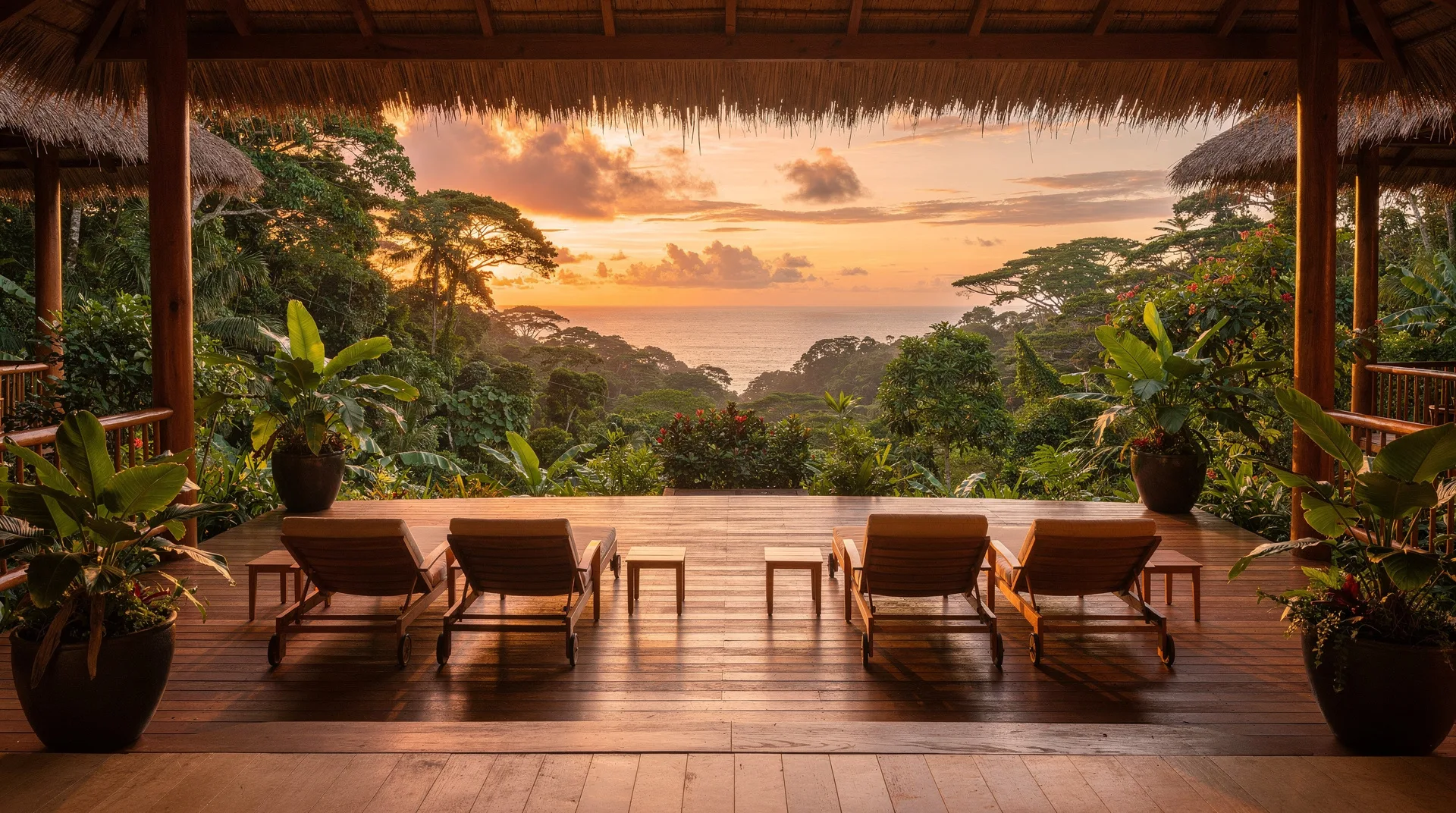
Costa Rica's best eco-luxury wellness lodges
Top eco-luxe wellness lodges?
Pacuare Lodge, Lapa Rios, Nayara Springs, Nicuesa, Origins Luxury Lodge.
What makes a Costa Rica eco-luxury lodge
The term “eco-luxury” has been abused by marketing teams globally, but in Costa Rica, it has a more specific meaning grounded in the country’s serious sustainable tourism certification system. The Instituto Costarricense de Turismo (ICT) operates a Certificate of Sustainable Tourism (CST) program that rates properties on a 1-5 leaf scale based on environmental management, wildlife interaction policies, community relations, and service quality. The properties in this guide carry 4-5 leaf ratings — they are genuinely, measurably sustainable.
What does this mean in practice? These lodges use solar power or hydroelectric micro-systems, manage their own water treatment, source food from local producers, pay living wages to local staff, contribute to conservation programs on their land, and accept the limitations that come with building in sensitive ecosystems. Some are on private reserves ten times larger than the built footprint. Others are surrounded by national parks.
The wellness dimension — yoga shalas, spa facilities, therapeutic programs, meditative environments — emerges naturally from the kind of environments these lodges inhabit. When your breakfast terrace overlooks primary rainforest and you can hear howler monkeys from your bungalow, the definition of “wellness” expands beyond any formal programming.
This guide covers the five properties that consistently represent the highest standard across both ecological integrity and wellness quality.
| Price range | $400-1,600/night, most meals + activities included |
| CST rating | 4-5 leaves (verified sustainable) |
| Booking lead time | 2-4 months for peak season (Dec-Mar) |
| Access | Varies — river raft, flight, boat, or 45-min drive from SJO |
| Best for | Couples, honeymooners, wellness-focused travellers |
Pacuare Lodge, Turrialba
Location and access
Pacuare Lodge sits on the banks of the Pacuare River in the Caribbean lowlands, surrounded by 300 hectares of private reserve. It is accessible only by whitewater raft (the entry is a 2-hour raft ride down the river from Turrialba) or by aerial tram from a road access point. There are no roads into the lodge itself. This enforced remoteness is part of the experience — arrival by raft, through class III-IV rapids, with rainforest walls rising on both sides, is how you transition from the outside world to Pacuare’s reality.
The lodge
Bungalows perch on a cliff above the river, each with its own viewing deck. The main lodge areas are open-air — dining, the bar, the yoga shala — and the sounds of the river are constant. The spa offers massages, wraps, and treatments using local plants and volcanic elements.
Wildlife is extraordinary: Pacuare Lodge’s reserve includes nesting great green macaws, jaguars (camera-trapped on the reserve, rarely visible), river otters, sloths, and one of the country’s most intact riparian bird lists.
Wellness programming
Pacuare offers daily yoga (typically morning), guided meditation, massage, and multi-day “digital detox” packages that lean into the isolation deliberately. No cell reception; limited wifi by design. The detox is unforced but structural — the river and the forest do most of the work.
Pricing
$550-900 per night for a standard bungalow, all meals included. Honeymoon suites and treehouse accommodations (suspended platforms in the forest canopy) range higher. The Pacuare River rafting entry is included in the accommodation rate.
Getting there from San José: 3-hour drive to the Pacuare put-in point near Turrialba, then 2-hour raft to the lodge. One of the most memorable arrivals in Costa Rica.
Lapa Rios, Osa Peninsula
Location and access
Lapa Rios is a 16-bungalow property set on a 1,000-acre private rainforest reserve at the southern tip of the Osa Peninsula, near the town of Puerto Jiménez. It receives a consistent 5-leaf CST rating and is frequently cited by National Geographic and Condé Nast as one of the world’s best eco-lodges. The reserve borders Corcovado National Park and shares many of its wildlife species.
Access from San José is either a 50-minute Sansa flight to Puerto Jiménez followed by a 30-minute private transfer, or a 7-hour drive (including a challenging unpaved section). The flight is the strongly recommended option.
The lodge
Open-air thatched bungalows perch on a ridgeline with views of the Pacific over the rainforest canopy. The design integrates local hardwoods and natural materials throughout; the main lodge is a large palapa with panoramic views used for meals and community gathering.
Wildlife at Lapa Rios is outstanding by any standard: scarlet macaws in pairs are a daily sight, four monkey species are resident (howler, spider, capuchin, and squirrel — all four), sloths are in the trees above the bungalows, and the property’s private trails access primary forest rarely reached by other visitors.
Wellness programming
Yoga is offered in a dedicated open-air shala with forest views. Spa treatments (massage, body scrubs, facials) use local plant ingredients. The kitchen — one of the best farm-to-table operations in Costa Rica — produces food that is part of the wellness experience itself: fresh ceviche, tropical fruit presentations, locally caught fish.
Pricing
$600-1,100 per night, all meals and guided activities included. Lapa Rios’ all-inclusive model covers guided hikes, kayaking on the Gulf of Dulce, yoga, and naturalist tours. Very good value given the inclusion.
Nayara Springs, Arenal
Location and access
Nayara Springs is a different proposition from Pacuare or Lapa Rios — it is a purpose-built luxury villa resort rather than a converted wilderness property. But its standard of wellness programming and quality of execution place it among Costa Rica’s top wellness experiences.
Located in La Fortuna near Arenal Volcano, Nayara Springs consists of 35 villa suites, each with a private hot spring pool fed by natural volcanic water. The volcanic hot springs are not decorative — the water is genuinely geothermal, maintained at 38-42°C. Soaking under the jungle canopy in water heated by the same volcano visible from your terrace is the defining Nayara experience.
Wellness programming
The Nayara Spa is extensive: multiple treatment rooms, volcanic mud wraps, hot-spring hydrotherapy circuits, and a menu of traditional Costa Rican wellness practices alongside international modalities. Daily yoga classes are offered. The Nayara group also operates Nayara Tented Camp next door — a canvas-villa format with more adventurous programming (forest canopy zip tours, waterfall rappelling) while maintaining the luxury standard.
Pricing
$900-1,600 per night for a villa suite at Nayara Springs, inclusive of breakfast and access to the spa facilities (but treatments extra). Nayara Gardens, a sister property next door, offers similar volcanic hot spring access at $350-600 per night.
Accessible via Arenal volcano day trip programming:
La Fortuna: Arenal Volcano, lunch & hot springs morning tour — from $120Nicuesa Rainforest Lodge, Golfo Dulce
Location and access
Nicuesa is the least-known property on this list and arguably the most pristine. Located on the Golfo Dulce at the far southern Pacific coast, accessible only by boat from Golfito (30-minute water taxi), Nicuesa is surrounded by 165 acres of private rainforest reserve with an additional 400+ acres of conservation easement.
The lodge was designed by a Costa Rican architect who sourced all materials locally and used sustainable hardwoods certified by FUNDECOR. Eight bungalows and a main lodge building blend into the forest without clearing any canopy. The result is a property where howler monkeys walk across the dining roof and humpingbirds feed two metres from your breakfast table.
Wellness offering
Nicuesa does not market itself primarily as a yoga retreat, but its complete isolation, extraordinary wildlife, organic kitchen, and natural hot springs (on-site volcanic pools) create a wellness environment that rivals any formal retreat. The lodge offers yoga on request, massages, and guided kayaking through the Golfo Dulce’s mangrove systems.
Pricing: $400-650 per night, all meals and guided activities included.
Origins Luxury Lodge, Heredia Province
Location and access
Origins is a newer property (opened 2021) and represents a different wellness model: a therapeutic retreat lodge designed specifically for immersive wellness programs, located in the Central Valley foothills above Heredia, 45 minutes from San José. The proximity to the capital makes Origins uniquely accessible — no river crossing, no remote flight — while maintaining the privacy and environmental quality of a much more remote property.
The lodge’s 12 suites overlook a private cloud forest reserve. Programming is structured around 3/5/7-day wellness retreats with full-day itineraries including yoga, hiking, sound healing, and holistic nutrition sessions led by in-house practitioners.
Wellness programming
More formal than the other lodges in this guide — Origins operates a genuine wellness retreat model rather than a luxury lodge with add-on spa services. Programs are designed around specific outcomes (stress recovery, digital detox, mindfulness intensification). Visiting specialists — trauma therapists, Ayurveda practitioners — are brought in for themed retreats.
Pricing: $450-700 per night for retreat packages; shorter stays available.
How to choose
| Lodge | Wilderness quality | Wellness depth | Access difficulty | Price/night |
|---|---|---|---|---|
| Pacuare Lodge | Exceptional | Strong | High (river entry) | $550-900 |
| Lapa Rios | Exceptional | Good | Moderate (flight) | $600-1,100 |
| Nayara Springs | Good | Exceptional | Easy (road) | $900-1,600 |
| Nicuesa | Exceptional | Moderate | High (boat only) | $400-650 |
| Origins | Good | Exceptional | Easy (road, 45 min SJO) | $450-700 |
For first-timers to eco-luxury in Costa Rica: Nayara Springs has the smoothest logistics, the most polished wellness programming, and the Arenal backdrop makes it the most photogenic. It’s the entry point to this tier.
For serious wildlife encounters: Lapa Rios or Nicuesa, both in Southern Pacific ecosystems with four monkey species, macaws, and the quality of wildlife that attracts National Geographic photographers.
For the most dramatic arrival experience: Pacuare Lodge, without question.
For proximity to San José: Origins is the only property that doesn’t require a significant travel investment beyond the capital.
Sampling the experience without the full price tag
Not every trip has room for $500+ nightly rates across a full circuit. Several elements of these lodges can be experienced independently at a fraction of the cost. The Pacuare River rafting entry that makes Pacuare Lodge’s arrival so memorable can be done as a standalone day trip from Turrialba without an overnight stay — see our Pacuare River rafting guide for the day-trip version.
Pacuare River day rafting trip from Turrialba — from $120Similarly, Arenal’s volcanic hot springs — the defining feature of Nayara Springs — are accessible at public and semi-public thermal complexes covered in our hot springs day pass guide for a fraction of the villa rate. This lets budget-conscious travellers taste the wellness ecosystem before committing to a full-price stay, or as a standalone alternative if the lodge rates are simply out of range.
What “wellness” means differently at each property
The five lodges in this guide interpret wellness quite differently, and matching the interpretation to what you actually want matters more than comparing star ratings. Pacuare Lodge and Nicuesa lean into isolation itself as the wellness mechanism — limited or no wifi, river and forest sounds replacing programming, a genuinely enforced digital detox.
Nayara Springs and Origins take the opposite, more structured approach: daily scheduled classes, dedicated spa facilities, and staff trained specifically in wellness modalities rather than general hospitality. Lapa Rios sits in between — its wellness offering is real but secondary to its wildlife and conservation identity, so guests who come primarily for yoga or spa treatments may find the programming lighter than at Nayara or Origins.
If you are choosing based on a specific goal — genuine digital detox, structured retreat programming, or wildlife-first travel with wellness as a bonus — that goal should drive the choice more than the property’s marketing language, since all five use similar vocabulary (“mindful,” “immersive,” “regenerative”) regardless of how differently they actually deliver it.
A useful question to ask any property directly before booking: how many guided wellness sessions run per day, and are they included or add-on? The answer separates lodges with genuine daily programming from those offering wellness as an occasional amenity — both are legitimate models, but they suit different expectations.
Including eco-luxury lodges in an itinerary
The 10-day eco-luxury itinerary covers the classic combination of Pacuare Lodge → Nayara Springs → Lapa Rios — three nights at each property, each in a dramatically different ecosystem (river canyon → volcanic plateau → Osa rainforest). This is Costa Rica’s most celebrated luxury circuit.
For those wanting a shorter eco-luxury introduction, Nayara Springs (3 nights) combined with a Manuel Antonio tour makes for an excellent 7-night trip from San José — easy logistics, high quality, no 4WD required.
Frequently asked questions about eco-luxury wellness lodges
Are children welcome at these properties?
Policies vary. Nayara Springs accommodates families (Nayara Gardens is more family-friendly than Nayara Springs). Lapa Rios and Pacuare Lodge welcome children but note that some experiences — rafting arrival at Pacuare, jungle hikes — require a minimum age of 10-12. Check policies before booking.
Are all-inclusive rates genuinely all-inclusive?
Most properties in this guide include meals, guided activities, and yoga in their rates. Spa treatments, premium alcoholic beverages, and transportation to/from the lodge are typically additional. Read inclusions carefully — the daily rate can look expensive until you factor in what a comparable meal and activity spend would cost independently.
Is it necessary to book spa treatments in advance?
Yes, particularly at peak-season (December-March). Nayara Spa and Pacuare Lodge spa books up 2-4 weeks in advance during peak season. Book simultaneously with your room reservation.
Are these lodges genuinely sustainable or is “eco” just branding?
The properties in this guide have verifiable CST certification from ICT, which involves third-party audits. Lapa Rios has particularly strong credentials — it has operated a wildlife education program for surrounding communities since 2001. Pacuare Lodge purchases land specifically to expand its conservation buffer. That said, any lodge that asks you to fly in private charter and consumes significant resources in running a luxury operation has a carbon footprint. The certification addresses local environmental management, not global carbon impact.
Can I do a yoga teacher training at any of these properties?
Not as a primary offering. For 200-hour or 500-hour YTT programs, see our yoga teacher training guide — the Bodhi Tree and Pranamar are the appropriate venues for that. These eco-luxury lodges offer yoga as a guest amenity, not as a certification program.
Related guides
Nosara yoga retreats covers the formal retreat-centre model, distinct from the lodge model here. Spa resorts in Arenal goes deeper on the volcanic hot spring properties around La Fortuna. Yoga teacher training in Costa Rica covers the intensive program options at Bodhi Tree and Pranamar. And the 10-day eco-luxury itinerary offers the full routing for a lodge-focused trip.