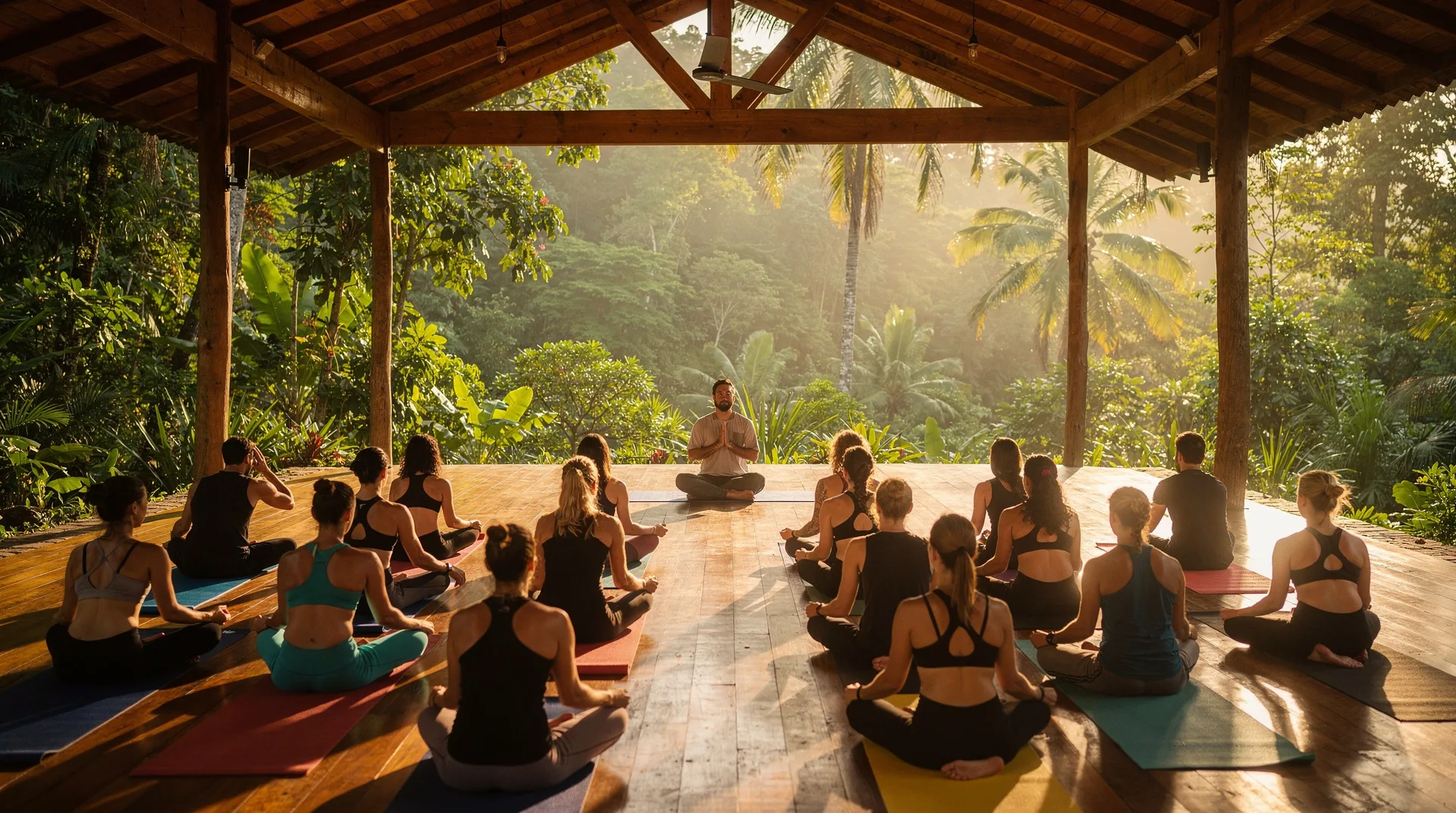
Yoga teacher training in Costa Rica: 200 and 500-hour guide
200/500-hr YTT in Costa Rica?
Bodhi Tree Nosara, Blue Osa, Pranamar Santa Teresa, Anamaya Montezuma.
Why Costa Rica has become a YTT destination
Yoga teacher training programs (YTT) are one of the fastest-growing segments of the global wellness tourism market. The Yoga Alliance reports that the number of registered 200-hour teachers has increased more than tenfold since 2010, driven in part by the proliferation of international training programs in locations that combine natural beauty with lower costs than urban Western cities.
Costa Rica’s appeal for YTT programs is well-documented among the international yoga community. The Nicoya Peninsula — where Nosara and Santa Teresa both sit — is one of the world’s five “Blue Zones,” regions where exceptional human longevity has been documented. The Blue Zone designation has nothing to do with yoga specifically, but it attracts a health-conscious international audience who discovers the yoga scene once they arrive.
The result is a concentration of YTT programs in Costa Rica — particularly in Nosara, Santa Teresa, and Montezuma — that rivals Bali and India as international teacher training destinations, while offering the advantages of accessibility (direct flights from North America) and the natural environment that makes 28 days of intensive immersion more sustainable.
This guide covers the four leading programs, what each offers, what to realistically expect, and how to choose.
| Where | Nosara, Santa Teresa, Montezuma, Osa Peninsula |
| Cost (200hr) | Around $2,600–3,800, usually incl. accommodation & meals |
| Duration | 21–30 days, full immersion |
| Certification | Yoga Alliance RYT-200 / E-RYT-500 |
| Apply by | 3–4 months ahead for peak Jan–Mar / Jun–Sep cohorts |
Understanding YTT formats
200-hour programs (foundation)
A 200-hour YTT is the minimum qualification for teaching yoga in most professional contexts. It covers anatomy and physiology, yoga philosophy, pranayama, teaching methodology, Sanskrit basics, and extensive asana training. Most 200-hour programs run 22-30 days at full-immersion pace, or 6-12 months at weekend format.
The Yoga Alliance 200-hour certification (RYT-200) is the most widely recognised standard globally. Programs must be Yoga Alliance-registered to confer this certification. All four programs in this guide are registered.
Typical cost: $2,500-4,000, usually inclusive of accommodation and meals for residential programs.
500-hour programs (advanced)
A 500-hour YTT is an advanced certification that includes either a standalone 500-hour program or a 200-hour plus a 300-hour continuing education program. The 500-hour credential (E-RYT-500) is required by many studios that hire teachers for their regular curriculum and is the standard for teachers who want to lead their own 200-hour trainings.
Typical cost: $4,000-6,000 for standalone 500-hour programs; $2,000-3,000 for 300-hour top-up programs for existing RYT-200 holders.
Specialty certifications
Beyond the standard 200/500-hour track, Costa Rica’s YTT providers also offer:
- Yin Yoga teacher training (50-hour modules)
- Pre/postnatal yoga training
- Kids yoga certification
- Trauma-informed yoga teacher training
- Therapeutic yoga for specific conditions
These specialty modules are most commonly available at Bodhi Tree and Blue Osa. If your goal is teaching a specific population — prenatal clients, children, or trauma survivors — confirm the specialty module is offered in the specific cohort dates you’re considering, since not every session runs every add-on module; scheduling varies year to year and is worth confirming directly with the school rather than assuming from the general program description.
Bodhi Tree Nosara
The program
Bodhi Tree has operated continuous 200-hour YTT programs from Nosara since 2014 and is widely considered the most polished institutional offering in Costa Rica for teacher training. The programs attract a high percentage of North American trainees — many of whom have already attended Bodhi Tree retreats and return specifically for the training.
The 200-hour program runs over 21-24 days and follows a Yoga Alliance-compliant multi-style curriculum: vinyasa and hatha as primary styles, with yin, restorative, and pranayama modules integrated. The faculty roster typically includes 3-4 core teachers with 500-hour-plus certifications and significant teaching histories, plus visiting specialists for anatomy and yoga philosophy modules.
Curriculum structure:
- Morning sadhana (personal practice): 90 min
- Asana training and teaching practicum: 3-4 hours
- Philosophy/theory lecture: 90 min
- Anatomy module: 2 hours (distributed across the program)
- Afternoon practice: 90 min
- Evening group discussion or guest lecture
Daily schedule commitment: 8-10 hours of formal programming. This is not a retreat — it is an intensive educational program delivered in a resort setting.
What makes it stand out: Bodhi Tree’s infrastructure — the quality of shalas, the kitchen, the grounds — means the physical learning environment is exceptional. The ocean proximity (Playa Guiones is 5 minutes’ walk) and the Nosara ecosystem mean that the intense program is balanced by a genuinely beautiful setting.
Pricing: $3,200-3,800 for 200-hour program, inclusive of shared accommodation and meals.
Alumni profile: A high proportion go on to teach at yoga studios in their home countries within 12 months. The Bodhi Tree alumni network in North America and Europe is genuine and can be useful for job placement.
Blue Osa Yoga Retreat and Spa, Osa Peninsula
The program
Blue Osa is a remote property on the Osa Peninsula, accessible from Puerto Jiménez by a 45-minute boat ride or a rough road. The seclusion is not incidental — Blue Osa’s founder designed the program specifically for the kind of immersive focus that is difficult to maintain in more accessible locations. No nightlife, limited connectivity, and an extraordinary natural environment (the property borders Corcovado National Park) mean that the 200-hour training is experienced without the social distractions common to beach-town programs.
The curriculum at Blue Osa leans more Ashtanga and Vinyasa than most Costa Rica programs, with a particular emphasis on alignment and hands-on adjustment training. The anatomy module is more extensive than the Yoga Alliance minimum — a genuine strength.
Pricing: $3,000-3,600 for 200-hour program, inclusive of accommodation (twin sharing) and all meals.
The trade-off: The remoteness that makes Blue Osa’s program powerful also makes it logistically demanding. Getting there requires coordination, and leaving during the program — for emergencies or personal reasons — is not simple. Trainees who choose Blue Osa should commit fully to the immersion.
Who it’s for: Practitioners who want maximum immersion and don’t need social diversion during training. Particularly suited to those who find beach-town environments distracting.
Pranamar Oceanfront Villas, Santa Teresa
The program
Pranamar’s YTT programs are conducted in the same beachfront shala used for the resort’s retreat programming, with direct Pacific views from the practice space. The program runs on a seasonal schedule (typically 2-3 cohorts per year) and draws a mix of Santa Teresa regulars — people who have discovered the town on a previous trip and returned for the training — and first-time Costa Rica visitors.
The style emphasis at Pranamar is Vinyasa and Yin, reflecting the teaching community’s preferences. Philosophy lectures engage both classical yoga texts (Yoga Sutras, Bhagavad Gita) and contemporary Western approaches to somatic awareness and mindfulness.
The Santa Teresa context: Unlike Nosara’s retreat-bubble environment, Santa Teresa during a YTT program includes the surf town’s broader energy — restaurants, social life, nightlife. This is a feature for trainees who want a community context; it requires more self-discipline for those who are easily distracted.
Pricing: $2,800-3,400 for 200-hour program, inclusive of accommodation and meals.
300-hour advanced training: Pranamar also offers a 300-hour advanced program for existing RYT-200 teachers, with a stronger emphasis on Thai yoga massage, trauma-informed teaching, and mentorship.
Anamaya Resort, Montezuma
The program
Anamaya sits on a hillside above the beach town of Montezuma, overlooking the Pacific from an elevation of 150 m. The resort is smaller than Bodhi Tree or Pranamar — 15-18 trainees per cohort — which creates an intensive small-group dynamic that some find more supportive than larger programs.
The YTT curriculum is multi-style, with an emphasis on sequencing intelligence — understanding how to build yoga classes that serve diverse student bodies. Anamaya’s faculty has a stronger representation of therapeutic yoga specialists than most other programs in Costa Rica, reflecting the property’s background in retreat programming for recovery and healing contexts.
The Montezuma context: Montezuma is a bohemian beach town with a distinct energy — waterfalls, hammock culture, an eclectic traveller community. Less developed than Nosara or Santa Teresa, with a younger demographic. The Anamaya hillside property is separate from the town scene, but Montezuma’s personality bleeds in.
Pricing: $2,600-3,200 for 200-hour program, inclusive of accommodation and meals. Among the most affordable residential YTT programs in Costa Rica.
Who it’s for: Practitioners on a tighter budget who don’t need resort-level infrastructure, or those drawn to Montezuma’s character.
Comparison table
| Program | Location | Style focus | Price (200hr) | Cohort size | Infrastructure |
|---|---|---|---|---|---|
| Bodhi Tree | Nosara | Multi-style (vinyasa + yin) | $3,200-3,800 | 20-30 | Excellent |
| Blue Osa | Osa Peninsula | Ashtanga + alignment | $3,000-3,600 | 12-18 | Good (remote) |
| Pranamar | Santa Teresa | Vinyasa + yin | $2,800-3,400 | 15-25 | Very good |
| Anamaya | Montezuma | Multi-style + therapeutic | $2,600-3,200 | 15-18 | Good |
Not ready for a full 200-hour commitment?
A 200-hour YTT is a significant investment of time, money, and physical energy — 3-4 weeks fully immersed, thousands of dollars, and a demanding daily schedule. If you’re unsure whether you want to teach, or simply want to deepen your practice without the certification track, a shorter retreat is a lower-risk way to experience the same regions first.
Nosara yoga retreats and Santa Teresa wellness cover week-long options, and the 7-day yoga and wellness itinerary builds a full trip around practice without the training commitment. Many trainees who eventually complete a 200-hour program did a retreat first and returned once they knew the region and the teaching style suited them.
What to expect from a residential YTT
The first week: overwhelm is normal
The first 5-7 days of a 200-hour intensive are almost universally described as overwhelming by trainees. The volume of information — anatomy, Sanskrit, philosophy, teaching methodology, plus daily double practices — is significant. The physical demand of 3-4 hours of asana practice per day is also more than most recreational practitioners are used to.
This overwhelm normalises by week two. The curriculum starts to connect, the group cohesion develops, and the body adapts to the practice volume.
The middle period: depth
Weeks 2-3 are when the teaching practicum intensifies — trainees teach sections of class to each other under faculty observation and receive detailed feedback. This is the most technically demanding and most valuable part of the training. Expect to be challenged on your assumptions about yoga.
The final days: integration
The final week typically involves independent teaching assessments (leading a full class) and integration discussions. The emotional dimension of completing a 200-hour program in an immersive setting is significant — many cohorts describe strong bonds formed during the training.
Connectivity and daily life during training
Wifi reliability varies significantly by property. Bodhi Tree and Pranamar, both close to established surf towns, have consistent wifi in common areas and at most accommodation. Blue Osa’s remote Osa Peninsula location means connectivity is intermittent — trainees typically get a window of reliable signal once or twice a day rather than constant access. Anamaya’s hillside position above Montezuma sits somewhere in between.
If you need to stay reachable for work or family during training, factor this into your choice: Blue Osa is the wrong pick if you cannot disconnect for three weeks, but it is precisely this forced disconnection that many trainees later describe as the most valuable part of the experience. Laundry, basic toiletries, and simple pharmacy items are available at all four locations, either on-site or a short walk into town.
Post-certification
Registration with Yoga Alliance is straightforward after completion of a Yoga Alliance-approved program — the school handles the paperwork. Insurance for teaching can be obtained immediately through professional associations in your home country.
Practical considerations
When to apply
Most Costa Rica YTT programs have 2-4 cohorts per year, with peak scheduling in January-March and June-September. Apply at least 3-4 months ahead for preferred dates; popular programs fill fast.
What visa category applies
A tourist visa (90 days for most nationalities) covers YTT participation — the programs are educational activities, not employment. If your program extends beyond your visa-free period, discuss with the program administration — Yoga Alliance-registered programs have standard documentation for this. Check the specifics for your passport on our visa and entry requirements guide before booking flights.
Travel insurance for a YTT trip
Standard travel insurance policies do not automatically cover extended stays, medical evacuation from remote properties, or injury during intensive physical training. Given that Blue Osa and Anamaya are genuinely remote, confirm your policy covers medical evacuation and extended-stay activities before departure — see our travel insurance guide for what to look for specifically.
What to do after the program
Many trainees build in 3-7 days of travel after their YTT completion before flying home — the physical and emotional intensity of the training makes an immediate return to routine work difficult. Nosara or Santa Teresa beach days, or a trip to see Arenal or the Osa Peninsula, are common decompression choices.
After completing a cooking class to integrate local culture during your stay:
Nosara: traditional Costa Rican cooking class and meal — from $95Getting there and getting ready
Each of these four schools sits in a different corner of the country, so the first practical decision is how you will arrive. Our airport transfers guide and the shuttle services overview explain the usual ground options, while the domestic flights guide is worth reading if you are heading to the Nicoya Peninsula or the Osa and want to avoid a long day on the road. If you are tempted to rent a vehicle, weigh it first against renting a car or not, because most trainees barely leave the property once the program starts.
Packing for a training is different from packing for a holiday. You will spend most of your days in practice clothes, and humidity affects how quickly things dry, so the packing list is a good starting point, with a few extras such as a personal mat or a notebook for lectures. Because the programs run across both dry and green seasons, the best time to visit and the explanation of microclimates will help you picture the weather during your particular cohort. Phone and data options are covered in the eSIM and internet guide, and the money and currency guide helps with the small cash needs that come up in town.
Using your free time well
Most programs leave a little unstructured time, usually in the evening or on a rest day. Trainees in Nosara often use it for the beach, and our Nosara surf guide and Santa Teresa surf guide are helpful if you want to try the water between sessions. Check the beach safety guide before swimming, since currents on these coasts deserve respect, and read the general safety overview if you plan to walk around town after dark.
For something gentle that does not tax a tired body, a sunset on the water suits the mood of the training well: a sunset catamaran sail off the Nosara coast — from $135 is an easy way to celebrate the end of the program with your cohort. If you add a stop at wildlife-rich areas on your way out, the wildlife watching ethics guide explains how to do it responsibly, and the Costa Rica food overview is useful for exploring local cooking once the program’s own kitchen is behind you.
Frequently asked questions about YTT in Costa Rica
Do I need to be an advanced practitioner to enrol in a 200-hour YTT?
No. Yoga Alliance standards for 200-hour programs do not specify a minimum practice level — the training itself builds your practice. Most programs recommend at least 1-2 years of regular practice before enrolling, primarily so you have sufficient body-awareness foundation. If you’ve been practicing consistently for 2+ years in any style, you have the prerequisite.
Is a Costa Rica YTT recognised globally?
Yes, if the program is Yoga Alliance-registered. The RYT-200 credential has the same international standing whether earned in Costa Rica, India, or New York. Some studios prefer specific lineage training (Iyengar, Ashtanga, Kundalini) — if you are targeting employment at a specific style studio, verify their requirements.
What happens if I get sick or injured during the program?
All programs have policies for medical leave — you will not automatically fail if you miss 1-2 days due to illness. Discuss the policy before enrolling. Travel insurance that covers medical evacuation is strongly recommended for programs in remote locations (Blue Osa, Anamaya).
Can I do a 200-hour program and a retreat in the same Costa Rica trip?
Technically possible — add a retreat week before or after the training. However, the 200-hour program is physically and mentally demanding enough that most participants don’t benefit from trying to combine it with active travel. The most common approach: arrive 2-3 days early to acclimatise, complete the training, and travel for 4-7 days after.
How do I choose between programs?
Location first (which part of Costa Rica suits your travel plans), then infrastructure and group size (do you want a polished resort experience or more rustic immersion?), then style focus (if you have a strong existing style preference, match it). Price differences are real but secondary to program quality for a credential that lasts your entire teaching career.
Is the food included in YTT packages good?
Yes, consistently above the average for Costa Rica. All four programs in this guide run organic or semi-organic kitchens that prioritise plant-based food with protein options. The food at Bodhi Tree and Pranamar is particularly well-reviewed by alumni. Blue Osa’s remote location means limited ingredient variety but high-quality preparation.
Related guides
Nosara yoga retreats covers the broader Nosara wellness scene for those visiting outside of a YTT context. Santa Teresa wellness does the same for Santa Teresa’s yoga and wellness offerings. Our eco-luxury wellness lodges guide covers the high-end stay options available after completing a program — useful for planning the decompression days that most trainees build into their trips.