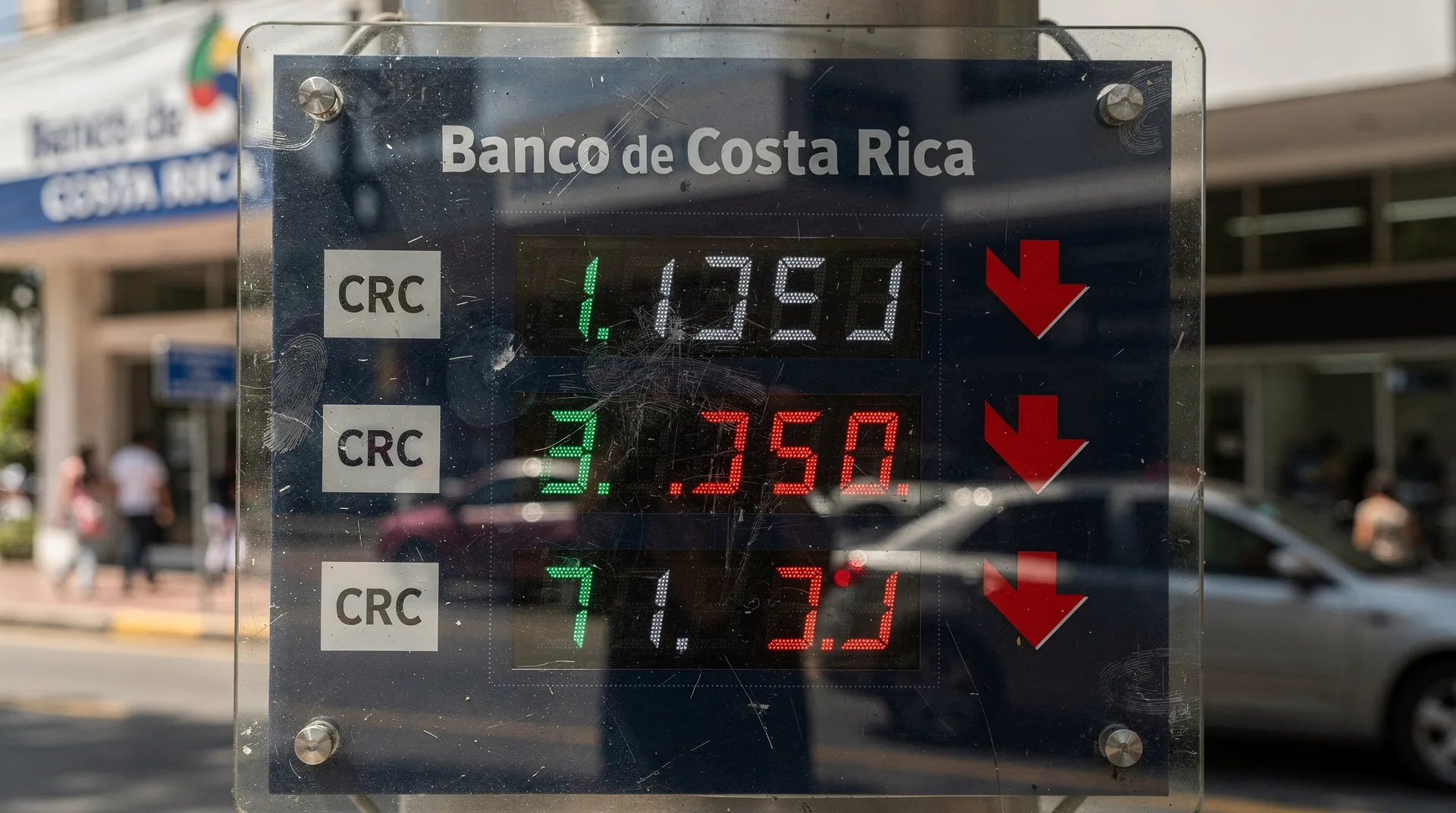
Why the colón fell against the dollar
The number that confused every traveler in 2022
For years, the Costa Rica colón traded in a narrow band around 570-600 CRC to the dollar. If you had visited in 2018, 2019, or even 2020, you had internalized that rough exchange — and if you had done any mental math for local prices (a soda lunch at 3,000 CRC was around $5, a moderate hotel night at 50,000 CRC was around $85-90), it held reasonably stable.
Then, in mid-2022, something shifted. By August of that year, the exchange rate had moved to around 680-700 CRC per dollar — a depreciation of roughly 15-20% in under twelve months. For travelers arriving with dollars or euros, this was unexpectedly favorable. For Ticos watching their purchasing power erode against imported goods and fuel prices, it was the opposite of favorable.
We have been asked by readers about this move often enough that a proper explanation seems warranted.
| 2022 peak | ~680-700 CRC/USD (colón weak) |
| 2026 rate | ~520 CRC/USD (colón stronger) |
| What’s affected | Local-price purchases: sodas, buses, markets |
| What’s mostly unaffected | Hotels, tours, shuttles (usually quoted in USD) |
| Best practice | ATMs over airport exchange desks (8-10% better rate) |
What actually caused the depreciation
The 2021-2022 colón depreciation had several intersecting causes, most of them tied to the same global forces driving currency moves everywhere in that period.
The dominant factor was the US Federal Reserve’s interest rate cycle. Starting in early 2022, the Fed began raising rates aggressively to combat the highest US inflation in four decades. Rising US rates attract capital toward dollar-denominated assets — investors shift money out of emerging market currencies and into dollars, putting pressure on currencies like the colón. This dynamic played out across essentially every emerging market currency simultaneously in 2022; Costa Rica was not special in this respect.
A secondary factor was Costa Rica’s own fiscal position. The country had taken on significant debt during the pandemic period to fund its public health response and social protection programs. By 2022, the government’s debt load as a percentage of GDP had risen to levels that made markets cautious about the country’s medium-term fiscal trajectory. The IMF had agreed to a $1.8 billion support package with Costa Rica in 2021, which helped stabilize confidence but also came with conditions that complicated domestic spending.
Oil prices played a role too. Costa Rica imports essentially all of its petroleum products (the electricity grid is renewable, but vehicles and heavy machinery run on fossil fuels). The spike in global oil prices following Russia’s invasion of Ukraine in February 2022 sharply increased the country’s import bill, putting pressure on the balance of payments and, by extension, on the exchange rate.
What happened next: the reversal
Here is the part of the story that is less often told: the colón staged a significant recovery in 2023 and 2024.
By late 2023, the exchange rate had moved back toward 520-540 CRC per dollar — a stronger colón than at any point since the early 2020s. The reasons for the reversal were the same kind of confluence as the original move: the Costa Rican central bank (Banco Central de Costa Rica) had raised its own interest rates to defend the currency, fiscal consolidation efforts had improved investor confidence, tourism revenues recovered strongly and generated dollar inflows, and global oil prices had come down from their 2022 peaks.
For travelers, this reversal had a noticeable effect on relative costs. Visiting Costa Rica in 2024 at 520 CRC/USD was more expensive in dollar terms than visiting in mid-2022 at 700 CRC/USD — the same local-currency-priced hotel room cost meaningfully more in dollars.
As of April 2026, the rate is approximately 520 CRC/USD. This is the figure we use in our 2026 pricing update.
What this means practically when you travel
For most travelers, the exchange rate matters less than they think it will — and more than they notice when they get home. For a broader look at how these currency swings interact with the general cost of a trip, our post on whether Costa Rica is still affordable tracks the bigger picture beyond just the exchange rate.
The reason it matters less: the majority of tourist-facing prices in Costa Rica are quoted in USD or indexed to USD, not in colones. Your hotel rate, your tour price, your shuttle cost — these are typically presented in dollars regardless of what the colón is doing. The exchange rate only directly affects you when you are buying in colones: the soda lunch, the local bus ticket, the market purchase, the small tip.
The reason it matters more than you notice: those local-price purchases add up over a two-week trip. If you eat two meals a day at sodas, take local buses occasionally, and buy your groceries at the mercado, a 15% swing in the exchange rate costs you a real amount by the time you land home.
The practical guidance has not changed much despite these swings:
- Use ATMs rather than exchanging at the airport. The airport exchange desk rate is consistently 8-10% worse than what a BAC or Promerica ATM gives you.
- Carry some colones for local purchases. Many sodas, market stalls, and local buses only accept cash in colones.
- Credit cards for hotel and tour payments. Most tourist-grade hotels and tour operators accept Visa and Mastercard; the transaction rate from your bank is usually better than cash exchange.
- Avoid exchanging at money changers on the street. These are not illegal, but the rates are poor and the risk of receiving counterfeit bills is real.
The broader economic picture for Costa Rica
It is worth understanding the economy that underlies the exchange rate, because it shapes what kind of country you are visiting.
Costa Rica is, by Central American standards, a middle-income country with relatively strong institutions. GDP per capita is around $13,000-14,000 (PPP-adjusted higher), which puts it well above Guatemala, Honduras, and Nicaragua, and comparable to Mexico and Peru. The economy is diversified across medical devices manufacturing (one of the world’s leading exporters per capita), pineapple and banana agriculture, services, and tourism.
Tourism accounts for roughly 7-9% of GDP in normal years. The medical devices sector — companies like Boston Scientific and Medtronic have major facilities near San José — has become a more important employer and foreign exchange earner than tourism in recent years. This diversification is one reason Costa Rica’s economy is more resilient to tourism shocks than you might expect from a country so associated with its visitor industry.
The fiscal position in 2022-2024 improved significantly. The IMF program supported structural reforms, and primary surplus targets were met. The debt trajectory, while still elevated, was moving in the right direction by 2024.
For travelers, this translates to a country where the ATMs work, where the financial system is stable, where you are not going to arrive and find your hotel closed because the owner’s bank failed. These are things you notice by their absence in more fragile economies, and they are worth a brief appreciation in a country that has maintained them.
The stability also matters to anyone thinking beyond a single trip. Readers who write in about buying property in Costa Rica or applying for permanent residency are, in effect, asking about exposure to this same currency and fiscal picture over a much longer horizon — the same ATMs-work, banks-are-stable logic applies, just compounded over years rather than a two-week trip.
What we budget for 2026
Given where the exchange rate sits in 2026 and the price increases we have documented since 2018, our current budget benchmarks are:
- Backpacker (hostel, sodas, local buses): $40-60 per person per day
- Mid-range (small hotel, mixed restaurants, shared shuttles, guided tours): $100-160 per person per day
- Comfort/luxury (boutique eco-lodge, private transfers, premium tours): $250-500+ per person per day
These are rough guides. Actual spending depends enormously on destinations chosen (Guanacaste resorts cost more than Caribbean budget travel), activities (a day at Corcovado with mandatory guide adds $100+), and travel style.
For a more complete breakdown by category, read our money and currency guide.
Shuttle from San José to Puerto Viejo — from $65One note on quoting prices in this article
Exchange rates move. By the time you read this, the CRC/USD rate will be different from when we wrote it. We have tried to give context for the 2022 movements that prompted the article, but for current rates, the most accurate source is the Banco Central de Costa Rica’s published daily rate (bccr.fi.cr) or simply checking Google’s currency converter before you travel.
The underlying point — that the colón floats against the dollar and the swings can meaningfully affect your purchasing power — holds regardless of the current number. It is worth checking before you travel, and worth using the right financial tools (ATMs over airport desks, local currency for local prices) regardless of where the rate sits. If you are staying longer than a standard trip, our digital nomad visa guide covers the financial and logistical side of a longer stay, including how residents manage currency exposure day to day.