Sodas and local restaurants: how to eat like a Tico
What is a soda?
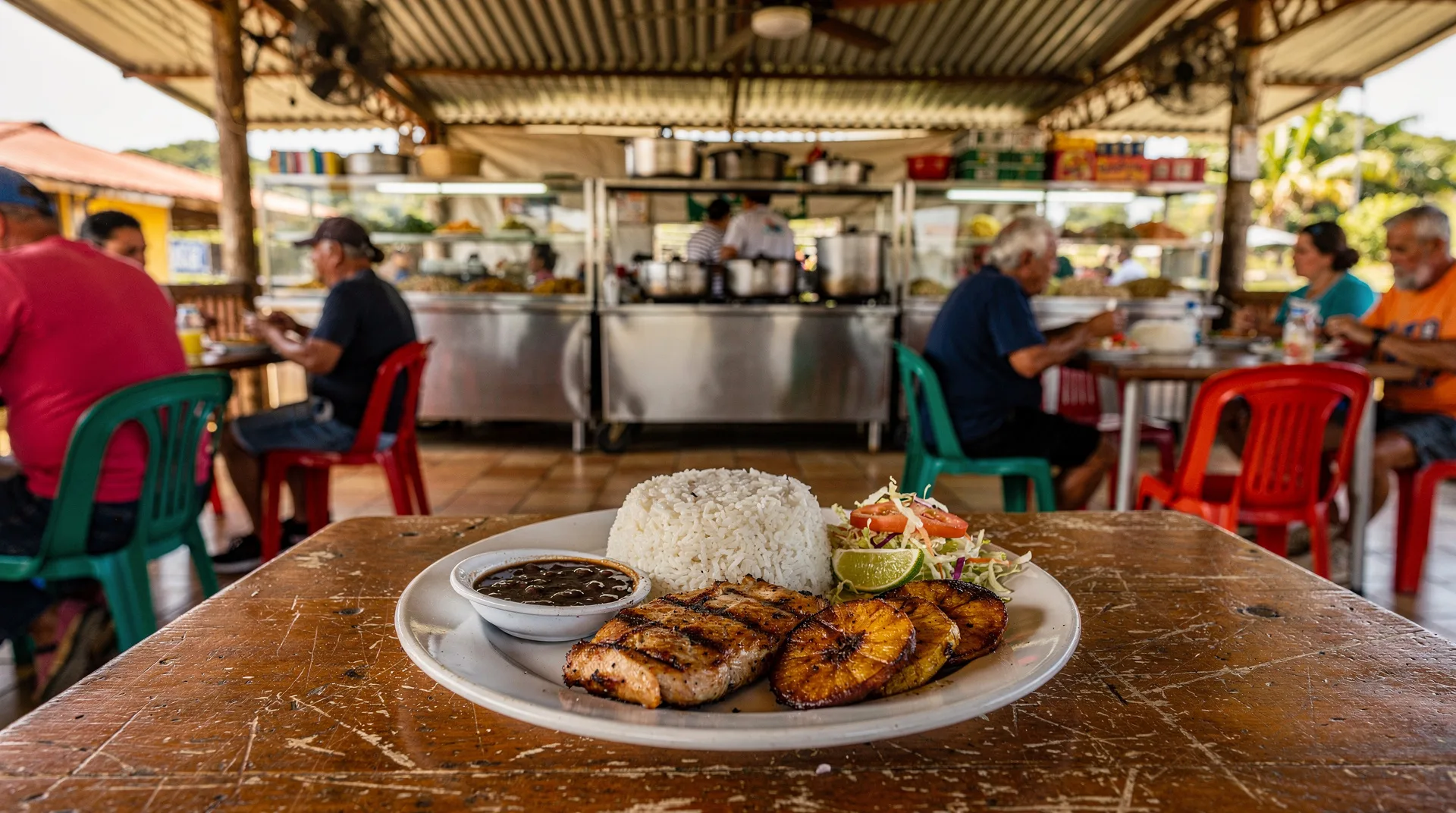
Family-run typical kitchen serving casado lunch for $5–8 — found in every town.
A soda is Costa Rica’s family-run answer to fast food — cheap, unpretentious, and the single best window into how Ticos actually eat.
| What it is | Family-run kitchen serving casado and gallo pinto |
| Casado price | Around $5–8 |
| Breakfast price | Around $4–6 |
| Best hours | Breakfast 6–9am, lunch 11:30am–2pm |
| Where to find real ones | Away from beachfronts and tourist strips |
The soda: Costa Rica’s defining food institution
A soda is not a drink. In Costa Rica, a soda is a small, family-run kitchen — the kind of place where the cook is also the dishwasher, sometimes also the cashier, and where the menu is written on a whiteboard or simply recited verbally when you sit down. The food is the same food that family eats at home. The price reflects this.
For any visitor who wants to understand Costa Rican food at its most authentic and most affordable, the soda is the essential institution. Hotels can offer you an interpretation of Tico cuisine. Restaurants in tourist corridors can offer you a polished version with a wine list. Only a soda offers you the actual thing: gallo pinto made before dawn, casado assembled to order with whatever the market had that morning, sour cream ladled from a bucket, and coffee brewed from a cloth filter held over a ceramic mug.
This guide tells you what to look for, what to order, what to pay, and where to find the best sodas in the destinations that matter.
Two practical notes before you go. Small family kitchens often prefer cash, so the ATM and cash tips and the money and currency guide are worth a read first. And if you are wondering whether to leave something extra at the end of the meal, the tipping culture guide explains what is normal.
What a real soda looks like
There is no official designation for a soda. Any restaurant can call itself one. This creates the predictable problem: tourist-facing establishments in Tamarindo, Manuel Antonio, and La Fortuna hang “Soda” signs above restaurants that charge $25 for a casado and $10 for a Coke.
Signs of a genuine soda:
- The menu is short — usually 3–5 casado protein options at lunch, a soup, possibly a few breakfast options in the morning
- Prices are visible and low: casado $5–8, gallo pinto breakfast $4–5, soup of the day $3–4
- The cook is visible or audible from the dining area
- The furniture is functional, not designed
- Local workers, construction crews, or school-age children are eating there
- There is no photos-only menu with aspirational plating
- Natilla and Salsa Lizano are on the table without asking
Signs of a soda in name only:
- A full printed menu with English translations and photographs of the dishes
- Prices above $12 for a casado
- Located at street level in a tourist shopping strip
- A hostess at the door
The geographical rule that usually holds: the further you walk from the beach, the surf school, or the zip-line operator, the closer you get to an actual soda.
What to order at a soda
Breakfast (desayuno): 6am–9am
The typical Tico breakfast (known as “un desayuno típico” or “el gallo pinto completo”):
- Gallo pinto
- Two eggs (scrambled or fried — “revueltos o fritos”)
- Natilla (sour cream)
- Fresh local cheese (queso blanco)
- Corn tortilla or bread toast
- Fresh fruit juice (cas, tamarindo, guanábana, or watermelon depending on season)
- Coffee (with milk — “con leche” — if you want it that way)
Total: $4–6. This is the best-value meal in the country. A 6am start means everything is freshest.
Lunch (almuerzo): 11:30am–2pm
The casado is the core of soda lunch service. Arrive between 11:30 and 1pm for the best selection — late arrivals may find the soup has run out or protein options limited.
The meal as ordered verbally (“me da un casado de pollo / pescado / carne, por favor”):
- Rice and black beans
- Shredded cabbage salad with vinaigrette
- Fried sweet plantain (maduro)
- Soup of the day (typically a thin vegetable broth with potato, chayote, or carrot — consumed before the main plate)
- Protein of choice
- Natural fruit drink (agua fresca or jugo natural)
Total: $5–8. The best value lunch in the country for the caloric and nutritional content delivered.
What to drink
Frescos naturales (natural juices): Blended fresh fruit with water or milk, lightly sweetened. The staple soda drink. Cas (a local guava-adjacent fruit, tart and refreshing), tamarindo (sweet-sour), guanábana (soursop — earthy and tropical), mora (blackberry), piña (pineapple). Approximately $1.50–2 for a large glass.
Agua dulce: Hot drink made from raw cane sugar (tapa de dulce) dissolved in water. The original Tico hot drink before coffee became dominant. Very sweet, warm, and comforting. Increasingly rare but found at traditional sodas.
Cerveza: Most sodas serve beer (typically Imperial or Bavaria) but are not primarily bars. Beer with a casado lunch is normal.
Best sodas by destination
San José
The San José destination guide covers the wider city, including the neighbourhoods worth walking for sodas.
Soda Tapia (Calle 42, near Sabana Park): One of the oldest and most beloved sodas in the capital. Open 6am–11pm — unusual late hours for a soda. The gallo pinto at breakfast and the casado at lunch are both reference-quality. Unpretentious, packed with workers and students at midday.
Soda La Casita (Mercado Central area, Avenida 1): The Mercado Central’s surrounding streets are dense with traditional sodas. La Casita is consistently cited by long-time San José residents as one of the best breakfasts in the city. Arrive before 9am.
Soda Tipica El Sol (Barrio La California): Slightly newer than the classic references but maintains a genuinely local clientele and produces one of the better corvina casados in the city.
The Mercado Central itself deserves a separate mention. The food stalls inside the market (not the peripheral tourist-facing ones — the interior stalls) serve ceviche, casados, and fish preparations to the market’s working community at prices that reflect this: $3–5 for a plate of ceviche, $5–7 for a casado.
Costa Rica historical tour in San José — from $55Cahuita
See the Cahuita destination guide for accommodation and beaches to pair with a soda-focused food itinerary.
Restaurant y Soda Sarafina: A small Caribbean-style soda near Cahuita’s main beach, run by a family with decades in the village. The rice and beans are made with coconut milk, the fish is fresh, and the portions are generous. Lunch for $7–8.
Doña Alcira: Home-kitchen soda (location communicated by word of mouth among regular visitors). Caribbean-style rice and beans with fried fish or chicken, arguably the best in the village. No sign, no printed menu, no reservation system. Arrive at 11:30am before the food runs out.
Nosara
The Nosara restaurant scene skews heavily toward health food and international cuisine for the yoga and surf community. Genuine sodas exist but require effort to find. The market area of Nosara town (not the beachfront corridor) has a few traditional options. The Nosara destination guide shows how the town is laid out, and the Nosara yoga retreats guide is useful if you are staying somewhere that serves its own meals and want to know when a soda lunch is worth the detour.
Nosara: traditional Costa Rican cooking class and meal — from $95Tamarindo
See the Tamarindo destination guide for the wider town layout. The tourist density in Tamarindo has largely eliminated the traditional soda from the beachfront area. Walk inland toward the residential streets or toward the local market area east of the main road for prices that make sense. Soda Rancho La Cascada on the outskirts of town is a frequently recommended local option.
La Fortuna
La Fortuna has a reasonable cluster of local sodas on the streets adjacent to the central park (Parque Central). The tourist-facing restaurants on the main street charge 3–4x what the sodas two blocks inland charge for equivalent food. The central market area (Mercado Municipal) has soda counters serving breakfast from 6am.
A soda breakfast fits neatly around a volcano day: eat early, then head out. The La Fortuna destination guide covers the town itself, and the Arenal Volcano National Park guide helps you plan the rest of the day once you have eaten.
Puerto Viejo and Cahuita (Caribbean)
The Caribbean coast’s sodas reflect Caribbean cooking: rice and beans in coconut milk (not gallo pinto), fried fish with plantain, spicier seasoning, and an influence that is distinctly Jamaican-Afro-Caribbean in character. The sodas here may not look like the Central Valley model but they are excellent in their own right. Walk the back streets of Puerto Viejo rather than the tourist strip restaurants. The Puerto Viejo destination guide gives the wider picture, and the best Caribbean beaches guide is a good companion for planning a day that mixes sand and a long, slow lunch.
Sodas as part of a food-focused day
For visitors who want soda culture explained rather than self-discovered, San José food and market walks typically include a Mercado Central stop and a stall-by-stall introduction to casado, ceviche, and fresh juices, with a guide who can order and translate in Spanish. This is a useful shortcut if you’re only in the capital for a day and want the soda experience without the trial and error.
San José coffee tasting experience — from $75What to avoid
The same instinct that helps you spot a fake soda helps with other pitfalls; our honest look at tourist traps covers more of them, and the safety in Costa Rica guide puts everyday food and travel risks in proportion.
“Soda” restaurants charging $25+ for a casado near tourist hotspots in Manuel Antonio, Tamarindo, and La Fortuna are not sodas. They are mid-range restaurants using the word as an authenticity signal. If a place describes itself as a “typical Costa Rican soda restaurant” in English on a tourist-facing menu board, it probably isn’t one.
Hotel breakfast buffets are expensive ($15–25 per person) and not representative of how Costa Ricans actually eat. The gallo pinto at the buffet is a version made for international palates — less Salsa Lizano, milder seasoning. It is fine, but it is not the real thing.
Tourist-zone “tipica” restaurants often serve casados that look the part but are made with lower-quality ingredients and proportionally priced upward. If the restaurant is next to a souvenir shop and has a table of German and American tourists at every table, keep walking.
The value calculation
For travellers, the soda system offers an exceptional budget option. Breakfast at a soda ($5), casado lunch ($7), and evening street food or a simple dinner ($6–10) means eating well for $18–22 per day in food costs. Compared to hotel restaurant prices ($12–18 per meal), the savings over a 10-day trip are material.
For food quality, the fresh ingredients, home-cooking technique, and reasonable portions at sodas consistently outperform the tourist-facing mid-range restaurants that charge twice the price. This is not universal — some tourist restaurants are genuinely excellent — but as a baseline, the soda is the reliable choice for an honest meal.
Frequently asked questions about sodas
Do sodas have vegetarian options?
Most sodas can prepare a vegetarian casado on request — typically substituting the meat protein with an additional portion of beans, cheese, or egg. The base components (rice, beans, plantain, salad) are naturally vegetarian. Vegan options are harder — sour cream and cheese are standard components, and cooks may not immediately understand a vegan request. In larger cities and tourist destinations with a wellness community (Nosara, Santa Teresa, Manuel Antonio), vegetarian and vegan accommodations are more easily made.
Is it safe to eat at a soda?
Generally yes. Costa Rica has higher hygiene standards than most Central American countries, and sodas serving a local clientele of regulars have strong incentives to maintain food safety (they would lose their customer base quickly otherwise). The risk of food-borne illness at a local soda is comparable to eating at a local restaurant in any developed country. Standard precautions: avoid raw shellfish from establishments that don’t appear to have refrigeration, drink bottled water in rural areas if tap water is uncertain.
What is the tipping culture at sodas?
Tipping at sodas is not expected but is appreciated. A tip of 500–1,000 CRC ($1–2) on a meal is a generous acknowledgment of good service. Many sodas include a 10% service charge on the bill — if so, no additional tip is necessary unless service was exceptional. The situation is different at upscale restaurants, where 10–15% is standard even when service is included.
Can I find sodas in rural areas?
Yes — this is one of their defining characteristics. Even in very small towns and villages with no other food options, there is usually a soda near the central park or the bus stop. In remote areas (near national park entrances, for example), the soda may only be open for lunch and may have a single menu option. Flexibility and early arrival are the practical strategies.
What time do sodas close?
Most traditional sodas close by 6–7pm, and many stop serving after the lunch rush (by 2–3pm). Evening dining in Costa Rica is typically at mid-range or upscale restaurants. If you want a full meal after 7pm in a small town, options narrow significantly. Plan your main meal at midday when soda food is freshest and most complete.
Related guides
The gallo pinto and traditional dishes guide goes deeper on the specific dishes you will find at sodas and how they vary by region. For the broader context of Costa Rican food culture, the food overview guide covers everything from market seafood to coffee and desserts. If you want to understand how the food changes as you move around the country, the cuisine by region guide maps the differences from Caribbean to Pacific to Central Valley.