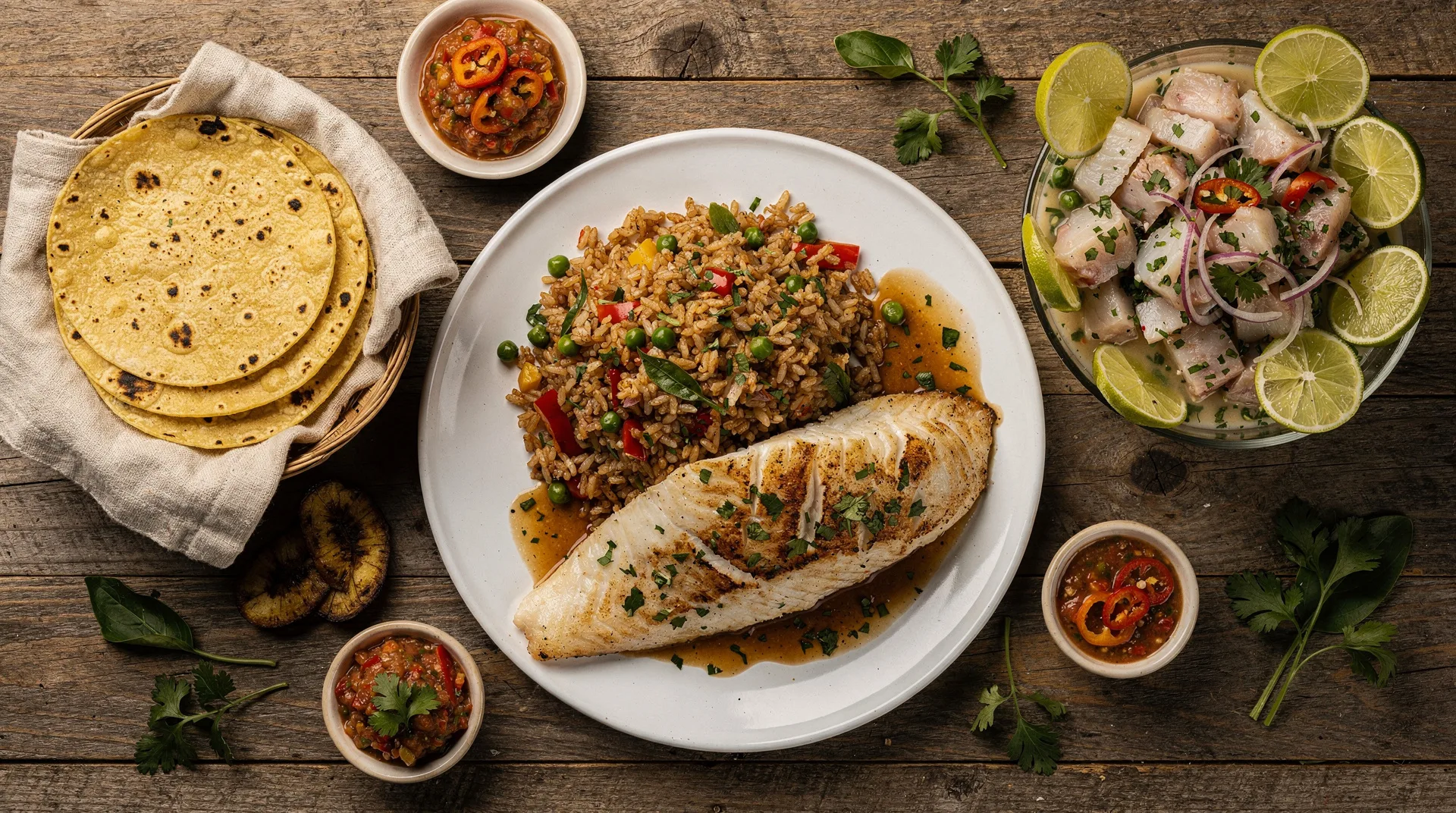
Costa Rican cuisine by region: how food changes coast to coast
Regional differences?
Caribbean coconut + jerk influences, Guanacaste maize-heavy, Pacific seafood-rich, Central Valley meat-and-rice classic.
Skip the hotel buffet and Costa Rica reveals four genuinely distinct food cultures shaped by geography, history, and migration — not one blended “Costa Rican cuisine.” This guide maps what changes region to region and how to actually taste the difference on a real trip.
| Regions covered | Central Valley, Guanacaste, Pacific coast, Caribbean coast |
| Where to eat | Sodas and local markets, not tourist-corridor restaurants |
| Typical meal cost | Around $4–8 at a soda; $15–30 at a mid-range restaurant |
| Most distinct region | Caribbean coast (coconut rice and beans, jerk, Rondon) |
| Best time for seafood | Dorado April–October; lobster season July–September (Caribbean) |
One country, four food cultures
Costa Rica is small by most measures — about the size of West Virginia. But its internal food geography is far more varied than that footprint suggests. The country’s dramatic topography — Caribbean lowlands, Central Valley highlands, dry Pacific northwest, wet Pacific south — creates not just different landscapes and climates but different agricultural traditions, different crop profiles, and fundamentally different food cultures.
The tourist who eats only at hotel buffets or tourist-corridor restaurants will encounter a fairly homogenised “Costa Rican cuisine” that is a blend of all regions, adjusted for international palates. The traveller who eats at sodas and markets across the country will discover four genuinely distinct regional expressions. This guide maps those differences.
Central Valley: the classic baseline
The Central Valley — encompassing San José and the surrounding provinces of Alajuela, Heredia, and Cartago — is where the majority of Costa Rica’s population lives, and where the “standard” Tico food culture is most concentrated. This is the cuisine that gets exported to tourist menus: gallo pinto, casado, sopa negra, olla de carne.
The Central Valley pantry
The foundation is rice and black beans, supplemented by a protein (beef, chicken, or pork are most common), root vegetables (yuca, chayote, potato), fresh vegetables (cabbage, tomato, onion), and dairy in the form of natilla (sour cream) and queso blanco (fresh white cheese). The fat of choice is vegetable oil for most cooking; lard appears in traditional preparations but is less common than in previous generations.
Pejibaye (the boiled orange palm fruit) is specific to this region and sold from roadside carts. It is starchy, slightly oily in texture, and eaten with mayonnaise. Visitors either find it revelatory or puzzling — it tastes nothing like anything else in the tropics.
Tamales are the Central Valley Christmas food, prepared in enormous quantities by family groups in December. Each family has a recipe. The fillings include rice, black beans, pork or chicken, olives, and vegetables, wrapped in plantain leaves and boiled or steamed.
Chicharrones: Fried pork rinds, eaten as a snack at bars and sold at market stalls. The good version (fresh-fried) is a completely different product from the bagged snack version.
Coffee as the Central Valley identity
Coffee is Central Valley. The Alajuela and Heredia highlands are where Costa Rica’s most prized beans grow, and the country’s major coffee estates — Doka, Café Britt, and Hacienda Alsacia — are all within an hour of San José. The coffee tours comparison guide covers these in detail.
Urban San José has developed a specialty coffee scene that rivals comparable cities in producing countries. Barrio Escalante, the neighbourhood east of downtown San José, has become the city’s most culinarily adventurous area — specialty coffee cafes, wine bars, upscale sodas, and a farmers’ market that would not look out of place in Portland or Melbourne.
San José: coffee production tour and tasting — from $75Guanacaste: the maize tradition
Guanacaste Province in Costa Rica’s northwest occupies a special place in the country’s food history. The Chorotega indigenous people, who inhabited this region before and after Spanish colonisation, maintained a sophisticated maize-based food culture that has been partially preserved in modern Guanacaste cooking.
Corn preparations
Chorreadas: Sweet corn pancakes, thick and slightly grainy, cooked on a clay comal and served with natilla. Found at traditional restaurants in Santa Cruz, Liberia, and Nicoya — less common outside of Guanacaste.
Tamales de maíz: Guanacaste’s tamales use corn dough differently from the Central Valley version — often incorporating corn itself into the filling, and the masa (corn dough) may be coarser.
Tortillas de maíz: Thick, hand-patted corn tortillas, typically larger and more substantial than the Central Valley equivalent. A Guanacaste soda breakfast often includes tortillas with queso rather than bread toast.
Tortillas de queso: Corn tortillas stuffed with fresh cheese and grilled until the cheese melts and the exterior crisps. One of the most satisfying simple foods in the region.
Pinolillo: A traditional drink made from roasted corn and cacao, mixed with water or milk. Pre-Columbian in origin, still served at traditional festivals and by Chorotega artisan communities.
Guanacaste seafood and meat
The Gulf of Nicoya produces excellent seafood — corvina, pargo, dorado, and jumbo shrimp. The best Guanacaste fishing towns (Puntarenas, Playas del Coco, and the Nicoya Gulf coastal communities) have fish restaurants that are genuinely excellent when you find the local spots rather than the tourist-facing establishments.
The inland Guanacaste diet, on cattle ranches and farming communities, is meat-heavy. Beef preparations — typically grilled or slow-cooked — are central to the cuisine here in a way that reflects the historical economic importance of cattle ranching in the region.
To taste this tradition in context, base yourself in Liberia or Playas del Coco and eat where the locals eat. The Guanacaste beach guide helps you pair a beach day with a proper soda lunch, and the wider Guanacaste province page shows how the region fits together.
Pacific Central and South: seafood-rich, diverse
The Pacific coast from Jacó south through Manuel Antonio, Uvita, and down to the Osa Peninsula is where seafood eating reaches its highest expression in the country.
Pacific seafood traditions
Corvina (sea bass): The king of Pacific coast cooking. Fresh corvina is typically grilled whole or as fillets, served with garlic butter, lime, and rice. The quality depends almost entirely on freshness — corvina caught and sold the same day in a port town is exceptional; corvina that has traveled inland for two days is significantly inferior.
Dorado (mahi-mahi): A warm-season fish (April–October) that forms the basis of the best ceviche and grilled fish preparations at Pacific coastal restaurants. More complex flavour than corvina, slightly firmer texture.
Pargo (red snapper): Rich, fatty, excellent when grilled over charcoal with minimal seasoning. Quepos and Jacó are particularly strong for fresh pargo.
Camarones (shrimp): The Nicoya Gulf shrimp are among the best in Central America. Large, sweet, and firm — best eaten simply grilled or in garlic sauce.
Ceviche as the Pacific expression
Pacific ceviche uses lime-marinated corvina or tilapia, mixed with onion, sweet pepper, and cilantro. The preparation is lighter and more citrus-forward than Caribbean preparations. Market stalls in Quepos, Jacó, and Uvita serve this for $4–6 a cup at lunch.
Manuel Antonio and Quepos restaurant scene
The Manuel Antonio / Quepos area has the most developed mid-range restaurant scene on the Pacific outside of Santa Teresa. Some genuinely excellent restaurants (La Cantina, El Patio del Balmoral in Quepos, El Wagon near the park entrance) justify their prices with quality ingredients and skilled preparation. But the tourist density also means there are many establishments charging $30+ for mediocre fish — use recent reviews carefully.
Jacó Beach: 2-hour chocolate experience tour — from $35Osa Peninsula and Drake Bay
At the far south of the Pacific coast, the Osa Peninsula’s food scene is limited by its remoteness and tourist volume. Drake Bay and Puerto Jiménez have a handful of excellent small restaurants — the best serving fresh fish caught by local boats. Don’t expect a sophisticated dining scene, but the freshness of the ingredients compensates.
For the seafood-led stretch of the Pacific, Jacó, Manuel Antonio and Uvita are the natural bases, and the Pacific beaches guide is useful for planning meals around your beach days.
Caribbean coast: the most distinct food culture
The Caribbean coast — Limón Province and its communities of Cahuita, Puerto Viejo, and Manzanillo — has the most distinctive food culture in Costa Rica, reflecting its entirely different historical and demographic development.
The history on the plate
Limón Province’s population descends primarily from Afro-Caribbean workers — many Jamaican — brought to Costa Rica to build the Atlantic Railroad in the 1880s. They brought with them Jamaican and broader Caribbean food traditions: coconut milk cookery, jerk spicing, breadfruit, sweet potato, and a range of preparations that have no equivalent on the Pacific coast or in the Central Valley.
The indigenous Bribrí and Cabécar communities of the Talamanca mountains also maintain distinct food traditions centred on cacao, plantain, and forest products.
Rice and beans (not gallo pinto)
This is the most fundamental distinction. On the Caribbean coast, the rice and beans preparation is made with red kidney beans (not black beans), cooked together with full-fat coconut milk, thyme, and garlic. The result is creamy, slightly sweet, and carries the characteristic coconut undertone throughout. Every Tico who has eaten this for the first time will tell you it is completely different from gallo pinto — and they are right.
“Rice and beans” accompanies every substantial meal on the Caribbean coast. Fried fish, chicken, lobster, crab, or shrimp served alongside rice and beans, maduro (fried sweet plantain), and a simple green salad is the signature Caribbean lunch plate.
Rondon
Rondon (from “run down” in Caribbean English) is the Caribbean coast’s signature stew — a coconut-milk base slow-cooked with whatever the cook has available: fish, crab, snail, yuca, plantain, breadfruit, and vegetables. It takes 3–4 hours to make properly and is not widely available from menus (it requires advance notice at most places). The best versions come from home cooks and a few family-run restaurants in Cahuita and Puerto Viejo.
Jerk seasoning
Jamaican jerk spicing (scotch bonnet, allspice, thyme, garlic, ginger) appears throughout the Caribbean coast food scene. Jerk chicken grilled over wood coals is a standard option at roadside stands and beach sodas. The heat level varies — ask about spice before ordering if you are sensitive.
The Bribrí cacao connection
The indigenous Bribrí people of Talamanca cultivate cacao and prepare traditional cacao-based drinks that are entirely different from the sweetened chocolate familiar to international visitors. The bitter, thick, slightly fermented drink has ceremonial and nutritional significance. Community-led chocolate tours in the Talamanca region provide the most authentic encounter with this tradition.
See the chocolate and cacao tours guide for the full breakdown of Bribrí tour options.
Puerto Viejo’s food scene
Puerto Viejo has developed a restaurant scene that is arguably the most culturally interesting in Costa Rica — Caribbean cooking traditions combined with indigenous influences, a significant reggae-influenced culture, and an international backpacker food scene that has imported flavours from Brazil, Jamaica, and elsewhere. Standouts include the open-air restaurants near the beach serving fresh lobster in high season (July–September), the informal jerk chicken stands on the main road, and a few excellent Caribbean-cooking restaurants that are consistently cited by long-term expats.
If the Caribbean food is what draws you, plan time in Puerto Viejo and Cahuita, and read the Caribbean vs Pacific coast trip guide to decide how to split your days between the two coasts.
Markets vs sodas vs restaurants: where regional food actually lives
Regional identity shows up most clearly in three kinds of venue, and each teaches you something different. Municipal markets (Mercado Central in San José, the Puntarenas fish market, smaller town markets in Liberia or Nicoya) are where you see raw regional ingredients and eat the cheapest, most authentic prepared food — market ceviche and lunch counters inside these buildings routinely outclass nearby tourist restaurants at a third of the price.
Sodas — small, family-run, no-frills eateries found in every town — serve the daily regional casado and are the single best gauge of what a region actually eats day to day; menus rarely translate into English and that is usually a good sign, not a barrier. Restaurants, particularly in tourist hubs like Manuel Antonio, Tamarindo, or Puerto Viejo, range from genuinely excellent regional cooking to expensive, homogenised “Costa Rican” plates aimed at visitors who will not return to compare. Reading recent reviews carefully and asking hotel staff where they themselves eat remains the most reliable filter.
Comparing the regions: a summary
| Region | Base starch | Key flavour | Protein focus | Distinctive dish |
|---|---|---|---|---|
| Central Valley | Rice + black beans | Salsa Lizano, cilantro | Beef, chicken | Gallo pinto, olla de carne |
| Guanacaste | Corn + rice | Maize, lard, cheese | Beef, pork | Chorreadas, corn tortilla |
| Pacific (north) | Rice + fish | Garlic, lime | Seafood, beef | Grilled corvina, ceviche |
| Pacific (south) | Rice + fresh fish | Coconut (some), citrus | Seafood, wild game | Fresh ceviche, grilled pargo |
| Caribbean | Coconut rice+beans | Coconut, jerk, thyme | Fish, crab, chicken | Rice and beans, Rondon |
How to eat across all regions on a single trip
A 10-day Costa Rica trip spanning Guanacaste, the Central Valley, and the Caribbean coast will expose you to all four food cultures if you eat at local sodas and markets rather than hotel restaurants. The route:
- Guanacaste (days 1–3): Tortillas and chorreadas for breakfast; grilled fish from the Gulf of Nicoya for lunch
- Central Valley / San José (days 4–5): Mercado Central for ceviche; Soda Tapia for gallo pinto; Doka Estate for coffee
- Caribbean coast / Puerto Viejo (days 6–8): Rice and beans with coconut milk; jerk chicken; Rondon if you can find it
- Pacific south / Uvita (days 9–10): Corvina ceviche; casado with fresh dorado
This is not an itinerary — it is a food framework. Adapt it to wherever your trips take you, and the culinary variety will track.
Shorter trips can still capture regional contrast without covering all four zones. A five-day Central Valley plus Caribbean loop, for example, pairs the “classic baseline” cuisine with the most distinctive regional cooking in the country and requires only a single overland transfer, rather than the multiple long drives a full four-region circuit demands. Travellers based only on the Pacific coast, meanwhile, get real variety simply by moving between Guanacaste in the north and the Osa Peninsula in the south — the maize-heavy Chorotega tradition at one end and the seafood-driven cooking of the wetter south at the other, without leaving the Pacific side of the country at all.
Getting between these food regions is part of the planning. The driving guide and the shuttle services overview explain the two main ways to cover the distances, and the money and currency guide is worth a look before you start paying for market lunches in cash.
Frequently asked questions about regional Costa Rican food
Which region has the best food?
This is genuinely subjective. Travellers with Caribbean food backgrounds often find the Limón Province food the most exciting — familiar flavours in a new tropical context. Seafood lovers tend to prefer the Pacific south. Coffee and artisan food enthusiasts skew toward the Central Valley. Pure comfort and value: the Central Valley casado wins on almost every metric.
Is Caribbean coast food available in San José?
Rarely and in limited form. San José does not have a significant Caribbean restaurant scene despite the cultural presence of Afro-Caribbean communities. The Mercado Central has one or two Caribbean-influenced stalls, but for authentic Limón-style rice and beans and Rondon, you need to be on the Caribbean coast.
Are there vegetarian-friendly regional specialties?
Guanacaste’s corn preparations (tortillas, chorreadas, pinolillo) are naturally plant-based. The Caribbean coast has excellent fresh produce — coconut-based preparations can be made without meat. The Central Valley’s bean-and-rice base is inherently vegetarian; the challenge is that the protein component of a casado defaults to meat, and requesting a vegetarian substitution requires clear communication. In tourist destinations with a wellness focus, vegetarian options are more readily available.
Where is the best ceviche in Costa Rica?
The seafood-producing areas: Quepos market, Jacó’s local fish restaurants, Uvita’s beachside places, and — for a different style — the Caribbean coast in Cahuita and Puerto Viejo. San José’s Mercado Central has good ceviche, particularly at the interior fish stalls. The worst ceviche tends to be at tourist-facing beach restaurants near major resort areas, where volume and markup compress quality.
Is there a growing craft food scene beyond coffee and chocolate?
Yes. San José’s Barrio Escalante has seen significant development of an urban craft food scene — independent bakeries, cheese makers, small-batch fermenters, and specialty food producers. The Saturday BorBón market in San José features small artisan food producers. This is nascent compared to comparable cities in Latin America, but growing.
Dietary restrictions across the regions
Travelling with dietary restrictions is manageable in every region but requires slightly different strategies. Vegetarians fare best in the Central Valley and Guanacaste, where the rice-bean-corn base is naturally meat-free and requesting “sin carne” at a soda is well understood; the Caribbean coast’s coconut-based cooking is also easy to adapt, though rondon and most rice-and-beans plates are typically cooked alongside fish or meat stock, so ask specifically.
Gluten-free travellers do well with corn-based Guanacaste dishes (tortillas, chorreadas) but should watch for wheat flour in Central Valley baked goods and some Caribbean patties. Shellfish allergies need particular caution on the Pacific and Caribbean coasts, where shared kitchen equipment for fish and shellfish is common at smaller sodas — flag the allergy clearly rather than just avoiding shellfish dishes on the menu.
Related guides
The food overview guide covers the country’s full food landscape in one place. The gallo pinto guide zooms in on the national dish and where to find it at its best. For the artisan food and drink experiences — coffee and chocolate — the coffee tours comparison and chocolate and cacao tours provide the full picture. And for itinerary planning that incorporates culinary travel, the 14-day wildlife and food itinerary maps a routing that covers all of Costa Rica’s food regions.