Carbon neutrality and Costa Rica's climate leadership
The country that actually walks the talk
Few countries talk about environmental leadership as loudly as Costa Rica, and fewer still have the receipts to back it up. We have watched this conversation evolve over nearly a decade of trips — from the first time a lodge owner in Drake Bay explained the national parks system to us, to the moment a government press release about net-zero 2050 landed in our feeds in 2019. The ambition is real. So are the complications.
Costa Rica set a formal goal of carbon neutrality by 2021 — a target it later revised to 2050 when it became clear that the first date was aspirational in ways that the science did not fully support. What happened between those two dates is a useful case study in what genuine environmental leadership looks like: messy, iterative, honest about its failures, and still, on balance, ahead of almost every comparable nation.
| Electricity grid | 98-100% renewable most years (hydro, geothermal, wind, solar) |
| Weak point | Road transport, roughly 70% of national emissions |
| Strong point | Forest cover recovered from ~21% to over 52% since the 1980s |
| Target | Net-zero by 2050 (revised from 2021) |
| What travelers can do | Choose CST-certified operators, use shared shuttles |
The renewable electricity story
The headline figure that gets quoted most often is Costa Rica’s electricity grid: in most recent years, between 98% and 100% of the country’s electricity comes from renewable sources. In 2019, 2020, and 2021, Costa Rica ran on 100% renewable power for stretches of several months at a time. Hydropower accounts for the majority — roughly 70-75% — with geothermal from the volcanic highlands providing a reliable base load, and wind and solar filling the remainder.
This is not a developing-world achievement. This is something that Germany, France, or Canada would consider exceptional. It is the product of decades of deliberate policy, starting with a constitutional amendment in 1994 that recognized a healthy environment as a fundamental human right, and continuing through a series of national energy plans that consistently prioritized renewable infrastructure over fossil fuel expansion.
The practical result for travelers is immediate and visible: the grid is reliable, power outages are uncommon outside major weather events, and the electricity running the air conditioning in your hotel or the water pump at your jungle lodge is, in fact, clean. This matters more in Costa Rica than in many destinations because the country’s conservation credentials are so central to its tourism proposition.
Where the emissions actually come from
Here is where the picture gets more complicated, and where we think honest travel journalism requires some nuance.
Costa Rica’s electricity is clean. Its transport sector is not. Road transport — private cars, trucks, buses — accounts for roughly 70% of the country’s total greenhouse gas emissions. The vehicle fleet is old by international standards, diesel-heavy, and concentrated in the central valley where San José’s infamous traffic gridlock means those engines idle for hours each day.
The government has known this for years. The National Decarbonization Plan, launched in 2019, set specific targets for electrifying public transport — commuter trains, buses — by 2035, and for phasing out new internal combustion vehicle sales by 2050. Progress has been slower than the plan envisioned. Electric vehicle adoption is growing — you now see Tesla charging stations at several major hotels and the San José airport — but the transition is moving at a pace that the 2050 net-zero target requires to accelerate significantly.
For travelers, this matters in a specific way: the shuttle bus you take from San José to La Fortuna, or the local bus to Montezuma, almost certainly runs on diesel. This does not make the trip wrong, but it is worth knowing.
A regular shared shuttle still beats a private transfer or a rental car on a per-passenger emissions basis, simply through occupancy. If minimizing your transport footprint matters to you, our shuttle services overview compares the shared and private options by route.
Travelers who still prefer to drive should read our notes on whether to rent a car at all and on driving in Costa Rica before deciding. Linking several stops into one longer stay, rather than hopping between regions every other day, cuts the number of transfers you need. Our internal flights guide covers the other side of that trade-off, since flying within the country is not automatically the greener or the more practical choice.
The forests: Costa Rica’s real climate asset
If Costa Rica has a genuine claim to being the world’s most important test case for climate-positive land management, it is in its forests — not its electricity grid.
In the 1980s, Costa Rica had one of the highest deforestation rates in the world. More than half of the country’s original forest cover had been cleared for cattle ranching and agriculture by the late 1980s. Then, in 1997, the government launched the Pagos por Servicios Ambientales program — payments to landowners who maintained or restored forest on their property. Private landowners received direct government transfers for protecting watersheds, biodiversity, and carbon sequestration.
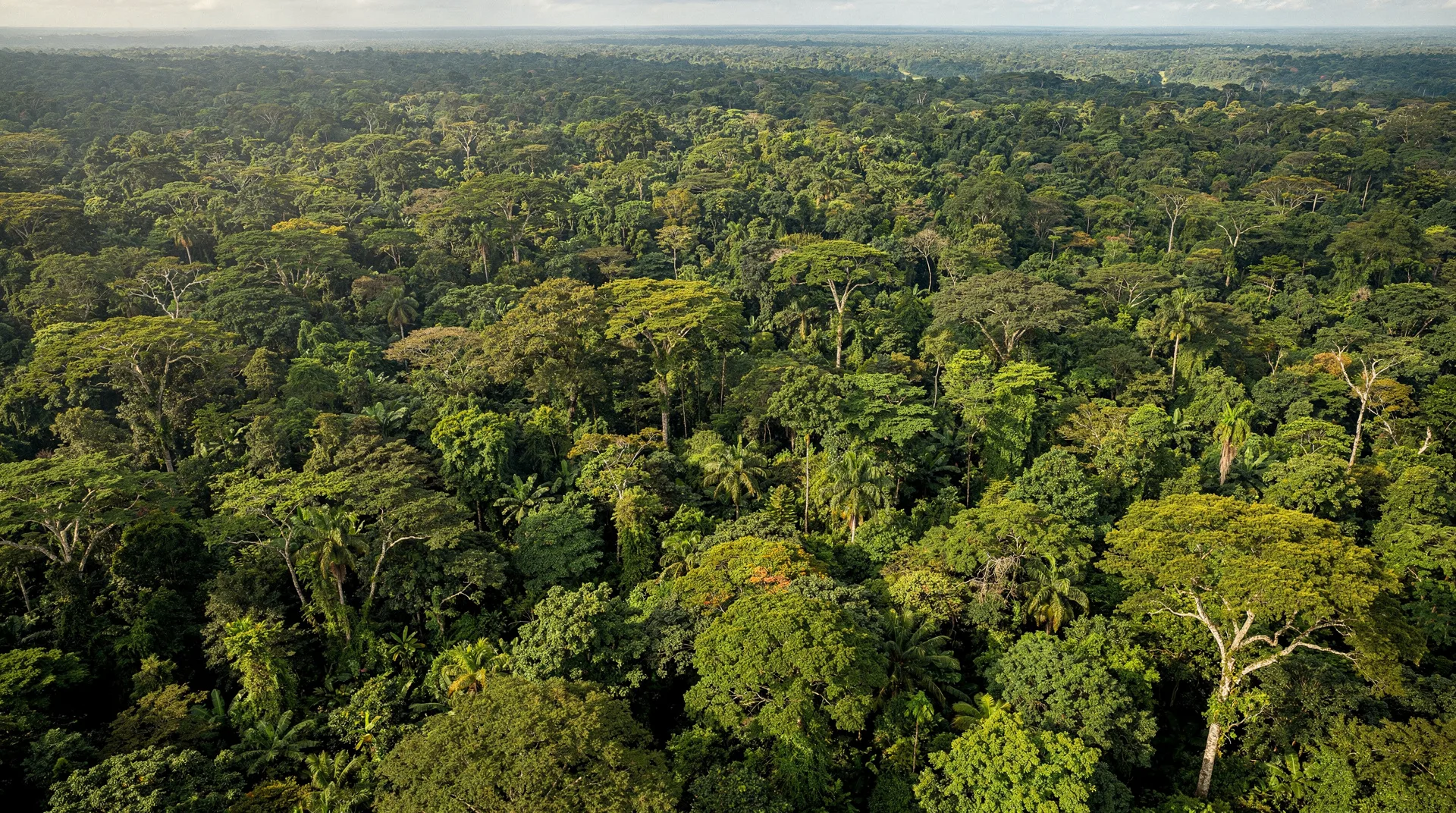
The results were striking. Forest cover, which had fallen to around 21% in the 1980s, recovered to over 52% by the early 2010s and continues to increase. Costa Rica became the first tropical country in the world to reverse deforestation — not by eliminating cattle or agriculture, but by making intact forest economically valuable to the people living alongside it.
When you visit Corcovado National Park or walk through the cloud forest at Monteverde, you are walking through land that is actively sequestering carbon and harboring species found nowhere else on earth. That is not a marketing claim. It is measured.
Other protected areas tell the same story from different angles. Tortuguero National Park shows how a remote coastal wetland and its nesting beaches depend on protection, while Manuel Antonio National Park shows how a small, heavily visited reserve can coexist with a busy tourism town. Carara National Park is a useful reminder that forest recovery matters just as much close to the main tourist roads as it does in the far south.
Drake Bay: Corcovado NP and Sirena Station tour — from $135What travelers can do with this information
We have been asked many times, by readers who care about this, whether traveling to Costa Rica is a defensible choice given the carbon cost of getting there. Our honest answer is that it is a more defensible choice than most alternatives, for several reasons.
First, tourism revenue funds conservation directly. The SINAC system of national parks is financed partly through entrance fees. Tour operators who depend on intact ecosystems have strong incentives to advocate for their protection. When you pay for a guided Corcovado tour, some of that money reaches the ranger services that keep poaching pressure off one of the world’s most biodiverse patches of land.
Second, Costa Rica’s model of payments for environmental services — which funds its forest recovery — was partly designed to demonstrate to international funders that conservation could be economically viable. Tourism gave that demonstration credibility.
Third, the country’s own emissions, per capita, are relatively low — around 1.7 tonnes of CO2 equivalent per person per year, compared to roughly 15 for the United States or 9 for Germany.
None of this erases the emissions from your transatlantic or transpacific flight. But it puts the destination side of the equation in a different light.
The 2050 target: achievable or aspirational?
We are not climate scientists, and we do not pretend to fully adjudicate this question. What we can say, based on following the data over several years, is that the 2050 net-zero target is more credible than most comparable national commitments, and less certain than its advocates sometimes claim.
The electricity transition is essentially complete. The transport transition is underway but behind schedule. The forest sequestration is working and is well-measured. The agricultural sector — particularly dairy and beef — remains a significant emissions source that the decarbonization plan addresses but that politics makes difficult to move quickly.
Our read: Costa Rica will get closer to net-zero by 2050 than almost any other country in its income bracket. Whether it reaches the precise target depends on the pace of electric vehicle adoption and agricultural transformation in ways that are genuinely uncertain.
We would also note a structural advantage that rarely gets mentioned: Costa Rica abolished its army in 1948, and the resulting reallocation of budget toward education, health, and, over subsequent decades, environmental policy is part of why the country was able to fund programs like Pagos por Servicios Ambientales at a scale most comparable nations could not match. That history is not incidental to the climate story — it is one of its structural preconditions.
For what it is worth, the government has more transparency about this uncertainty than most — the National Decarbonization Plan publishes annual progress reports that are honest about the gaps. That kind of institutional honesty is itself a climate leadership quality that deserves recognition.
Río Celeste National Park hike — from $95How this shows up in the lodges and tours you book
The sustainability claims made by Costa Rican hotels and tour operators range from the genuinely rigorous to the superficial. The ICT’s Certificación para la Sostenibilidad Turística (CST) program rates operations on a four-leaf scale, and some of the country’s best operators — Lapa Rios on the Osa Peninsula, Pacuare Lodge in the Talamanca foothills — have achieved four-leaf status through verified practices.
When you book through platforms like GetYourGuide, look for operators who mention CST certification or specific environmental practices. The best ones will compost, source food locally, use solar water heating, and have policies around single-use plastics that have actual teeth. The worst will have a green leaf on their logo and a box of plastic water bottles in the lobby.
This is worth checking even for small operators. A one-boat whale-watching outfit or a family-run canopy tour is not going to have a four-leaf CST rating — the certification process is bureaucratic and geared toward larger properties — but you can still ask about group size limits, engine idling policy near wildlife, and whether they employ local guides rather than importing labor from the capital. The answers tell you more about actual practice than any certificate would.
We have learned, over the years, to ask one simple question when checking into a property: “What happens to your food waste?” The answer tells you almost everything you need to know.
The same certification question applies to marine and wildlife tours. A whale-watching operator working near Marino Ballena National Park that keeps a respectful distance and limits boat numbers around pods is a different proposition, ecologically, from one that does not — and the difference rarely shows up in the marketing copy, only in how the boat actually behaves on the water.
If whales are the reason you are heading to the south Pacific, our whale watching season guide explains when to go, and our piece on wildlife watching ethics sets out what good behavior around animals looks like, whichever operator you choose. The wider picture of eco-tourism after 2020 and our advice on supporting local tourism go deeper on the same themes, and our honest look at tourist traps helps you spot greenwashing from the other direction.
Uvita: whale watching tour in Marino Ballena — from $80What we tell our readers in 2026
When we started this site, one of our commitments was to report Costa Rica accurately — including the parts that complicate the marketing. The carbon neutrality story is one of those parts. It is a genuine achievement, more significant than almost any other developing-world example, and it coexists with a transport sector that has not yet made the transition the government has promised.
That combination is not a reason to avoid Costa Rica. It is a reason to visit with realistic expectations, to choose certified operators, to use shared shuttles over private transfers where possible, and to support the national parks whose entry fees fund the ranger services and land protection that make the reforestation story real.
For an overview of the ecological systems you will be protecting when you visit, read our guide to Costa Rica’s national parks.
The net-zero 2050 bet may or may not land exactly on target. But the direction of travel is not in doubt, and in a world where most governments’ climate commitments are aspirational at best, that is worth something.