Our first trip to Costa Rica
The flight landed at 11pm and nothing went as planned
We arrived at Juan Santamaría International Airport in the kind of bleary, overconfident state that only long-haul travelers know. We had a spreadsheet. We had a printed itinerary. We had booked a shuttle for the next morning to La Fortuna. What we had not done was account for the fact that the shuttle would leave at 6am, that San José traffic was already moving at 5:45, and that our hotel — billed as “five minutes from the airport” — was twenty-five minutes away with a driver who took the scenic route.
| Original route | La Fortuna (3n) → Monteverde (2n) → Manuel Antonio (2n) → San José (1n) |
| Length | 9 days, two people |
| Total cost (2018) | around $3,800 all-in, including flights |
| Biggest lesson | Do not overpack the itinerary |
| What we’d do differently | One fewer destination, more nights per stop |
We missed the shuttle. Day one, before we had even eaten breakfast.
That is how our first trip to Costa Rica began. And yet, looking back from 2026, it was probably the best introduction to this country we could have had. Because Costa Rica has a way of teaching you to let go of the spreadsheet.
What surprised us immediately
We had read the guidebooks. We thought we knew what to expect: jungles, monkeys, beaches, expensive coffee tours. What we had not expected was the sheer density of the place. Within an hour of leaving San José on the reprogrammed shuttle (we caught the 8am departure after a panicked phone call), we were watching three white-faced capuchins cross the road in front of us. Just — crossing the road. No park, no guided tour, no ticket required.
The landscape shifts constantly. The central valley around San José is temperate and surprisingly green, more like rural Switzerland than any tropical fantasy. Then the road starts to climb into Alajuela province and the vegetation thickens, the air grows heavy, and banana plantations appear on the roadside. By the time you reach the turn-off for La Fortuna and Arenal, you understand why people call this country the most biodiverse place on earth per square kilometer.
We also had not expected the roads. We had rented a Toyota RAV4, having read that 4WD was advisable. That turned out to be one of our better decisions. The main highway from San José to La Fortuna is fine — paved, well-marked, genuinely pleasant. But we made the mistake of trying to find a waterfall “three kilometers off the main road” that our guidebook mentioned. That three kilometers took forty-five minutes and involved a stream crossing that the RAV4 handled with exactly zero margin for error.
La Fortuna: the volcano that changed everything
We spent three nights at La Fortuna, which in hindsight was exactly right — though we had almost cut it to two to squeeze in more destinations. The lesson we have repeated to everyone who asks us about Costa Rica since: do not try to see too much.
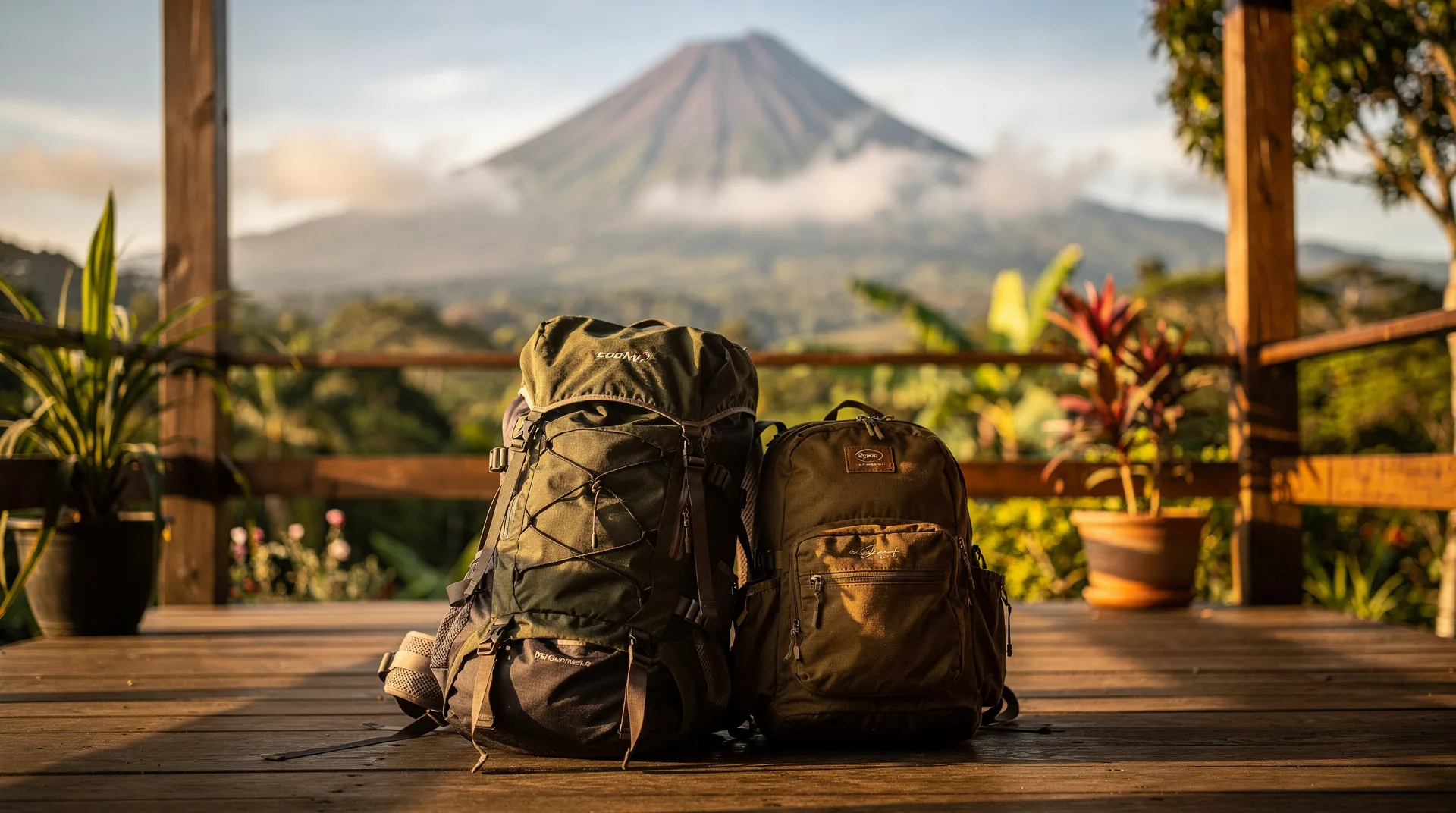
Arenal Volcano dominates the town in a way that is hard to convey until you have sat on a hotel terrace at dawn with your coffee and watched the clouds break open to reveal that perfect conical silhouette. The last eruptive phase ended in 2010 and the volcano has been in a resting phase since, but you would not know it from looking at it — steam still drifts from the summit on clear mornings, and the scale of it, sitting in the middle of an otherwise ordinary-looking town, never stops feeling surreal.
We did the hanging bridges at Místico Park, which we had almost skipped because it sounded like a tourist trap. We were wrong. Walking at canopy height through a forest where you can hear but not see howler monkeys, where toucans cross the sky between tree crowns, where the humidity wraps around you like a warm towel — that was the morning we understood what Costa Rica actually is.
La Fortuna: Místico Arenal hanging bridges admission ticket — from $26If you want the full picture of the town and its surroundings, our La Fortuna destination page covers where to stay and what to build a stay around, and the Arenal Volcano National Park guide explains what the park offers once you are there.
On the hot springs, we later wrote a side-by-side look at the options in Tabacón vs Baldí vs Eco Termales, which is the comparison we wished we had had before choosing on that first evening.
In the evening, we drove to the hot springs. We went to Baldí, because it was the most visible and we did not know better. It is fine — there are slides for kids, the pools are warm, and the swim-up bar is genuinely fun. On subsequent trips we discovered Eco Termales, which is smaller, quieter, and does not feel like a waterpark. But Baldí on that first evening, with Arenal visible across the flat land and a cold Imperial beer in hand, was not a bad introduction.
The rookie mistakes we made
Looking back, we made every classic first-timer error.
We booked too many destinations. We had planned La Fortuna (3 nights), Monteverde (2 nights), Manuel Antonio (2 nights), and a final night in San José — all in nine days. That is not a vacation, that is a logistics relay race. We managed it, but we spent more time in vehicles than on trails.
We exchanged money at the airport. The rate at the Banco de Costa Rica desk in arrivals is roughly 8-10% worse than at ATMs in town. We lost about $40 on that exchange and learned our lesson for all subsequent trips: use a BAC or Promerica ATM once you are in the destination.
We assumed everything would be cheaper than home. Costa Rica is not cheap. It is not expensive by European standards, but mid-range hotels run $80-150 per night, restaurants in tourist areas charge $12-20 per main course, and tours add up fast. Our nine-day trip for two cost around $3,800 all-in, including flights. That was a surprise.
We left valuables in the rental car. Twice. Nothing was taken, but we heard the stories from other travelers at our La Fortuna hostel: both instances happened in daylight, both at beaches. Costa Rica’s real safety risk is not violent crime — it is opportunistic theft from unlocked or visible-contents cars. We never left anything in the car again after those warnings.
Looking back at this list years later, none of it was unique to us — it’s essentially the standard first-timer checklist, and we’ve since documented the broader pattern of things that catch visitors off guard in our honest look at Costa Rica’s tourist traps.
Monteverde to Manuel Antonio: the scenic middle
The lake crossing from La Fortuna to Monteverde — van to boat to van — is one of those travel moments that sounds like a gimmick and turns out to be genuinely wonderful. You cross Lake Arenal in a small motorboat with the volcano behind you and the cloud forest ahead. The whole crossing takes about forty minutes and costs around $30-35 per person. We have done it four times since.
Monteverde was cold, which surprised us both. We had packed for the tropics and stood at the entrance to the cloud forest reserve shivering in shorts. Bring a light layer — this is not beach Costa Rica. The forest itself is extraordinary: old-growth trees draped in bromeliads and orchids, trails that disappear into mist, and the sound of the Resplendent Quetzal audible but infuriatingly invisible for most of our two hours. We heard it. We did not see it. That incomplete encounter is part of why we went back the following year.
Manuel Antonio was our last major stop and, at that point in the trip, we were honest with ourselves: we were tired. Two nights was the right call. The national park is compact — you can walk every trail in a day — and the beach inside the park is one of the genuinely beautiful beaches in Central America. We saw sloths (the guide spotted two before we had even adjusted our eyes), three species of monkey, and a Jesus Christ lizard running across the surface of a pond.
Manuel Antonio Park: guided walking tour with a naturalist — from $65For more detail on each stop, see our pages on Monteverde and Manuel Antonio, as well as the Manuel Antonio National Park guide if you want to plan the park visit itself.
Several of our rookie mistakes have dedicated guides now. If you are unsure whether to drive at all, rent a car or not lays out the trade-offs, and driving in Costa Rica covers what the roads are really like. For money, ATM and cash tips is the fix for our airport exchange blunder, and safety in Costa Rica puts the car-theft warning in its wider context.
What stuck
The thing about Costa Rica that no travel article really prepares you for is the density of life. Not just wildlife — though the wildlife is extraordinary — but the density of experience per kilometer traveled. You can drive forty minutes and move through three different ecosystems. You can wake up to howler monkeys at 5am in a cloud forest and be on a Pacific beach by noon. That compression is unusual, and it is addictive.
The other thing that stuck was Pura Vida. We had read about it before we came, and it sounded like a marketing slogan. On the ground it is something else — a genuine orientation toward ease, toward accepting what is, toward not catastrophizing the missed shuttle or the unexpected rain. Our driver on the second day, a man named Rodrigo who had been taking tourists to Arenal for fifteen years, said it simply: “Costa Rica teaches you the important things are not the things on the schedule.” He was right.
We were searching for return flights on the plane home.
We’ve written more directly about what that phrase actually means, beyond the marketing use, in why Pura Vida is more than a saying — worth reading if the phrase has started to feel like a tourist-board slogan to you before you’ve even landed.
What a smarter version of this trip looks like now
If we were rebuilding this exact itinerary today rather than stumbling through it, we would drop one destination and add nights to the remaining three — the logistics-relay-race problem was real and it is avoidable. We would also time it deliberately: our best time to visit guide and our case for shoulder season both reflect lessons we only learned on later trips. La Fortuna, Monteverde, and Manuel Antonio remain a genuinely excellent first-timer combination — the mistake wasn’t the destinations, it was trying to see all of them properly in nine days.
What we’d say to someone reading this in 2026
This post was written in 2018, when we had been to Costa Rica once and thought we knew the place. Eight years and many trips later, the fundamentals hold: do not overpack your itinerary, use a 4WD, do not leave things in the car, and let the schedule breathe.
What has changed is the price. Costa Rica in 2026 is meaningfully more expensive than 2018. Hotel rates are up 50-60% in the most popular destinations. Some of the quieter corners we found on that first trip have since been discovered. But the wildlife is still there, the roads are marginally better, and the phrase “Pura Vida” is still said with the same sincerity by people who mean it.
If you are planning your first trip now, read our 7-day Arenal and Manuel Antonio itinerary — it is essentially the refined version of what we stumbled through in 2018. And check our updated 2026 price guide before you set your budget, or our 2023 affordability deep-dive for the fuller category-by-category picture.
The missed shuttle, it turned out, was the best thing that happened to us.