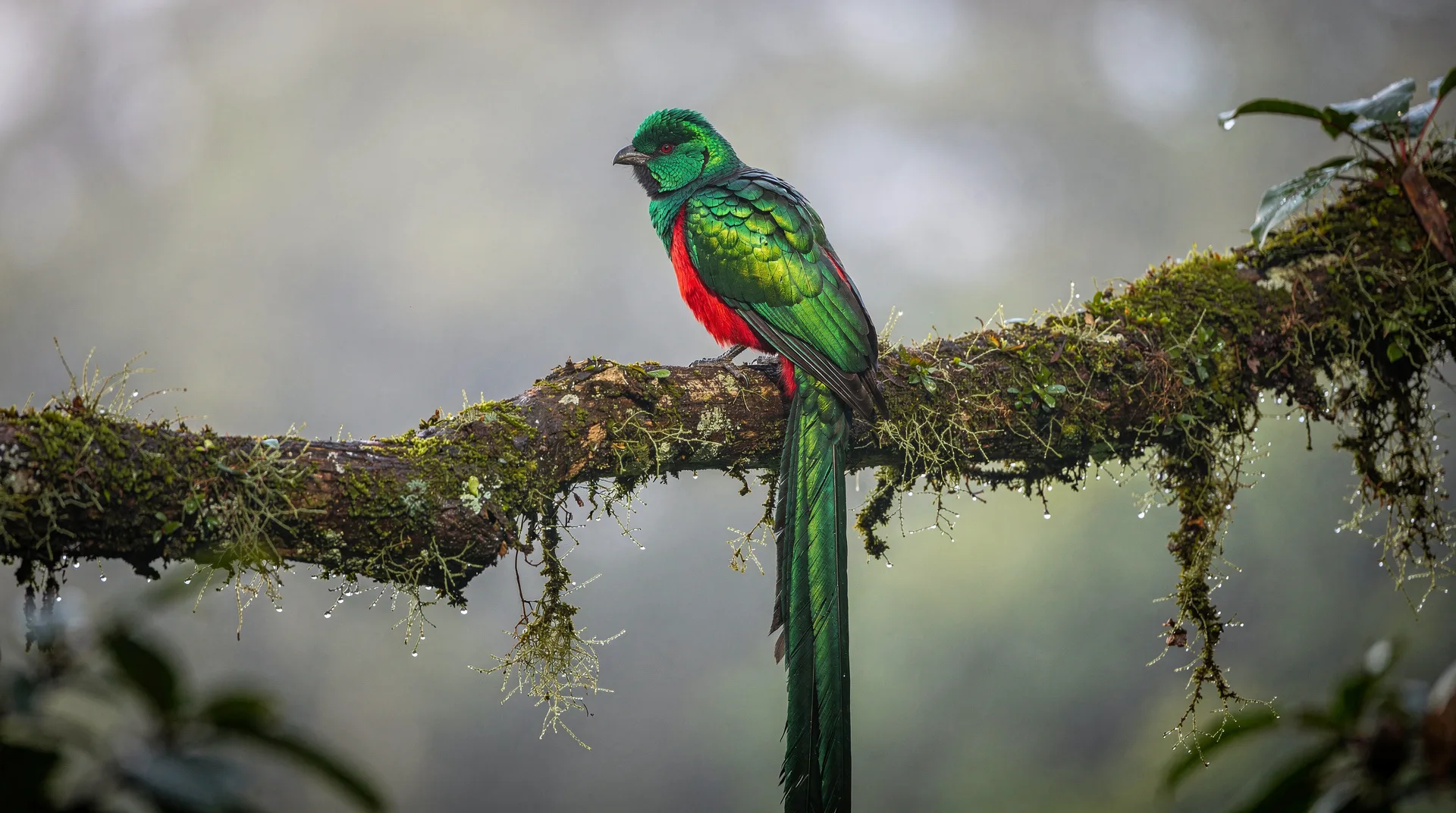
The quetzal I finally saw
Three days, one bird, and a grudging respect for patience
The first morning I arrived at San Gerardo de Dota, I climbed out of the car at 5:30am into air that was cold enough to see my breath, walked fifty meters to the edge of the road, and heard a quetzal calling in the darkness somewhere above me. I could not see it. The sound — a deep, rolling call, surprisingly resonant for a bird that size — drifted from somewhere in the canopy of a aguacatillo tree and then stopped. I stood there for twenty minutes. Nothing.
That was day one.
| Where | San Gerardo de Dota, Talamanca mountains, ~2hrs south of San José |
| Best months | March–June (breeding plumage, fruiting aguacatillo trees) |
| Stay | 2-3 nights minimum for realistic odds |
| Cost | ~$100-120/night at Trogon Lodge, incl. breakfast & dinner |
| Bring | Fleece, waterproof layer — nights drop to 8-10°C |
San Gerardo de Dota is a narrow valley cut into the Talamanca mountains on the road between San José and San Isidro de El General, about two hours south of the capital. The drive down from the Inter-American Highway drops nearly 1,200 meters in a series of switchbacks so steep that the local lodge operators describe the road — with some affection — as “character-building.” The valley floor sits at around 2,200 meters. At that altitude, even in April, the mornings are cold enough that you need a fleece and your breath clouds in the early light. It is about as far from beach Costa Rica as you can get while still being in Costa Rica.
Why this valley, and why April
The Resplendent Quetzal — Pharomachrus mocinno, to use the name it deserves — is Costa Rica’s most sought-after bird. The male in breeding plumage has tail feathers that can exceed 60 centimeters, emerald and crimson coloring that seems physically impossible in nature, and a reputation among birders that rivals any animal on earth. It appears on the Guatemalan currency. The ancient Aztecs used its feathers as a form of money. Killing one was punishable by death in several pre-Columbian civilizations.
In the Talamanca mountains of Costa Rica, quetzals reach peak abundance from March through June, when the aguacatillo trees — a type of wild avocado that forms the core of the bird’s diet — are fruiting. Males in breeding plumage are present and often visible as they fly from tree to tree. San Gerardo de Dota is the most accessible place in the country to find them, and arguably the most reliable outside of Monteverde, which sees more visitors and more disturbance.
I had been to Monteverde twice, heard quetzals twice, seen them precisely zero times. For the fuller picture of where quetzals and other high-value species show up across the country by region, our bird-watching by region guide is worth reading before you pick a valley.
The cloud forest guided tours in Monteverde are excellent for many reasons — the forest itself is extraordinary, and your chances of seeing dozens of other species are very high. But the quetzal, when present at Monteverde, is often deep in the reserve, visible for a few seconds before vanishing. San Gerardo de Dota offers something different: fruiting aguacatillo trees right along the valley road, where birds feed openly in the early morning, sometimes low enough to see the iridescent sheen of those tail feathers without binoculars.
Monteverde and Santa Elena: cloud forest bird-watching tour — from $65If Monteverde is where your route already runs, a guided morning there is a sensible way to build up your eye before the southern detour, and a guided bird-watching outing in the cloud forest — from $65 gives you a naturalist who can teach you what to listen for. Our comparison of Monteverde and the Santa Elena reserve and the Monteverde destination page help you choose where to start, and the cloud forest versus rainforest guide explains why the two habitats feel so different on foot.
The lodge at the bottom of the valley
I stayed at Trogon Lodge, which sits at the base of the valley and has been the standard recommendation for serious birders for many years. It is not fancy by international standards — wooden cabins, basic but comfortable beds, hot water that takes a minute to arrive, meals served in a communal dining room where you share tables with other birders comparing notes. The price runs around $100-120 per night including breakfast and dinner, which felt reasonable until I got the three-night bill and did the math.
Worth every colón.
The lodge has a list of over 180 bird species recorded on the property. The dining room windows look directly into the canopy of several fruiting trees, and the staff — led by their resident naturalist, a man in his sixties who has been guiding here for thirty years — know the current feeding trees, the best morning light positions, and, on any given day, where the quetzals were last seen. This intelligence network is informal but precise. Two birders from Canada had spotted a nesting pair in a tree 200 meters up the valley the previous evening. That information was on the whiteboard at breakfast on day two.
Day two: the aguacatillo tree
On the second morning I was at the marked aguacatillo tree before dawn, which meant standing on a muddy road shoulder in the dark with a headlamp and damp boots. Two other people were already there — a German couple with better binoculars than mine and a patience I found slightly intimidating.
The light came up slowly. Tanagers and hummingbirds arrived first — the diversity of species that use these fruiting trees is genuinely astonishing even before the main event. Emerald tanagers, spangle-cheeked tanagers, black-and-yellow silky-flycatchers. I was cataloging these in my notebook when the German woman said, quietly and without moving: “There.”
A female quetzal landed in the tree canopy about fifteen meters above us. Green and white, without the male’s tail streamers, but unmistakably a quetzal — the size and posture and that distinctive rounded head. She stayed for perhaps three minutes, picking at the aguacatillo fruit, before dropping off the branch and disappearing into the forest below.
We waited another two hours. No male appeared.
Day three: what patience actually means
By the third morning I had recalibrated my expectations. The female sighting had been extraordinary; I was being greedy hoping for the male. I had walked the valley road, eaten excellent casado lunches at a small soda run by a Tico family who had lived in the valley for three generations, drunk more hot chocolate than was probably advisable, and read half a book in the evenings when the cloud mist came in thick and cold.
At 6:20am on the third morning, with no warning and no preamble, a male quetzal landed in the fruiting tree I had been watching since before dawn.
I will not overclaim the experience. It was a bird. I have seen elephants in Botswana, whales in the Azores, and a snow leopard once at impossible distance in Nepal. I was not expecting the quetzal to compete with those moments.
It competed.
The tail streamers were visible immediately — two long green feathers extending past the branch it perched on, catching the early light with a metallic shimmer that photographs fail to reproduce. The crimson chest was exactly the red that color photographs oversaturate and reality somehow makes more saturated still. It ate steadily for eleven minutes, turning its head in the deliberate way of birds that know they are being observed and have decided not to care.
When it flew, it undulated — the tail streamers making the flight path look like something from a dream sequence.
The German woman, who had driven from Frankfurt specifically to see this bird and had been in the valley for five days, said nothing. She lowered her binoculars and stood very still. That said everything about what we had just watched.
Practical notes for the quetzal trip
If you want to replicate this, several things matter. April through June are the best months — the fruiting is reliable and the males are in breeding plumage. San Gerardo de Dota is more reliable than Monteverde for close sightings because the fruiting trees are along the accessible road. Hire a local guide — Trogon Lodge and Dantica Lodge both have excellent naturalists who know the current feeding trees and will get you to the right place at the right time.
The cold is real. Pack a fleece and a waterproof layer. The valley can drop to 8-10°C at night in April. Rain gear is essential.
Expect to spend at least two nights. One night gives you one morning and the odds are against you. Two or three nights dramatically improves them.
Fitting the valley into a wider trip
The valley works best as a deliberate stop rather than a squeeze between two long drives. If you are renting a car, read driving in Costa Rica and the road conditions by region before you commit to the switchbacks; if you would rather not drive, the shuttle services overview covers the alternatives. The timing of your visit matters too: our April weather guide and the dry season pros and cons explain what the mountain mornings are likely to feel like.
Good birding is also about manners. The wildlife watching ethics guide sets out how close is too close, and the wildlife photography tips are worth a read if you plan to bring a long lens. For a slower, more reflective read on how travel choices shape a trip, see how the Osa Peninsula changed our trip planning.
The other birds worth the trip on their own
Even without a quetzal, San Gerardo de Dota’s fruiting trees produce a birding morning that stands on its own merits. Emerald tanagers, spangle-cheeked tanagers, and black-and-yellow silky-flycatchers passed through the same tree in the twenty minutes before the female quetzal appeared on day two.
The valley also holds the Fiery-throated Hummingbird — a high-altitude specialist rarely seen outside the Talamanca range — and the Flame-throated Warbler, another highland endemic. If you are combining a Talamanca detour with lowland or coastal birding elsewhere in the country, the contrast is part of the appeal: nowhere else in Costa Rica do you move from cloud-forest highland specialists to lowland rainforest and Caribbean species within a few hours’ drive.
What we’d say to someone reading this in 2026
San Gerardo de Dota has become better known since 2019 — Trogon Lodge is booked solid in April and May most years, and you need to reserve three to four months ahead. The fruiting trees and quetzal populations appear stable, but guide quality matters more now than it did five years ago because the road sees more casual visitors who disturb feeding birds.
For the full context on when and where to see quetzals across Costa Rica, including Monteverde options for visitors who cannot make the southern detour, read our quetzal watching guide. For the destination page on the valley itself, see San Gerardo de Dota, and for building a broader birding trip around it, our bird-watching itineraries guide has multi-day routes that combine it with other high-value sites.
The $200 lodge bill over three nights was the best money we spent in Costa Rica that year. And that is saying something in a country that charges $110 for a Rincón de la Vieja day pass — a detail I first noted properly in our first trip to Costa Rica.