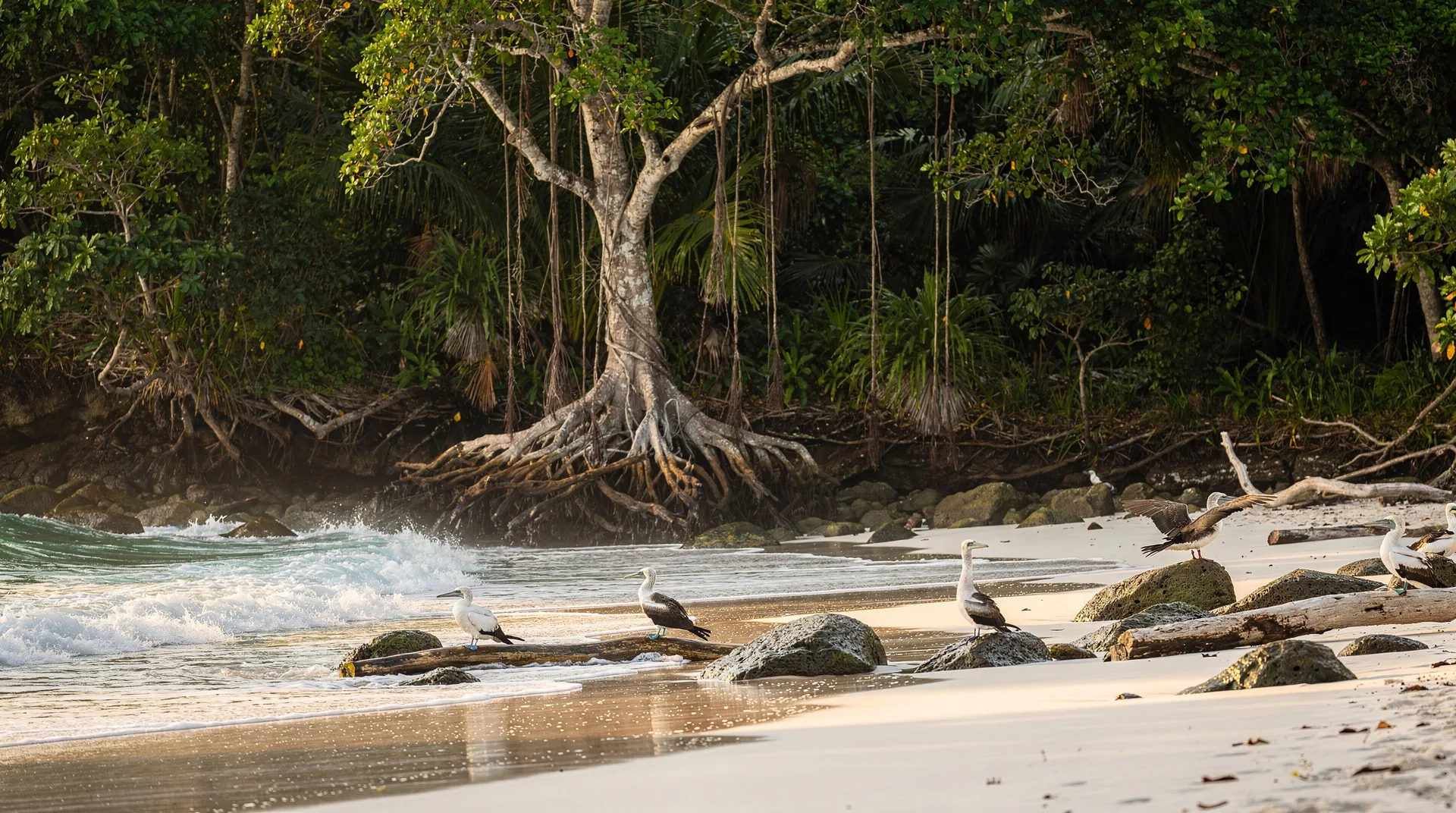
Cabo Blanco and Mal País: the end of the Nicoya Peninsula
Cabo Blanco Absolute Nature Reserve — Costa Rica's first protected area — and the wild Mal País surf coast. Remote, raw, and worth every kilometre.
Top experiences nearby
Quick facts
- Best time to visit
- December – April (reserve open; dry season for beaches)
- Days needed
- 1-2 days
- Getting there
- 40 min south of Santa Teresa on unpaved road; ferry from Puntarenas to Paquera + 1 hr drive
- Budget per day
- $70-130 per person for accommodation; Cabo Blanco entry $12
Where Costa Rica’s conservation story began
In 1963, a Swedish couple — Olof Wessberg and Karen Mogensen — convinced the Costa Rican government to set aside 1,172 hectares at the southern tip of the Nicoya Peninsula as an Absolute Nature Reserve. It was a radical act for its time; deforestation was proceeding rapidly across Costa Rica and the concept of protected wilderness was barely established in Central American law. That original reserve became the Reserva Natural Absoluta Cabo Blanco — Costa Rica’s first protected area and the conceptual anchor for the national park system that would eventually protect 28% of the country’s territory.
Cabo Blanco and Mal País — the ragged coastal zone at the very end of the Nicoya Peninsula — remain among the least-visited corners of Costa Rica’s Pacific coast, and among the most rewarding for travellers willing to navigate the unpaved roads and ferry crossings that keep casual visitors away.
| Where | Southern tip of the Nicoya Peninsula, 40 min south of Santa Teresa |
| Cost | Reserve entry around $12; accommodation $30-150/night |
| Getting there | Ferry Puntarenas–Paquera + drive, or Sansa flight to Tambor |
| Reserve hours | Wed–Sun, 8am–4pm (closed Mon–Tue) |
| Best time | December to April |
The nature reserve
The Cabo Blanco Absolute Nature Reserve covers 1,172 hectares of land and 1,790 hectares of marine area at the tip of the Nicoya Peninsula. The “absolute” designation — unusual in Costa Rica’s park system — originally meant zero human access, no trails, no visitors. This has been relaxed; day visitors are now admitted, but the reserve remains among the least-developed park environments in the country.
The primary forest within the reserve is some of the most intact on the Nicoya Peninsula — old-growth trees reaching 30-40 metres, dense canopy blocking out direct sunlight, fig trees with cathedral-like buttress roots. White-faced capuchin monkeys, howler monkeys, and coatis are common along the two main trails. Brown pelicans, magnificent frigatebirds, and blue-footed boobies nest on Cabo Blanco island (visible offshore; landing is not permitted).
Two trails connect the park entrance (inland from Montezuma) to the coast:
Sueco Trail — 4 km one-way through primary forest to Playa Cabo Blanco, a long white-sand beach backed by cliffs at the peninsula’s tip. Round trip: 8 km, 3-4 hours. The descent to the beach involves steep sections; hiking boots with ankle support are strongly recommended.
Danés Trail — a shorter, less maintained loop offering good wildlife habitat and birdwatching without reaching the coast.
The reserve is open Wednesday through Sunday (closed Monday and Tuesday) from 8am to 4pm. Entry costs $12 per person. No food or water is sold inside; bring your own.
Mal País: the surf village at the edge
Mal País (the name translates loosely as “bad lands” or “difficult terrain”) sits 3 kilometres north of the Cabo Blanco entrance and has evolved from a fishing village into a low-key surf and yoga community that shares DNA with Santa Teresa to the north but lacks its polish and price tag.
The beach breaks through Mal País and El Carmen are excellent for intermediate surfers — less crowded than Santa Teresa’s main peak, with multiple sections offering different wave characteristics depending on the swell direction. Surf rental shops and a small number of surf schools operate from the beachfront, with board rentals at $20-25/day.
The area between Mal País and Playa Carmen is sometimes marketed as a single destination with Santa Teresa; in practice they are three distinct villages with different atmospheres. Santa Teresa (northernmost) is the most developed and expensive; Mal País (southernmost) is quieter and more authentically local.
Beginners are better served by the gentler beach breaks listed in our beginner surf spots guide than by the more exposed sections here. If you are still learning, a lesson with an instructor such as a beginner-friendly surf lesson in Jacó — from $50 is an easy stop on the way back toward the mainland. Swell direction and tides change what the beaches do from one day to the next, so read tide and surf conditions and the surf seasons by region before you plan a session. For a wider view of the scene on this coast, the Santa Teresa surf guide and the best surf beaches overview give useful context, and surf camps in Costa Rica covers longer stays with coaching included.
Snorkelling off the peninsula tip
The marine reserve surrounding Cabo Blanco protects a relatively healthy Pacific reef system — uncommon on Costa Rica’s Pacific coast, where most reef-snorkelling quality is inferior to the Caribbean. Offshore from Playa Cabo Blanco, the rocky outcrops attract puffer fish, parrotfish, sergeant majors, and occasional Pacific hawksbill sea turtles.
Boat-based snorkel trips from Santa Teresa are the most practical way to access the best snorkelling areas, combining the Cabo Blanco marine reserve with Tortuga Island further north. Santa Teresa: Tortuga Island full-day boat tour with snorkel — from $155 runs full-day Tortuga Island boat tours from Santa Teresa with snorkelling, beach time, and lunch — the most popular organised tour from this area.
Independent snorkelling from shore at Playa Cabo Blanco itself is possible after the hike in — bring gear as nothing is available at the reserve.
If snorkelling is a main reason for your trip, compare this stretch with the options in the best snorkel beaches guide and the snorkel versus dive comparison. Visibility on the Pacific side varies with conditions, so treat it as a bonus rather than the reason to travel. Whatever you see in the water or on the trail, follow the principles in our wildlife watching ethics guide: keep your distance, never feed animals, and leave nothing behind.
What to expect on the trail
The walk to the coast is as much about atmosphere as destination. Under the canopy the light is dim and the air is humid, and the forest is noisy at first light, when the monkeys and birds are most active. Move slowly and quietly, and you give yourself a far better chance of spotting wildlife than a group walking fast and talking loudly. The monkey species guide helps you tell the troops apart, and bird watching by region lists what to listen for if you carry binoculars.
Pack light but sensibly: water, sun protection, insect repellent, and shoes you trust on wet, uneven ground. Our packing list covers the essentials, and the beach safety guide is worth reading before you swim anywhere on this coast, since currents can be strong on open Pacific beaches. A good travel policy is also sensible for a remote area like this; see travel insurance for Costa Rica.
Choosing the season
The dry months make everything easier: trails are firmer, the road is more forgiving, and the beaches are at their best. The green months bring lush forest, fewer visitors, and lower prices, but also muddier trails and a rougher road. Weigh the trade-offs in the dry season pros and cons and green season pros and cons guides, or start with the best time to visit Costa Rica if you are still fixing your dates. If you value solitude over sunshine, a trip outside the busiest weeks can feel like having the peninsula to yourself.
Yoga and the slower side of the peninsula
Mal País and Playa Carmen share the wellness culture that has made Santa Teresa a destination in its own right, just with fewer studios and lower prices. Several small guesthouses run drop-in yoga classes timed around sunrise and sunset, and the walkable stretch of coast between the two villages means a morning class, an afternoon surf, and an evening at Cabo Blanco’s edge of the reserve are all within reach without a car. Travelers building a longer wellness stop should compare this area with the more developed studio scene up in Santa Teresa itself — see the Santa Teresa wellness guide for the fuller picture.
Getting here: the logistics explained
Reaching Cabo Blanco and Mal País from the Costa Rican mainland requires a ferry crossing of the Gulf of Nicoya. The main route:
-
Ferry from Puntarenas to Paquera — operated by Naviera Tambor, 1 hour 20 minutes, runs roughly every 2-3 hours from 5am onwards. Passenger fare: around $2.50; car ferry: $16 each way. Arrive at the Puntarenas terminal 30-45 minutes before departure, especially on weekends and holidays.
-
Drive from Paquera to Santa Teresa/Mal País — approximately 55 km on paved road as far as Cóbano, then 7 km of unpaved coastal road. In the dry season, a standard car handles the final section. In the rainy season, the road can have significant potholes; 4WD is strongly recommended.
Total time from San José: approximately 4-5 hours, including the ferry wait and crossing. A Sansa domestic flight to Tambor airport (25 minutes from SJO) + taxi (40 minutes) is the faster alternative for those without a car.
From Santa Teresa, the drive to Cabo Blanco is 40 minutes south on the unpaved road via Mal País.
For more on the crossing itself, see the ferry routes guide. If you would rather fly, the domestic flights guide explains the Sansa and Aerobell options, and shuttle services covers road transfers. Deciding whether to drive yourself is easier with rent a car or not, driving in Costa Rica, and road conditions by region, all of which matter on the final unpaved stretch.
Accommodation
Accommodation at Mal País is limited to small boutique hotels and surf camps; there are no large resorts. Options range from dorm beds in surf camps ($20-30/night) to comfortable rooms in small hotels ($80-150/night). The most atmospheric options are on the beachfront at Playa Carmen:
Casa Zen — a yoga and surf-focused guesthouse with a restaurant and pool; good community atmosphere for solo travellers.
Frank’s Place — the longest-established budget option in Mal País, with basic but comfortable rooms and a lively, social restaurant.
Tierra Viva Hotel — one step up in comfort, with sea-view terraces and a quiet adult-oriented atmosphere.
For a more polished experience, stay in Santa Teresa (3 km north) and day-trip to Cabo Blanco. See the Santa Teresa destination guide for full hotel recommendations.
Frequently asked questions about Cabo Blanco and Mal País
Is the hike to Cabo Blanco beach difficult?
Moderate. The Sueco Trail covers 4 km each way with some steep descents and a river crossing (knee-deep in dry season, potentially waist-deep in wet season). Total elevation change is around 200 metres. Average round-trip time for fit walkers: 3-4 hours. Start by 8am to maximise your time on the beach before the midday heat.
Is Cabo Blanco reserve open every day?
No — the reserve is closed on Mondays and Tuesdays. Plan your visit for Wednesday through Sunday. Arrive at the entrance by 9am at the latest if you want to complete the Sueco Trail and have beach time before the 4pm closing.
How does Mal País compare to Santa Teresa for surfing?
Mal País is less crowded, slightly less consistent (the wave quality is good but slightly less predictable), and considerably cheaper across accommodation, food, and rentals. Santa Teresa has better wave variety, more facilities, and a more established surf school presence. Experienced surfers who dislike crowds tend to prefer Mal País; those new to surf or travelling with non-surfers often prefer Santa Teresa’s infrastructure.
Can I reach Cabo Blanco without a car?
Yes. Local shared taxis (colectivos) run between Montezuma, Cóbano, and Mal País daily. From Santa Teresa, it is possible to hire a local driver for the day (around $60-80 round trip) to drop you at the Cabo Blanco entrance, wait, and return. The unpaved road can also be covered by rented ATV or motorcycle from Santa Teresa, though the route requires attention in wet conditions.
Should I stay in Mal País or in Santa Teresa?
Stay in Mal País if quiet, low-key, and close to Cabo Blanco matters more than restaurant and nightlife variety — it’s cheaper and less crowded. Stay in Santa Teresa if you want more dining options, a bigger surf-school scene, and easier logistics for boat trips like the Tortuga Island snorkel run. Many travelers split their time: a few nights in Santa Teresa for facilities, one or two in Mal País for the calmer pace and the Cabo Blanco hike.
Where to go next
From Cabo Blanco and Mal País, the natural direction is north toward Santa Teresa and Montezuma (both within 40 minutes on the coastal road), or back across the ferry toward Jacó and the Central Pacific coast. For those interested in more of Costa Rica’s conservation history, the national parks guide provides context on the protected areas network that Cabo Blanco helped inspire.
If the peninsula has you hooked, the Nicoya Peninsula beaches guide and the list of hidden beaches suggest where to go next. Surfers can fold this stop into the 10 days surf trip on the Pacific, and anyone leaning toward a slower, wellness-focused trip will find the 7 days yoga and wellness itinerary a natural match. To compare this coast with the north, read Guanacaste versus the south Pacific.