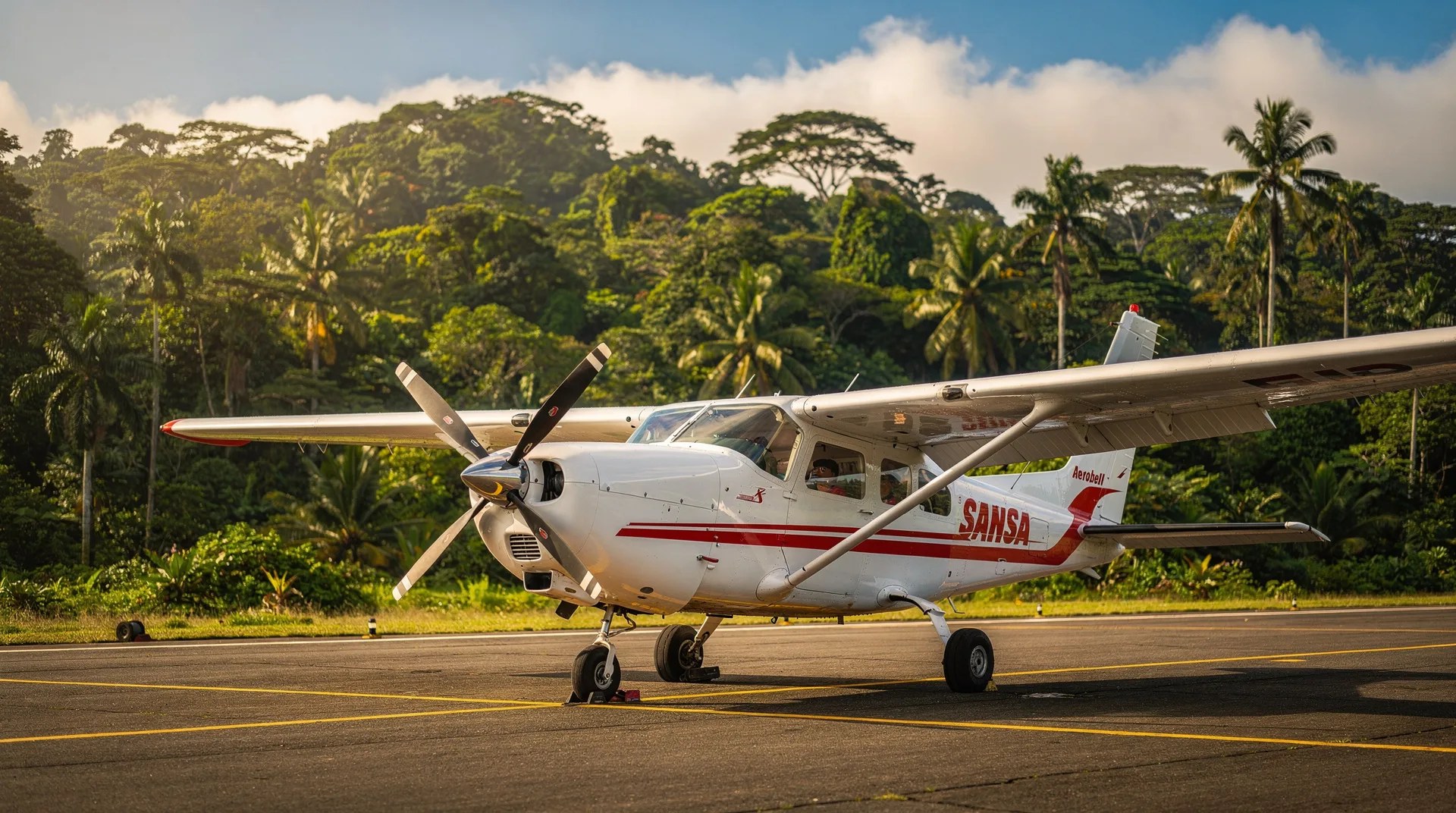
Internal flights in Costa Rica: Sansa and Aerobell explained
When does flying internally make sense in Costa Rica?
For Drake Bay, Tortuguero, Tambor, and Quepos — saves 4-6 hours of road or boat. Sansa & Aerobell are the two regional carriers.
Why a 45-minute flight beats a 6-hour drive
Costa Rica is small on a map but enormous on a clock. The Osa Peninsula, Tortuguero, and the southern Pacific coast are places where roads either do not exist, are punishing four-wheel-drive tracks, or require a ferry plus a boat connection. For travellers with limited time or those who simply want to arrive fresh, the domestic flight network operated by Sansa and Aerobell is one of the most practical tools available.
Both carriers use small propeller aircraft — primarily Cessna Caravans — and both fly out of the San José area on short hops ranging from 25 minutes (Quepos) to about 50 minutes (Drake Bay or Tortuguero). The planes carry between 9 and 14 passengers, luggage is strictly limited, and punctuality depends heavily on weather. Understanding how these two operators differ, what their flights actually cost, and which routes make financial sense will save you both time and surprises.
| Carriers | Sansa (from SJO) and Aerobell (from Tobías Bolaños/Pavas) |
| Cost | around $90-180 per leg one-way |
| Flight time | 25-50 minutes depending on route |
| Baggage | around 35-40 lbs (16-18 kg) strictly enforced |
| Book by | 6-8 weeks ahead in high season for best fares |
The two carriers: how Sansa and Aerobell differ
Sansa Airlines
Sansa is the larger of the two domestic carriers and has been operating since the 1980s. It flies exclusively out of Juan Santamaría International Airport (SJO) — the main international gateway — which means you can connect directly from your arriving international flight without changing airports. Sansa operates scheduled, fixed-departure flights on a published timetable. Routes include Quepos/Manuel Antonio (XQP), Drake Bay (DRK), Palmar Sur (PMZ), Nosara (NOB), Tamarindo (TNO), Liberia (LIR), Tortuguero (TTQ), and Tambor (TMU), among others.
Fares on Sansa range from roughly $90 to $180 per leg for a one-way ticket, depending on the route and how far in advance you book. Quepos and Tambor tend to sit at the lower end; Drake Bay and Tortuguero run higher. Sansa now uses a dynamic pricing model, so booking early — ideally six to eight weeks out in high season — delivers the best rates. The baggage allowance is 35 lbs (approximately 16 kg) per person including carry-on, and the airline enforces this strictly because weight distribution on Cessna Caravans directly affects flight safety.
Aerobell Airlines
Aerobell operates out of Tobías Bolaños International Airport (TOB) in Pavas, a suburb roughly 15 minutes west of downtown San José. This is a separate airport from SJO, so if you are connecting from an international flight you will need to take a taxi or rideshare to reach it — budget about $15–20 and 20–30 minutes from SJO depending on traffic. Aerobell’s main advantage is that it runs charter and on-demand flights in addition to scheduled services, giving you more flexibility on timing if you are willing to pay for a private charter.
Aerobell’s scheduled fares are broadly comparable to Sansa’s, from approximately $95 to $175 per leg one-way. The baggage limit is 40 lbs (about 18 kg), slightly more generous than Sansa. Key Aerobell destinations include Drake Bay, Palmar Sur, Quepos, Nosara, Tambor, and Tortuguero. Aerobell also offers charter flights to airstrips not on the scheduled network, which is useful for reaching remote lodges in the Osa Peninsula or southern zone.
Routes where flying is genuinely worth it
Not every destination justifies the cost of a domestic flight. Here is a realistic breakdown by route.
Drake Bay is the clearest case for flying. The overland alternative involves driving to Sierpe (4–5 hours from San José), then taking a river and ocean boat to the lodge, adding another 1.5 hours. Flying cuts total travel time to under one hour from San José. For families or anyone with heavy luggage, the driving alternative is punishing on rough roads near Rincón. Both Sansa and Aerobell serve Drake Bay directly.
Tortuguero has no road access at all. You either fly or take a bus-and-boat combination that takes most of a day. A direct 45-minute flight from San José is almost always the better choice for anyone staying two nights or more at a Tortuguero lodge. See the Tortuguero destination guide for what to expect on arrival.
Quepos and Manuel Antonio are reachable by bus in about 3.5 hours or by shuttle in 3 hours, making the 25-minute flight harder to justify unless time is extremely tight. That said, during rainy season when the coastal highway slows considerably, flying earns its price. The Manuel Antonio destination page covers ground transfer options as well.
Tambor (Nicoya Peninsula) eliminates the ferry crossing from Puntarenas, which adds uncertainty and queues, especially in peak season. A 20-minute flight into Tambor Airport saves most of a half-day of travel. Naviera Tambor operates the ferry alternative if you want to bring a vehicle.
Nosara and Tamarindo are longer drives (4–5 hours) but have good road connections via the Interamerican Highway and Route 21. Flying is convenient but not essential unless you are routing through Liberia from an international connection. Liberia’s Daniel Oduber Airport (LIR) is worth noting because several international carriers fly there directly, potentially making it a better hub than San José for Guanacaste destinations.
What to plan once you land
A domestic flight only solves the journey; the days after it still need planning. In Tortuguero, the canals, the village, and the beach are the main draw, and booking a guided outing such as a guided tour of the canals and park — from $95 before you arrive keeps your first morning simple. The Tortuguero National Park guide explains how the park is organised, and the turtle nesting guide helps you judge whether your dates suit a night walk.
If you decide that flying to the central Pacific is not worth it and go by road instead, a shared shuttle between San José and Quepos — from $60 is the simplest ground alternative, and it leaves you free to spend the saved fare on activities. Once in Quepos, the Manuel Antonio National Park guide and the Quepos destination page cover what to do with your first day.
Southern routes pair well with other parts of the country. The Drake Bay destination page describes the lodge-based stay that most flyers have in mind, and the Osa Peninsula-focused itinerary shows how a flight can free up days for the south. For a shorter Caribbean trip, the 7 days quick Caribbean itinerary uses the same time-saving logic. Before booking any of it, check the travel insurance guide and the packing list, since small planes make both more relevant.
Baggage limits: what you can and cannot bring
The 35–40 lb limit is the most common source of stress for first-time passengers on these small aircraft. Here is how to handle it practically.
Pack a single mid-size soft-sided bag rather than a rigid suitcase, as Cessna Caravans have narrow cargo holds. If you are travelling with camera gear, dive equipment, or surf boards, contact the airline directly before booking — oversized or overweight items require prior approval and may incur an extra fee or be refused. Sansa charges approximately $1–2 per additional pound. Aerobell’s charter option is worth pricing out if you have a group of four or more with equipment, since the per-seat cost narrows considerably.
For the rest of your Costa Rica trip where you are travelling by shuttle or rental car, consider leaving non-essential luggage in San José or at a storage facility near your hotel. The driving in Costa Rica guide has tips on trunk safety and luggage management when renting.
Booking, check-in, and airport logistics
Both Sansa and Aerobell allow online booking through their respective websites. Payment by credit card is accepted. Sansa’s online booking system is more polished; Aerobell’s site can be slow — if you encounter errors, calling their reservations line directly often resolves the issue faster.
Arrive at the airport at least 60 minutes before departure. For SJO domestic departures with Sansa, the check-in desk is located in a separate domestic terminal section to the left of the main international building. For Aerobell at TOB, the Pavas terminal is small and easy to navigate but can feel chaotic during peak morning departures.
Flights are frequently rescheduled or delayed during the rainy season (May–November) due to afternoon cloud cover and crosswinds at mountain airstrips. Morning departures before 11 a.m. have the best on-time performance. If your connection with an outgoing international flight is tight, always buffer at least one full day between your last domestic flight and your international departure.
Sansa and Aerobell timetables are easiest to fit around an overseas ticket that is already fixed, so choose that flight first and build the domestic hops around its arrival or departure at SJO. Read the fare’s change and rebooking rules before paying, because a ticket you cannot alter makes any domestic reshuffle more costly. For the long-haul leg, you can compare fares on Aviasales for your travel dates.
Charter flights: when a private plane actually pencils out
Both Sansa and Aerobell offer charter services beyond their scheduled routes, and it is worth pricing these out for groups. A charter Cessna typically seats 4-5 passengers with luggage, and for a group of four flying to a remote Osa Peninsula airstrip not on the scheduled network, the per-seat charter cost can land close to — or occasionally below — four scheduled tickets, especially to lodges that arrange their own airstrip transfers. Aerobell’s charter desk is generally the more flexible of the two for custom routing; contact them directly rather than trying to book online. For lodges deep in the Corcovado National Park area, a charter into Sirena or Carate can eliminate hours of unpaved road entirely.
Weighing the flight against the alternatives
The decision usually comes down to three factors: time, cost, and comfort with Costa Rica’s rougher roads. For a couple travelling to Tortuguero, the price gap between two shuttle seats and two flight seats is often $60-120 total — a modest premium for saving most of a travel day and avoiding the bus-to-boat transfer entirely.
For a family of four, the gap widens considerably, and a rental car plus shuttle combination becomes more competitive on routes with decent road access. The clearest cases for flying remain Drake Bay and Tortuguero, where the overland alternative genuinely eats most of a day; the weakest case is Quepos, where the coastal highway is fast enough that flying saves little beyond avoiding traffic.
Frequently asked questions about internal flights in Costa Rica
Are small planes in Costa Rica safe?
Sansa and Aerobell operate under DGAC (Costa Rica’s civil aviation authority) regulations and use well-maintained Cessna Caravans, one of the most proven short-haul aircraft types in the world. Weather-related cancellations happen and are handled conservatively — pilots do not fly when conditions are borderline. The safety record of both carriers over the past decade is good by regional standards.
Can I bring a car seat or stroller?
Car seats can travel as checked baggage within the weight limit. Strollers are generally refused due to size constraints on Cessna cargo holds. Check with your airline at booking time.
What happens if my flight is cancelled?
Both airlines will rebook you on the next available departure or offer a refund. Given how small the fleets are, a cancellation can mean a delay of 24 hours or more in peak season. Travel insurance that covers domestic flight disruptions is recommended, especially for Osa Peninsula or Tortuguero itineraries where the alternative transport is slow.
Is it cheaper to fly or take a shuttle?
Shuttles typically cost $50–65 per person per leg to most destinations. Domestic flights run $90–180. For two people, the price gap is $80–$230 per leg. The shuttle is cheaper; the flight saves 3–5 hours. Whether that trade-off is worth it depends on your schedule and your comfort with winding mountain roads. See the shuttle services overview for a full comparison.
Do I need to reconfirm my domestic flight?
Sansa recommends checking your booking 48 hours before departure via email or their app. Aerobell appreciates a reconfirmation call for charters. For scheduled flights, the electronic ticket is sufficient, but checking departure times 24 hours out is always wise.
Is it worth flying to Manuel Antonio/Quepos specifically?
Rarely. The Costanera Sur highway to Quepos is fast and reliable, making the ground transfer only about 30-45 minutes longer than flying once airport transfer time is factored in. The exception is peak rainy-season afternoons when the coastal highway slows considerably — otherwise, save the money and take a shuttle. See the Manuel Antonio destination guide for ground options.
Related guides
For travellers deciding between renting a car, taking a shuttle, or flying, the rent a car or not guide lays out the full cost and flexibility comparison for Costa Rica. If you are arriving by air and need to plan your first transfer out of San José, the airport to destination transfers guide covers your options in detail, including shared shuttles and private transfers. The driving in Costa Rica guide is essential reading if you plan to combine a rental car with one or two domestic flights for efficiency.