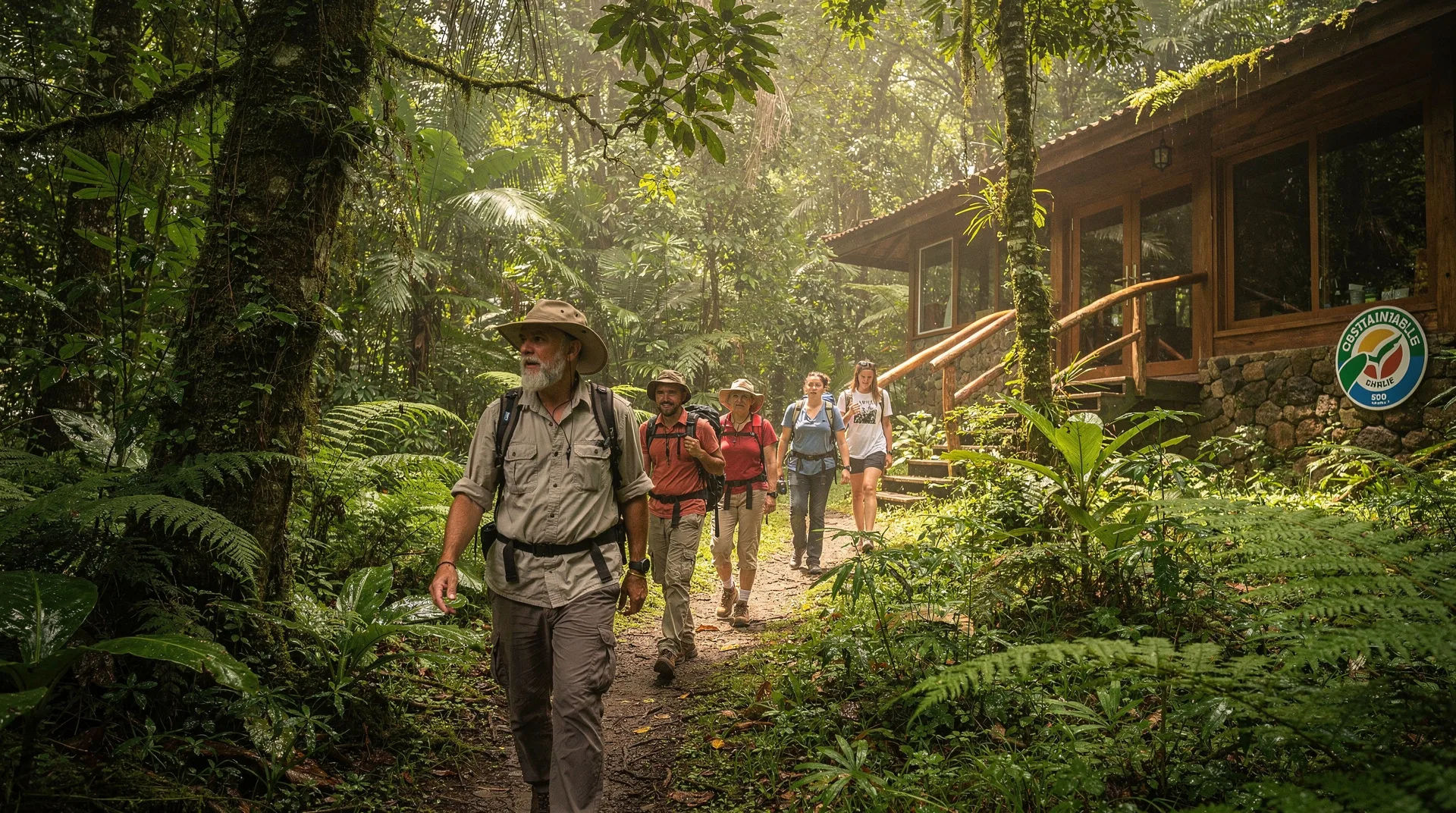
Eco-tourism in Costa Rica post-2020: who survived and who didn't
Eighteen months of closed borders changed the landscape
When Costa Rica shut its borders in March 2020, the country’s tourism sector — responsible for roughly 8.2% of GDP and over 200,000 direct jobs — went into freefall. The first question in early 2021, as borders cautiously reopened, was not which destinations recovered fastest. It was which operators survived.
The answer, somewhat surprisingly, tracked closely with one variable: CST certification.
| What to check | CST leaf rating (0–5) at turismo-sostenible.co.cr |
| Good sign | 4–5 leaves, independently audited |
| Red flag | ”Eco” marketing with no visible CST listing |
| Hardest-hit region | Osa Peninsula (Drake Bay, Puerto Jiménez) |
| Cost impact | Certified operators are rarely the cheapest — expect a fair premium |
The Certificación para la Sostenibilidad Turística (CST) is Costa Rica’s national sustainability rating system, administered by the Instituto Costarricense de Turismo (ICT). It scores hotels, tour operators, and transport companies across four categories — physical-biological parameters, infrastructure, external clients, and socioeconomic environment — and awards a leaf rating from one to five. A five-leaf operation is, in theory, as close to genuinely sustainable tourism as Costa Rica defines it.
What the pandemic revealed is that CST certification is a surprisingly good proxy for business resilience.
Why certified operators fared better
The correlation between CST status and survival is not accidental. It reflects structural differences in how these businesses operate.
First, CST-certified operators tend to have deeper relationships with local communities. When tourist revenue dropped to near zero, businesses embedded in their surrounding villages could pivot — working with local cooperatives, pivoting toward domestic Costa Rican travelers (who proved a critical lifeline), or simply being supported by communities that had seen economic benefit from the operator’s existence.
Second, the environmental practices that earn CST points often translate into lower operating costs. Solar panels, rainwater collection, reduced waste streams — these aren’t just good marketing, they’re genuine cost reductions that gave certified lodges more runway during 18 months of near-zero income.
Third, and most practically: CST certification is increasingly required for international tour operator partnerships. The German and Dutch eco-tour markets — significant sources of high-spend travelers — have tightened their vetting. If your operation isn’t certified, you’re invisible to TUI’s sustainability portfolio or SNP Natuurreizen clients. Certification meant maintaining those international relationships through the shutdown.
The casualties: who didn’t make it
The hardest-hit segment was mid-tier operators who had built their business on volume: day-trip vans leaving Jacó for Manuel Antonio, bulk-booking souvenir shops at Monteverde’s entrance, cheaper zipline operators in La Fortuna competing on price rather than experience quality.
Without CST certification, these operators had no cushion. Many — particularly in Guanacaste’s hotel strip near Playa del Coco and the cheaper end of Tamarindo — simply didn’t reopen. Others downsized dramatically, and in some cases this was visible on the ground: trails that had been maintained are now overgrown, small lodges that had been expanding added a half-built concrete structure to their entrance that construction never resumed.
In the Osa Peninsula around Drake Bay and Puerto Jiménez, the damage was acute. This is a region where 90% of income is tourism-dependent, alternatives are limited, and the lodges that did survive — Lapa Rios, Luna Lodge, Drake Bay Wilderness Resort — are precisely the high-commitment, CST-certified operations that had invested in certification for years. The smaller budget cabinas that catered to backpackers on a shoestring largely did not make it through. We’ve written separately about how that regional fragility changed our own trip-planning approach to the Osa — it is worth reading alongside this post if you’re weighing a Corcovado trip against the region’s more crowded alternatives.
How this plays out region by region
The unevenness of the recovery is easiest to see by comparing regions rather than individual operators.
Osa Peninsula and Drake Bay: the smallest margin for error, the deepest damage, and — because the survivors were disproportionately CST-certified — arguably the highest average quality bar today of any region in the country. If you’re booking a lodge here now, CST certification is close to a proxy for “will still exist in five years.”
Monteverde: the reserve system (see our notes on the Cloud Forest vs Santa Elena comparison) recovered on institutional strength rather than pure market demand, which insulated the destination’s core wildlife experience even while smaller souvenir and tour businesses around the entrance struggled.
Guanacaste’s budget strip: the segment that recovered slowest and least completely. Cheaper zipline and day-trip operators competing purely on price had the thinnest margins pre-pandemic and the least incentive — or capital — to pursue CST certification once things reopened. If you are comparing this coast with the rest of the country, our Guanacaste beach guide and the Tamarindo destination page show what is on offer today.
The Caribbean coast: the story here is quieter but just as instructive. Small, community-rooted operators around Cahuita and Puerto Viejo depended on a handful of local guides and family-run lodges, and the ones that held on were largely those with a real tie to the village. If you want to spend your money where it stays in the community, a guided outing with a certified local guide is a good place to start, for example a guided snorkel and coastal hike with a certified guide — from $75 . Our Cahuita National Park guide explains how the park works before you go.
Tortuguero and the northern lowlands: remote, boat-access communities were hit by the same loss of visitors, and turtle-season tourism is a clear example of why responsible behavior matters. Read the Tortuguero turtle nesting guide and our notes on wildlife watching ethics before booking anything on the water or the beach.
The five-leaf properties worth knowing
A handful of five-leaf CST operations are useful reference points, not because they’re the only good options, but because they show what maximum-effort certification looks like in practice: full wildlife-corridor investment, transparent local sourcing, and community profit-sharing structures that survive downturns precisely because the community has a stake in the business staying open. Lapa Rios in the Osa and Selva Verde in the Sarapiquí lowlands are the two most frequently cited examples by conservation researchers we’ve spoken to, and both were still expanding their guide-training programs through the recovery years rather than merely surviving them.
The survivors: what they did right
Lapa Rios, with its 1,000-hectare private reserve in the Osa Peninsula, spent the shutdown period doing what most operators couldn’t: actively improving the product. They repaired trails, trained additional naturalist guides, and strengthened relationships with the Osa Conservation Area (ACOSA) for the permit system that governs access to Corcovado National Park.
Nacientes Palmichal in Acosta, a community-based tourism cooperative near San José, pivoted almost entirely to domestic tourism. With a new zip line and repackaged day-trip offers for San José residents, they turned the shutdown into a rebuilding period.
In Monteverde, the Cloud Forest Biological Reserve and the Santa Elena Reserve both held on — partly because their international donor networks (the former has NGO backing, the latter is community-owned) provided a financial floor that pure market operations lacked. By the time borders reopened, they had refreshed their trail systems and updated their wildlife interpretation materials.
Monteverde: cloud forest reserve guided hike — from $60What “eco” actually means now versus 2019
There is a useful tension in the Costa Rican eco-tourism conversation that the pandemic sharpened considerably: what does CST certification actually certify?
The honest answer, pre-2020, was: commitment to a process, not necessarily environmental purity. A four-leaf hotel that serves imported bottled water, prints paper menus daily, and brings in foreign staff for management roles can still score highly on the physical-biological metrics if its building materials were locally sourced and it has a recycling program. The CST system has genuine strengths — particularly in pushing properties to engage with their local community economically — but it has also been gamed by properties that treat certification as a marketing exercise.
Post-2020, the distinction between authentic and performative eco-tourism has become clearer. Travelers returning in late 2020 and 2021 were, anecdotally, more discerning — burned by over-marketed “eco” experiences that turned out to be conventional tourism with a green sticker. The operators who invested in naturalist guide training, in wildlife corridor maintenance, in community benefit-sharing, are the ones travelers in 2021 were actively seeking out and willing to pay premiums for.
The greenwashing problem didn’t disappear
It would be convenient to say that the pandemic’s economic brutality cleansed the market of greenwashing operators. It didn’t, entirely.
What it did was compress the market, and into that compressed market stepped a new generation of “eco” marketing. Properties reopening after renovation quickly learned that slapping solar panels on the roof and updating their website copy with phrases like “carbon offset” and “regenerative travel” moved bookings. The ICT, to its credit, has been tightening CST renewal requirements — properties must now demonstrate continuous improvement, not just initial certification compliance — but enforcement is slow.
If you’re booking anything marketed as “eco” in Costa Rica, the practical checklist remains:
- Is the property CST-certified? (Verify at turismo-sostenible.co.cr, not just from the property’s own website.)
- Does it employ guides from the local community?
- What percentage of its food sourcing is local?
- Can it explain specifically what conservation activity it funds?
A property that can answer all four clearly is probably the real thing. One that pivots to talking about the infinity pool view when you ask about sourcing is not.
Putting certification to work when you plan
Knowing the leaf rating is only useful if it shapes real decisions. A few practical ways to use it:
- Start with the lodge, then build the route. If you are drawn to the Osa, Sarapiquí or the cloud forest, pick the certified base first and then fit the rest of the trip around it. Our Sarapiquí destination page and the Drake Bay page are good starting points.
- Choose small-group, guide-led experiences. Naturalist guides trained locally are the clearest way your spending reaches a community. The bird watching by region guide and the quetzal watching guide show how much a good guide changes what you see.
- Look at the whole park system. Protected areas such as Carara National Park and Tenorio and Río Celeste rely on entry fees and responsible visitor numbers, so book in advance and follow the rules on site.
- Slow down. A longer stay in fewer places supports local businesses better than a rushed circuit. Our shoulder season recommendation explains why travelling outside the peak months also spreads income more evenly through the year.
- Spend where it counts. Our piece on how to support local tourism after COVID lists concrete habits, and our honest look at tourist traps helps you avoid the operators that give the sector a bad name.
What we’d say to someone reading this in 2026
This post was written in early 2021, when the dust from the border closures was just beginning to settle. From a 2026 vantage point, the picture is clearer: the eco-tourism sector in Costa Rica did recover, but it recovered unevenly.
The high-commitment, genuinely sustainable operations came back stronger — premium rates, better-trained guides, longer booking lead times. The volume-based budget operators that survived are now competing in a market where travelers have raised the floor on what they expect from an “eco” experience.
The CST’s role as a quality signal has strengthened. International tour operators are now treating certification as a hard requirement, not a soft preference. If you’re planning a trip now and want to ensure your money goes to operations that genuinely benefit the places you’re visiting, the CST verification tool is still the best public resource available.
The operators who didn’t survive — the casualty list from 2020-2021 — represent a permanent restructuring of the market. For better or worse, Costa Rica’s eco-tourism has moved upmarket. The challenge now is ensuring that “upmarket” doesn’t mean “inaccessible,” and that the communities who built their livelihoods around sustainable tourism can still participate in it at every economic tier.
Read more about how prices have shifted in our 2023 affordability analysis and how the country’s broader climate commitments play into this story in our carbon neutrality overview.