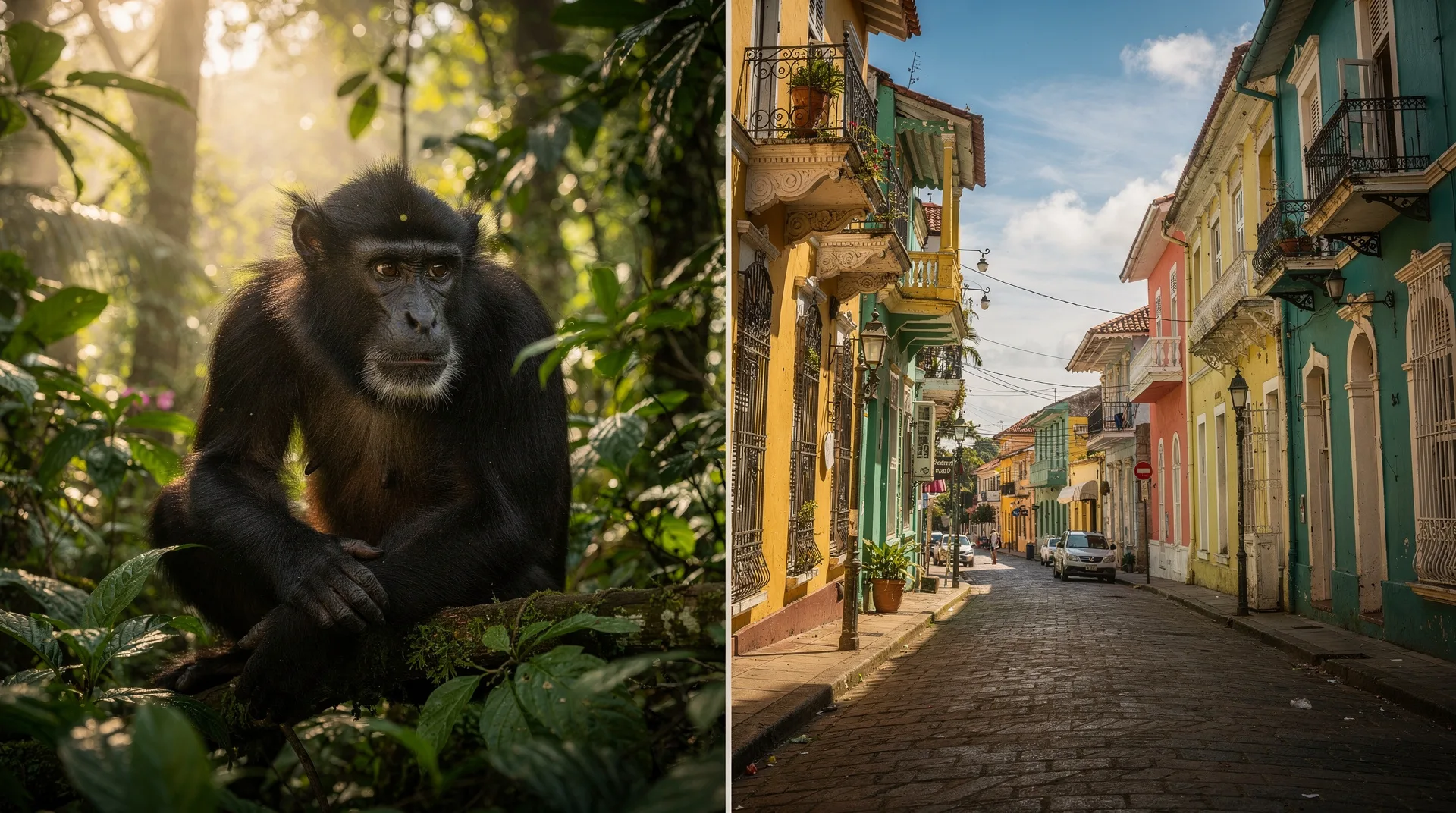
Costa Rica vs Panama: which country should you visit first?
Costa Rica or Panama?
Costa Rica excels in wildlife infrastructure, national parks, and eco-tourism depth. Panama offers a lower budget threshold, the engineering marvel of the canal, Bocas del Toro Caribbean beaches, and a capital city with genuine cosmopolitan energy. They are worth treating as separate trips rather than interchangeable substitutes.
Costa Rica and Panama get lumped together as interchangeable Central America options, but they deliver genuinely different trips. This guide compares them category by category — wildlife, budget, cities, beaches — so you can pick the right one first, or plan both.
| Costa Rica wins on | Wildlife infrastructure, national parks, whale watching |
| Panama wins on | Budget (20-30% cheaper), the canal, urban Panama City |
| Combined trip | Feasible in 3 weeks via the Paso Canoas land border |
| Visa | 90 days visa-free, both countries, for US/EU/UK/CA/AU |
| First-timer pick | Costa Rica, for the most established eco-tourism access |
The question Central America travellers ask
Costa Rica and Panama share a border, a general biodiversity profile, and a reputation as two of the most stable, traveller-friendly countries in Central America. They also get compared endlessly by people deciding between them — often by travellers who have time and budget for one dedicated trip and want to know which delivers better value, better wildlife, or a more complete experience.
The honest answer is that they are not substitutes for each other. Costa Rica has built 50 years of eco-tourism infrastructure around a specific promise — accessible wildlife, national parks, and nature travel that requires no special preparation. Panama has delivered something different: a more layered experience that combines urban energy, a genuine engineering wonder, Caribbean island beaches, and wilderness areas (Darién, Bocas del Toro) that are less visited and arguably more raw than most of Costa Rica.
This guide compares both countries across every factor that matters for a traveller making a first-time decision.
Wildlife and national parks: Costa Rica’s strongest argument
This is where Costa Rica wins, and it wins clearly.
Costa Rica protects 25% of its national territory across 28 national parks, wildlife refuges, and biological reserves. The result of 50+ years of conservation policy — beginning with the creation of the national parks system in the 1970s under president Daniel Oduber — is the most accessible wildlife in Central America. You can see sloths, toucans, and howler monkeys from a hotel garden in Manuel Antonio. You can watch humpback whales from a boat off Uvita with 90% reliability in peak season. You can enter Corcovado National Park (the “most biologically intense place on Earth” per National Geographic) with a certified guide and spend the day among tapirs, spider monkeys, and scarlet macaws.
Crucially, Costa Rica’s wildlife infrastructure makes this accessible. The national parks system has maintained trails, regulated tourism, trained guide certification programmes, and years of accumulated knowledge about where to see specific animals at specific times of year. The Costa Rica wildlife overview gives the full picture, but the short version is: Costa Rica has set the gold standard for accessible eco-tourism in the region.
Panama also has extraordinary biodiversity. It sits at the junction of North and South American continental plates, making it a corridor for species from both continents. Bocas del Toro has Caribbean reef systems. Darién National Park on the Colombian border is one of the most biodiverse places on Earth — but it is also genuinely inaccessible, with no roads, and entered only by experienced expedition groups. Barro Colorado Island in the Panama Canal Zone is a world-class research station open to small group tours. Soberanía National Park on the canal is convenient for birding — the Pipeline Road is legendary in birding circles as one of the best single trails for species count in the world.
But Panama’s wildlife is harder to access at scale. The infrastructure for nature tourism is thinner, the guide certification system is less developed, and the national parks system — while impressive on paper — has less operational depth than Costa Rica’s.
Verdict: Costa Rica wins on wildlife accessibility by a significant margin.
Budget: Panama’s strongest argument
Panama is, on average, 20-30% cheaper than Costa Rica for comparable quality.
| Budget category | Costa Rica (daily per person) | Panama (daily per person) |
|---|---|---|
| Backpacker | $40-65 | $30-50 |
| Mid-range | $90-150 | $70-120 |
| Comfortable | $150-250 | $110-190 |
| Luxury | $300-700+ | $200-500+ |
The reasons for this are structural. Costa Rica’s tourism industry has been running for longer and has absorbed more international demand — prices have risen accordingly. The Costa Rican colón has strengthened against the dollar over the past decade. Panama uses the US dollar directly (the Balboa is pegged at 1:1), which creates price transparency but also means Panama City operates at near-US service costs in some sectors, offset by cheaper food and accommodation outside the capital.
Specific examples:
- A mid-range hotel room in Bocas del Toro costs $60-90/night; comparable quality in Tamarindo costs $100-150.
- A meal at a non-tourist restaurant in Boquete costs $6-10; in La Fortuna the equivalent is $10-16.
- National park entry fees are generally lower in Panama ($5-10 vs $15-25 in Costa Rica).
- Domestic flights are cheaper in Panama (Air Panama hub connects efficiently to Bocas and Chiriquí).
Verdict: Panama wins on budget by a meaningful margin, particularly for mid-range and backpacker travelers.
The Panama Canal: a unique drawcard
No wildlife experience in Costa Rica competes with the Panama Canal as a sheer human achievement. The canal connects the Atlantic and Pacific oceans across 77 km of the Isthmus of Panama, lifting ships 26 metres above sea level through a series of locks using gravity-fed lake water. Construction killed an estimated 25,000 workers between 1881 and 1914. The canal opened in 1914 and processes approximately 14,000 ships per year, handling 5% of world trade.
Watching a massive container ship pass through the Miraflores or Agua Clara locks in real time — rising or falling in minutes within a lock chamber that measures the ship’s beam to metres — is one of the most impressive engineering spectacles available to travellers anywhere. The Miraflores Locks visitor centre is 30 minutes from Panama City and open daily. The Agua Clara visitor centre on the Atlantic side shows the new post-Panamax expansion locks (opened 2016), which handle ships three times the size of the original canal.
If engineering history, maritime culture, or simply wanting to stand next to something genuinely world-historical appeals to you: Panama is the answer.
Verdict: Panama wins this category outright — Costa Rica has no comparable attraction.
Capital cities: Panama City vs San José
Panama City is a genuine regional metropolis of 1.5 million people with a skyline visible from 40 km at sea, a UNESCO World Heritage colonial district (Casco Viejo), multi-star hotel infrastructure, and a dining scene that mixes Latin American, Afro-Caribbean, Asian, and North American influences in ways that San José cannot match.
San José is a functional capital, not a destination capital. It is the transit hub for Costa Rica — where you fly in, clear customs, pick up a rental car, and head for La Fortuna, Manuel Antonio, or the coast. The historical centre (Avenida Central, Teatro Nacional, Mercado Central) is worth a morning visit but not a multi-day stay. If you only have a morning, a guided city tour that includes the National Theater — from $45 covers the centre without logistics. Our San José destination page lists what else is worth the stop. San José has improved significantly as a city over the past decade, but it does not compete with Panama City as an urban experience.
Casco Viejo in Panama City — the 400-year-old colonial district on the Pacific coast — is now an extraordinary place: restored colonial architecture, boutique hotels, rooftop bars, world-class restaurants, and the contrast of container ships passing through the canal visible from waterfront terraces. It was declared a UNESCO World Heritage Site in 1997 and has been under sustained restoration since.
Verdict: Panama City wins as an urban experience. San José is transit infrastructure.
Beaches: a more even comparison
Both countries have excellent Pacific and Caribbean beaches, but with different strengths.
Costa Rica’s Pacific beaches are more developed and more varied: from Guanacaste’s dry-forest backed golden beaches (Conchal, Flamingo, Nosara) to the southern Pacific’s wilder coastline (Dominical, Matapalo) and the whale watching waters off Uvita. Caribbean beaches (Punta Uva, Manzanillo) are lush, palm-lined, and have accessible reef snorkelling.
Panama’s Caribbean coast (Bocas del Toro) is an archipelago of islands — a different experience from a continuous coastline. The beaches on the outer islands of the Bocas del Toro archipelago (Isla Bastimentos, Isla Carenero, Zapatilla islands) are among the most beautiful in Central America: clear Caribbean water, fringing coral reefs, little infrastructure. Bocas del Toro has a party reputation that draws backpackers and a growing boutique hotel scene that serves couples seeking seclusion.
Panama’s Pacific beaches are largely underdeveloped and lack the tourist infrastructure of Guanacaste or Manuel Antonio.
For Costa Rica’s side of the comparison, the Caribbean vs Pacific beaches guide and the Guanacaste beach guide show how much the coastlines differ from one another. Reef snorkelling on the Costa Rican Caribbean is covered in the Cahuita reef snorkel guide.
Costa Rica’s beach overall: More variety, better infrastructure, more reliable conditions. Panama’s Caribbean islands: More spectacular in isolation; better for snorkelling and diving at the reef islands.
Wildlife highlights: a side-by-side
| Experience | Costa Rica | Panama |
|---|---|---|
| Sloths | Abundant (Manuel Antonio, Cahuita) | Present but less accessible |
| Howler monkeys | Everywhere | Present |
| Jaguars | Corcovado (possible) | Darién (difficult access) |
| Humpback whales | Excellent (Uvita, 2 seasons) | Limited |
| Sea turtle nesting | Outstanding (Tortuguero, Ostional, Playa Grande) | Present (Bocas del Toro) |
| Birding | World-class (500+ species) | Slightly more species (Panama = 1,000+) |
| Coral reef snorkel | Caribbean coast (Cahuita, Punta Uva) | Bocas del Toro (outstanding) |
| Tapirs | Corcovado (likely sighting) | Darién (inaccessible) |
| Scarlet macaws | Manuel Antonio, Corcovado | Present but fewer |
| Quetzals | San Gerardo de Dota | Chiriquí highlands (Boquete) |
Panama actually has a higher total species count than Costa Rica — more bird species (over 1,000 vs Costa Rica’s 920+), comparable reptile and amphibian diversity. But Costa Rica’s infrastructure for encountering that diversity is dramatically more developed. The Pipeline Road in Soberanía is legitimate world-class birding. Boquete in the Chiriquí highlands is a worthy quetzal alternative to San Gerardo de Dota. But reaching these experiences in Panama requires more planning, less tourism support, and often more physical commitment.
Monteverde and Santa Elena: cloud forest bird-watching tour — from $65If you want to test the Costa Rica side of the birding argument yourself, the bird watching by region guide shows where to concentrate your time, and the quetzal watching guide covers the highland specialist. For a wetland alternative away from the busiest circuits, a wildlife trip around the Caño Negro wetlands — from $95 is another way to see how organised nature tourism works here, and the Caño Negro destination page gives the background.
Infrastructure and practicalities
| Practicality | Costa Rica | Panama |
|---|---|---|
| Currency | CRC (colón); USD accepted widely | USD (Balboa pegged 1:1) |
| Language | Spanish | Spanish; English common in Bocas and Panama City |
| Driving | Right-hand; 4WD recommended; roads challenging in wet season | Right-hand; variable road quality |
| Best airports | SJO (San José), LIR (Liberia) | PTY (Panama City) — major hub |
| English spoken | Yes in tourist areas | Yes in Panama City and Bocas del Toro |
| Safety | Good overall (theft from cars main risk) | Panama City: safe tourist areas; Darién: high risk |
| Visa | 90 days visa-free for US/EU/UK/CA/AU | 90 days visa-free for same countries |
| Healthcare | Good; CAJA public system; private clinics accessible | Good in Panama City; limited in rural areas |
| Internet/SIM | Kolbi, Movistar widely available | Cable & Wireless, Digicel widely available |
Volcanoes: a quieter Costa Rica advantage
Costa Rica’s Pacific volcanic spine — Arenal, Poás, Irazú, Rincón de la Vieja — gives visitors a genuinely easy way to combine a dramatic landscape with hot springs, hiking, and day-trip logistics from San José or La Fortuna. Panama’s volcanic terrain (Volcán Barú near Boquete, the country’s highest point) is real but far less developed for casual visitors — the summit hike is a serious overnight undertaking rather than a half-day outing, and there is nothing in Panama comparable to Costa Rica’s hot-spring resort infrastructure around Arenal.
If a volcano visit with minimal logistical effort matters to your trip, this is a quiet but real point in Costa Rica’s favour; see the best volcanoes in Costa Rica guide for the full lineup.
Safety: how the two compare in practice
Both countries are genuinely safe for standard tourist itineraries, but the risk profile differs. Costa Rica’s main safety issue for visitors is opportunistic property crime — car break-ins at beach parking areas and national park trailheads are the most common incident type, not violent crime. Our safety in Costa Rica guide covers the specific precautions that prevent the majority of these incidents.
Panama’s tourist zones (Casco Viejo, Bocas del Toro, Boquete) carry a broadly similar risk profile to Costa Rica’s tourist areas, but Panama City as a whole has a higher general urban crime rate outside the well-patrolled tourist districts, and the Darién region is a genuine no-go area that requires deliberate avoidance rather than casual caution.
The combined trip: Costa Rica and Panama together
The Osa Peninsula and Panama border are less than 50 km apart at their closest point — Puerto Jiménez to David (Chiriquí) is a 3-4 hour drive. A two-country itinerary is entirely feasible for a 3-week trip:
Suggested 3-week combined route:
- San José (1 night transit) → La Fortuna (3 nights) → Monteverde (2 nights) → Manuel Antonio (2 nights) → Uvita (2 nights) → Osa Peninsula/Corcovado (3 nights) → cross border at Paso Canoas → David/Boquete, Chiriquí (2 nights) → Panama City (2 nights) → Bocas del Toro (2 nights) → fly home from PTY.
This requires crossing the Costa Rica-Panama land border at Paso Canoas (straightforward but time-consuming — allow 3-4 hours) and arranging transport on each side independently (shuttles don’t typically cross borders). Renting a car in Costa Rica and returning it before the border, then arranging a Panama rental or shuttle from David, is the standard approach.
What to expect at the border itself: Paso Canoas is a functioning town straddling the line, with money changers, small shops, and touts offering “help” with paperwork for a fee that is not required. Exit stamps from Costa Rica and entry stamps into Panama are handled at adjacent booths; keep your passport, proof of onward travel out of Panama, and evidence of sufficient funds ready, since border officers do occasionally ask for these. Crossing early in the day avoids both the midday heat in the queue and the risk of arriving at your next stop after dark on unfamiliar roads.
Alternative to driving: Travellers who prefer not to manage two rental cars and a self-driven border crossing can fly between the countries instead — Copa Airlines and Air Panama connect San José or Liberia to Panama City directly, cutting the land logistics entirely at the cost of skipping the Chiriquí highlands leg. This suits travellers prioritising the canal and Bocas del Toro over a full overland circuit.
Frequently asked questions about Costa Rica vs Panama
Is Costa Rica worth the price premium over Panama?
For first-time wildlife travelers: yes. The premium pays for infrastructure — trained certified guides, maintained park trails, shuttle networks, English-speaking tour operators, and years of accumulated expertise in getting visitors to wildlife efficiently. If you are going to see a tapir, a quetzal, and humpback whales on your first Central America trip, Costa Rica makes those experiences more likely and easier to arrange than Panama.
For experienced budget travelers who have done Costa Rica: Panama is a logical next step that offers new experiences (the canal, Bocas, Darién edge if you are very adventurous) at lower cost.
Which country is better for birding?
Panama has more species — over 1,000, making it the second most bird-diverse country in the world relative to its size. The Pipeline Road in Soberanía National Park is one of the world’s great single-day birding opportunities. However, Costa Rica’s birding infrastructure (guides, lodges, site access) is more developed, making it more productive per day for most visitors. Serious birders should consider Panama specifically for Pipeline Road and the Chiriquí highlands; most wildlife generalists will see more birds per day in Costa Rica.
Can I enter Panama on a tourist card at the land border?
Yes. US, EU, UK, Canadian, and Australian passport holders receive 90 days visa-free at the Paso Canoas or Sixaola-Guabito land crossings. You need a valid passport, onward ticket out of Panama, and proof of sufficient funds. The crossing can be slow (2-4 hours at busy periods) but is straightforward. There is no tourist card fee.
Which country is safer?
Both are among the safer countries in Central America. Costa Rica has a stable political system, a strong tourism police (Politur), and rates its main risks as property theft rather than violent crime. Panama City has safe tourist areas (Casco Viejo, Marbella, Paitilla) but higher general urban crime than in tourist-focused Costa Rica destinations. The Darién region is extremely dangerous (FARC and criminal networks) and should not be visited — this caveat applies only to one corner of Panama and does not affect standard tourist itineraries.
What is Bocas del Toro really like?
Bocas del Toro is an archipelago of Caribbean islands near the Panama-Costa Rica border — the most backpacker-oriented destination in Panama. The main town (Bocas Town) has a party reputation with a young international crowd. The outer islands (Bastimentos, Zapatillas) are quieter, with spectacular beach and reef. The snorkelling and diving quality in Bocas is genuinely excellent. It is worth 3-4 nights as part of a Panama trip but would feel thin as a sole destination on a short trip.
The verdict
Choose Costa Rica if: This is your first Central America wildlife trip and you want the highest-probability access to diverse wildlife in the most established eco-tourism infrastructure in the region. You want national park trails, certified naturalist guides, hot springs, whale watching, and sloths from your hotel window.
Choose Panama if: You have done Costa Rica (or the Pacific wildlife circuit), want lower prices, are specifically interested in the Panama Canal as an attraction, want to explore Bocas del Toro’s Caribbean islands, are a serious birder targeting Pipeline Road, or are building a combined two-country trip from Costa Rica south.
If you are leaning towards Costa Rica, the two-weeks Caribbean, Pacific and volcanoes itinerary and the blog comparison of the two countries are good next reads. Budget-minded readers should also see the money and currency guide.
Choose both if you have 3 weeks and want the complete Central America experience. The border crossing is straightforward and the contrast between the two countries makes the combined trip more interesting than either country alone.
Start your Costa Rica planning with the best time to visit guide, visa and entry requirements, and rent a car or not for practical logistics. For the wildlife case for Costa Rica specifically, the Corcovado National Park guide and Costa Rica wildlife overview lay out what makes the country genuinely extraordinary.