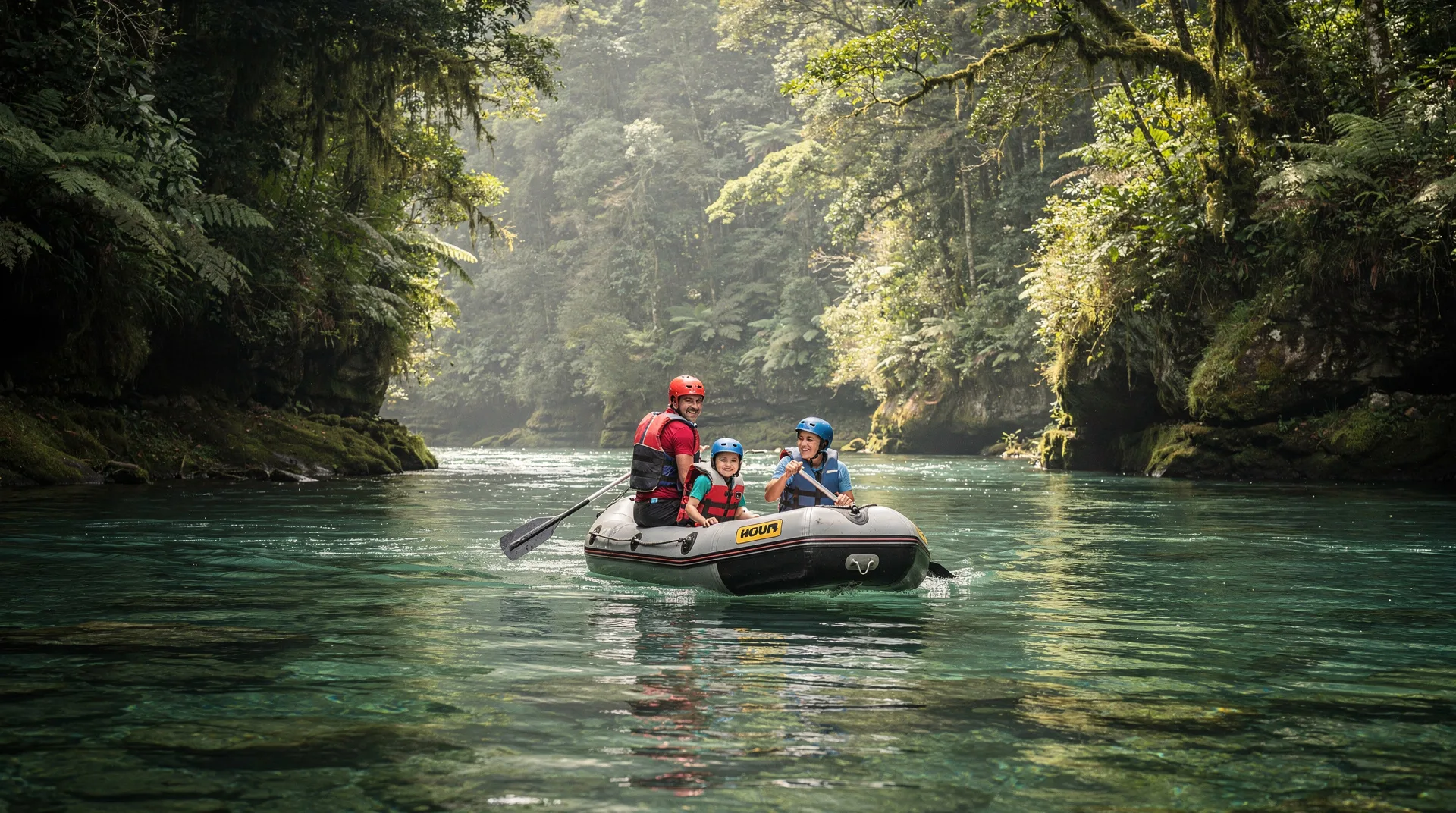
Savegre River rafting: scenic Class II-III near Manuel Antonio
Savegre rafting near Manuel Antonio?
Yes — the Savegre River offers half-day Class II-III rafting from Quepos, 30-45 minutes from Manuel Antonio. Pristine river with excellent wildlife viewing, appropriate for beginners and families. Around $75-95 per person.
The Savegre River: rafting near Manuel Antonio
The Río Savegre is one of the cleanest rivers in Costa Rica. It originates in the high-altitude San Gerardo de Dota valley — one of the best quetzal-watching sites in the country, at 2,000 meters elevation — and descends through cloud forest and Pacific-slope jungle before reaching the coast near Matapalo, south of Quepos.
The rafting section sits in the lower and middle course of the river, where the gradient has moderated to produce a Class II-III run appropriate for beginners, families with children from about age 10, and visitors who want to add a water activity to a Manuel Antonio trip without the full commitment of a Pacuare expedition.
This guide covers what the Savegre experience involves, why its wildlife value is underrated, practical logistics from Manuel Antonio and Quepos, and how it compares to other Costa Rica rafting options.
| Difficulty | Class II-III, beginner and family friendly |
| Price | Around $75-95 per person |
| Duration on water | 2.5-3.5 hours |
| From | Quepos (25-35 min) / Manuel Antonio (30-45 min) |
| Best for | Wildlife viewing, first-timers, half-day activity |
What makes the Savegre special
Ecological purity
The Savegre watershed is one of the least developed in Costa Rica’s Pacific region. The upper catchment falls within a biological reserve that protects the valley’s cloud forest and ensures the river receives no industrial discharge or significant agricultural runoff. The result is a river with exceptional water clarity — you can see the riverbed at several meters depth in calm sections, which is unusual for a commercially rafted tropical river.
This clarity supports healthy aquatic ecology: native fish (including the Savegre landlocked-form rainbow trout in the upper section), river shrimp, and freshwater crabs are visible from the raft in transparent pool sections. Crocodiles are not present in the mountain section of the river — a reassurance worth knowing.
Wildlife on the banks
The Savegre corridor between the mountains and the Pacific coast passes through one of the most biodiverse stretches of Pacific-slope jungle in Costa Rica. Riverside wildlife commonly observed includes:
Mangrove kingfisher at lower river sections. Squirrel monkeys — Costa Rica’s smallest monkey and one of only two populations in the country — are regularly seen in the trees above the river. The Quepos-Manuel Antonio area has one of the largest concentrations of squirrel monkeys in the country, and the Savegre corridor connects their habitat to the forest of Manuel Antonio National Park.
Great green macaws, scarlet macaws (abundant in this region), and toucans are frequently spotted in the riparian canopy. The bird density here is exceptional compared to most Pacific-slope rivers.
The rafting section: what to expect
The commercial Savegre rafting section covers approximately 10-12 km on the river, taking 2.5-3.5 hours on the water at typical flow. The difficulty is genuinely Class II-III — comfortable for first-timers, engaging for intermediates, not demanding enough to require paddling experience.
The river alternates between calm gliding sections (excellent for wildlife spotting) and intermittent Class II-III rapids with characteristic Pacific-slope river features: river-worn boulders, chutes between rock formations, and occasional small drops.
There are no Class IV features on the standard commercial section. The consequences of swimming are very manageable — pools are typically shallow enough to stand in within seconds of a capsize, and the current speed in the canyon section is moderate.
What stands out: The river canyon scenery is more intimate than the Pacuare’s dramatic gorge but more enclosed and jungle-dense than the Sarapiquí’s open lowland sections. The overhanging vegetation creates a tunnel effect in places, with roots and hanging vines brushing the surface. It has a primary-forest intimacy that larger rivers lose.
Logistics: getting to the Savegre from Manuel Antonio
The Savegre River rafting put-in is accessed from the Costanera Sur (Route 34) south of Quepos, turning inland toward the mountains. The drive from central Manuel Antonio takes 30-45 minutes depending on the operator’s pickup arrangements.
Most operators serving the Savegre are based in Quepos. Hotel pickup from Manuel Antonio hotels is standard and included in the tour price.
From Quepos: 25-35 minutes by car to the put-in. From Uvita: 45-60 minutes north along the Costanera Sur. From San José: 3 hours. Not typically booked as a day trip from the capital — this is a Manuel Antonio region activity.
Operators: The Quepos region has several rafting operators. Amigos del Río is the longest-established Savegre specialist. Iguana Tours and Midworld Rafting also run the section. Booking through local operators is straightforward and typically less expensive than through large aggregators.
For context on the range of adventure options available in the broader central Pacific region:
Arenal: rafting Sarapiqui River day tour Class II-III — from $85The Sarapiquí Class II-III tour from La Fortuna gives useful comparison for the difficulty level.
Savegre vs other Costa Rica Class II-III options
| River | Difficulty | Wildlife | Scenery | Best for |
|---|---|---|---|---|
| Savegre | II-III | Excellent (primates, macaws) | Jungle canyon | Manuel Antonio visitors |
| Sarapiquí upper | II-III | Very good (kingfishers, monkeys) | Lowland jungle | La Fortuna / SJO visitors |
| Reventazón downstream | III | Moderate | Open valley | Turrialba visitors |
| Pacuare | III-IV | Limited (moving fast) | Spectacular gorge | All base locations |
The Savegre’s wildlife advantage is its greatest differentiator. Squirrel monkey and scarlet macaw sightings from the raft are remarkably consistent. For a visitor who has already done the Manuel Antonio National Park walk (where macaws and monkeys are also present), the Savegre provides a river-level perspective on the same species in different habitat.
Best season on the Savegre
The Savegre is a Pacific-draining river, which means its flow is heavily influenced by the dry/wet season pattern of the Pacific coast:
Dry season (December-April): Lower water levels, cleaner lines, more rocks exposed, easier for beginners. Wildlife on riverbanks tends to concentrate near the water source. The river is at its clearest.
Green season (May-November): Higher water levels make the Class II-III features more energetic. Lush vegetation. Afternoon rains often start after 1-2pm, so morning departures are recommended. The river can become Class III-IV in extreme September-October rainfall — operators modify or cancel if conditions are unsafe.
Best months overall: January-March (dry season peak) for easiest conditions, or June-July for high water and empty tourist rolls.
Combining with Manuel Antonio National Park
The Savegre rafting works naturally as a morning activity (typical return by 1pm) before an afternoon visit to Manuel Antonio National Park. The park’s wildlife includes many of the same species — squirrel monkeys, capuchins, sloths, and scarlet macaws — but from a hiking-trail perspective rather than a river one.
Manuel Antonio National Park is closed every Tuesday. If Tuesday falls during your visit, the Savegre half-day is an excellent alternative that keeps you active without conflicting with the park closure.
For the full picture of Manuel Antonio’s activities beyond the river, see our Manuel Antonio National Park guide.
If you would rather not spot animals on your own in the park, a guided walk through the national park — from $58 pairs well with a river morning, since a naturalist guide points out the sloths and monkeys that are easy to miss. Visitors especially keen on the slower residents of the canopy can read our where to see sloths guide and consider a park tour focused on sloth watching — from $60 for the afternoon. Both fit the same day without rushing, and the Manuel Antonio destination page lists where to stay nearby.
Practical information
Price: $75-95 per person for the half-day river trip including equipment and hotel pickup.
Duration: Typically 5-6 hours total including transport, briefing, 2.5-3.5 hours on the water, and a riverside snack break.
Minimum age: 10 years at most operators (some allow 8 with parental accompaniment). Verify at booking.
What to bring: Swimsuit, secure water shoes, quick-dry clothes, sunscreen (applied before pickup, not during tour near the river), small dry bag for valuables.
Included: Life jacket, paddle, helmet, and wetsuit jacket (offered but typically not needed in the warm southern Pacific climate).
Wildlife watching beyond the river
The broader Savegre valley — particularly the upper reaches near San Gerardo de Dota — is one of Costa Rica’s premier wildlife destinations. The upper Savegre valley (accessible by car, 2 hours inland from Quepos) is the country’s most reliable location for resplendent quetzal sightings in March-June nesting season. It is a dramatically different ecosystem from the lower rafting section.
For visitors with a flexible itinerary, a Savegre rafting morning followed by an afternoon drive up toward San Gerardo de Dota (passing through cloud forest from sea level to 2,000 meters in 2 hours) offers extraordinary ecological diversity. See our San Gerardo de Dota destination guide for details.
Frequently asked questions about Savegre River rafting
Is the Savegre appropriate for complete beginners?
Yes. The Class II-III difficulty means the guide handles navigation and the paddler’s role is to follow commands and balance their weight. No swimming ability is required (life jacket provides full buoyancy), and the consequences of exiting the raft are minimal in the calm pool sections.
Are there crocodiles in the Savegre?
Not in the mountain rafting section. American crocodiles are present in the lower Savegre near the Pacific coast estuary — several kilometres downstream from the commercial rafting takeout. The rafting section itself is crocodile-free.
Can I do the Savegre as a day trip from San José?
Technically yes (3 hours drive each way), but it makes for a very long day and is not the most efficient use of San José as a base. The Savegre is best treated as a Manuel Antonio or Quepos region activity.
How does the Savegre compare to the Pacuare for first-timers?
The Savegre is significantly easier, shorter, and less intimidating than the Pacuare. If you want whitewater with a nature-walk vibe rather than an adrenaline expedition, the Savegre is the right choice. If you want Costa Rica’s best river experience and are physically fit, go directly to the Pacuare.
What wildlife is guaranteed on the Savegre?
“Guaranteed” is never the right word for wildlife, but squirrel monkeys (Manuel Antonio corridor is their stronghold), scarlet macaws, and kingfishers are encountered on the vast majority of runs. Spider monkeys and howler monkeys are common but not certain. Our monkey species of Costa Rica guide explains what distinguishes the squirrel monkey from the other three species you might see in the same trip.
Choosing an operator: what to check
The Quepos rafting market has several established names, and a few checks separate a well-run trip from a mediocre one. Confirm ICT certification (verifiable on the tourism board’s website), ask about maximum group size per raft (8-10 with a dedicated guide is standard), and look for a genuine pre-trip safety briefing rather than a rushed formality. Amigos del Río’s long track record on this specific river makes it the default recommendation, but Iguana Tours and Midworld Rafting are both credible alternatives if scheduling or pricing steers you elsewhere. Our rafting class comparison guide explains how to read difficulty ratings across operators consistently.
Price alone is a poor signal of quality on this river — the difference between operators is rarely more than $10-15 per person, so it makes little sense to choose the cheapest option if it means an inexperienced guide or overcrowded raft. Ask specifically how many years the company has operated on the Savegre, since institutional knowledge of the river’s rock positions and seasonal changes genuinely matters even at Class II-III difficulty. A guide who has run the same stretch for years will also know exactly where wildlife tends to gather on a given morning, which meaningfully improves the sighting odds that make this particular river worth choosing over other Class II-III options in the region.
Rest-day and rainy-day alternatives
If a rafting trip is cancelled for weather (rare on the Savegre given its manageable Class II-III profile, but it happens in extreme September-October rainfall), Manuel Antonio has enough indoor and low-water alternatives to salvage the day. A visit to Manuel Antonio National Park itself is largely unaffected by rain — wildlife viewing continues regardless — and the Manuel Antonio National Park guide covers what to prioritise on a shorter or wetter visit.
Other rain-tolerant fallback options in the Quepos-Manuel Antonio area include the covered market and restaurant scene in central Quepos, a spa afternoon at one of the area’s hotels, or simply rescheduling the rafting trip for the following morning if your itinerary allows the flexibility — most operators will happily move a booking rather than run a cancelled trip. Given how rarely the Savegre actually closes compared to higher-water rivers, building in a one-day buffer before a hard flight departure is a reasonable precaution rather than an overreaction.
San Gerardo de Dota: where the Savegre begins
The Savegre River originates in one of Costa Rica’s most remarkable and undervisited landscapes: the San Gerardo de Dota valley, tucked into the Talamanca mountain range at 2,000 meters elevation. This is the country’s premier quetzal-watching site, where the resplendent quetzal — Costa Rica’s most sought-after bird — nests from March to June in wild avocado trees above the valley.
The ecological gradient of the Savegre watershed — from cool, high-altitude oak cloud forest at the top to warm Pacific-slope jungle at the bottom — is one of the most dramatic in Central America. The river that you raft on the Quepos commercial section begins as a cold, clear highland stream flowing through forest where temperatures drop to 8°C at night.
For visitors combining a Savegre rafting trip with a San Gerardo de Dota detour, the contrast between the two endpoints of the same river is striking. The drive from Quepos to San Gerardo de Dota takes approximately 2 hours. This combination works best across two days: day one, raft the lower Savegre near Quepos; day two, drive up to San Gerardo de Dota for quetzal spotting and cloud-forest birding.
See our San Gerardo de Dota destination guide for accommodation, quetzal season timing, and birding logistics.
Squirrel monkey conservation and the Savegre corridor
The Manuel Antonio area is one of only two locations in Costa Rica where the Central American squirrel monkey (Saimiri oerstedii) survives. The species is classified as Vulnerable on the IUCN Red List, with the Manuel Antonio-Quepos corridor holding one of the two remaining significant populations.
The Savegre River corridor is a critical habitat connection between the squirrel monkeys of Manuel Antonio National Park and the forest fragments further inland. Riparian forest along the river bank provides a movement corridor that allows genetic exchange between otherwise isolated groups. When you raft the Savegre and observe squirrel monkeys in the riverside canopy, you are seeing one of Costa Rica’s most endangered primate populations in their essential habitat — not in a park but in the actual landscape they depend on for survival.
Conservation organisations including Amigos de las Aves have worked with local landowners along the Savegre corridor to maintain riparian forest buffers and reduce the fragmentation that threatens the squirrel monkey population. Supporting the rafting operators who operate on the Savegre and contribute to this conservation framework is a meaningful form of wildlife tourism.
Travellers who want to go a step further can ask their rafting operator directly whether they contribute to any of these local conservation initiatives — a question that, in a small tourism market like Quepos, tends to be answered honestly and specifically rather than with vague marketing language, since operators here know their guests and their reputations are built on repeat local relationships as much as online reviews.
Savegre water quality: why it matters
The Savegre is consistently rated among the cleanest rivers accessible to visitors in Costa Rica’s Pacific zone. Several factors maintain this quality:
Protected upper catchment: The headwaters in the Chirripó and Talamanca protected zones are within areas that limit agricultural and residential development. Groundwater entering the river at its source carries minimal pollutant load.
Low agricultural pressure in the middle section: The steep canyon between the highlands and the coastal lowlands limits farming access to the middle Savegre. Unlike the Tárcoles, which passes through heavily agricultural land and carries significant contamination, the Savegre’s canyon section remains relatively pristine.
Community stewardship: The Quepos-area communities have recognised that the Savegre’s water quality is an economic asset — ecotourism depends on it. Local schools participate in river health monitoring, and community-organised cleanup events occur several times per year.
The result is a river where you can genuinely see the bottom at 2-3 meter depth in calm sections — unusual for a tropical river accessible to commercial tourism. The aquatic ecology reflects this quality: native fish, river shrimp, and freshwater crabs are visible from the raft in clear pool sections.
A note on safety standards for Savegre operators
The Quepos/Manuel Antonio area has seen some operator consolidation in recent years, which generally improves safety standards by removing undercapitalised small operators who cannot maintain equipment adequately.
When booking the Savegre, look for:
- ICT certification (verifiable on the ICT website)
- Maximum group size of 8-10 per guide-led raft
- Equipment that is visibly well-maintained (harnesses without fraying, helmets without cracks)
- A genuine safety briefing that covers defensive swimming, paddle commands, and what to do if you exit the raft
The Class II-III difficulty means the Savegre’s safety margin is high compared to the Pacuare or high-water Sarapiquí. But the minimum safety standards still matter — a raft without a functioning throw bag and a guide without first aid training is a substandard operation regardless of the river’s difficulty.
Related guides
For the more technically demanding river experience near Turrialba, see our Pacuare River rafting guide. The Sarapiquí River rafting guide compares another Class II-III option from La Fortuna. For the full picture of activities in the Manuel Antonio region beyond rafting, start with Manuel Antonio National Park and Quepos.