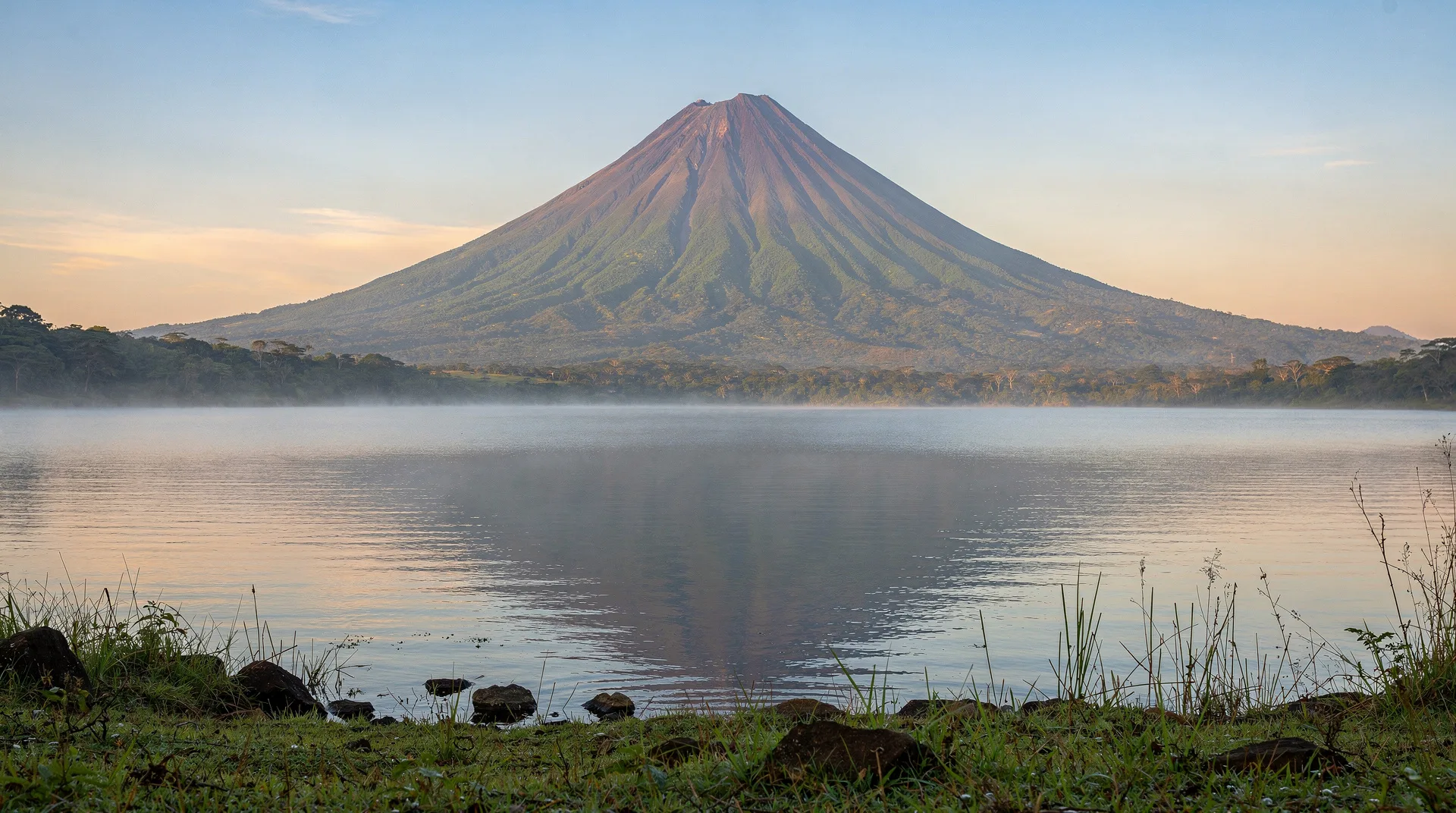
Arenal eruption anniversary revisit 2024
Back at the volcano that started everything
The eruption of July 29, 1968 killed 87 people, destroyed the town of Tabacón, and transformed Costa Rica’s approach to volcanic risk management. The eruption of 2010 — a smaller, ongoing effusive phase — was the last time Arenal produced significant lava flows. On the forty-second anniversary of that quieting, we drove back up to La Fortuna.
We had been to Arenal many times since our first visit in 2018. What we had not done was treat a return trip as the thing itself — as a deliberate observation of how the landscape, the town, the tourist experience, and the conservation story had evolved. April 2024, fourteen years after the lava stopped flowing, felt like the right moment.
| Where | La Fortuna, Alajuela Province, base for Arenal Volcano |
| Status | Resting phase since 2010, monitored, not currently erupting |
| Best cone views | Around 7am, before afternoon cloud builds in |
| Wildlife highlight | Howler monkeys and glass frogs back in the recovery zone |
| Related reading | Arenal Volcano National Park guide |
What the forest has done
The most striking thing about Arenal in 2024, compared to photographs from the 1990s and early 2000s, is the vegetation. The 1968 eruption had razed a significant area of primary forest on the south and west flanks of the cone. During the active period — roughly 1968 through 2010 — that area remained largely barren: a landscape of hardened lava flows, tephra deposits, and sparse pioneer vegetation that made for dramatic photographs but supported minimal biodiversity.
Fourteen years after the last significant activity, the recovery is remarkable. Secondary forest — tall, dense, with a closed canopy in many areas — now covers much of the zones that were still open in 2010. The ecological succession has moved fast by the standards of post-volcanic recovery: birds brought seeds, the consistent rainfall of the Arenal region (one of the wettest in Costa Rica outside the Osa) supported rapid germination, and the absence of cattle or agriculture on the protected flanks allowed succession to proceed uninterrupted.
The 1968 eruption zone on the south side — the direction the original explosion traveled — is still visible from the main road as a distinct swath of younger vegetation: the trees are smaller, the canopy lower, the species composition different from the mature forest at the park boundaries. A trained eye can still read the 1968 event in the landscape. But it requires training now; in 2005, you could not have missed it.
For context on how this compares to Costa Rica’s other volcanic landscapes, our best volcanoes in Costa Rica guide covers Poás, Irazú, and Rincón de la Vieja, each recovering from a different kind of activity on a different timeline.
La Fortuna: Arenal Volcano and waterfall tour with lunch — from $110What the guides say about the resting phase
We spent a morning with one of La Fortuna’s certified volcanic geology guides — a young man from a family that had lived in the valley for three generations, who had learned his craft from a OVSICORI (the Costa Rican volcanological observatory) scientist who had monitored the volcano since the 1980s.
His explanation of the “resting phase” concept was more nuanced than what most tourist literature suggests. The phrase “resting” implies dormancy — a volcano that has gone quiet and may stay quiet indefinitely. The more accurate framing, he said, is that Arenal remains an active volcanic system in which the surface expression has temporarily changed. The magma chamber beneath the volcano did not disappear; the conduit that connected it to the surface is less open than it was. OVSICORI records persistent seismic activity under the mountain — small earthquakes that confirm ongoing magmatic processes — and the fumaroles on the upper cone still emit gas (sulfur dioxide is measurable) and steam.
The probability of renewed eruptive activity in any given year is assessed as low by the observatory. The probability over the next century is, in their view, high. Arenal is a young stratovolcano — it formed within the last 7,000 years — and young stratovolcanoes follow cycles. The 1968-2010 period was one cycle. Another will come, on a timeline that volcano science cannot predict precisely.
This information does not make a visit to Arenal more dangerous. The monitoring systems in place — seismographs, satellite tilt meters, gas sensors — are sophisticated enough to provide early warning of renewed significant activity. The exclusion zone around the upper cone remains in place.
What it does is put the “dormant volcano” framing in more accurate context: this is a volcano in a quiet phase, watched carefully, still alive.
The town in 2024
La Fortuna has grown enormously since we first visited. The strip of hotels, restaurants, tour operators, and souvenir shops along the main road is now genuinely long — several kilometers of tourist infrastructure that was, in 2018, half its current length.
This growth has not made La Fortuna worse, exactly, but it has changed its character. The scale now means that the better experiences require more deliberate selection. The hanging bridges at Místico remain excellent. The hot springs range from genuinely good (Eco Termales, La Fortuna thermal pools) to theme park adjacent (Baldí, Titokú). The Arenal 1968 park trail, which takes you through the oldest lava field and right to the boundary of the most recent flows, is still the most honest volcano experience available.
The volcano tour operators have also matured. The guides we encountered in 2024 were — on average — better trained and more scientifically literate than the guides we encountered in 2018. The guide certification system has had time to raise the baseline. We met guides who carried OVSICORI data on their phones and could answer detailed questions about eruptive history accurately.
From La Fortuna: Mistico Arenal hanging bridges park tour — from $60The wildlife story
The secondary forest recovery means that wildlife in the volcano’s immediate zone has increased compared to five years ago. We heard howler monkeys on the Arenal 1968 trail — something that we had been told was unlikely in the more recent lava fields. Our guide explained that the monkeys had been expanding their range into the recovery zone as the canopy closed.
White-faced capuchins were visible on the edges of the national park trail, unimpressed by our small group, moving through the canopy with the casual confidence of animals that have become entirely habituated to binocular-wielding tourists. A glass frog — one of the most photogenic and improbable creatures in Costa Rica — was found on the underside of a leaf beside a small stream that crossed the trail.
In the lake area, north of town, the transition zone between dry forest (Guanacaste side) and wet forest (Arenal side) produced a species list that the birdwatchers in our group found extraordinary: toucans, trogons, several tanager species, and — briefly — a great tinamou on the forest floor that our guide spotted before any of us had any idea what we were looking at.
Where else to see this recovery for yourself
If the succession story interests you as much as the volcano itself, the hanging bridges at Místico let you walk through the canopy of the recovering forest at a slower pace than a road-level trail allows, with a decent chance of spotting the same howler troops we heard. For a comparison point on how young volcanic forest differs from true old-growth, the cloud forest reserves around Monteverde — never touched by the 1968 event — show what several more centuries of undisturbed succession looks like. The contrast between the two, walked back to back, is one of the more instructive things you can do in this part of the country.
Immerse yourself in the Monteverde Cloud Forest — from $55Planning your own return to the volcano
If our trip prompts you to plan one, a few companion pages help you build it. For the science behind the resting phase, understanding Costa Rica’s volcanic activity explains how monitoring works and what “active” really means. If you are weighing Arenal against other cones, Arenal vs Poás vs Irazú lays out the trade-offs, and Arenal vs Rincón de la Vieja does the same for the Guanacaste side.
The hot springs deserve their own decision. Our Arenal hot springs overview and the head-to-head Tabacón vs Baldí vs Eco Termales comparison go into the differences we only sketched above. For photographers hoping to catch the cone on a clear morning, volcano photography tips is worth reading before you arrive.
Wildlife is the other reason to come back. The monkey species of Costa Rica will help you tell the howlers from the capuchins, and wildlife watching ethics covers how to enjoy habituated animals without making things worse for them. If you would rather spend your active hours on the water and in the canyons, canyoning in Arenal is the place to start, and the 7 days Arenal and Manuel Antonio itinerary shows how the volcano fits into a wider route.
What 14 years of quiet has produced
The honest summary from our April 2024 visit: Arenal’s resting phase has been good for the mountain, good for the forest, and good for the wildlife. It has not been good for the people who remember watching lava flows from hotel terraces — that particular experience is not available now and has not been for fourteen years.
What is available instead is a more complex story: a volcanic landscape actively healing, a secondary forest in rapid succession, a scientific monitoring operation that is genuinely excellent, and a guide community that has had time to develop a mature interpretation of a volcano that is not currently performing but is not finished.
The cone on a clear morning — which requires arriving at the viewpoints by 7am before clouds build — is as dramatic as it ever was. The steam plume is visible. The silhouette is perfect. The scale is humbling.
We were booking a return before we reached San José.
For the practical guide to visiting the Arenal area — which trails are currently open, how to reach the best viewpoints, the hot springs comparison — see our La Fortuna destination guide, our Arenal Volcano National Park guide, and our roundup of how to see Arenal’s eruptions (or, honestly, why you mostly can’t anymore).